
Introduction
For two weeks every May, a beauty bush turns into a fountain of pink. The arching branches bend all the way to the ground under the weight of small bell-shaped flowers, each one with a soft yellow throat. Bees and hummingbirds work it over from dawn on. Nothing else in the yard looks like it during those few days.
Then the show ends. I planted my first one against a fence for that May display, and by July I kept looking at a plain green mound and wondering where the magic went. The other 50 weeks tell a very different story, and you should know that part before you dig a hole. This old-fashioned shrub earns its keep in spring and then fades into the background. That trade is the whole point of growing it.
The plant is Kolkwitzia amabilis. Its new name is Linnaea amabilis. It is an arching deciduous shrub in the honeysuckle family. It grows 6 to 10 feet tall and 6 to 8 feet wide. The branches form a loose, open mound with many stems. It is hardy across roughly USDA zones 4 to 8. Sources split a bit on the cold end and the final height, so think in ranges, not one fixed number.
This guide digs into the details where people get tripped up. Beauty bush blooms on old wood, which changes how and when you prune it. The cultivars are not interchangeable either, so I compare the real ones you can actually buy. And you get the honest off-season picture, not the usual promise that the plant looks great year round.
There is a good story behind this pink flowering shrub as well. Plant hunter E.H. Wilson collected it in China in 1901, and it reached the Arnold Arboretum in 1907. Much of what grows in American gardens traces back to that introduction, a thread I come back to later. For now, let's get into what it takes to grow one well and what you are signing up for the rest of the year.
Beauty Bush Plant Profile
The beauty bush belongs to the honeysuckle family. On a plant tag you may see that group written as Caprifoliaceae. Its formal name is Kolkwitzia amabilis, and the genus holds just one species. It takes the name of Richard Kolkwitz, a German botanist who studied stream pollution. So this plant has a real pedigree, not a garden-center label.
It comes from central and western China, where it grows wild on mountain slopes at 300 to 1,300 m (1,000 to 4,300 ft). You will sometimes see pages call it tropical or worldwide, and that is flat wrong. You are growing a cold-hardy deciduous shrub, and it drops every leaf each fall, so do not expect winter greenery from it.
Most expert sources put the mature size at 6 to 10 feet (1.8 to 3 m) tall. The spread runs 6 to 8 feet (1.8 to 2.4 m) wide. A few outliers claim up to 15 feet on old plants. Hardiness lands at USDA zones 4 to 8 by the same group, though some sources shade that warmer to zones 5 or 6. It grows fast, so a young shrub fills its space in just a few years.
Think of the habit as a multistemmed fountain shape. The branches push up from the base and then arch out and down, like water spilling over the lip of a fountain. That arch is why your shrub looks so graceful in full bloom, and also why it can read as shapeless and coarse once the flowers drop.
I planted one against a bare fence corner my first spring in this house. For two weeks it threw out a pink waterfall of bloom and stopped every neighbor on the block. Then the petals dropped, and I stared at a loose pile of arching sticks for the rest of the summer. You should know that trade before you buy, because the bare months are the price you pay for those two glorious weeks.
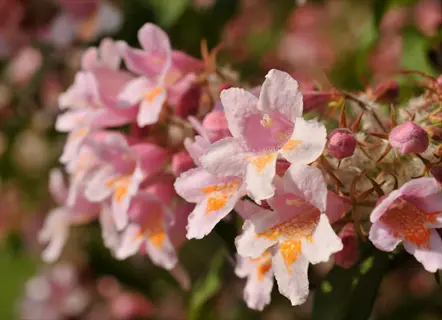
The whole show rides on the flowers. In late spring, around April to May, your branches load up with soft pink bell-shaped flowers. Each one runs about 0.5 to 1 inch (1.3 to 2.5 cm) long with a yellow throat. They cluster in groups 2 to 3 inches (5 to 8 cm) across and smother the arching stems. One detail drives every care choice you make later on. Beauty bush blooms on old wood, so your buds form on last year's stems, not on fresh spring growth. Cut the wrong stems at the wrong time and you lose a whole year of that pink.
The primary and sole attractive aspect of beautybush is a stunning mass of pink, bell-shaped flowers in spring.
How to Grow and Care
My Pink Cloud beauty bush sat in the sunny back corner by the fence. The first spring, I watched it from the porch. It carried only a thin scatter of pink. The bed had started wet and drained poorly that year, so the roots stayed soggy for weeks. Then I fixed the drainage and eased off the water. The next spring it filled out into the arching pink fountain I had wanted.
That fix sums up most of how to grow beauty bush well. Some thin blog pages push a narrow acidic 6.0 to 6.5 pH rule. But NC State and University of Illinois agree the shrub takes a wide pH range with no fuss. The numbers below come from sourced facts, not copied folklore.
Good beauty bush care really comes down to one big call at planting time, and that call is sun. The plant flowers far more heavily in full sun and turns sparse and leggier in too much shade. Give it bright light and well-drained soil, and most of the work is done.
Light and Placement
- Sun: Plant in full sun for the heaviest flowering, since bloom thins noticeably in shade and the shrub stretches and gets leggier reaching for light.
- Partial shade: It tolerates partial shade and may hold slightly better leaf color there, but you trade away some of the pink spring display.
- Space: Give it room to reach 6 to 10 feet (1.8 to 3 m) tall and 6 to 8 feet (1.8 to 2.4 m) wide so its fountain shape can arch freely.
Soil and Drainage
- Type: It adapts to clay, loam, and sand and tolerates a wide pH range, so most garden soils work as long as they are not waterlogged.
- Drainage: Good drainage is the real requirement, because soggy ground leads to drowning and edema rather than to faster, lusher growth.
- pH: Ignore narrow acidic-only advice from some blogs; extension sources confirm beauty bush handles neutral and alkaline soils comfortably.
Watering and Feeding
- Establishing: Water regularly through the first year or two so roots settle in, then beauty bush becomes notably drought tolerant once established.
- Maturity: Mature shrubs usually get by on rainfall in most regions, needing extra water mainly during long dry spells in summer.
- Feeding: It is not a heavy feeder, so a little compost or a light all-purpose feeding in spring is plenty for a healthy, vigorous plant.
Climate and Toughness
- Hardiness: It grows across roughly USDA zones 4 to 8, though sources differ slightly on the cold and warm edges of that range.
- Tolerances: Beyond drought, it shrugs off clay soil and even the juglone from black walnut trees, where many shrubs struggle.
- Pests: It has no serious insect or disease problems, so most care comes down to siting, drainage, and well-timed pruning.
Planting beauty bush in heavy, poorly drained soil invites drowning and edema. Pick a spot that drains freely, since soggy roots, not dry ones, are the real threat.
Get the spot right and beauty bush asks for very little after that. It needs almost no fertilizer, shrugs off clay, and even copes with the black walnut roots that poison most shrubs nearby. Once the plant settles in, it grows drought tolerant and gets by on rainfall through all but the longest dry spells.
It is also tough across much of the map. The shrub is hardy in USDA zones 4 to 8. Sources differ a bit on the cold and warm edges of that range. Plant it in sun, drain the soil, and water it for the first year or two. Do that and this shrub can thrive for decades.
Pruning Beauty Bush
One spring my established Pink Cloud in the back-corner bed barely flowered. A few thin sprays of pink showed up where a full pink fountain stood the year before. The plant looked healthy and green, so the bare branches made no sense at first.
The culprit was a tidy-up I had done the previous late winter. I had cut the shrub back hard to clean up its shape while it sat bare and dormant. Beauty bush blooms on old wood, and that winter cut took off the very stems that were holding the coming buds. The next year I left the shears alone until the flowers faded, and the pink show came right back.
That spring taught me when to prune beauty bush. You wait until the pink flowers fade in late spring. Then you prune. The buds for next spring sit on the old wood. Cut in winter or early spring and you take off the bloom before it can open.
Here is how to prune beauty bush the right way once flowering ends. Always prune after flowering, and work through the shrub stem by stem rather than shearing the outside.
Hold off until the pink flowers fade in late spring. Pruning earlier removes the old wood that carries this year's buds and erases the display.
Cut about one-third of the wood at the base, taking the oldest, thickest canes first. This opens the shrub and pushes fresh, more floriferous growth.
Take out thin, weak, or crossing shoots at ground level so energy goes into strong arching stems rather than a congested, leggy base.
Tip back any wayward branches lightly to keep the natural arching form. Avoid shearing it into a box, which ruins the graceful fountain shape.
For a tired, woody shrub, cut it back hard right after flowering. You lose one year of bloom but gain a far better-looking plant the seasons after.
A tired, leggy plant needs rejuvenation pruning. Wait for the flowers to fade. Then cut the shrub back hard. Take out about one-third of the wood, starting with the oldest, thickest canes and the weak growth at the base. You give up one year of bloom from that hard cut. But the shape and health bounce back so well that the trade pays off.
The timing matters more than the technique here. Get the season right and the rest is hard to mess up, since this shrub grows back fast and forgives a heavy hand.
Since it blooms on old wood, hard pruning in the winter will reduce blooms the following spring.
Best Beauty Bush Cultivars
From the porch, my Pink Cloud reads as a deep, warm rose. The plain species shrubs at the garden center looked washed out, almost gray-pink, in that same light. I planted Pink Cloud in the back-corner bed for that reason. I can see the color clear across the yard, a good 40 feet away. The species bloom would have faded into the green from there.
The straight species is a fine, tough shrub. But for most yards the best beauty bush variety is a named one. A named form fixes the plant's two weak spots: pale flowers and a dull off-season. The right pick depends on your goal, so match the cultivar to what you most want from the plant.
Want the biggest, richest spring show? Choose Pink Cloud. Want a shrub that earns its space past bloom time? Go with Dream Catcher. Chasing the single deepest pink, and willing to search for it? That is Rosea. Here is how the main beauty bush cultivars stack up side by side.
Species Beauty Bush
- Baseline: The plain wild species is the reference all the named forms improve on, with the familiar pink, bell-shaped, yellow-throated flowers.
- Bloom: Its flowers are a softer, paler pink than the selected cultivars, which is why nurseries usually offer an improved form instead.
- Habit: It shows the classic multistemmed fountain shape, arching to 6 to 10 feet (1.8 to 3 m) tall and 6 to 8 feet (1.8 to 2.4 m) wide.
- Availability: Increasingly the species is replaced at garden centers by named selections, so you may have to look to find the straight species.
- Value: It is perfectly garden-worthy and tough, but you give up the deeper color and extra interest the cultivars provide.
- Best for: Gardeners who want the original old-fashioned shrub and are not chasing the richest possible bloom color.

Pink Cloud
- Bloom: Carries deeper, larger, and more abundant pink flowers than the plain species, making it the showiest choice for a spring display.
- Availability: This is the most commonly offered form, so it is the one you are most likely to find at a good garden center or nursery.
- Pedigree: Raised at the Royal Horticultural Society garden at Wisley in 1946 from Morton Arboretum seed, with a real horticultural track record.
- Awards: It holds the RHS Award of Garden Merit, a reliable signal that it performs well as a garden plant under typical conditions.
- Size: Expect the same fountain habit as the species, roughly 6 to 10 feet (1.8 to 3 m) tall and 6 to 8 feet (1.8 to 2.4 m) wide.
- Best for: A strong all-rounder when you simply want the best version of the classic pink beauty bush bloom.

Dream Catcher (Maradco)
- Foliage: Stands out for copper-to-chartreuse spring leaves that mature through the season, giving interest well beyond the brief flower window.
- Fall color: Turns warm orange and gold in autumn, an unusual bonus since the plain species has only poor, undistinguished fall color.
- Bloom: Still produces the familiar pink, bell-shaped spring flowers, so you get the classic display plus the colorful leaves.
- Use: A smart pick when you want a beauty bush that earns its space across more of the year rather than just at bloom time.
- Habit: Keeps the arching, fountain-shaped growth of the species, so it fits the same border, specimen, or screen roles.
- Best for: Gardeners who love the flowers but want to solve the plant's plain off-season look with foliage interest.

Rosea
- Color: Prized for the deepest, richest pink of the named forms, the choice for gardeners chasing the most saturated bloom color.
- Availability: Rarely offered for sale, so it usually takes some searching through specialist nurseries to track one down.
- Pedigree: Introduced in 1960 by Ruys of Dedemsvaart and awarded an RHS First Class Certificate in 1963, marking it as a distinguished old selection.
- Bloom: Flowers are the same bell shape with yellow throats as the species, just in a notably deeper pink tone.
- Habit: Shares the arching fountain form and mature size of the other beauty bushes, so siting and care are the same.
- Best for: Collectors and color purists willing to hunt for the deepest pink the species offers.
These names carry real pedigree, not just marketing. Pink Cloud was raised at the RHS garden at Wisley in 1946. The seed came from the Morton Arboretum. Rosea came later, introduced in 1960 by Ruys of Dedemsvaart. Both earned top RHS honors, so you buy selections with a long, proven track record.
For most gardeners I point them straight to Pink Cloud. It is the easiest to find. It holds the RHS Award of Garden Merit. And it gives you the deeper, fuller bloom the plain species can't match. Reach for Dream Catcher only if you want that copper-to-chartreuse foliage all season, and chase Rosea only if the deepest pink is worth the hunt.
Landscape Uses and Wildlife
The smartest beauty bush landscape uses all share one trick. You put the plant where its late-spring flood of pink steals the show, and where its plain summer-to-winter self can fade into the background. Get the spot right and you forgive everything else.
This shrub earns its keep in four roles for you. Grow it as a bold specimen plant, a soft informal screen, a magnet for bees and birds, or an anchor at the back of your mixed border. Each role plays to its fountain shape and fast growth.
It also brings real toughness to your hard spots. Beauty bush is deer resistant, and it shrugs off drought, heavy clay, and the juglone that leaks from black walnut roots. So you can hand it the difficult corner where your fussier shrubs sulk and die.
Specimen and Focal Point
- Spring star: As a standalone specimen it gives you a dramatic fountain of pink in late spring that earns a prominent spot for those few weeks.
- Placement: Site it where you enjoy the spring show but its plainer summer-to-winter look can recede, such as a side yard or your mixed bed.
- Scale: Give your single plant enough open room to arch to its full 6 to 8 foot (1.8 to 2.4 m) width without crowding paths or neighbors.
Informal Screen or Hedge
- Privacy: Its fast growth and dense arching habit make it useful as an informal screen or a loose privacy hedge between your yard and the next.
- Massing: Plant a row or mass and you get a soft, billowing band of pink in bloom rather than a stiff, formal clipped hedge.
- Caution: Do not shear it into a tight formal hedge, since that removes flowering wood and fights your shrub's naturally loose, arching form.
Pollinators and Wildlife
- Pollinators: The pink, yellow-throated flowers draw bees and hummingbirds to your yard, adding real wildlife value during the late-spring bloom.
- Deer: Beauty bush is listed as deer resistant, a meaningful advantage if browsing wrecks the other flowering shrubs in your garden.
- Toughness: It also tolerates drought, clay soil, and the juglone near black walnut trees, so it suits your difficult planting spots.
Borders and Companions
- Border role: It anchors the back of your shrub border well, where taller spring interest is welcome and lower plants screen its bare legs.
- Companions: Pair it with later-blooming shrubs or perennials in front so something else carries the scene after its own bloom fades.
- Cottage style: Its old-fashioned, informal look fits your cottage and naturalistic beds far better than crisp, modern, formal designs.
Plant later-flowering perennials or a leafy shrub just in front of your beauty bush. They hide its leggy lower stems and keep your spot interesting long after the pink bloom is gone.
Run a few in a row and you get a loose privacy hedge that billows pink in May, not a stiff clipped wall. Leave yours loose, since shearing it tight cuts off the flowering wood and ruins your arching form. As a pollinator plant it pulls in bees and hummingbirds while it blooms, so your tough, deer-proof screen feeds your garden too.
Four-Season Look and History
Let me be honest about what you are signing up for. Beauty bush has one big moment, and the other nine months ask you to be patient. In late spring the whole shrub turns into a fountain of pink bell-shaped flowers with soft yellow throats, and people stop on the sidewalk to ask what it is.
Then the show ends. Through summer you get a green, coarse, somewhat leggy mass that blends into the back of the border. The fall color is poor and never reliable, so do not plant this hoping for a fiery autumn. Some years the leaves drift to a muted yellow or dull red, and most years they just brown and drop.
Winter is where this shrub quietly wins you back. The bare arching stems show off light gray-brown bark that splits and peels on older wood, and the bristly seed capsules hang on through the cold. That exfoliating bark is the real reason to count it for beauty bush winter interest. The spring flowers get the praise, but the bark does the work in January.
So the four-season interest here is real but uneven. You get a knockout spring, two quiet seasons, then bark that earns its keep in winter. Walk it through the calendar and you can plan around that rhythm rather than fight it.
Late Spring
Its one big moment: branches arch under masses of pink, bell-shaped flowers with yellow throats. This is the display that earns the name beauty bush.
Summer
Flowers fade to leave a green but unremarkable, somewhat coarse mass of foliage. Bristly seed capsules begin forming and the plant fades into the background.
Fall
Autumn color is poor and inconsistent, occasionally turning a muted yellow or reddish. Do not expect a fiery fall show from this shrub.
Winter
Bare arching stems reveal light gray-brown bark that splits and exfoliates on older wood, while persistent bristly capsules add subtle winter interest.
The plant carries a real piece of garden history too. The famous collector E.H. Wilson found the unknown shrub in China in 1901. It reached the Arnold Arboretum in 1907, the first time it grew in North America. The genus name honors Richard Kolkwitz, a German botanist. So even the Latin tag points back to its long road from the wild.
Wilson rated it among the best shrubs China ever sent to American gardens. He was not shy about saying so.
among the deciduous-leaved shrubs that central and western China has given to American gardens Kolkwitzia stands in the front rank
5 Common Myths
Beauty bush should be cut back hard in late winter, just like many other shrubs, to keep it tidy and to boost the spring flower show.
It blooms on old wood, so hard winter pruning removes the flower buds and sacrifices that spring's display. Prune right after flowering instead.
Beauty bush has sweetly scented flowers, and planting one near a patio fills the late-spring air with a strong floral perfume on warm days.
The flowers are essentially unscented. Beauty bush is grown for its showy pink bloom, not its fragrance, though it still draws bees and hummingbirds.
Beauty bush and weigela are just two names for the very same plant, so the care, size, and pruning advice for one applies directly to the other.
They are different genera in different families. Both arch and bloom pink, but they differ in flower shape, leaves, and the details of their care.
A beauty bush looks attractive and full all year long, earning its place in the garden through every season with consistent, reliable good looks.
It is showy mainly during its brief spring bloom and often looks plain, coarse, or leggy the rest of the year, aside from its peeling winter bark.
Beauty bush is a fussy, delicate shrub that needs rich acidic soil, constant watering, and a sheltered spot to survive and flower in the garden.
It is tough and adaptable, handling clay, drought, a wide pH range, and even black walnut once established, as long as the soil drains well.
Conclusion
Let me be straight with you about the beauty bush. For a few weeks each spring it covers itself in pink bell-shaped flowers, and almost nothing in the yard can match that show. The rest of the year it is a plain, leggy shrub that mostly fades into the back of the border. You are buying those few unforgettable weeks, not a year-round star, and that trade is worth making if you go in with open eyes.
The shape of this plant guides every choice you make. Kolkwitzia amabilis is an arching shrub that grows about 6 to 10 feet (1.8 to 3 m) tall and wide. It is hardy across roughly USDA zones 4 to 8. The one rule that matters most is simple. It blooms on old wood, so you prune after flowering and never in winter. Cut it back in the cold months and you slice off next spring's flowers with the branches.
Everything else falls into place once you respect that rule. Give it full sun and soil that drains well, since both feed a heavier bloom. Pick a named cultivar like Pink Cloud for fuller, more reliable color than a no-name seedling. Then tuck some low, leafy companions across the front to hide its bare ankles once the petals drop. None of this is hard, and the plant forgives most mistakes except bad pruning timing.
This is an old-fashioned shrub that E.H. Wilson carried west from China more than a century ago, and gardeners are warming to it again. Grow it for what it is. Hand it the right spot, prune it at the right moment, and accept the quieter seasons in between. Do that, and it pays you back every spring with a wave of pink you will count the days for.
Glossary
- Blooms on old wood
- A shrub that forms next year's flower buds on existing stems, so pruning at the wrong time removes the coming blooms.
- Caprifoliaceae
- The honeysuckle family of flowering plants, the botanical family that beauty bush belongs to.
- Edema
- A plant condition caused by waterlogged soil, where cells take up too much water and form blistered or corky patches.
- Exfoliating bark
- Bark that naturally splits and peels away in thin layers on older stems, adding texture and winter interest.
- Juglone
- A natural chemical released by black walnut trees that harms many nearby plants; beauty bush tolerates it.
- Kolkwitzia amabilis
- The botanical name for beauty bush, an arching deciduous shrub in the honeysuckle family grown for its pink spring flowers.
- Monotypic genus
- A plant genus that contains only a single species, as Kolkwitzia contains only beauty bush.
- Rejuvenation pruning
- Cutting an old or overgrown shrub back hard to force fresh, vigorous growth, often at the cost of one season of bloom.
External Sources
Frequently Asked Questions
What is a beauty bush?
Beauty bush (Kolkwitzia amabilis) is an old-fashioned, arching deciduous shrub in the honeysuckle family, grown for its pink, bell-shaped spring flowers.
How do you take care of a beauty bush?
Give it full sun and well-drained soil, water until established, then prune right after it flowers since it blooms on old wood.
When should you prune a beauty bush?
Prune right after it finishes flowering in late spring. It blooms on old wood, so winter or early-spring pruning removes the coming flowers.
How fast does a beauty bush grow?
Beauty bush is a fast-growing shrub. It can add a foot or more of growth a year, reaching 6 to 10 feet (1.8 to 3 m) tall over a few seasons.
Is beauty bush the same as weigela?
No. Beauty bush (Kolkwitzia) and weigela (Weigela) are different genera. Both arch and bloom pink, but they differ in flowers, habit, and pruning.
Is a beauty bush fragrant?
No, beauty bush flowers are essentially unscented. The plant is grown for its showy pink spring display, not for fragrance.
Is a beauty bush deer resistant?
Yes. Beauty bush is listed as deer resistant and also tolerates drought, clay, and black walnut, making it a tough landscape shrub.
What are common beauty bush problems?
It has few serious pests. The main complaints are getting leggy and plain after bloom, plus occasional gray mold, drought stress, or edema.
Is a beauty bush invasive?
Beauty bush is not widely classed as invasive. It has escaped only sparingly in New England, recorded in Massachusetts and Vermont.
What is the best beauty bush variety?
Pink Cloud is the most popular for its deeper, abundant blooms. Dream Catcher adds colorful foliage and Rosea has the deepest pink.