
Introduction
Picture a shady corner that turns bright gold every spring. That is what kerria japonica gives you. The flowers glow like little golden buttons against thin Kelly-green stems that zigzag from branch to branch. Those stems stay green through winter too, so the shrub earns its keep long after the petals drop. If you have a spot where other shrubs sulk and refuse to bloom, this is the plant that fixes it.
Most flowering shrubs need sun to put on a show. Japanese kerria does the opposite. It blooms heavily in partial to full shade, which makes it one of the few shrubs that flowers well where the light is weak. It also handles cold down to USDA zones 4 to 9, so it works across most of the country. That mix of shade tolerance and toughness is rare, and it is the main reason gardeners keep coming back to this shade flowering shrub.
Plenty of pages will tell you to water it and walk away. That advice is not wrong, but it skips the parts that trip people up. This japanese rose blooms on last year's growth, so a poorly timed prune wipes out your spring color. It spreads by suckers into wide colonies, and it can pick up a leaf blight in wet summers. I will walk you through all of it, including the strange genetic accident behind the puffy double-flowered types.
First, picture the scale. A mature plant runs 3 to 8 feet tall and 6 to 9 feet wide, often wider than it is tall, so give it room to sprawl. From here we cover planting and the light and soil it wants. Then we get into when to prune, how to keep the suckers in check, and how to fix pests and disease. We finish with the cultivars worth your money. Let's start in the ground.
How to Grow Kerria Japonica
My first kerria sat sulking in a damp shaded bed on the north side of the house, right where the lawn meets the fence line. Spring came and the stems pushed out a thin, sorry handful of blooms. The soil there stayed soggy after every rain, so I lifted the whole plant and reset the crown an inch higher for better drainage. The next spring it covered itself in golden yellow flowers.
That fix tells you most of what you need to know about how to grow japanese kerria. This shrub asks for very little, but it does want roots that never sit in standing water. Get the drainage right and the rest falls into place on its own.
Planting kerria works best when you treat it as a short, ordered routine. Start with the spot, fix the soil, set the crown at the right height, then give the plant room. The steps below walk you through each part so your shrub settles in fast.
Pick a site in partial to full shade with well-drained soil, since the golden flowers fade and bleach in full sun.
Loosen the bed and mix in compost, especially in heavy clay, so water drains freely and roots avoid waterlogging.
Plant the shrub so the crown sits level with or slightly above the surrounding soil, then firm the soil gently around the roots.
Allow about 5 to 6 feet (1.5 to 1.8 m) between plants, because a mature kerria spreads 6 to 9 feet (1.8 to 2.7 m) wide.
Soak the area once after planting and add a thin mulch layer, keeping feeding light so growth stays compact and full of flowers.
Go easy on the fertilizer. Rich, heavily fed soil pushes the Japanese rose into weedy, leafy growth. You also get far fewer flowers, so a lean bed serves you better. A bit of compost worked into well-drained soil at planting is plenty for the first year.
Give each plant real elbow room from day one. Kerria is a fast-growing, suckering shrub that fills its space within a few seasons and spreads 6 to 9 feet wide. Space your shrubs about 5 to 6 feet apart now and you save yourself hours of thinning and digging out runners later.
Light, Soil and Hardiness Needs
The kerria light requirements will surprise you if this is your first time planting it. Most flowering shrubs beg for sun, but this one does its best work out of it. Put it in partial shade or even full shade, and your golden blooms hold their color far longer than they would in a bright, exposed bed.
Think of a north-facing border or the dappled edge of a woodland as a stage built for this shrub. The cool, filtered light is where your yellow flowers glow longest and look richest. Shade is not a compromise here. It is the spot where kerria shows off, and that flips your usual planting rule on its head.
Soil matters almost as much as light. Kerria wants well-drained soil, ideally a loamy mix that holds some moisture but never stays soggy. It even copes with alkaline ground, which trips up a lot of other shrubs. The one thing it cannot stand is heavy clay. If you leave its roots sitting in wet clay, they either drown or swell up with a problem called edema, and the plant sulks instead of blooming.
On climate, kerria is tougher than its delicate flowers suggest. It grows across USDA hardiness zones 4 to 9, though in zone 4 you need reliable snow cover to protect the stems through deep cold. Once your shrub settles in, it turns drought tolerant and shrugs off dry spells with little fuss. Deer leave it alone too, so it asks very little of you after the first year or two.
Planting kerria in full sun to boost flowering backfires: the golden petals fade and bleach in strong light, so shade gives the richest color.
Pruning and Reviving Old Plants
Bare canes, a few thin blooms near the tips, nothing lower down. That was my older 'Pleniflora' in the north-side bed by the fence line, gone leggy and sparse. The other shrubs around it filled in, so this one just looked tired and gappy by comparison. I waited until the last golden flowers dropped, then took the whole thing down hard with the loppers. The next spring it came back thick and golden from the base, packed with bloom all the way up.
That recovery comes down to one fact about this shrub. Kerria blooms on previous year's wood, which means each spring's flowers ride on stems that grew the year before. The plant sets those flower buds during summer and carries them through winter. Cut at the wrong time and you slice off the buds before they ever open.
This is why the right window for pruning after flowering is so narrow. You wait for the show to finish, then cut back the old stems that just bloomed before the plant builds next year's buds. Knowing when to prune kerria is less about the calendar and more about watching the flowers fade. Once the gold drops, you are clear to cut.
Timing shifts with your climate. In the warmer US South you often cut in late March to April, while cooler UK gardens reach that point closer to July or August. The rule stays the same in both places, though. Prune right after flowering and well before midsummer, so fresh growth has time to mature and set buds for the coming year.
A fall or winter cut breaks that whole cycle. Trim then and you strip away the very buds that hold next spring's flowers, which leaves you with a bare, bloomless shrub. The buds are already sitting on that old wood, waiting. Take them off in the cold months and there is nothing left to open.
For a tired plant, do not be timid. A leggy kerria has bare lower stems and weak flowering. It responds well to rejuvenation pruning, a hard cut that takes the old, overgrown growth back close to the ground right after bloom. That shock pushes a flush of new shoots, and those fresh stems carry the heavy flowering you want. With this shrub, good timing beats a cautious hand every time.
Early To Mid Spring
Flowers open on last year's wood; enjoy the display and leave pruning shears alone so you do not remove blooming stems.
Right After Flowering
Cut back the stems that just flowered and shorten any that flop, since this is the safe window before next year's buds form.
For Leggy Plants
Renew an old, overgrown shrub with a hard rejuvenation cut taken right after bloom to spark fresh, flower-bearing growth.
Fall And Winter
Avoid pruning now; cutting at this time removes the buds set on old wood and erases next spring's golden flowers.
Controlling Suckers and Spread
Kerria japonica does not stay where you plant it. The shrub sends up kerria suckers from its roots and keeps colonizing the bed up to 10 feet (3 m) wide over time. That habit is a gift in one spot and a headache in another.
Many gardeners ask the same thing: is kerria japonica invasive in their yard? In parts of the eastern and southeastern United States it can turn weedy and earn that label. Elsewhere it just spreads more than tidy gardeners want. Check with your local cooperative extension first, since the answer depends on where you live.
Controlling spread is simple once you know the moves. Slice through unwanted suckers with a sharp spade and dig the roots out while they are young. Sink a root barrier at least 12 inches deep around the clump, or skip the ground and grow kerria in a large pot. And go easy on feeding. Too much fertilizer drives spread and pushes the plant to throw even more suckers.
Where you put the shrub decides how you feel about all this. A damp shaded corner or a slope where you want fast green cover plays right into kerria's strengths. A small formal bed near a neighbor's fence will demand yearly digging to stay neat. The chart below sorts the two cases so you can match the plant to the spot.
- Covering a shaded slope or bank for erosion control.
- Filling a naturalized woodland edge with quick green growth.
- Creating a low-cost mass planting in a large informal area.
- Crowding a small, tidy mixed border within a season or two.
- Sending suckers toward a lawn or a neighbor's bed.
- Demanding yearly digging to keep a formal shape neat.
Read your goal off that list before you dig the hole. If you want a tough, self-filling green cover on a bank, let kerria run. If you want a polished border, put it in a pot or pencil in a yearly sucker patrol. The plant rewards the right site and punishes the wrong one.
Pests, Disease and Problems
Good news first. Most kerria problems are easy to read once you know what to look for, and this is a tough plant that shrugs off pests. The one issue worth real attention is a fungal disease, and even that gives you clear warning signs before it does serious harm.
The main threat is kerria twig and leaf blight, a disease caused by the fungus Blumeriella kerriae that attacks only kerria. You first see red-brown leaf spots with purple borders, then stem cankers that wrap around branches and choke them. Those girdled stems die back, and in a wet year the shrub can drop most of its leaves.
This blight is an emerging concern, not an old familiar one. UK reports have climbed since 2014, so the careful cleanup that gardeners once skipped now matters more than it used to. Catch it early and you keep it in check. The fungus loves wet weather, which is why airflow and sanitation do most of the heavy lifting.
The fix is plain work, not chemistry magic. Prune out and destroy any cankered stems, then rake up and bin every fallen leaf so the fungus has nowhere to overwinter. Thin crowded growth to let air move through the shrub. In a stubborn wet summer, spray chlorothalonil, sold as Daconil, every two weeks to protect new growth.
Kerria Twig And Leaf Blight
- Symptoms: Red-brown leaf spots with purple borders appear, followed by stem cankers that girdle branches and cause dieback.
- Cause: The kerria-specific fungus Blumeriella kerriae thrives in wet weather and can lead to severe defoliation in bad years.
- Fix: Prune out and destroy cankered stems, rake away fallen leaves, and spray chlorothalonil bi-weekly through wet summers.
Waterlogging And Root Drowning
- Symptoms: Yellowing, wilting, or blistered edema spots show up where soil stays soggy and roots cannot get air.
- Cause: Heavy clay or poorly drained sites trap water, which kerria does not tolerate well over time.
- Fix: Improve drainage with compost, avoid overwatering, and relocate plants out of low, boggy spots if needed.
Faded Or Sparse Flowers
- Symptoms: Golden petals look washed out and bleached, or the shrub produces lush leaves with few blooms.
- Cause: Too much full sun bleaches the flowers, while heavy fertilizer pushes leafy growth at the expense of bloom.
- Fix: Move plants into partial shade, cut back on feeding, and prune at the right time to restore the spring display.
Drought Stress On Young Plants
- Symptoms: Wilting and crisp leaf edges appear on newly planted shrubs during hot, dry spells before roots establish.
- Cause: Kerria is drought tolerant only once established, so the first season or two needs steadier moisture.
- Fix: Water deeply during dry weather in the first year and mulch to hold soil moisture while roots settle in.
So why is my kerria dying? Diagnosis is simpler than it feels. Walk up close and check whether the trouble spreads. Blight shows expanding leaf spots with dark margins plus branch dieback, and it gets worse week by week. That movement is the tell. A few washed-out flowers in a bright spot are just sun bleaching, since the petals fade in full sun and the plant is fine.
Two other look-alikes trip people up. Crisp, brown leaf edges on a young plant during a hot dry spell point to drought stress, and a deep soak settles that fast. Raised, blistered bumps over soggy soil are edema from too much water. That is not disease. If the marks are flat, dark-rimmed, and creeping, treat it as blight and start the cleanup.
Japanese kerria is meant for the shade garden, as its flowers fade in full sun.
Cultivars, Flowers and the Science
One overcast spring morning I looked out my kitchen window at the single-flowered kerria I planted in the north-side bed by the fence line. It sat in deep shade, yet it glowed like a low golden lamp against the gray. The flowers were open and simple. From across my own yard they pulled my eye the way no big showy bloom in full sun ever does.
That glow is the whole point of this shrub. The leaves and the golden flower color do the work in shade, not flower size. That quiet light is why so many of us tuck a kerria into a dim corner. The plant has been loved for this a long time. In Japan it is the yamabuki, a flower praised in old poetry. It shows up again and again in the Man'yoshu, the country's oldest book of verse.
When you go to buy one, you face a real choice between single vs double flowers. The form most people picture is the double flowered cultivar, but the single types have their own quiet appeal. Each cultivar below brings a different look to the same easy shade shrub, so match the one you pick to the effect you actually want.

Pleniflora Double Flowered Kerria
- Flowers: Round, chrysanthemum-like double blooms in deep golden yellow give the showiest, fullest spring display.
- Size: The most upright and tallest form, reaching about 6 to 8 feet (1.8 to 2.4 m) in good conditions.
- Origin: This is the form William Kerr introduced in 1805, and it remains the most widely grown cultivar.
- Science: Its extra petals come from a transposon mutation that disables an AGAMOUS gene, converting stamens and carpels into petals.
- Habit: It can grow gangly with age, so it benefits from rejuvenation pruning right after flowering.
- Best for: Gardeners who want maximum flower impact in a shaded spring border or along a fence line.
Golden Guinea Single Kerria
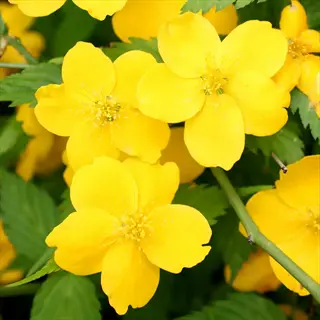
- Flowers: Large single five-petaled golden flowers, often the biggest in the species, with a long bloom season.
- Form: A graceful, arching shrub that shows off the open rose-like blooms against bright green stems.
- Fragrance: The flowers are slightly fragrant, an extra touch the double form lacks.
- Awards: It is well regarded by gardeners and holds a Royal Horticultural Society Award of Garden Merit.
- Pollinators: Single flowers offer more accessible nectar and pollen than the tightly packed double form.
- Best for: Naturalistic and wildlife-friendly shade gardens where simple, open flowers fit the style.

Picta Variegated Kerria
- Foliage: Green leaves edged in creamy white brighten shaded corners even when the shrub is not in bloom.
- Flowers: Single yellow flowers appear against the variegated leaves for a softer, two-tone effect.
- Size: A smaller, more restrained grower than 'Pleniflora', useful in tighter shaded spaces.
- Caution: It is prone to reverting, sending out all-green shoots that should be cut out to keep the variegation.
- Use: The pale leaf edges lighten dim spots where solid green plants can look flat.
- Best for: Gardeners who value foliage interest as much as the spring flowers in a shade bed.

Shannon Single Kerria
- Flowers: Large single golden flowers similar to 'Golden Guinea', giving a clean, open rose-like look in shade.
- Form: An upright, arching shrub that shows the bright green zigzag stems well between flushes of bloom.
- Habit: A vigorous grower that, like all kerria, suckers and benefits from pruning right after flowering.
- Stems: The Kelly-green winter stems carry the same year-round interest the species is valued for.
- Use: A good single-flowered choice where a gardener wants simple flowers rather than the packed double form.
- Best for: Shade gardeners who prefer the look of the single flower but want a strong, established cultivar.
There is real science behind those packed double blooms. The double form goes by the name kerria japonica pleniflora. In it, a jumping bit of DNA slipped into an AGAMOUS gene. That move switched off the gene's C-class job. The gene tells the flower to build stamens and carpels. With it shut down, those parts turn into extra petals. So you get the round chrysanthemum look instead of a simple open flower.
So the double form is a single flower with its reproductive parts swapped out for more color. That is why the golden guinea and other single types still set seed and feed bees, while the double form gives you show over substance. Pick the double for pure spring impact, or a single if you want pollinators and a touch of fragrance.
If foliage matters more to you, the variegated kerria lightens a dim bed all season long, even with the flowers gone. Just watch for all-green shoots and cut them out fast, or the plant slowly drops its cream edges. Whichever one you choose, you get the same tough roots, the same green winter stems, and that same golden glow in the shade.
5 Common Myths
Kerria japonica needs full sun to flower well, just like most other yellow-flowering spring shrubs in the garden.
It blooms profusely in partial to full shade, and its flowers actually fade and bleach when grown in full sun.
Because Kerria is a tough plant, you can prune it any time of year, including fall and winter, without losing blooms.
It flowers on the previous year's wood, so pruning in fall or winter removes the buds and ruins next spring's display.
Kerria japonica is a type of climbing vine that you can train up a trellis like a rose or clematis.
It is an arching deciduous shrub, not a climber; stems may lean on a wall but it never twines or clings like a vine.
Feeding Kerria heavily with rich fertilizer will reward you with more golden flowers and a fuller, healthier shrub.
High fertilization makes it weedy with excess leafy growth and fewer flowers; it performs best with lean soil and light feeding.
The double-flowered Pleniflora is simply a luckier seedling that naturally produces more petals than the single form.
Its extra petals come from a transposon mutation that disables a single floral gene, converting stamens and carpels into petals.
Conclusion
Good kerria japonica care comes down to learning a few quirks, then mostly staying out of the plant's way. This is a low-fuss shrub that rewards a light touch far more than constant fussing. Once you know how it grows, it gives you years of color for very little work.
Keep the load-bearing facts close. Japanese kerria blooms in partial shade across USDA zones 4 to 9. It reaches 3 to 8 feet (1 to 2.4 m) tall and 6 to 9 feet (1.8 to 2.7 m) wide. It flowers on last year's wood, so you prune right after the blooms drop. And it spreads by suckers, so give it room or pull the strays each spring.
The health rules are just as plain. Plant it in lean, well-drained soil and feed it lightly, since rich soil and heavy feeding push leafy growth at the cost of flowers. Give it the right shade so those golden yellow flowers hold their color instead of bleaching in hot sun. Clean up fallen leaves and prune out dead twigs to keep kerria twig and leaf blight from taking hold.
Get those basics right and you have a shade flowering shrub that few gardeners think to plant. I have left mine in a dim north corner for years, and it asks for little beyond a quick trim and a rake of old leaves. It hands you early spring gold, lively green stems through winter, and almost no chores in between.
There is a deeper story under all that yellow. In Japan this plant is the yamabuki, a flower old poets wrote about for its bright, fleeting color. And the crowded petals on the double form trace back to one switched-off gene that turns the flower's inner parts into petals. A plain shrub in your shade border carries both a piece of poetry and a small genetic accident, blooming on quietly each spring.
Glossary
- AGAMOUS gene
- A floral identity gene that controls the formation of stamens and carpels; switching it off turns those parts into petals.
- Blumeriella kerriae
- The specific fungus that causes kerria twig and leaf blight.
- Edema
- Blister-like swellings on leaves caused by roots taking up more water than the plant can release, often in waterlogged soil.
- Kerria twig and leaf blight
- A fungal disease of kerria that causes leaf spots, stem cankers, and dieback, especially in wet weather.
- Previous year's wood
- Stems that grew the season before, which is where kerria forms the buds for its spring flowers.
- Rejuvenation pruning
- Cutting an old, overgrown shrub back hard to encourage fresh, vigorous, flower-bearing growth.
- Sucker
- A new shoot that grows from a plant's roots and can spread the shrub into a widening colony.
- Transposon
- A mobile piece of DNA that can insert itself into a gene and disrupt how that gene works.
External Sources
Frequently Asked Questions
Does Kerria japonica spread?
Yes. Kerria japonica spreads by underground suckers and can colonize a wide area over several seasons.
Where is the best place to plant Kerria japonica?
Plant it in partial to full shade with well-drained loamy soil, where the golden flowers hold their color longest.
How and when should I prune Kerria japonica?
Prune right after flowering finishes in late spring, since the shrub blooms on the previous year's wood.
Is Kerria japonica fast growing?
Yes. It is a fast-growing shrub that reaches its full 3 to 8 foot height within a few seasons and spreads by suckers.
How long does Japanese kerria bloom?
The main spring bloom lasts about two to three weeks, with scattered reblooms possible through summer.
Is Japanese kerria toxic to dogs?
Kerria japonica is not listed among the plants known to be seriously toxic to dogs, but supervision is still wise.
What problems affect Kerria japonica?
The main problems are kerria twig and leaf blight, waterlogged soil, and reduced flowering from over-fertilizing.
Is Kerria japonica a shrub or a vine?
It is a deciduous shrub with arching stems, not a climbing vine, though it can be loosely trained against a wall.
What are the benefits of growing Kerria japonica?
Benefits are:
- Bright golden flowers in shade where few shrubs bloom
- Green zigzag stems that add winter interest
- Deer resistance and drought tolerance once established
- Low-maintenance, easy-to-grow nature
How do I make Kerria japonica grow faster?
Give it well-drained loamy soil, partial shade, and only light feeding, since heavy fertilizer causes weak, weedy growth.