Ornamental · Fabaceae
Alfalfa
Medicago sativa
Nail the soil and pH first, and this taprooted legume just keeps giving you cuttings for years.
Full sun
Every 7–14 days
60–70 days
USDA 3–9
Overview
Think of alfalfa as the dependable old hand of the hay world, a perennial legume with roots that plunge deep, and growers mow it several times each season. It sits in the pea family, so just like its cousins it grabs nitrogen from the air using Rhizobium bacteria tucked into nodules on its roots. And that long taproot? It's why a healthy stand laughs off dry spells and bounces back season after season.
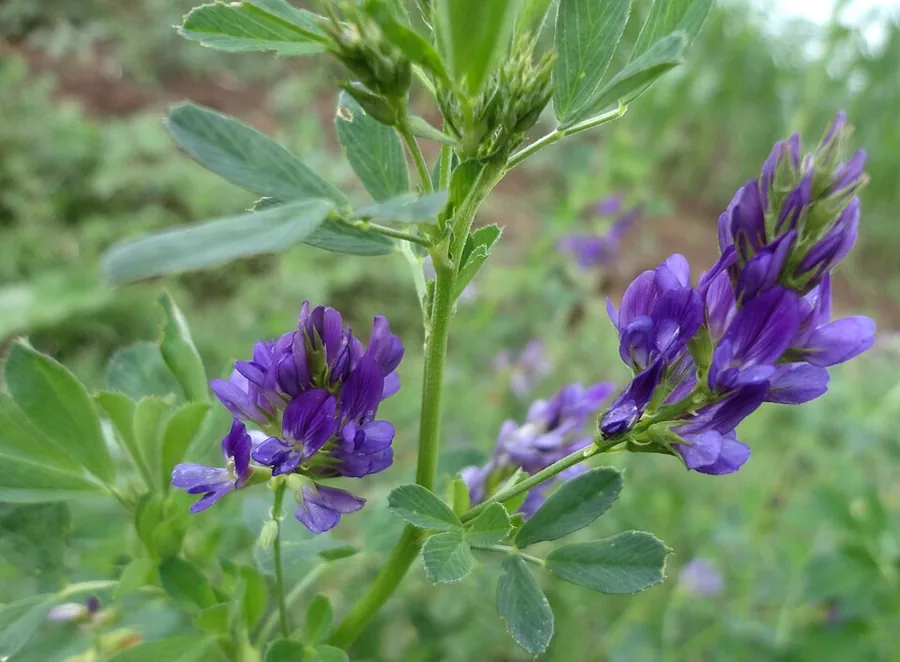
Where this crop gets picky is the dirt underneath it. It really wants deep, well-drained, near-neutral ground and sulks on sour, waterlogged, or thin sites. Sort out the pH and drainage before seeding and you'll get years of payback, but botch them and the stand fades fast. Come summer it puts up purple to blue-violet pea blooms, though most folks have already mown for forage before flowering really kicks in.
Here's the odd bit: alfalfa kind of holds a grudge against itself. An aging stand turns the soil hostile to its own babies, a quirk known as autotoxicity, so you can't simply drop fresh seed back into a worn-out patch. Slot it into a rotation instead, and whatever you grow next picks up the leftover nitrogen as a nice bonus.
Care
The short version: give it full sun and deep, well-drained dirt that sits at a pH of 6.5 to 7.5. Coat the seed with inoculant, then once the roots are down water deeply but not often, and keep cutting on a steady rhythm all season.
Light
This is a full-sun plant through and through, with basically zero patience for shade. Wide-open ground soaking up sun all day long is exactly what fuels that strong regrowth you get between cuttings.
Water
After it settles in, that deep taproot leaves alfalfa very drought tolerant, so the move is to soak it well every 7 to 14 days instead of dribbling water on constantly. Figure on roughly 10 to 12 inches of moisture across the season, but remember it just can't handle flooding or soggy footing, which means good drainage counts every bit as much as the watering does.
Soil
Set it up with deep, well-drained, fertile loam and hold the pH between 6.5 and 7.5. Sour, super-alkaline, wet, or shallow spots leave it struggling, and that pickiness about the bed is honestly the single biggest thing deciding whether your stand makes it.
Temperature
Alfalfa is plenty hardy on both ends, riding out anywhere from about -20°F to 95°F (-29°C to 35°C) wherever its zones reach. That knack for taking the cold is what lets the winter-hardy strains pull through northern winters and pop back up each spring.
Humidity
Regular outdoor air won't bother a field crop like this one bit. What really matters instead is good airflow and drainage, because still, damp conditions are what roll out the welcome mat for root rots and white mold.
Feeding
Being a legume, alfalfa makes its own nitrogen through Rhizobium nodules as soon as the seed gets inoculated, so skip the nitrogen entirely. What it does want is phosphorus, potassium, and lime, guided by a soil test to keep the pH near neutral, both when it's getting established and after you've taken cuttings.
Pruning
Cutting really is the entire reason you grow the stuff. Pull your first harvest off a direct-seeded stand about 60 days after seeding, then settle into a steady cutting rhythm right through the season for hay or forage.
Repotting
none
Size & spacing
A grown stand reaches somewhere around 24 to 35 inches (60 to 90 cm) tall, with each plant fanning out 12 to 24 inches (30 to 60 cm) wide. Since you're broadcasting or drilling it as a field crop rather than tucking in spaced garden plants, you tend the whole thing as one thick stand instead of fussing over individuals.
When to plant
You won't be raising transplants here, since alfalfa drops straight into the ground as seed. Scatter it onto a firm bed in spring or come back at it in late summer, grab a first cut roughly 60 days later, and then just keep mowing through the warm stretch while those purple blooms come and go.
Northern hemisphere
Southern hemisphere
Typical months for a temperate climate: start earlier in warm zones, later where spring frosts linger.
- Sow: Not typical; direct sown in field
- Plant: Spring (April-May) or late summer (late July-early September) into a firm, well-drained seedbed at neutral pH
- Harvest: Purple to blue-violet pea flowers in summer (May-October depending on latitude); cut for hay or forage multiple times per season
Hardiness
USDA hardiness zones: 3–9
Temperature: down to -40°C
Troubleshooting
Funny thing about alfalfa trouble: most of it brews down in the dirt or the seedbed long before you spot it up top, where old-field chemistry and lousy soil quietly do their thing. Then the bugs arrive and chew up the leaves. Find the picture below that matches yours and step in while the stand can still bounce back.
A patchy stand, or one that just won't get going
Alfalfa is choosy about its ground, and a patchy stand almost always points to soil that's gone too sour or stays too wet. Down in acid dirt the Rhizobia that feed the plant just clock out, while sitting water rots the roots and shoves crowns up out of the ground over winter. Sweeten the soil with lime to roughly neutral plenty ahead of seeding, choose a deep field that drains, and dose the seed with inoculant so those roots can nodulate the way they should.
Fix:
- Lime acidic soils to pH 6.5-7.0 at least six months before seeding if pH is below 6.2
- Select deep, well-drained fields and avoid hilltops, eroded ground, and low spots where water pools
- Inoculate seed with the correct Rhizobium and ensure good seed-to-soil contact in a firm seedbed
You reseed old ground and it comes up thin and tiny
Welcome to autotoxicity, which trips up plenty of growers. An older alfalfa stand leaks out compounds that stop its own seedlings cold, so dropping fresh seed right back into that tired field gives you a sparse, weak result well under the 25 plants per square foot you're aiming for. Want to dodge it? Swing over to corn or a grass for a year at least before alfalfa goes back in, and let that fill-in crop gobble up the leftover nitrogen.
Fix:
- Do not reseed alfalfa directly back into an old alfalfa stand
- Rotate to a non-alfalfa crop such as corn or a grass for at least one year before returning to alfalfa
- Use the residual nitrogen from the old stand for the rotation crop
Plants flagging, going pale, with crowns turning mushy
A handful of diseases creep in as a gradual fade of the stand, and wet ground is what really lets them rip. Phytophthora and Aphanomyces root rots turn the roots brown in soaked fields, bacterial wilt leaves the plants stunted and a sickly yellow-green, and Sclerotinia wraps the crowns in fluffy white mold. Reach for resistant cultivars, sort out the drainage, and rotate off alfalfa for a while to beat down the inoculum hiding in the soil.
Fix:
- Plant disease-resistant cultivars (bacterial wilt, Phytophthora, Aphanomyces resistant)
- Improve drainage and avoid wet, low fields
- Rotate away from alfalfa to reduce soilborne inoculum
Foliage that's been nibbled while the planting thins out
Three critters cause most of this mess. Alfalfa weevil grubs munch and lace up the tender new growth, potato leafhopper scorches the leaf margins yellow with what's nicknamed hopperburn, and aphids just pile on for good measure. Drag a sweep-net through to see who's actually out there, spray once the numbers tip past the economic threshold, and either cut early or set out leafhopper-resistant cultivars to keep the upper hand.
Fix:
- Scout regularly and treat at established economic thresholds
- Use early or timely cutting to disrupt pest cycles
- Plant potato-leafhopper-resistant and pest-resistant cultivars where available
Toxicity
Good news here: alfalfa is safe all around and you won't find it on any ASPCA poison list. Folks munch it as sprouts and capsules, and it happily feeds cats, dogs, rabbits, horses, and poultry too. The only thing you've really got to mind is grazing cattle and sheep, where a rich stand can trigger bloat, so the answer is smart pasture management, not steering clear of the plant.
Safe for
People · Cats · Dogs · Horses · Rabbits · Livestock · Birds
Cats None
Cats have nothing to fear from alfalfa, and it's simply never on the ASPCA poison rosters. A curious bite does no more than a mouthful of regular grass would.
Dogs None
Dogs can hang around alfalfa with zero concern. You'll even spot dried alfalfa listed as an ingredient in certain pet foods, so there's really nothing here to fence them off from.
Horses Safe
Horses tuck into alfalfa as a rich hay and do great on it. It ranks among the more nourishing forages you can put in front of them.
Rabbits Safe
Alfalfa is a go-to in loads of rabbit diets and a treat they love. The little ones especially thrive on it.
Livestock Mild
Cattle and sheep can graze alfalfa just fine, with one genuine gotcha to keep in mind. A rich, pure stand can kick off frothy bloat that puffs up the left flank, and tender new growth now and then sets off photosensitization. Hold the legume to roughly a third of the pasture, offer hay before turnout, and never shove hungry animals onto a heavy stand.
Birds Safe
Birds can eat alfalfa with no trouble at all, and poultry happily take it as a green feed.
People Safe
People dig into alfalfa as well, usually as sprouts or a dried supplement. There's nothing toxic in it to make it risky.
Not poisonous to cats, dogs, or people. The only real caveats are with grazing ruminant livestock: lush alfalfa can cause frothy bloat in cattle and sheep grazed heavily, fresh alfalfa can rarely cause photosensitization, and alfalfa contains phytoestrogens. Limit legume to about 30 percent or less of pasture, feed hay before turnout, and avoid turning hungry animals onto lush stands.
Varieties
How do alfalfa types differ? Mostly by how hard they shut down come fall and which diseases they can shrug off. Here are the splits worth understanding before you grab a bag of seed.
Fall-dormant (winter-hardy northern) types, FD 2-4
Carrying a low fall-dormancy rating, these slow right down early and tough out brutal winters, which is exactly what you're after in chilly northern ground.
Non-dormant (southern) types, FD 8-9
Thanks to a high fall-dormancy rating, these keep on growing late into the year for the warm southern regions, though they give up some winter hardiness to do it.
'Alfagraze'
Built to handle the punishment of grazing, this one turned into the yardstick that grazing-tolerance trials hold everything else up against.
Disease-resistant modern cultivars
These fresher lines pack together resistance to bacterial wilt, Phytophthora and Aphanomyces root rots, Fusarium wilt, anthracnose, and the potato leafhopper.
Companions
Plant near
Grasses (orchardgrass, timothy): Grass-alfalfa mixtures reduce frothy bloat risk in grazing ruminants and improve stand productivity.
Corn or other rotation crops following alfalfa: Rotating to a non-alfalfa crop for a year uses alfalfa's residual nitrogen and avoids autotoxicity when returning to alfalfa.
Keep apart
New alfalfa seeded into an existing alfalfa stand: Autotoxicity from the established alfalfa inhibits germination and growth of the new alfalfa seedlings.
How to propagate
Alfalfa comes up from seed dropped right into the field, and honestly the sowing itself is the easy part. The real work is in prepping the bed, picking the inoculant, and planning the rotation so things go smoothly.
SeedModerate
Spring (April-May) or late summer (late July-early September) · About 60 days to first harvest; full stand establishes over the seeding year
Alfalfa skips the indoor start and gets sown straight into the field, either come spring around April to May or in late summer running from late July into early September. First, dust the seed with the proper Rhizobium so it can fix its own nitrogen, then tuck it down a quarter to half an inch deep, going a touch deeper in sandy spots, into a firm, well-drained bed near neutral pH. You'll be able to grab a first cut about 60 days in, while the stand keeps filling out across the rest of that seeding year. And here's the one rule you can't bend: never drop alfalfa seed straight back into an old alfalfa field, or autotoxicity will tank the whole new stand.
Myths
A lot of folks think alfalfa is poisonous and risky to feed to animals or people.
Not so. Alfalfa is a safe, nourishing forage that goes to livestock and rabbits, gets taken as a supplement by people, and shows up in some pet diets, and it never lands on ASPCA toxic-plant lists. The lone real catch is frothy bloat in cattle and sheep let loose on a rich stand, plus the odd photosensitization and a bit of phytoestrogen. None of that turns the plant into poison for your pets or for you.
Sources
- USDA Forest Service FEIS
- University of Minnesota Extension
- University of Minnesota Extension
- University of Wisconsin-Madison Extension (Team Forage)
- University of Kentucky
- UC ANR Statewide IPM Program
- UC ANR Statewide IPM Program
- Penn State Extension
- ASPCA
- University of Kentucky
- USDA SARE
- University of Kentucky Master Grazer