Ornamental · Fabaceae
Crimson Clover
Trifolium incarnatum
Sow it in fall and crimson clover gives back fixed nitrogen and a sheet of brilliant red bloom.
Full sun
Every 5–10 days
150–210 days
USDA 6–9
Overview
Crimson clover is a fast cool-season legume that earns its keep more by what it does than by how it looks, even though it does both nicely. Being part of the pea family, it grabs nitrogen from the air and tucks it away in its roots, and that is exactly why gardeners and farmers plant it as a cover crop and green manure. It comes up quick, crowds out weeds, and keeps the bees busy while it goes about its work.
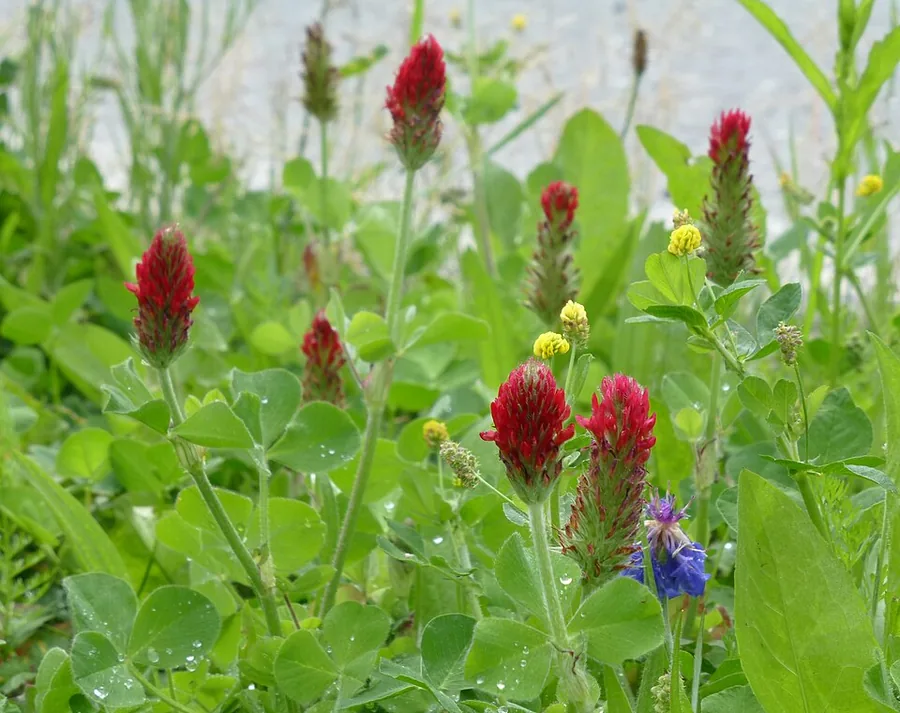
It is an annual, and a quick one at that. Put it in the ground in late summer or fall and it forms a low rosette before winter, then springs up come spring to send out brilliant crimson-red conical flower heads before it seeds and finishes. The speed is really the whole appeal: you get cover and fertility in one season, then turn it under for whatever crop comes next.
The real magic is in the handoff. Terminate it right at bloom or just before, and you let loose a burst of nitrogen exactly when a hungry follow-on crop like corn can grab it. Let it go too far, though, and it sets hard seed and shows up as a volunteer weed in next year's bed.
Care
The short version: full sun and well-drained soil, inoculated seed direct-sown about 1/4 inch deep into a firm, moist bed, kept watered while it establishes and then mostly handed off to the rain, and terminated at or before early bloom.
Light
Crimson clover does best in full sun for the strongest growth and bloom, though it will get by in partial sun. Give it too much shade and it grows thin and floppy and fixes less nitrogen, so pick an open, sunny spot.
Water
Keep the seedbed moist through germination and establishment, then back off and water only during dry spells, since a settled stand mostly takes care of itself on rain. The one thing it just will not put up with is wet feet, so steer clear of soggy or waterlogged ground.
Soil
Give it well-drained loam or sandy loam of moderate fertility. Heavy clay or waterlogged ground will hold it back, and it prefers a near-neutral pH somewhere between 6.0 and 7.0.
Temperature
This one is built for cool weather and copes with a wide span, roughly 10°F to 84°F (-12°C to 29°C), though it does not take cold as well as other clovers. Where winters are harsh, hard freezes can thin or wipe out an overwintering stand.
Humidity
Plain outdoor humidity is all it asks for, so there is no number to chase. What counts more is air movement and drainage, because cool, wet, crowded conditions are exactly what bring on the crown and root rots.
Feeding
Because it is a nitrogen-fixing legume, it wants no nitrogen fertilizer; instead, inoculate the seed with the right Rhizobium so the plants make their own. Only reach for phosphorus or potassium if a soil test points to a genuine shortfall.
Pruning
There is no pruning here in the usual sense. What you are really doing is termination: mow, till, roll, or just let it winterkill at or before early bloom, ahead of hard-seed set, then work it in as green manure or leave it on top as mulch.
Repotting
none
Size & spacing
A stand reaches about 12 to 35 inches (30 to 90 cm) tall, while single plants spread somewhere around 6 to 12 inches (15 to 30 cm). You broadcast or drill it as a thick stand rather than planting out spaced individuals.
When to plant
Crimson clover lives by the cool season. Get it in the ground in late summer to fall, around 6 to 8 weeks ahead of your first frost, so it builds a crown to ride out winter in mild zones; somewhere colder, sow it in early spring instead. The bloom shows up the next spring, and that is when you terminate, right at it or just before.
Northern hemisphere
Southern hemisphere
Typical months for a temperate climate: start earlier in warm zones, later where spring frosts linger.
- Sow: Not applicable; crimson clover is direct-sown in the field, not started indoors.
- Plant: Sow in late summer to fall, about 6 to 8 weeks before the average first frost, to overwinter in mild zones (roughly USDA 6-9); in colder areas sow in early spring.
- Harvest: Showy brilliant crimson-red elongated conical flower heads appear in spring (about April to May). Terminate at or before early bloom for maximum nitrogen and to prevent reseeding.
Hardiness
USDA hardiness zones: 6–9
Temperature: down to -23°C
Troubleshooting
Nearly every crimson clover headache comes back to one of two things: how you sowed the stand, or when you terminated it. Learn to read the early clues in the plants and the roots, and you can patch a thin spot or stop a weedy reseed before it gets expensive. Find what matches what you are seeing below, then act while it can still help.
A thin, spotty stand with pale, feeble plants
When plants come up pale and limp, the usual story is simple: the seed went in without its Rhizobium inoculant, so no root nodules formed and nothing is putting nitrogen into the plants. Throw in dry ground and loose seed-to-soil contact, and the stand thins out even more. Want to check? Pull up a few seedlings a couple weeks after they sprout and look for pink, working nodules, then drop fresh inoculated seed into the bare spots over a firm, damp bed.
Fix:
- Use fresh pre-inoculated seed or treat seed with the proper Rhizobium inoculant before sowing
- Sow about 1/4 inch deep into a firm, moist seedbed with good seed-to-soil contact
- Sow 6 to 8 weeks before first frost into adequate moisture, or reseed thin areas
The stand fades or dies off through winter
Here is the thing about crimson clover: it is less cold-hardy than other clovers, so it can winterkill where the freezes get rough, especially below about zone 6. Sow it too late and the crowns stay too tiny to pull through. If it does winterkill, just treat what is left as mulch or green manure, and in cold spots grow it as a spring-sown annual or reach for tougher types like AU Robin or AU Sunrise.
Fix:
- Treat winterkilled residue as mulch or green manure and follow with a spring crop
- In cold areas grow it as a spring-sown annual instead of overwintering it
- Choose hardier improved types such as AU Robin or AU Sunrise
Volunteers show up in the next crop
Let it bloom and set hard seed, and crimson clover becomes a weedy volunteer that keeps popping up in whatever you grow next. So what is the trick? Timing, plain and simple. Mow, till, or roll the stand at or before early bloom, before any viable seed forms, and pull or turn under anything that already managed to seed.
Fix:
- Mow, till, or roll to terminate at or before early bloom, before viable seed forms
- Remove or incorporate any plants that have already set seed
Wilting, chewed roots, or sticky leaves from bugs and rot
A few troublemakers can show up together here. Clover root curculio larvae gnaw away at the roots and nodules, crown and root rots or Sclerotinia take hold on soggy fall plantings, and aphids and thrips crowd onto the leaves and flower heads. Look over the roots for chewing and rot and scan the foliage for insects, then lean on well-drained ground and crop rotation, because a cover crop does not have to be perfectly pest-free.
Fix:
- Plant on well-drained soil and avoid waterlogged sites
- Rotate away from legumes to break pest and disease cycles
- Tolerate minor feeding, since a cover crop need not be pest-free
Toxicity
Here is the good news: crimson clover is not poisonous to pets, people, or wildlife. It is a legume forage that animals can graze without harm. The one real catch involves grazing ruminants, where lush stands can bring on bloat if the grazing is handled badly, and that is a management problem, not a poisoning one.
Safe for
People · Cats · Dogs · Horses · Rabbits · Livestock · Birds
Cats None
You will not find crimson clover on the ASPCA toxic-plant lists, so a cat that chews a leaf has nothing to fear. That said, a big bite of any unfamiliar green can leave a touchy tummy a bit off for a day.
Dogs None
Dogs are fine to hang around it and to take a taste. If one wolfs down a big batch at once, the most you might get is some loose stool that sorts itself out.
Horses Safe
For horses, crimson clover is good, safe forage. The clover that gives horses grief is the related alsike, not this one, so there is really nothing to fret about here.
Rabbits Safe
Rabbits can munch crimson clover with no trouble, and it makes a nice fresh green for them. Just bring any new forage in slowly so their gut has time to catch up.
Livestock Mild
Cattle and sheep take to crimson clover happily and do well on it, with one thing to watch: grazing lush, fast-growing stands too hard can set off pasture bloat. Keep the grazing in check and the risk stays small.
Birds Safe
Both the seeds and the tender growth are safe for birds, and chickens are glad to forage a stand. Nothing about the plant is a hazard to them.
People Safe
Crimson clover is not poisonous to people at all. Folks have used the flowers and sprouts for ages, though clover pollen can be a mild allergen for some.
Safe around pets and people. Like other clovers and legumes, lush crimson clover can cause bloat in ruminant livestock (cattle and sheep) if grazed heavily, but it is not poisonous to pets or people. Note that some related Trifolium species (for example alsike clover) can cause photosensitization or liver problems in horses, and clover pollen can be a mild allergen.
Varieties
Most of the crimson clover you will buy is just common seed, but a handful of named types are worth a look, mostly for how they handle cold and how reliably they reseed.
Dixie
A southern favorite that is grown widely for its dependable hard-seed reseeding, so the stand comes back on its own where winters stay mild.
AU Robin
An improved release that takes the cold better and blooms and matures sooner than the standard types, which really pays off in tougher zones.
AU Sunrise
Another hardier, early-maturing cultivar developed for sooner bloom and a broader fit across regions.
Kentucky Pride
A naturalized reseeding pick that does well in the upper South and the transition zone where warm and cool climates meet.
Companions
Plant near
cereal rye: Grass-legume cover crop mix; the rye adds biomass and scavenges nitrogen while the clover fixes nitrogen and suppresses weeds.
oats: Oats provide quick fall cover and a nurse crop while crimson clover establishes and fixes nitrogen.
corn: Crimson clover green manure releases fixed nitrogen for a following heavy feeder such as corn.
How to propagate
There is really only one way to grow crimson clover, and that is from seed dropped straight into the ground. The tricky part is the inoculant, not the sowing itself.
SeedEasy
Late summer to fall (6-8 weeks before first frost) to overwinter, or early spring in cold areas · Germinates in about 1-2 weeks; establishes a stand within several weeks of sowing
There is just one way to grow crimson clover: from seed, dropped right into the ground. Direct-sow about 1/4 inch deep over a firm, moist seedbed, and either use pre-inoculated seed or treat it with Rhizobium inoculant so the plants build their nitrogen-fixing nodules. Seed sprouts in roughly one to two weeks and fills in a stand within several weeks, timed for late summer to fall to overwinter or early spring where it gets cold.
Myths
Any clover will do the same job, so crimson clover is interchangeable with white or red clover.
Not quite. Crimson clover is a quick, showy annual that fixes nitrogen, but it does not take winter as well and lives a shorter life than perennial white or red clover. The point of growing it is a fast fall or spring cover crop and green manure that you terminate before it seeds. Treat it as a one-season workhorse, not a long-lived pasture clover.