Ornamental · Asparagaceae
Black Mondo Grass
Ophiopogon planiscapus 'Nigrescens'
Few plants get this close to true black, and a little sun is all it takes to keep the leaves darkest.
Full sun
Every 3–7 days
USDA 6–9
6–12 in · 15–30 cm
Overview
It's one of those rare plants with near-black foliage, which is exactly why designers can't get enough of it. The arching, grass-like leaves start out a deep green-purple and darken as they mature, and since it's an evergreen perennial, it holds that color all year. Despite the name, it isn't actually a grass at all; it belongs to the asparagus family and hails from Japan.
Think of it as a slow, well-behaved groundcover. It spreads on short underground runners and grows by inches rather than feet, so it won't bully its neighbors. That makes it easy to tuck along a path edge, slip between stepping stones, or mass at the front of a border.
It's cold-hardy down to 0°F (-18°C) and asks for very little once it's settled in. Give it decent soil, steady moisture, and enough light to keep the leaves dark, and it'll hold its own for years.
Care
The short version: give it full sun to part shade for the blackest leaves, keep the soil rich and evenly moist but never waterlogged, and tidy up the old foliage in late winter.
Light
Aim for full sun to part shade to keep the leaves at their darkest. Deep shade lets them drift back toward green, while a touch of afternoon shade helps out in hot regions.
Water
Keep the soil evenly moist, watering roughly every 3 to 7 days during dry spells. It's drought tolerant once established, but steady moisture gives you the best color and growth.
Soil
Go with a rich, humusy, well-drained loam that's slightly acidic, around pH 5.5 to 7.0. Mixing in some compost at planting time gives it a good start.
Temperature
It handles 0°F (-18°C) on the cold end and up to about 95°F (35°C) on the warm end, which covers zones 6 through 9. The evergreen leaves stay put through the cold and green up again in spring.
Humidity
Ordinary outdoor humidity is plenty, so there's no number to chase here. Drainage matters more than air moisture, since soggy ground is the real problem.
Feeding
Feed lightly in spring with a balanced general-purpose fertilizer or some compost. It's a low-demand plant, so heavy feeding doesn't really move the needle.
Pruning
Barely a chore, this one. Just shear off tattered or winter-worn leaves in late winter before new growth shows, and the clump comes back fresh.
Repotting
If it's in a container, lift and divide it every 2 to 3 years before the roots crowd the pot. A thinning center or slowing growth is your cue that it's time.
Size & spacing
Each clump runs 6 to 12 inches (15 to 30 cm) tall with a spread of 8 to 12 inches (20 to 30 cm). Space them a foot apart for distinct clumps, or closer for quicker groundcover.
When to plant
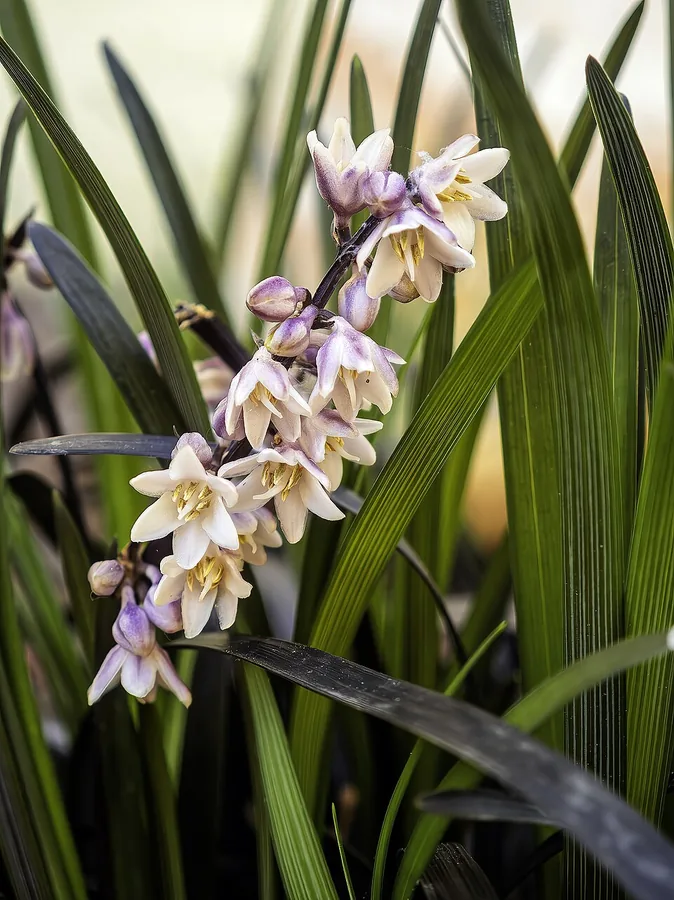
This is a hardy perennial for zones 6 through 9, so plant it once and it sticks around. Put it in the ground in spring and it gets a full season to settle in. Look for little bell-shaped flowers in summer, roughly July into August.
Northern hemisphere
Southern hemisphere
Typical months for a temperate climate: start earlier in warm zones, later where spring frosts linger.
- Plant: spring
- Harvest: summer (July to August)
Hardiness
USDA hardiness zones: 6–9
Temperature: down to -23°C
Troubleshooting
It's a forgiving plant, honestly. Most of the trouble traces back to either too much shade or too much water. Catch the early signs on the leaves and roots and act before things spread.
Yellowing leaves and a clump that rots in wet soil
When roots sit in standing water, root rot tends to follow, and once the damage sets in the foliage yellows and flops over. Dig up a section and check: rotted roots feel soft and dark. Work in some grit or compost for drainage, ease off the watering, and replant the healthy divisions somewhere that drains well.
Fix:
- Improve drainage by amending soil with organic matter or grit
- Reduce supplemental watering when soil stays wet
- Replant healthy divisions in a better-drained, raised, or amended site
Weak, slow regrowth after dividing
A slow grower bounces back slowly, plain and simple. Fresh divisions tend to sit quietly for a while before they start pushing new growth. Divide in spring so they get a full season ahead of winter, keep the soil evenly moist while roots form, and just give it time instead of digging it back up.
Fix:
- Divide in spring so plants have the full season to re-establish before winter
- Keep soil evenly moist while new roots form
- Allow extra time for recovery rather than disturbing again
Slow to spread and fill in as a groundcover
This one's all about the plant's own pace. It creeps along on short stolons, so it can take a few seasons to knit together into solid cover. That sparse look early on? Totally normal. Want results sooner? Set new plants closer, around 4 inches apart, and divide established clumps to fill in the gaps.
Fix:
- Be patient and allow clumps to establish over several seasons
- Plant more closely (about 4 in apart) when a faster groundcover effect is wanted
- Divide established clumps to make more plants and fill gaps
Black leaves washing out toward green
That deep color is really a sun-driven trait, so when the plant sits in deep shade, the leaves start drifting back toward green. The fix is simple: give it a brighter spot and the near-black look returns. In hot regions a bit of afternoon shade is fine, but otherwise lean toward sun.
Fix:
- Move or transplant to a brighter, sunnier location
- In warm climates provide some afternoon shade but otherwise favor sun for color
Ragged, chewed leaves with slime trails
Holes in the leaves and shiny slime trails are a giveaway for slugs and snails. They do their feeding at night and love damp, shady corners. Head out after dark and pick them off by hand, clear away leaf litter and other hiding spots, and only reach for slug controls if the damage really starts piling up.
Fix:
- Hand-pick slugs and snails in the evening
- Remove debris and reduce excess moisture and hiding spots
- Use slug controls where pressure is heavy
Toxicity
Good news here: it isn't toxic. It sits in the asparagus family, not among the dangerous true lilies people so often mistake it for. The worst case is a mild stomach upset from eating a lot of it, which makes it a fine pick for homes with pets and kids.
Safe for
People · Cats · Dogs · Horses · Rabbits · Livestock · Birds
Cats None
Cats are safe around it. A few nibbled blades might leave one with a brief upset tummy, but that's true of pretty much any plant eaten in quantity.
Dogs None
No real danger for dogs. There's no known toxin here, though a big mouthful could leave a dog feeling briefly queasy.
Horses Safe
Not toxic to horses. It carries none of the poisons found in the true lilies it tends to get confused with.
Rabbits Safe
Rabbits can graze on it without harm. Nothing in it is poisonous, so an occasional bite is fine.
Livestock Safe
Livestock aren't at risk. It has none of the compounds that trouble grazing animals.
Birds Safe
Birds are safe. Backyard poultry can pick at the leaves and small fruit with no worry.
People Safe
No risk for people handling or gardening with it. A stray taste won't do any harm beyond the mild upset any non-food plant might cause.
No special handling required; as with any plant, discourage pets from eating large quantities to avoid mild stomach upset.
Varieties
A handful of selections and look-alikes turn up under the mondo grass name. The easiest way to tell them apart? Check the leaf color, the flower habit, and the fruit.
Ophiopogon planiscapus 'Nigrescens'
The standard black mondo grass. Its arching, grass-like leaves come up green-purple and mature to a glossy near-black, making it one of the darkest-foliaged perennials you can grow.
'Black Dragon' / 'Ebony Knight'
These are just trade names sold for the same near-black foliage you get from 'Nigrescens'.
Ophiopogon japonicus (green mondo grass / dwarf lilyturf)
The common green-leaved species, with narrower leaves than Liriope, flowers mostly tucked out of sight under the foliage, and blue fruit rather than black.
Black-leaved Liriope (lilyturf)
A whole different genus, Liriope, with broader leaves, flowers held up on erect spikes above the foliage, and black fruit instead of the blue you see on green mondo grass.
Companions
Plant near
Chartreuse or gold-foliage plants (e.g., golden creeping Jenny, Hakone grass 'Aureola'): Bright lime/gold foliage gives strong color contrast against the near-black leaves.
Silver or gray foliage plants (e.g., lamb's ear, dusty miller): Silver tones highlight the dark foliage for dramatic contrast in borders and containers.
How to propagate
There's really just one reliable way to make more of this plant, and it keeps that prized dark color true every single time.
DivisionEasy
Spring · One growing season
Division is really the way to go, since this one won't come true from seed. Split an established clump in spring and the pieces hold onto that black color while getting the whole season to settle in. Figure on about one growing season to root and fill out.
Myths
Black mondo grass is a true grass.
Nope, it isn't a grass at all. It's Ophiopogon planiscapus, a member of the asparagus family that just happens to grow in a grass-like evergreen clump. It only looks the part.
It's the same plant as green mondo grass or lilyturf.
They get mixed up a lot, but they're genuinely different plants. Green mondo is the related Ophiopogon japonicus, while lilyturf is the separate genus Liriope with broader leaves and flower spikes standing above the foliage. Black mondo's narrow leaves and hidden flowers set it apart.