Shrub · Rosaceae
Blackberry
Rubus fruticosus
Hand it full sun and room to ramble, and a blackberry will load you up with fruit for years.
Full sun
Every 3–7 days
USDA 5–9
3–10 ft · 0.9–3 m
Overview
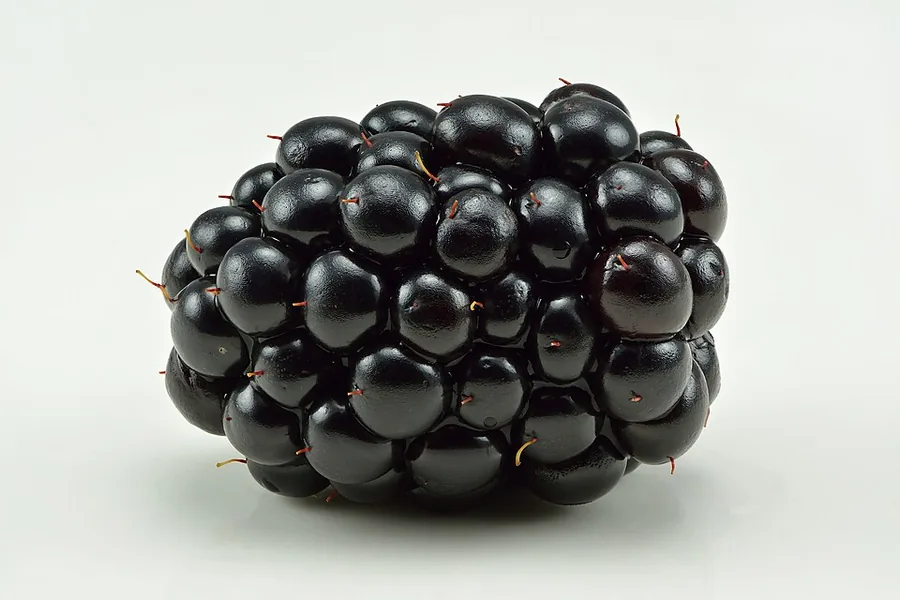
If you're new to growing fruit, a blackberry is about as forgiving as it gets. It's a bramble in the rose family, the kind that throws out long arching canes that root wherever they happen to touch down. Plant one and leave it alone, and it'll cheerfully try to take over its corner of the garden.
So what actually makes a blackberry tick? It's all about how the canes work in two-year pairs. A cane spends its first year as a leafy primocane, then fruits the next year as a floricane and dies back. Once that clicks, the pruning suddenly makes sense and the harvest just keeps coming.
These are tough, cold-hardy plants that give you a lot for barely any effort. Give them sun, halfway decent soil, and a quick tidy-up once a year, and you'll be grabbing handfuls of warm berries by midsummer. The big thing to plan around is space, since a happy patch spreads fast.
Care
The short version: full sun, deep well-drained soil, and roughly an inch or two of water a week. Cut out the old fruited canes every year and give it plenty of room to wander, and you're set.
Light
Blackberries fruit best in full sun, so try for six or more hours a day. They'll put up with a touch of afternoon shade, but the more sun they catch, the sweeter and heavier your berries are going to be.
Water
Keep the soil evenly moist but never waterlogged. That's about 1 to 2 inches of water a week, and a bit more while the plant's flowering and filling out its fruit, because a dry spell right then leaves you with small, crumbly berries.
Soil
Get them into deep, well-drained loam with plenty of organic matter mixed through. A pH between 5.5 and 7.0 is what they like, and the better the drainage, the less you'll wrestle with root and cane disease.
Temperature
These plants are tough as nails, riding out winters down to -4°F (-20°C) and summers up to 95°F (35°C). They're happy in hardiness zones 5 through 9, so most gardeners can just grow them without any protection.
Humidity
Regular outdoor humidity of 40% to 70% is totally fine. What matters more than the number is air movement, because still, damp air around crowded canes is exactly what lets rust and blight move in.
Feeding
Feed once in early spring as growth wakes back up, using a balanced 10-10-10 or a nitrogen-rich complete fertilizer. That one seasonal feeding is usually all it takes to carry the canes through fruiting.
Pruning
The canes are biennial, so the pruning just follows that two-year cycle. Cut the spent floricanes right to the ground after harvest, tip-prune the primocanes in summer to push out fruiting laterals, and thin things down to a handful of strong canes.
Repotting
Blackberries live in the ground, not pots, so repotting almost never comes up. If you do keep one in a container, though, move it up once roots start circling the pot or growth stalls and the soil dries out fast.
Size & spacing
Canes get to 3 to 10 feet (90 cm to 3 m) tall and spread about the same. Give each plant that much room to arch and sucker, both so air can move and so the patch doesn't end up crowding its neighbors.
When to plant
Blackberries want to go in while they're still dormant. Set out bare-root or potted canes in late winter to early spring once the hard frosts are done, keep an eye out for blooms in late spring, and start picking ripe berries right through the heat of July and August.
Northern hemisphere
Southern hemisphere
Typical months for a temperate climate: start earlier in warm zones, later where spring frosts linger.
- Plant: Set out dormant bare-root or container canes in late winter to early spring after danger of hard frost has passed.
- Harvest: Blooms in late spring; berries ripen mid to late summer (typically July to August).
Hardiness
USDA hardiness zones: 5–9
Temperature: down to -29°C
Troubleshooting
Most of the time blackberry trouble shows up on the canes or the fruit, and a quick stroll through the patch catches it early. Find what matches what you're seeing below, then jump on it before a fungus or a mite digs in for good.
Bright orange powder hiding under the leaves
See orange powder under the leaves? That's orange rust, and unlike most leaf problems it isn't just on the surface, it's living inside the whole plant. Here's the hard part: once a cane shows those spores it won't bounce back, and it'll keep handing the fungus to everything nearby. So dig the whole thing up, roots and all, and whatever you do, don't toss it on the compost.
Fix:
- Dig out and destroy entire infected plants including roots
- Do not compost infected material
Dark cracking patches on a cane, dead growth above
When a cane develops dark cracking patches and the top wilts out, you're usually looking at cane blight and anthracnose, fungi that sneak into a wound and choke the cane from inside. The fix is simple enough: prune the bad cane out well below the patch, then thin the others so air can flow. Just pick a dry day to do it, because cutting in wet weather basically rolls out the welcome mat for the fungus.
Fix:
- Prune out and destroy affected canes below the lesion
- Thin canes to improve air circulation
Lopsided berries with little hard red bumps
Ever pick a berry where half the little bumps are plump and the rest stay hard and red? That's usually poor pollination, though a redberry mite or a virus can pull the same trick. The easy wins are planting some flowers close by to draw in more bees, and reaching for horticultural oil if mites turn out to be the issue. And if you think a plant's carrying a virus, it's kinder to the rest of the patch to pull it and start over.
Fix:
- Encourage pollinator activity near the planting
- Apply horticultural oil to manage mites
Toxicity
Honestly, there's nothing poisonous to stress about here. The berries, leaves, and canes are all safe for people, pets, and livestock, and the fruit's a treat for pretty much everyone. The only real hazard is a physical one, since most blackberries come armed with sharp thorns that can scratch skin and snag fur.
Safe for
People · Cats · Dogs · Horses · Rabbits · Livestock · Birds
Cats None
Good news for cat people: there's nothing in this plant that'll poison a cat. The only thing to keep half an eye on is the thorns, which can scratch a nosy paw or nose.
Dogs None
Dogs can have the ripe berries no problem, and honestly a lot of them go nuts for them. Just don't let one inhale a whole pile, since that can mean a loose stomach later.
Horses Safe
Horses can graze the leaves and fruit and they'll be totally fine. What you actually want to watch are the sharp canes, since those can nick a soft muzzle.
Rabbits Safe
The leaves and fruit are both safe, and rabbits really do like a nibble of the greenery. Go light on the berries though, because all that sugar is a lot for a little body.
Livestock Safe
Cattle, goats, and sheep happily browse brambles, and a goat will basically volunteer to clear a thicket for you. None of it'll hurt them one bit.
Birds Safe
Wild birds can't get enough of ripe blackberries, and they spread the seeds all over the place as they go. There's nothing in the fruit that'll bother them.
People Safe
People have loved blackberries forever, fresh or cooked, and the young leaves have long been brewed into tea. The only catch is watching out for the thorns while you pick.
The main hazard is physical rather than chemical: most wild and cultivated blackberries bear sharp thorns (prickles) along the canes that can scratch skin or injure pets, though thornless cultivars such as 'Navaho' and 'Apache' exist and are safer to handle.
Varieties
There are hundreds of blackberries out there, mostly split into upright and trailing types. These three are worth knowing, and a couple of them have been bred to skip the thorns entirely.
Navaho
It's a thornless, upright type out of the University of Arkansas and USDA breeding program, and it gives you sweet, firm berries on canes you can grab without gloves.
Marionberry
This one's a trailing blackberry that came out of Oregon State University, a cross of Chehalem and Olallie, and it's been a Pacific Northwest favorite for ages.
Apache
Here's another thornless, upright pick, and it's the one to grab if you're after really big fruit and strong disease resistance.
Companions
Blackberries do best kept apart from their own relatives and from the nightshade family, since both trade diseases that brambles are prone to.
Keep apart
Raspberry and other Rubus: Planting close to other brambles spreads shared diseases such as orange rust and viruses.
Tomato, potato, and other Solanaceae: They share susceptibility to Verticillium wilt, so avoid planting blackberries where solanaceous crops recently grew.
How to propagate
Blackberries are really easy to multiply, and a single plant gives you a few different ways to do it. Layering and division take hardly any skill, while cuttings just want a little more patience.
LayeringEasy
Late summer · Roots form in 6 to 8 weeks; transplant the following spring
Trailing types pretty much layer themselves, so this one's hard to mess up. In late summer, just bend a cane tip down to bare soil and pin it, and you'll have roots in about 6 to 8 weeks. Leave the new plant attached over winter, then lift it the following spring once it's ready to go.
DivisionEasy
Late winter to early spring while dormant · One growing season
An established clump keeps sending up rooted suckers around the base, which makes this easy. Dig a few of those, or split a crown, in late winter to early spring while it's dormant, then get them back in the ground right away. Give each piece a full growing season to settle before you count on a real crop.
Stem cuttingsModerate
Winter for root cuttings or summer for softwood cuttings · Several weeks to a few months
Cuttings ask for a bit more care than the other two, but they're far from impossible. Take root cuttings in winter or softwood cuttings in summer, and expect rooting to take anywhere from several weeks to a few months. Root cuttings are how nurseries usually bulk up the upright types.
Myths
Blackberries and raspberries are the same fruit since both are brambles.
They're both in the genus Rubus, so honestly the mix-up makes sense, but the fruit gives the game away. A blackberry hangs onto its little white core when you pick it, the plug called the receptacle, while a raspberry pops off and leaves that core behind on the plant, and that's exactly why a raspberry's hollow inside.
Every blackberry has thorns.
Plenty of them do, sure, but thorns aren't a given anymore. A bunch of newer cultivars like Navaho and Apache are completely thornless and crop just as heavily, so you can grow and pick blackberries without ever getting scratched.