Tree · Rosaceae
Bradford Pear
Pyrus calleryana
It grows fast and shrugs off almost anything, but the Bradford pear splits in storms and spreads as an aggressive invasive, so it's one to skip.
Full sun
Every 7–14 days
USDA 5–9
30–50 ft · 9.1–15.2 m
Overview
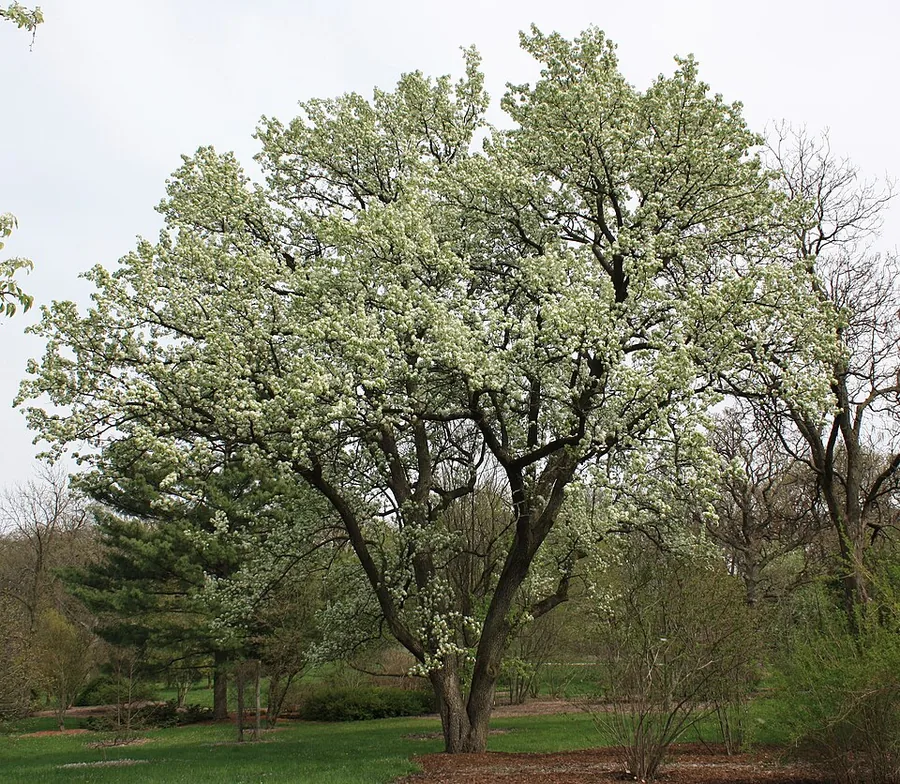
The Bradford pear is a kind of Callery pear, and it used to be planted just about everywhere for its neat shape and the big cloud of creamy white flowers it puts on in early spring. It doesn't mind poor soil, drought, or city pollution, which is exactly why it ended up in so many yards and parking lots. The catch? Those pretty flowers come with a sour, off-putting smell that catches people off guard the first time they get a whiff.
Underneath the easy good looks, though, there are two real problems. The branches grow at tight, weak angles that tear apart in wind, snow, or ice, so a grown tree often splits within 15 to 25 years. The bigger issue is that the cultivars cross-pollinate and set fertile seed, which birds carry out into the wild, where it forms dense thorny thickets that crowd out native plants.
And that second problem has finally caught up with it. Several states have banned its sale, and most experts will point you toward a native flowering tree instead. The notes below cover how to handle a Bradford pear you already have, but planting a new one? That's just not a smart move anymore.
Care
The short version: give it full sun and pretty much any soil, barely any water once it's settled in, and almost no feeding, but plan on pruning for structure and dealing with limbs that split as it gets older.
Light
Give it full sun if you want the best shape and the most flowers, though it'll put up with partial shade if it has to. The more sun it gets, the denser and more even the canopy fills in.
Water
Young trees need steady water while they're settling in, but a grown Bradford pear is drought-tolerant and does just fine on dry to medium moisture. Water it through a real dry spell, and otherwise just leave it be, letting the top half of the root zone dry out between drinks.
Soil
You'd be hard-pressed to find a less picky tree about soil. It grows in clay, loam, or sand across a wide pH of 5.5 to 8.0, likes good drainage but shrugs off heavy clay, the odd wet spell, drought, and city pollution.
Temperature
It's hardy from about -20°F to 100°F (-29°C to 38°C), so it handles zone 5 cold and southern heat without blinking. That toughness is a big part of why it spread so far.
Humidity
Regular outdoor humidity is all it wants, so there's no level to fuss over. Airflow matters way more than moisture in the air, since damp, crowded leaves are what invite leaf spot and fire blight.
Feeding
An established tree in decent soil hardly ever needs feeding. If growth stalls, a balanced slow-release tree fertilizer in early spring does the trick, and loading up on nitrogen just pushes the soft growth that fire blight loves.
Pruning
Prune in winter while it's dormant, taking out crossing, weak, and narrow-angled branches to build a sturdier shape. Good pruning helps the odds, but it can't undo the splitting weakness baked into the cultivar, so plant the tree well away from strong winds.
Repotting
none
Size & spacing
This is a big tree, hitting 30 to 50 feet (9 to 15 m) tall and spreading 20 to 35 feet (6 to 11 m) wide. Give it plenty of open space well clear of buildings, wires, and walkways, since older limbs have a habit of breaking.
When to plant
The Bradford pear keeps a pretty predictable schedule in zones 5 through 9. Pop balled-and-burlapped or container trees in the ground in early spring or fall, watch for that smelly white bloom in April, and look for the small brown pomes to ripen in fall, which is when the birds take over and spread the seed.
Northern hemisphere
Southern hemisphere
Typical months for a temperate climate: start earlier in warm zones, later where spring frosts linger.
- Plant: Plant balled-and-burlapped or container trees in early spring or fall.
- Harvest: Creamy white flowers in early spring (April), before or with the leaves; small round brownish pomes mature in fall.
Hardiness
USDA hardiness zones: 5–9
Temperature: down to -29°C
Troubleshooting
Almost everything that goes wrong here falls into two buckets: the structural failure the tree's known for, and the diseases it shares with other pears. Get to know the early signs of each and you'll have time to step in before something turns into a real hazard or spreads through the canopy.
The tree splits or drops big limbs in a storm
Here's the thing this tree is famous for: weak, narrow branch crotches with bark pinched inside just can't hold up under wind, snow, or ice, and a grown tree will sometimes tear itself in two, often within 15 to 25 years. So what should you look for? Tight V-shaped forks and a bunch of upright stems all the same size. If a tree's already in rough shape, get an arborist out to reduce or remove it.
Fix:
- Remove damaged or hazardous limbs promptly with proper cuts
- Have a certified arborist assess and reduce or remove the tree if structurally compromised
- Replace failing trees with a structurally sound, non-invasive species
Blooms and shoot tips go black and curl over
When shoots scorch black and flop over like a shepherd's crook, you're probably looking at fire blight, a bacterial infection that loves warm, wet spring weather. Check the branches for oozing cankers and dieback working its way back toward the trunk. The fix is to prune the bad wood out 8 to 12 inches below anything you can see, on a dry day, and wipe your tools between every cut so you don't spread it around.
Fix:
- Prune out infected wood at least 8-12 inches below visible symptoms during dry weather
- Disinfect pruning tools between cuts
- Remove and destroy pruned material; do not compost
Reddish-purple leaf spots and leaves dropping early
Those small reddish to purple spots that run together? That's Entomosporium leaf spot, a fungus that shows up in wet weather. A bad year will drop the leaves early, which looks worse than it is, since it hardly ever puts the tree itself in danger. Rake up the fallen leaves and get rid of them, open the canopy so air moves through, and try to keep water off the foliage.
Fix:
- Rake up and destroy fallen infected leaves
- Improve air circulation and avoid overhead wetting of foliage
- Apply a labeled fungicide in spring if the problem is recurring and severe
Toxicity
Good news on this one: the Bradford pear is not a poisonous tree. It's not on the ASPCA toxic-plant lists, and those small hard pomes won't poison a pet or a grazing animal. The one honest caveat? Like apple and pear seeds, the pips carry trace cyanogenic compounds, so it's worth raking up a heavy fruit fall instead of letting an animal go to town on it.
Safe for
People · Cats · Dogs · Horses · Rabbits · Livestock · Birds
Cats None
If a cat nibbles a leaf or a fallen pome, there's nothing to panic about, because this tree isn't on the toxic lists. The seeds inside the fruit do carry trace cyanogenic compounds like most of its rose-family cousins, so it's smart to keep the dropped fruit swept up anyway.
Dogs None
Dogs aren't at any real poisoning risk from the leaves or those little hard pomes. A dog that scarfs down a whole pile of windfall might end up with a passing stomachache, and since the seeds have the same trace cyanogenic compounds as other pears, you don't want one going to town on them.
Horses None
Horses can browse the leaves and fruit just fine in normal amounts. Like any pear, the seeds hold a bit of cyanogenic material, so the only thing worth watching is a horse getting into a big pile of dropped fruit.
Rabbits None
The leaves and twigs aren't toxic to rabbits and make a fine occasional snack. Just keep the seeds away from them, since those trace cyanogenic compounds are better off avoided in a little animal.
Livestock None
Cattle, goats, and sheep can graze the foliage and windfall fruit without any harm. The one catch is the usual rose-family thing, where the seeds carry trace cyanogenic compounds, so it's worth raking up a heavy fruit drop before the animals pile in.
Birds None
Birds eat the little pomes with zero trouble, and honestly that's exactly how the tree spreads its seed so far. There's nothing here that should worry them.
People Safe
There's no toxic threat to people from this tree. The hard little pomes aren't a food crop and aren't worth eating, and just like apple and pear seeds, the pips carry trace cyanogenic compounds, so there's really no reason to chew them.
No special handling needed for toxicity. Wear gloves and eye protection when pruning, as escaped seedlings and rootstock sprouts can bear sharp thorns.
Varieties
A handful of named Callery pear selections have been sold over the years, mostly chasing a sturdier shape or nicer fall color. Here's the thing, though: every one of them still crosses with the others, so they all feed the same invasive seedling problem.
'Bradford'
This is the original and most infamous one, a dense pyramidal-to-oval tree with those famously narrow crotches that split in storms, and even though it can't pollinate itself, it still feeds the invasive seedling mess by crossing with its neighbors.
'Cleveland Select' / 'Chanticleer'
It's a more upright, narrowly pyramidal tree at around 35 feet tall and 16 feet wide, with somewhat sturdier branches and better fire-blight resistance, but it's still a Callery pear that crosses with others to spread.
'Aristocrat'
It's got stronger, more open branching than 'Bradford', though it catches fire blight more easily, and it still pitches in to the invasive seedling spread.
'Autumn Blaze'
People picked it for its dependable red-purple fall color and good cold hardiness, but it crosses with the other cultivars to throw fertile, bird-carried seedlings just like all the rest.
How to propagate
There are two ways this tree multiplies, and honestly, neither one belongs in a home garden. Nurseries graft the named cultivars, while the species just sows itself through bird-spread seed, which is exactly the route that turned it invasive in the first place.
GraftingDemanding
Late winter to spring (bench grafting) or summer (budding) · 1-2 growing seasons to establish the graft union
Named cultivars like 'Bradford' won't come true from seed, so nurseries graft or bud them onto Pyrus calleryana rootstock, usually a bench graft in late winter to spring or budding in summer. The graft union needs one to two growing seasons to knit together. It's fussy, demanding work, and given everything wrong with this tree, why bother trying it at home?
SeedEasy
Fall, after fruit ripens · 1-2 growing seasons to a seedling
The species sows itself without any help, since birds drop seed from the fall fruit and a seedling takes hold over one to two growing seasons. The catch? Cross-pollination among the cultivars makes those seedlings invasive, so growing them on purpose is discouraged and, more and more, against the law.
Myths
Bradford pear is sterile and cannot spread, so it is safe to plant.
Sure, 'Bradford' can't fertilize its own flowers, but it crosses freely with other Callery pear cultivars and with rootstock sprouts, and that sets viable seed birds carry far and wide into dense thorny thickets. Several US states have now banned its sale outright.