Houseplant · Orchidaceae
Moth Orchid
Phalaenopsis
Give it bright indirect light and a real dry-out between waterings, and your moth orchid keeps blooming for months.
Bright indirect
Every 7–14 days
64–82°F · 18–28°C
USDA 11–12
Overview
The moth orchid is the one most people meet first, right? It's sold in bloom on a supermarket shelf and it's genuinely easy to keep going on a windowsill. It belongs to the genus Phalaenopsis in the orchid family, and out in the wild its relatives cling to tree bark up in the tropics instead of rooting in the ground. That one habit explains almost everything about its care, from the coarse bark mix it sits in to the chunky aerial roots that go wandering over the pot rim.
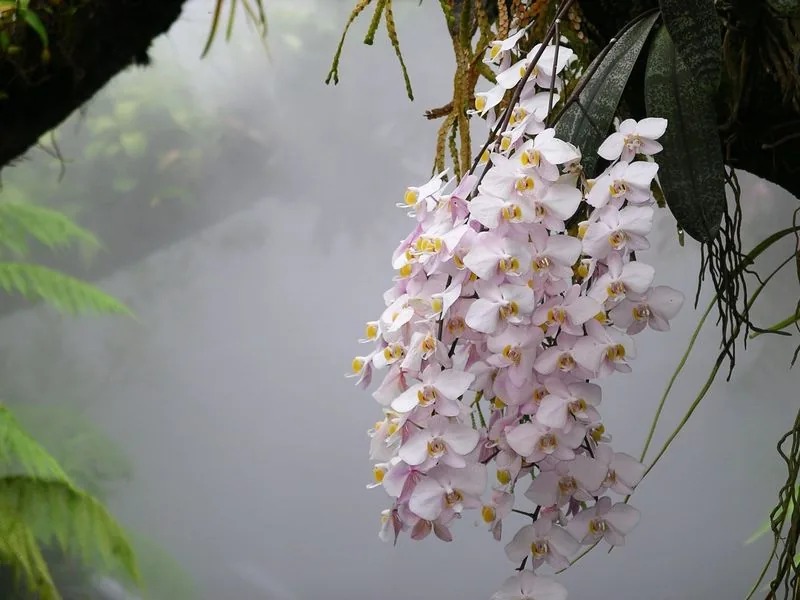
The flowers are what really sell it. A grown plant sends up an arching spike of flat, rounded blooms that hang on for weeks and sometimes months, in white, pink, or speckled patterns. And the plant itself stays small and slow, just a low rosette of broad, leathery leaves, so it slots onto a bright shelf or a kitchen counter without taking the place over.
The best part? It's forgiving if you're new to this. Get the light right, water it well and then let it dry, and a moth orchid won't ask for much else. Nearly every problem people hit traces back to one habit, keeping the roots too wet, and the rest of this guide will help you dodge it.
Care
The short version: bright indirect light, a good soak only once the bark mix gets close to dry, a coarse bark-based pot that drains fast, and warm, humid air. Feed it weakly through the year and it'll rebloom for you.
Light
Give it bright indirect light, the sort you get at an east window or a few feet back from a brighter one. It'll get by in medium light or light shade, but direct midday sun scorches the leaves, so keep it out of that hot beam.
Water
Soak the bark thoroughly until water runs from the drainage holes, then wait until the mix gets close to dry before watering again, usually every 7 to 14 days. Don't leave the pot standing in water, and tip out anything that pools in the crown at the center, because a wet crown rots.
Soil
Pot it in a coarse, bark-based orchid mix, not regular potting soil. Fir bark, sometimes with a bit of sphagnum or charcoal mixed in, gives the roots the air and fast drainage they want, at a slightly acidic pH of 5.5 to 6.5.
Temperature
Normal room warmth suits it just fine, ideally 64°F to 82°F (18°C to 28°C). A little dip at night can actually help kick off a new flower spike, but keep it away from cold drafts and hot vents.
Humidity
It's a humidity lover, happiest around 50% to 70%. Indoor air usually runs drier than that, so group it with other plants or set the pot on a tray of damp pebbles, and keep the air gently moving to head off rot.
Feeding
Feed it every two weeks with a balanced water-soluble fertilizer cut to about a quarter or half strength, the old 'weakly, weekly' trick. Keep it up all year, just easing off a bit in the darker months when growth slows down.
Pruning
Snip off each flower as it fades. Once a whole spike is done, cut a still-green one just above a lower node to try for a second bloom, or take it off at the base once it's brown and woody. Trim away any dead or rotted roots at repotting with sterile tools.
Repotting
Repot it every 1 to 2 years, ideally right after flowering, once the bark has broken down to a fine, soggy texture or the roots are spilling over the rim. Fresh, coarse mix brings back the drainage the roots count on.
Size & spacing
It stays compact, reaching about 12 to 35 inches (30 to 90 cm) tall in bloom and spreading 12 to 24 inches (30 to 60 cm) across. Give it a little elbow room from other plants so air can move freely around the leaves.
Troubleshooting
Most moth orchid trouble starts down in the roots where you can't see it, and it only shows up later as limp leaves or dropped buds. So whenever something looks off, check the roots first. Find the matching symptom below, then act before a soggy pot turns into a lost plant.
Mushy brown roots and a plant that wiggles in its pot
That's root rot, and here's the surprise: it's almost always about a soggy, worn-out mix, not about giving too little water. Slip the plant out and take a look, because firm green or silvery roots are fine, while the brown, hollow ones that squish when you pinch them have to go. Trim those with sterile scissors, repot into fresh dry bark, and back off on how often you water from now on.
Fix:
- Unpot and trim away all soft, brown rotted roots with sterilized scissors
- Repot into fresh, coarse, dry bark mix in a pot with drainage
- Reduce watering frequency and let the medium approach dryness between waterings
- Increase humidity and air movement to support remaining healthy roots
A bottom leaf going yellow all over, then dropping off
One old leaf at the bottom turning yellow while the plant stays firm and rooted? That's just natural aging, and it's nothing to lose sleep over. The thing to watch for is several leaves yellowing together while the roots feel soft, since that sends you back to the roots. Check those first, then move the plant somewhere out of harsh sun and away from cold drafts.
Fix:
- Confirm whether root health is the cause by checking the roots
- Adjust watering and repot if roots are rotting
- Move the plant out of harsh direct sun and away from cold drafts or heat sources
- Remove fully yellowed leaves once they detach easily
Buds going yellow and dropping before they open
This one's called bud blast, and it usually shows up right after some sudden change the plant didn't care for, like a move, a draft, or a temperature swing. Dry air can do it, and so can a bowl of ripening fruit sitting nearby, because the ethylene that fruit gives off makes buds drop. So leave a budding orchid right where it is, keep its watering and humidity even, and the rest of the spike should open just fine.
Fix:
- Keep the plant in a stable spot while in bud, away from drafts and heat vents
- Maintain consistent humidity and watering
- Keep the plant away from ripening fruit and other ethylene sources
Limp, leathery, wrinkled leaves even when you keep watering
When the leaves go soft and creased no matter how much you water, the culprit is nearly always that the roots can't drink. Rot's left them unable to pull up moisture, so watering more just makes it worse. So check the roots: trim and repot if they've rotted, but if they're sound and the bark is bone dry, just go back to a thorough, well-spaced soak and nudge the humidity up.
Fix:
- Inspect and correct root health, repotting and trimming rot as needed
- If roots are sound but dry, resume thorough but properly spaced watering
- Raise humidity to reduce moisture loss from the leaves
Toxicity
Good news if you've got pets or kids at home: the moth orchid is totally safe. The ASPCA lists it as non-toxic to cats and dogs, and there's nothing in the leaves or flowers that'll poison horses, rabbits, livestock, or birds either. Sure, a chewed petal might cause a little stomach upset from the roughage, but there's no actual toxin to worry about.
Safe for
People · Cats · Dogs · Horses · Rabbits · Livestock · Birds
Cats None
The cat's fine here. The ASPCA calls the moth orchid non-toxic, so a curious nibble won't poison her.
Dogs None
Dogs are good too. If a pup gnaws a leaf or flower it might get a slightly upset stomach from the roughage, but the plant itself isn't poisonous.
Horses None
Nothing here is going to hurt a horse. There's no toxin in the plant, though honestly it's a houseplant they'll almost never bump into.
Rabbits None
Rabbits are in the clear. There's nothing toxic in the leaves or flowers, so a random bite won't do any harm.
Livestock None
No worries for livestock either. The plant doesn't hold any toxins that could bother cattle, goats, or sheep.
Birds None
Pet birds can hang out in the same room, no problem. There's nothing poisonous in the leaves or the blooms.
People None
It's harmless for people, kids included. Nobody's growing it to eat, but a chewed petal or leaf won't cause poisoning.
Generally safe around pets and children; as with any plant, discourage chewing to avoid mild stomach upset and keep the bark medium from being eaten.
Varieties
Most moth orchids you'll find are unnamed hybrids, but there are a few clear groups worth knowing before you buy one.
Standard large-flowered hybrids
These are the everyday grocery-store moth orchids, and they carry a few big, flat, rounded blooms in white, pink, or patterned shades along arching spikes.
Miniature / multiflora Phalaenopsis
These little guys trade size for numbers, so you get lots of smaller flowers on branched spikes that tuck neatly onto a crowded windowsill.
Phalaenopsis amabilis
It's a white-flowered wild species, and it's a key parent behind a whole lot of the hybrids you'll find today.
How to propagate
Moth orchids are slow to multiply at home, and neither way is quick, but both can work if you've got some patience and a clean blade.
Offsets & pupsModerate
When a keiki (plantlet) on a flower spike or at the base has developed several leaves and roots a few centimeters long, usually in spring or summer · Several months to a year or more before it grows into a flowering-size plant
Every now and then a moth orchid surprises you with a baby plant, called a keiki, up on the flower spike or down by the base. Just wait until it's got 2 to 3 leaves and roots about 3 to 5 cm long, then snip it off with sterile tools and pot it into bark mix. After that you'll need to be patient, since it takes several months to a year or more to reach flowering size.
DivisionModerate
At repotting time, for large mature plants that have formed multiple growths · Several months to re-establish and resume strong growth
If a big clumped plant has thrown up more than one growth, you can sometimes split it at repotting time, keeping healthy roots on each piece. That said, most moth orchids grow as a single stem, so this hardly ever comes up at home. Each division then needs several months to settle in and get growing strongly again.
Myths
The best way to water a moth orchid is to drop a few ice cubes on the bark.
Here's the thing: these are tropical plants, and a couple of ice cubes leave the bark unevenly damp and never really soaked. Water it thoroughly with room-temperature water until it drains through, then let the mix get close to dry before its next drink.
Once a moth orchid finishes flowering you should always cut the spike off at the base.
If a spike is still green and healthy, you can often cut it just above a lower node and coax out a second round of flowers. Only cut a spike off at the base once it's turned brown and woody.
Moth orchids must be grown in regular potting soil like other houseplants.
Their roots want air and quick drainage, and that's exactly why they live in coarse bark-based orchid mix. Dense potting soil holds too much water and rots the roots.