Vegetable · Cucurbitaceae
Zucchini
Cucurbita pepo
Hand it full sun, warm soil, and a steady drink, and honestly, a plant or two will keep your kitchen swimming in squash all summer.
Full sun
Every 3–7 days
50–95°F · 10–35°C
45–60 days
Overview
So what is zucchini? It's a summer squash, which just means you pick the fruit young and tender instead of stashing it away for winter. It's part of the gourd family, it started out in Mexico, and the slim green version you probably picture got its shape from growers in Italy. Think of it as a warm season annual: it grows fast, sprawls out, and once the soil warms up it barely asks for anything.
Here's the fun part, zucchini gives back a lot. One happy plant can hand you fruit every day or two in high summer, so two of them will usually keep a whole household fed and then some. Each plant grows both male and female flowers, and it's the bees that shuttle pollen from one to the other, so you only get fruit when they're out and about. Seeing early flowers fizzle? That's normal, so don't sweat it.
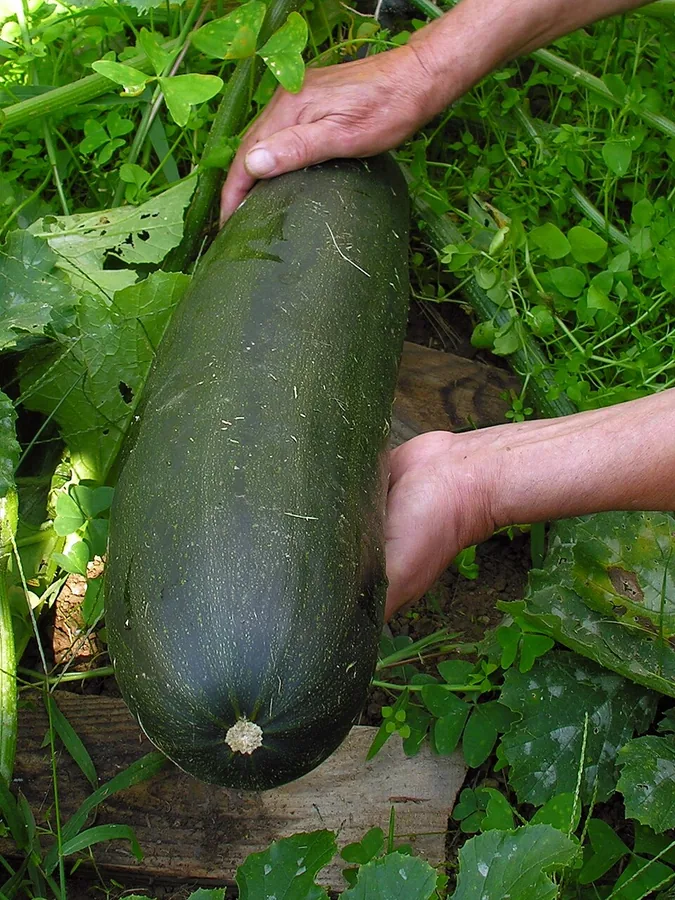
It's a genuinely easy crop, and here's why. Warm soil, plenty of sun, and even watering take care of most of what it wants, so your real jobs are just picking often and keeping half an eye out for a few pests. Forget to harvest, though, and the fruit turns into woody, seedy clubs while the plant quietly gives up. Miss a couple and it's no big deal, since it bounces back fast.
Care
The short version: pop it in full sun once the soil's warm, water deep at the base with about 1 inch (2.5 cm) a week, leave each plant room to breathe, and keep picking the fruit while it's young.
Light
Zucchini wants full sun, ideally 8 or more hours a day. Give it less and you'll get soft, floppy growth instead of fruit, and shaded plants pick up powdery mildew a lot quicker, so grab the brightest spot you've got.
Water
Aim for about 1 inch (2.5 cm) of water a week, a bit more when it's hot, and pour it right at the base instead of over the leaves. Keeping things evenly moist while it flowers and fruits is how you dodge blossom-end rot, and dry leaves mean less mildew, so low and slow is the way.
Soil
Plant it in rich, moisture-holding loam that still drains well, with a good scoop of compost mixed in. A pH of 6.0 to 6.8 is the sweet spot, and if your ground stays soggy, a raised bed sorts that out nicely.
Temperature
This one's a heat lover, happy across roughly 50°F to 95°F (10°C to 35°C). Don't rush it into cold ground, though, because the soil needs to hit at least 70°F (21°C) before a seed will budge, and one frost is enough to finish the plant off.
Humidity
There's no humidity number to fuss over, ordinary outdoor air is fine. What actually matters is airflow, since crowded, damp leaves are basically an invitation for powdery mildew.
Feeding
Mix some balanced fertilizer or compost into the bed at planting, then side-dress with nitrogen once the first fruits set. Just go easy on the nitrogen, or you'll end up with a mountain of leaves and hardly any squash.
Pruning
No routine pruning needed here, which is nice. Just pull off any dead or mildew-spotted leaves so air keeps moving, and pick the fruit every 1 to 2 days at 6 to 8 inches (15 to 20 cm) to keep it cranking out more.
Size & spacing
Plants get about 18 to 35 inches (45 to 90 cm) tall and spread out a fair bit, so give each one 2 to 4 feet (60 to 120 cm) of space. All that room keeps the air moving and mildew in check.
When to plant
Zucchini loves heat and can't handle frost, so there's no point rushing. Wait for the cold to clear and the soil to warm up, then sow straight into the ground in late spring. From early summer until frost, you'll be pulling fruit off the plant.
Northern hemisphere
Southern hemisphere
Typical months for a temperate climate: start earlier in warm zones, later where spring frosts linger.
- Sow: 2-4 weeks before last frost in individual pots (optional; direct sowing is usually preferred because cucurbit roots resent disturbance)
- Plant: After last frost once soil reaches at least 21°C (70°F) at 5 cm depth, typically late spring
- Harvest: Flowers and fruits early summer until frost; begin harvest about 45-60 days after sowing, picking fruit at 15-20 cm (6-8 in) while glossy
Hardiness
USDA hardiness zones: 3–10
Temperature: down to -40°C
Troubleshooting
Most zucchini hiccups show up in one of three spots: the leaves, the stems, or the little fruits. The trick is catching those early signs, because that's when a small issue is still easy to fix. Find the symptom that looks like yours below, then jump on it.
Wilting overnight even though the soil's wet
If a plant flops while the ground's still damp, it's usually the squash vine borer, a grub tunneling inside the main stem, though bacterial wilt from cucumber beetles can do the exact same thing. Check near the base for a hole stuffed with damp, sawdust-like frass. Slit the stem, dig the borer out, then mound moist soil over the wound so the plant can root again above the damage.
Fix:
- Slit the stem, remove the borer, and mound moist soil over the wound to encourage rooting
- Destroy collapsed plants to kill larvae before they pupate in soil
White dust showing up on the leaves
That white stuff is powdery mildew, a fungus that loves crowded, shady plants. It usually starts on the older leaves and keeps spreading until they go yellow and crispy. Pull the worst leaves, open things up so air can move, and water down at the base to keep the leaves dry, and you'll get ahead of it.
Fix:
- Remove heavily infected leaves
- Improve airflow by spacing or thinning plants
- Apply a fungicide labeled for powdery mildew on cucurbits if infection is severe
A sunken brown spot on the fruit's end
That dark, sunken end is blossom-end rot, and it's really about uneven watering, not a lack of calcium in the soil. When the plant dries out and then gets flooded, it can't move calcium into the growing fruit. Cut off the marked fruit, water deep on a steady schedule, and mulch to keep the moisture even.
Fix:
- Remove affected fruit
- Water deeply and evenly
- Mulch to stabilize soil moisture
Speckled, browning leaves with bugs down low
Yellow speckling that browns and crisps usually means squash bugs sucking the sap, and the striped or spotted cucumber beetles hanging around spread disease on top of their munching. Flip a few leaves and look for shiny bronze egg clusters and gray nymphs. Hand-pick the adults, squash the eggs, and lay a board out overnight to catch the bugs hiding under it by morning.
Fix:
- Hand-pick adults and crush egg clusters
- Trap squash bugs under boards overnight and destroy them in the morning
- Use insecticides labeled for cucurbits only as a last resort and never on open flowers
Baby fruits going yellow and dropping
When little fruits stall a few days after flowering and rot from the tip on a healthy-looking plant, it's down to poor pollination. Maybe the bees are scarce, maybe rain's keeping them in, or maybe the early flowers are all male. Hand-pollinate in the morning by brushing pollen from a male flower into a female one, and skip the insecticides while the flowers are open.
Fix:
- Hand-pollinate by transferring pollen from male to female flowers in the morning
- Avoid spraying insecticides when flowers are open
Toxicity
Good news, zucchini is one of the safe ones. The ASPCA calls it non-toxic to cats, dogs, and horses, and of course people eat it all the time. The only things to keep an eye on are a fruit that tastes really bitter, which you should just toss, and those prickly leaves that can scratch your arms at harvest.
Safe for
People · Cats · Dogs · Horses · Rabbits · Livestock · Birds
Cats None
The ASPCA says zucchini is safe for cats, so a nibble of the plant or fruit won't poison yours. If a cat pigs out on any new food it might get a little tummy upset, but there's nothing toxic going on.
Dogs None
Zucchini's fine for dogs, and plain cooked or raw bits make a nice low-calorie treat. Just skip the butter, salt, and seasonings, because those bother a dog way more than the squash ever would.
Horses None
Horses can eat zucchini no problem, just like the ASPCA says. Cut it into small pieces so a greedy one doesn't try to gulp a whole fruit and choke.
Rabbits Safe
Rabbits can have zucchini, leaves and all, as an occasional fresh treat next to their hay. Start with a little, since a sudden pile of any watery veg can upset their stomach.
Livestock Safe
Goats, sheep, pigs, and cattle all handle zucchini and its vines just fine, and it's a handy way to use up a glut. Just bring new feed in slowly so their guts can keep up.
Birds Safe
Chickens and pet birds love zucchini flesh and seeds, and there's no toxic risk. Offer it as part of a mixed diet rather than the whole meal.
People Safe
Zucchini's a kitchen staple you can eat raw or cooked, and it's safe for the whole family. The one rare catch is a fruit that tastes really bitter, which is high in cucurbitacins and should go in the bin, plus those prickly leaves and stems can scratch you at harvest.
Leaves and stems bear stiff prickly hairs that can irritate bare skin; wear long sleeves and gloves when harvesting. Discard any fruit that tastes strongly bitter (rare high-cucurbitacin fruit can cause stomach upset in people).
Varieties
Don't worry about endless choices here, zucchini keeps it simple with a handful of solid types. You've got everything from the old open-pollinated favorite to round ones and spineless ones. These are the names worth knowing.
Black Beauty
It's the trusty open-pollinated classic, with glossy dark green fruit and a long history of not letting home gardeners down.
Eight Ball
This award-winner makes round, baseball-sized dark green fruit on compact plants, and it's perfect for stuffing.
Spineless Beauty
It's bred with nearly smooth stems and leaf stalks, so you can pick it without getting scratched up.
Senator
A hard-working hybrid with straight, medium-green fruit that just keeps the basket full.
Elite
An early hybrid with an open, airy shape that makes the glossy medium-green fruit easy to spot and grab.
Companions
Zucchini's best-known companions come from the traditional Three Sisters planting, where corn and beans each pull their weight beside the sprawling squash.
Plant near
Corn: In the traditional Three Sisters planting described by Illinois Extension, sprawling squash acts as a living mulch beneath corn, suppressing weeds and conserving soil moisture
Beans: Beans fix nitrogen in the Three Sisters system, contributing fertility that heavy-feeding squash uses
How to propagate
Zucchini almost always comes from seed, and the seedlings really don't like their roots messed with. So more than any fancy trick, it's where and when you sow that makes the difference.
SeedEasy
Direct sow a half-inch (1.3 cm) deep after last frost once soil is at least 21°C (70°F); indoor starts only 2-4 weeks before transplanting · Germinates in about 5-10 days in warm soil; first harvest roughly 45-60 days from sowing
Just sow the seed straight into warm ground, about half an inch (1.3 cm) deep, once the last frost's gone and the soil's holding at least 70°F (21°C). Direct sowing beats transplanting because cucurbit roots hate being disturbed, so if you really want a head start, use individual pots only 2 to 4 weeks ahead and be gentle with the root ball. It'll sprout in 5 to 10 days in warm soil, and you'll be cutting your first fruit about 45 to 60 days from sowing. Each plant has separate male and female flowers, so it's counting on bees to set fruit.
Myths
Zucchini will poison cats and dogs.
Nope, the ASPCA lists zucchini squash as non-toxic to cats, dogs, and horses, so a nosy pet nibbling the fruit or plant is totally fine. The only real risk is a people problem, and it's rare: a fruit that tastes sharply bitter is loaded with cucurbitacins and can upset your stomach for a bit, so just chuck any bitter fruit.
Bigger zucchini are better.
Actually, the flavor and texture are best while the fruit's still young. Extension growers pick at around 6 to 8 inches (15 to 20 cm) while the skin's still shiny, and here's the kicker, picking often is what keeps the plant making more. Let one blow up into a baseball bat and the whole thing slows down.
The Three Sisters planting is proven to boost squash yields.
The corn, bean, and squash combo has loads of history and cultural meaning, but that's a different thing from yield. Illinois Extension points out there's little published evidence it actually beats regular spacing for productivity or soil health.