
Introduction
Plant experts at the University of Georgia have a nickname for the abelia shrub. They call it the gas station plant. You could drop it in the asphalt by the pumps and walk away. It would still grow and thrive. The plant shrugs off heat and runs on little water once its roots take hold. Deer leave it alone too. That mix of drought tolerant and deer resistant has made it a top pick for low-water, wildlife-friendly yards.
The plant most people mean is glossy abelia, or Abelia x grandiflora. It is a semi-evergreen shrub in the honeysuckle family. Growers made it back in 1886. They bred one plant, the Abelia chinensis, with a second plant. That second plant was the Abelia uniflora. So you get a real flowering shrub with deep roots in plant history. This is no flashy new release that fades in a season.
Most quick care tips on this plant stop at two words. Low-maintenance. Deer-resistant. Both true, and both worth knowing. This guide frames the rest of the market gap for you. You get real plant facts and winter behavior zone by zone. You get a variety picker that matches the right type to your job. And you get a fix for the day your shrub will not bloom.
Here is a preview of the value you will learn. You will see how big abelia gets, about 3 to 6 feet (0.9 to 1.8 m) tall. You will learn which zones it lives through, 5 or 6 to 9 based on the type and the source. And you will learn to prune it so flowers keep coming from late spring through frost. Let's start with the facts you need at a glance.
Abelia Shrub At A Glance
Before you dig a single hole, you want the core facts in one place. The abelia shrub you'll find at most plant shops is glossy abelia, and the tag on the pot will read Abelia x grandiflora. Most plants grow 3 to 6 feet (0.9 to 1.8 m) tall and wide. Dwarf types stay near 2.5 feet, while old plants in warm zones can hit 8 feet (2.4 m).
It thrives in USDA Zones 5 or 6 to 9. The zone floor shifts between 5 and 6 based on the cultivar and which expert you ask. The plant grows at a medium pace. It blooms from late spring straight through frost. That long bloom comes from one key trait. It flowers on new wood, so each season's fresh shoots carry the show.
This plant is a garden hybrid, not a wild species. To make it, growers took two wild kinds and bred them, and those two are Abelia chinensis and Abelia uniflora. That cross is thought to have shown up first in Italy. It came on the market in 1886. The name honors Dr. Clarke Abel, a British doctor and plant collector. In 2013, botanists moved the genus into the honeysuckle family. You may see that family written as Caprifoliaceae.
Here's one naming note worth knowing before you shop. Many experts now list the Latin name as Linnaea x grandiflora. The U.S. Fish and Wildlife Service still files it as Abelia x grandiflora. You'll see both on plant tags and in catalogs. Don't let the mismatch throw you. They point to the same semi-evergreen shrub.
The best part of abelia is how little it asks back. Carol Robacker breeds plants for a living. She works at the University of Georgia. She sums up just how tough it is in words that anyone can picture.
Around here, we call abelia the gas station plant. You could plant it beside a gas station surrounded by asphalt and forget about it, and it would still survive and thrive.
Abelia Varieties To Grow
My back corner stayed dull and dark for years. That is the damp spot where my lawn meets the woods. About six years ago I dropped in a one-gallon Kaleidoscope abelia. By its third summer it had grown into a glowing low mound. Plain green shrubs had sat there before and did nothing for it. Now the bright variegated abelia holds that corner all on its own. It does the job even when the plant has no flowers at all.
You have plenty of room to choose among abelia varieties. NC State Extension lists 16 of the more than 30 cultivars sold today. So your choice is about more than flower color. Size matters just as much here. Dwarf abelia types like Little Richard stay near 2 to 3 feet (0.6 to 0.9 m). Standard glossy abelia can reach 3 to 6 feet (0.9 to 1.8 m).
Pick by what you want the plant to do. For year-round color, reach for variegated types like Kaleidoscope or Confetti. For tidy edges and low hedges, Rose Creek abelia holds a neat shape with little work. For richer flowers, Edward Goucher brings warm lilac-pink blooms that white abelias can't match. For a fragrant medium hedge, Canyon Creek mixes scented blooms with shifting leaf tones.

Kaleidoscope Abelia
- Best for: Color all season, in beds, borders, and large containers where the foliage does the work between bloom flushes.
- Foliage: Variegated leaves shift from yellow-green in spring to gold in summer and fiery red-orange in cooler weather.
- Size: A low, spreading mound around 2 to 3 feet (0.6 to 0.9 m) tall and a bit wider, easy to keep tidy.
- Flowers: Small white tubular blooms appear from late spring through frost and draw in pollinators.
- Light: Grows in full sun to part shade, but full sun brings out the brightest leaf color.
- Why grow it: The shifting foliage gives you year-round interest even when the plant is not in bloom.
Rose Creek Abelia
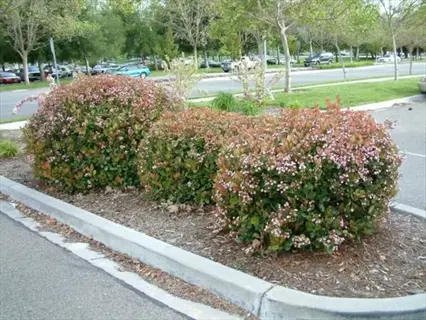
- Best for: Tidy mass plantings, low hedges, and foundation beds where a compact, uniform habit matters.
- Foliage: Glossy dark green leaves carry pink and bronze tints, deepening through the cooler months.
- Size: A dense, mounding shrub about 2 to 3 feet (0.6 to 0.9 m) tall and 3 to 4 feet (0.9 to 1.2 m) wide.
- Flowers: Clusters of small white flowers with rosy calyces that persist and add color after petals drop.
- Origin: One of the cultivars bred at the University of Georgia abelia breeding program.
- Why grow it: Its neat shape needs little pruning, making it a reliable choice for low-effort plantings.
Edward Goucher Abelia
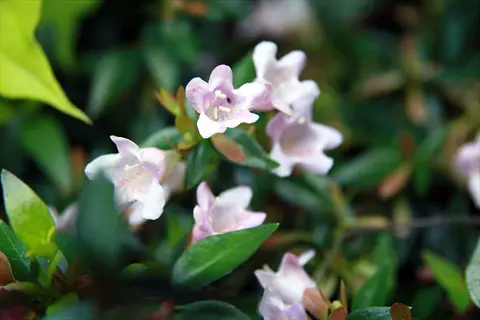
- Best for: Gardeners who want richer flower color than the white-flowered species offers.
- Foliage: Glossy green leaves take on bronze-purple tones in fall for added seasonal interest.
- Size: A graceful, arching shrub reaching about 3 to 5 feet (0.9 to 1.5 m) tall and wide.
- Flowers: Showy lilac-pink, funnel-shaped blooms appear over a long season and attract butterflies.
- History: An older hybrid valued for decades for its dependable color and pollinator appeal.
- Why grow it: Its warm pink flowers stand out among the many white-blooming abelia selections.
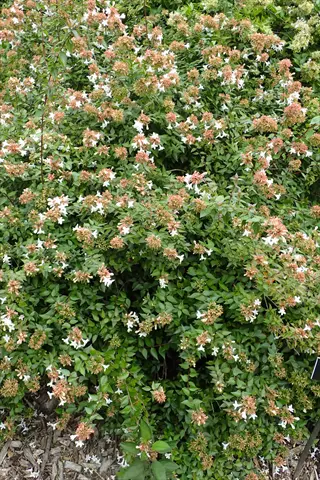
Little Richard Abelia
- Best for: Small spaces, containers, and the front of a border where a compact form is needed.
- Foliage: Dense, glossy green leaves that turn orange to burgundy as the weather cools.
- Size: A tidy dwarf, generally 2 to 3 feet (0.6 to 0.9 m) tall and wide with very full branching.
- Flowers: Abundant small white fragrant blooms from late spring well into fall.
- Habit: Rounded and compact by nature, so it seldom needs shaping to look neat.
- Why grow it: A heavy bloomer that fits where larger abelia would quickly outgrow the space.

Canyon Creek Abelia
- Best for: Medium hedges and mixed borders where changing foliage color is a feature.
- Foliage: New growth emerges coppery to gold, maturing to green, with rosy fall tints.
- Size: An upright, arching shrub around 3 to 5 feet (0.9 to 1.5 m) tall and wide.
- Flowers: Fragrant pale pink to white tubular blooms over a long midsummer-to-fall season.
- Origin: Another selection from the University of Georgia breeding work.
- Why grow it: It blends warm-toned new growth with a long bloom season for layered interest.

Confetti Abelia
- Best for: Edging, low borders, and containers where bright variegation is wanted.
- Foliage: Small green leaves edged in creamy white, picking up pink and red tones in cold weather.
- Size: A low, spreading dwarf about 2 to 3 feet (0.6 to 0.9 m) tall and a bit wider.
- Flowers: Light pink to white flowers appear over a long season among the bright leaves.
- Habit: Mounding and dense, useful as a colorful, semi-evergreen groundcover-style shrub.
- Why grow it: The crisp white-edged foliage brightens shaded edges and softens hard borders.
Several of these plants trace back to one spot. Rose Creek abelia and Canyon Creek both came from the abelia breeding work at the University of Georgia. New plants keep arriving too. Sunny Anniversary came out in 2014 and pushed the color range toward warm apricot and gold.
One last name sits apart from the rest of them. People call it the Korean abelia, or Abelia mosanensis in the books. It is its own species and not a glossy abelia cultivar. It is very fragrant and takes more cold. So it fits you well if you garden in a colder spot but still want that sweet abelia scent.
Growing Conditions And Hardiness
Most guides give you one line on abelia hardiness zones and move on. That line usually reads USDA Zones 6-9, which is what NC State Extension lists. But Illinois Extension and LSU AgCenter both stretch the range down to Zone 5, so the real answer depends on where you live and which winter you get.
Here is the part that line skips. Cold hardiness reaches down to about 0°F (-18°C), and in the coldest zones the plant does not just shrug off winter. In Zones 5 to 6 it can die back to the ground, then push fresh growth from the base each spring. The table below breaks down what your shrub will actually do, zone by zone.
Cold protection is simple work. In Zones 6 and below, spread a thick layer of mulch over the root zone in fall and pick a spot with some shelter from harsh wind. The mulch guards the crown through hard freezes, so even a shrub that dies back will bounce right back from the roots when spring warms up.
Sun drives the rest of the show. Abelia grows in full sun to partial shade, but treat full sun as the flower switch and shade as a dimmer. More sun means more blooms and stronger foliage color, while a shady spot gives you a leggy plant with fewer flowers. Give it 6 or more hours of direct light if you want the best display.
Soil seals the deal. Abelia wants well-drained acidic soil in the range of pH 5.5 to 6.5, and good drainage matters most. Soggy, poorly drained ground invites root drowning and edema, so skip low spots that stay wet. One more note for coastal gardeners: this shrub does not handle salty soil, so keep it back from the spray and the salted path.
Although height ranges from 3-6 feet, the taller heights are usually attained only where the plant is fully winter hardy, zone 6 and warmer.
Planting And Year-Round Care
Good abelia care starts the day you put the plant in the ground. Get the spot and the soil right, and this shrub mostly takes care of itself for years. The steps below walk you through planting from start to finish.
Pick a site with full sun to part shade and soil that drains well. More sun means more flowers, so don't tuck this plant into a dark corner if you want heavy bloom. The five steps that follow set your shrub up for a strong first season.
Choose a site with full sun to part shade and well-drained, slightly acidic soil, giving each plant room for its mature 3 to 6 foot (0.9 to 1.8 m) spread.
Dig a hole as deep as the root ball and twice as wide, loosening the surrounding soil so new roots can spread easily.
Place the root ball so its top sits level with the surrounding soil, then backfill and firm gently to remove air pockets.
Soak the area thoroughly after planting so the roots settle into even moisture, then keep soil damp during the first season.
Spread 2 to 3 inches (5 to 8 cm) of mulch around the base, keeping it off the stems, to hold moisture and suppress weeds.
The yellow, sad leaves showed up on the older Rose Creek abelia by the front step. A week of heavy spring rain had kept the bed soggy. The roots sat in water with nowhere to drain. I dug a shallow channel to carry the runoff away and cut the watering back to almost nothing. Within a month the plant pushed fresh green growth and bounced right back.
That sums up watering abelia in one rule. Once it settles in, water deep but not often, and let the top inch of soil dry between drinks. A mature abelia shrugs off a dry spell, but wet feet will turn the leaves yellow fast. Mulch holds the moisture you do give it and keeps weeds down at the same time.
You don't need to feed this plant much. Abelia needs no fertilizer to thrive, though a thin layer of compost in spring gives it a gentle boost. Skip the heavy feeding. Too much nitrogen pushes leafy growth at the cost of flowers, which is the opposite of what you want.
Timing makes or breaks your pruning abelia plan. The plant blooms on new wood. So the best time for when to prune abelia is late winter or early spring, around late February, before new growth wakes up. Cut it then and you shape the shrub without losing a single flower. One type breaks this rule, the fragrant Abelia mosanensis. It blooms on old wood, so prune it right after it flowers.
Do not prune abelia in fall or summer. Because it blooms on new wood, cut it back only in late winter or early spring, or you will trim off the coming season of flowers.
Not flowering at all? Two things cause it almost every time. You either pruned at the wrong time and cut off the buds, or the plant sits in too much shade. Move it to brighter light or fix your pruning calendar and the blooms come back.
When an old abelia turns leggy and bare at the base, give it a hard reset. Rejuvenation pruning means cutting one third to one half of the oldest canes right down to the ground in late winter. New shoots fill in the gaps and the whole shrub looks young again within a season or two.
Flowers, Foliage And Wildlife
Most flowering shrubs give you a show for two weeks and then go quiet for the rest of the year. Abelia works the other way. The abelia flowers open in clusters of small white-to-pink blooms, and you keep getting fresh ones for months instead of weeks. You get a long stretch of bloom from one easy plant in your yard.
Picture your shrub humming with bumblebees from May until the first frost. The blooms are shaped like little funnels or bells. Many types carry a light scent too, so your sunny border earns those fragrant flowers all summer. As petals drop, rosy calyces stay on the stems and color the bare wood deep into winter for you.
The long abelia bloom time comes down to one simple trait. Your shrub flowers on new growth. Fresh blooms keep coming all season as the plant pushes out new wood for you. That same honeysuckle family gives each flower a tube shape full of nectar. So abelia pollinators like bees, butterflies, and hummingbirds line up to feed in your garden.
Long Bloom Season
- Timing: Flowers open from late spring (around May) and keep coming until the first hard frost in fall.
- Flowers: Small funnel- or bell-shaped white-to-pink blooms appear in clusters at the branch tips.
- Fragrance: Many cultivars are lightly fragrant, adding scent to a sunny border over a long season.
- On new wood: Because blooms form on new growth, a healthy plant flowers steadily through summer and fall.
Foliage And Fall Color
- Glossy leaves: Small, glossy green leaves give the shrub a clean look through the growing season.
- Fall shift: Foliage turns reddish-purple to bronze as nights cool, extending the display past flowering.
- Variegated types: Cultivars like Kaleidoscope and Confetti add gold, cream, and red tones year-round.
- Winter color: Reddish calyces persist after petals drop, coloring the stems into winter.
Pollinator Magnet
- Bees: The nectar-rich tubular flowers draw bumblebees and other bees throughout the long bloom season.
- Butterflies: Abelia is a reliable nectar source that attracts butterflies to a sunny garden.
- Hummingbirds: Its honeysuckle-family blooms are shaped to suit feeding hummingbirds.
- Wildlife value: A single long-blooming shrub feeds pollinators when many other plants have finished.
Tough And Resistant
- Deer: Abelia is deer resistant, a useful trait in gardens where browsing is a problem.
- Drought: Once established it is highly drought tolerant and suits low-water landscapes.
- Pollution and erosion: It tolerates pollution and helps control erosion on banks and slopes.
- Disease: It resists Phytophthora root rot and is rarely troubled by serious pests.
The flowers steal the show, but you get plenty from the leaves too. Small, glossy green leaves keep your shrub looking clean all season. Then cool nights bring strong fall color as the green shifts to reddish-purple and bronze. Want color year-round? Pick a variegated type like Kaleidoscope or Confetti for gold, cream, and red tones. Your shrub stays worth a look long after the last bloom fades.
Abelia's are tough plants that bloom from May through frost. They are a great plant for hummingbirds, bees and butterflies. They are also quite drought tolerant once established.
Landscape Uses And Companions
One abelia plant can fill a lot of jobs in your yard. The same tough shrub works as a flowering abelia hedge, a neat foundation planting along the house, or a single specimen in a wide bed. It also holds soil on slopes and spills nicely over the edge of a raised wall.
"That thing will swallow your back path by July." My neighbor leaned over the fence to warn me. I had just tucked a Kaleidoscope abelia into the damp corner by the woods. It settled into a tidy low mound, about 3 feet (0.9 m) wide. It never once crept past its spot. The arching stems stayed in their clump, soft but neat, year after year.
That clumping habit is why abelia behaves in tight spaces. Dwarf types stay small enough for abelia for containers on your patio or by your front door. Taller types grow together into a soft, blooming screen. And because it is not invasive, you get a smart, well-behaved swap for the aggressive shrubs that take over your bed.
The trick to a full bed is spacing for the mature size. Abelia reaches 3 to 6 feet (0.9 to 1.8 m) wide, so leave room for it to fill in rather than crowd. The right companion plants make your abelia shine even brighter. Here are the pairings I reach for in your kind of bed again and again.
- Lavender: Pairs sun-loving, low-water lavender with abelia for fragrant purple spikes beside the long bloom season.
- Salvia: Adds salvia for upright color that draws the same bees, butterflies, and hummingbirds abelia feeds.
- Ornamental grasses: Uses ornamental grasses for movement and texture that soften abelia's arching form in a border.
- Boxwood: Plants evergreen boxwood nearby for tidy year-round structure when deciduous abelia drops its leaves.
- Nandina: Combines nandina for colorful foliage and berries that extend interest through the cooler months.
- Space plants for abelia's mature 3 to 6 foot (0.9 to 1.8 m) width so the bed fills without crowding.
For an informal flowering hedge, plant taller abelia types about 3 to 4 feet (0.9 to 1.2 m) apart so they grow together into a soft, blooming screen without heavy shearing.
Mix these partners for a planting that works all year. Pair abelia with low-water sun lovers like lavender and salvia for warm-season color. Then anchor your bed with evergreens for winter bones. In a mixed border, set abelia in the middle. Its arching stems link the bold plants up front to the taller ones behind.
5 Common Myths
Abelia is an annual or short-lived plant that you have to replant in the garden every single season.
Abelia is a long-lived perennial shrub. Even where winter kills the top growth, it regrows from the base and can thrive for many years.
You should prune abelia in fall or late summer to tidy it up before the cold winter weather arrives.
Abelia blooms on new wood, so prune in late winter or early spring. Fall pruning removes growth and can reduce the next season of flowers.
Abelia needs rich soil and regular fertilizer feeding to bloom well and stay healthy in the garden.
Abelia needs no fertilizer to thrive and prefers lean, well-drained, slightly acidic soil. A little spring compost is plenty for steady growth and blooms.
Abelia is a fragile, fussy shrub that struggles in tough spots and demands constant attention to survive.
Abelia is famously tough, handling heat, drought, pollution, and poor sites once established. A University of Georgia breeder nicknamed it the gas station plant.
Abelia must be evergreen everywhere, so if yours drops its leaves in winter the plant is dying.
Leaf drop is normal and zone-dependent. Abelia is evergreen in warm zones but deciduous in colder ones, and bare winter stems usually leaf out again in spring.
Conclusion
Few plants give you this much for so little work. The abelia shrub earned its reputation as a plant you can stick beside hot pavement and still count on, year after year. It shrugs off rough spots that would kill fussier shrubs and keeps right on blooming.
The facts that matter are simple. Most plants reach 3 to 6 feet (0.9 to 1.8 m) tall and wide, and they grow happily across USDA Zones 5 or 6 through 9. Give yours full sun to part shade and well-drained, slightly acidic soil. Because glossy abelia blooms on new wood, you prune once in late winter and then leave it alone.
Get those three things right and the payoff is huge. The right variety, the right spot, and one well-timed cut buy you months of flowers from late spring through frost, plus rich fall color on the foliage. Bees, butterflies, and hummingbirds work the blooms all season long. This low maintenance shrub doubles as a busy feeding station for wildlife.
That mix of toughness and beauty is why a long blooming shrub like this fits modern gardens so well. It sips water once established. That makes it a true drought tolerant shrub for low-water yards. It stays put too, instead of spreading where you do not want it. Picture your own garden next summer, full of pink-tinged flowers, humming with pollinators, then turning bronze and red as fall sets in. One small plant gets you there.
Glossary
- Abelia x grandiflora
- The scientific name for glossy abelia, a hybrid garden shrub in the honeysuckle family.
- Blooms on new wood
- Flowers form on growth produced in the current season, so pruning before that growth starts protects the coming flowers.
- Calyces
- The small leaf-like outer parts of a flower; on abelia they turn reddish and stay on the stems after the petals drop.
- Caprifoliaceae (honeysuckle family)
- The plant family that includes honeysuckles and abelia, known for tubular, nectar-rich flowers.
- Phytophthora root rot
- A common soil-borne disease that rots plant roots in wet conditions; abelia is resistant to it.
- Rejuvenation pruning
- Cutting an older, leggy shrub back hard, often removing a third to half of the oldest stems at the base, to spur fresh growth.
- Semi-evergreen
- A plant that keeps some or all of its leaves through mild winters but drops them in colder climates.
- semi-evergreen shrub
- A shrub that keeps some leaves through mild winters but drops them in colder zones.
External Sources
Frequently Asked Questions
How big does abelia get?
Most glossy abelia reach 3 to 6 feet (0.9 to 1.8 m) tall and wide. The range across types runs from about 2.5 to 8 feet (0.75 to 2.4 m), and dwarf varieties stay 2 to 3 feet (0.6 to 0.9 m).
Does abelia like sun or shade?
Abelia grows in full sun to partial shade. It blooms most heavily and shows the strongest foliage color in full sun, while too much shade reduces flowering.
Does abelia come back every year?
Yes. Abelia is a long-lived perennial shrub, not an annual. In cold zones it may die back to the ground in winter but it regrows from the base in spring.
Is abelia winter hardy?
Glossy abelia is hardy in USDA Zones 5 or 6 through 9, depending on the source and cultivar, and survives to about 0 degrees Fahrenheit (-18 degrees Celsius).
Does abelia lose its leaves in winter?
It depends on your climate. Abelia is evergreen to semi-evergreen in warm zones, usually deciduous around Zone 8, and may drop all leaves or die back in colder zones.
When and how do you cut back abelia?
Prune in late winter or early spring (around late February) before new growth starts, because abelia blooms on new wood. You can shape it lightly or cut old canes back hard to renew a leggy plant.
Is abelia low maintenance?
Yes. Abelia is one of the easiest flowering shrubs to grow. It is drought tolerant once established, deer resistant, rarely bothered by pests, and needs only one annual pruning.
What is the prettiest abelia variety?
Beauty is personal, but Kaleidoscope is loved for its color-shifting variegated foliage, Rose Creek for tidy pink-tinged growth, and Edward Goucher for rich lilac-pink flowers.
What grows well with abelia?
Abelia pairs beautifully with sun-loving, low-water plants such as lavender, salvia, and ornamental grasses, plus evergreen partners like boxwood and nandina for structure.
Is abelia invasive?
No. Glossy abelia is not considered invasive. It is even recommended by the Georgia Exotic Pest Plant Council as a non-invasive alternative to several invasive shrubs.