A leaf-and-stem piece from my golden pothos sat in a jar on the north-facing kitchen windowsill for a full month with zero roots. The stem stayed firm. The leaf stayed green. Nothing came out the bottom. I had snipped a bare strip with no node on it. So I pulled it out, re-cut a fresh piece that kept one node, and dropped it back in the same jar. It pushed white roots in about ten days. Same plant, same water, same window. The only thing that changed was the node.
Here is the short answer on cutting at the node. You cut just above a node on the parent plant, and you keep that node on the cutting itself. Those are two different cuts working together. The parent keeps the spot it regrows from, and your cutting carries the one part that can actually root. Knowing where to cut pothos comes down to that single rule. Get the node on your piece and the rest is easy. Miss it and you wait forever.
The reason is built into the plant. Roots only form at the node, not along the smooth stem between nodes. That node holds adventitious root tissue, the same tissue that makes the little aerial roots pothos puts out in the wild. A piece of stem with no node has no root tissue to draw on. So an internode-only strip or a lone leaf can sit in water for weeks and just stall. That is the trap I fell into with my first jar, and it has nothing to do with light or water quality. The stem section simply lacked the part that grows roots.
This is why the cut placement on the parent matters as much as the cut on your cutting. Penn State Extension points to trimming just above a node when you take material. Cut there and the parent regrows from that point instead of dying back along a bare stub. Your cutting, taken from the next section down, keeps its own node and the leaf attached to it. One snip serves both plants. I think of it as a shared cut: above the node feeds the parent, the node below feeds the new plant.
People often ask if they should cut below the node instead. You can, as long as the node stays on the cutting, not stranded on the parent. The risk with cutting low is leaving a long bare stub on the parent vine that browns and dies back. Trimming right above the next node up keeps that stub short and gives the parent a clean point to branch from. So the safe habit is the same either way: protect the node on the piece you want to root.
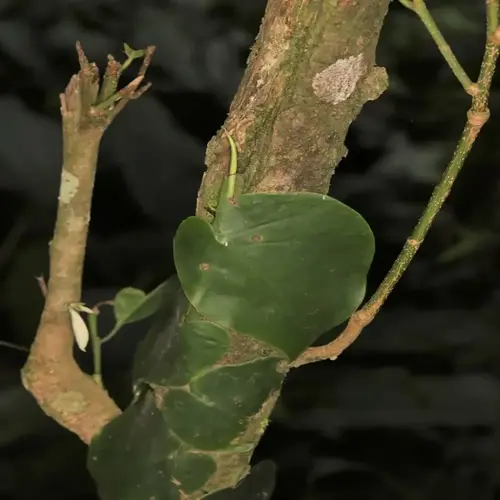
Finding the node is easier than it sounds once you know the marker. Look at the point where a leaf stem meets the main vine. Right there you will see a small brown nub, sometimes a stubby little bump, sitting against the stem. That nub is a pothos leaf node, and it is the same spot an aerial root would sprout from. If your piece has at least one of those nubs, it can root. If it has only smooth green stem and a leaf, it cannot.
So measure twice before the snip. Run your finger down the vine, find the brown nub, and cut about a quarter inch above it to free the parent's regrowth point. Then make sure the section in your hand still owns a node of its own. Get those two cuts right and the rest of the process takes care of itself. Skip the node and you get my jar of green nothing for a month.
Read the full article: Pothos Propagation: A Complete Guide