Introduction
One healthy pothos can turn into a dozen new plants for free, and you already own the only thing you need to start. Pothos propagation is the trick behind every full, trailing plant you have seen on a friend's shelf. The plant practically wants to root, so the real win is just making a few smart cuts and waiting.
Here is the timeline so you know what to expect. Extension growers say pothos cuttings root in about 3 to 4 weeks in water or vermiculite. You often spot the first white roots near the 2 week mark. That is fast for a houseplant. It is part of why pothos, the plant sold as Epipremnum aureum or devil's ivy, has been grown for cuttings in the US for almost 100 years.
The secret is the node. Think of the node as the engine of every cutting, the small bump where a leaf meets the stem. Leaves feed the plant, but only the node grows roots, so every cutting you take must carry at least one. I once tried a leafy stem with no node and watched it sit in water for a month with nothing to show. Pothos makes this easy because it grows tiny aerial roots at each node, ready to dig in the moment they hit water or soil.
Dropping a stem in a jar of water is where the typical advice ends. This guide goes further. You will learn where to find and cut the node. You will also see all four ways of propagating pothos, the best season to start, and how to move a water-rooted cutting into soil. We will cover why cuttings fail too. And there is a quick safety note, since every part of pothos holds calcium oxalate and can irritate kids and pets.
Pothos Propagation Methods
A row of jam jars sat on my north-facing kitchen windowsill, six of them in a tidy line. The first three held golden pothos cuttings and the back three held a Marble Queen I had trimmed the same afternoon. By the end of week two, the golden ones were pushing white roots into the water a touch faster than the Marble Queen. Same jars, same light, same day off the parent plant.
What that little experiment showed me has held up across every batch since. The variety nudges your speed a little, but the method you pick decides far more about how fast and how well a cutting roots. So before you cut anything, choose your route.
There are four solid pothos propagation methods, and each one earns its place. You can root stem cuttings in water, or propagate pothos in soil straight away, or use air layering, or split a crowded plant by root division. The good news is they all share the same starting unit.
Pick the one that fits your patience, your space, and how much you like watching roots appear. Water propagation lets you see every root form, while the other three trade that view for less fuss down the line.
Across every method, your standard cutting is a 1 to 1.5 inch (2.5 to 3.8 cm) stem piece with a node and one attached leaf. That same size works whether you choose water or soil, so you only have to learn the cut once.
Stem Cuttings in Water
- Method: Snip a 1 to 1.5 inch (2.5 to 3.8 cm) stem piece with a node and an attached leaf, then place the node in a jar of water.
- Why it works: The node carries undifferentiated cells and aerial root tissue, so roots emerge directly into the water within weeks.
- Timeline: First roots appear in about 2 weeks and full rooting takes roughly 3 to 4 weeks under warm, bright indirect light.
- Best for: Beginners who want to watch roots form before committing the cutting to a pot of soil.
Stem Cuttings in Soil or Perlite
- Method: Place the same node cutting directly into a moist, well draining mix such as soilless potting mix, perlite, or vermiculite.
- Why it works: Roots that form straight in soil skip the later shock of switching from water roots to soil roots.
- Timeline: Rooting still takes about 3 to 4 weeks, though you cannot see progress without gently tugging or waiting for new top growth.
- Best for: Growers who want one fewer transplant step and steadier, soil-adapted roots from the start.
Air Layering
- Method: Encourage roots to form on a node while it is still attached to the parent, then cut the rooted section free.
- Why it works: Pothos has aerial roots at every node, so a node left in contact with moist medium roots without being detached first.
- Timeline: The node roots over a few weeks while the parent keeps feeding it, lowering the risk of the cutting failing.
- Best for: Anyone wanting the most reliable method, especially on a longer vine with several usable nodes.
Root Division
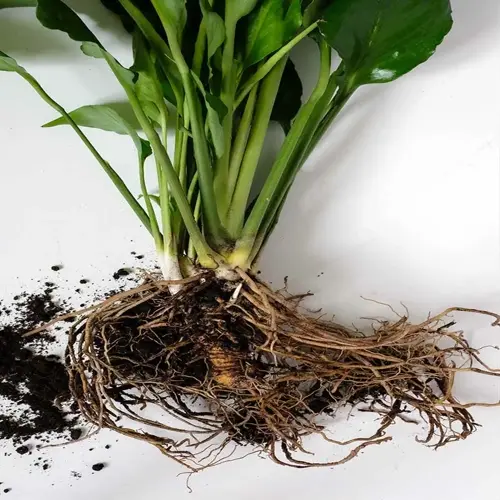
- Method: At annual repotting, separate a clump of the root mass with stems attached into two or more independent plants.
- Why it works: Each division already has established roots, so it skips the rooting stage other methods depend on entirely.
- Timeline: Divisions reestablish quickly because they keep working roots, though they may pause briefly after the move.
- Best for: Mature, crowded pothos that have outgrown their pot and would benefit from being split anyway.
Notice that every method starts at the same place: a node. Pothos grows aerial roots at every single node along its vine, and that one trait is why all four approaches work. The node already holds root-ready cells, so it does not much care whether you set it in water, soil, or sphagnum moss.
This is also why commercial growers can churn out pothos by the thousand. They use single-node cuttings, sometimes called wet sticks, and root them in trays at scale. The home methods above are the same trick, just done a few jars at a time instead of a few thousand.
Where to Cut and Find the Node
Every successful cutting comes down to one spot on the vine. That spot is the pothos node, the slightly swollen joint where a leaf stem meets the main stem. New roots grow from the node and nowhere else, so a leaf you snip off on its own will sit in water for weeks and never root.
Here is the simple botany. The node is the joint that holds a leaf, a bud, and tiny adventitious roots waiting to grow. The internode is the bare stretch of stem between two nodes, and it has no root cells, so a cut there gives you nothing to work with. Knowing where to cut pothos starts with telling these two parts apart.
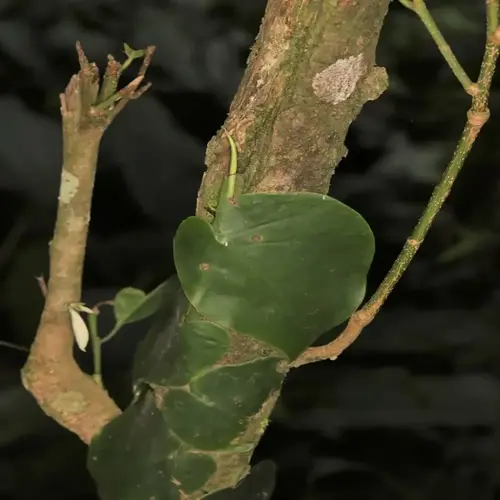
Finding the leaf node takes one trick. Run your finger along the vine until you hit the small brown bump where a leaf stem joins the stem. That bump is an aerial root nub, and it marks the node every time. Pothos climbs by pushing out brown aerial roots from these same nubs, so the structure that grips a wall is the structure that roots your cutting.
Run your finger along the vine to the small bump where a leaf stem joins the stem; that bump is the node and often shows a brown aerial root nub.
Pick a section with at least one node and one or two attached leaves, since the leaf fuels the cutting while the node grows roots.
Make a clean cut just above a node on the parent plant so it regrows from that point, leaving a short stub of about 2 inches (5 cm) if you are shortening a long vine.
Trim the cutting to 1 to 1.5 inches (2.5 to 3.8 cm) below the node so the node sits at the bottom, where it can root in water or soil.
Remove any leaf that would sit underwater or in soil so it does not rot, leaving the upper leaf intact to keep feeding the cutting.
Pothos has aerial roots at the node, so propagation through layering can also be successful (a method that this author accidentally discovered).
Penn State Extension puts the cut just above a node on the parent plant. Do that and the mother vine regrows from that same spot instead of dying back. If you are shortening a long runner, leave a stub of about 2 inches (5 cm) above the node so it has room to push new growth. One smart cut feeds two plants at once, and the node does the heavy lifting on both.
Water Propagation Step by Step
Water is the easiest way to propagate pothos in water because you watch the whole thing happen. The roots grow in plain sight, so you know exactly when your cutting is ready for soil. NC State, Wisconsin, and UF/IFAS all back this method, which makes it a safe place to start.
You need almost nothing to begin. A healthy node cutting and a clear water vessel are the whole kit. The clear glass matters because you can spot roots early and catch cloudy water before it turns on you. Follow these five steps and most cuttings root without a fuss.
Take a 1 to 1.5 inch (2.5 to 3.8 cm) node cutting with an attached leaf and strip any lower leaves that would sit underwater.
Place the cutting in a clear jar so the node and lower stem sit in water while the remaining leaf stays above the surface.
Position the jar in bright indirect light at room temperature of 60 to 80 degrees Fahrenheit (16 to 27 degrees Celsius), away from direct sun that warms the water and feeds algae.
Top up and change the water roughly every 5 to 10 days to keep it clear and oxygenated, which prevents the rot that ruins cuttings.
Expect the first roots in about 2 weeks and a usable root system in roughly 3 to 4 weeks, with new buds breaking in 1 to 3 weeks under warm conditions.
Timing helps you stay patient while rooting pothos in water. NC State shows the first thin roots near the 2 week mark, and Wisconsin and UF/IFAS put a full root system at 3 to 4 weeks. New buds tend to break in 1 to 3 weeks once the jar stays warm. Warmth speeds the whole process, so a cool room slows it down.
Light is the part people get wrong. Direct sun on a clear jar warms the water and feeds green algae on the glass, and that murky film steals oxygen your cutting needs. Bright indirect light gives the leaf what it wants without cooking the roots. A spot a few feet back from the window beats a hot sunny sill for algae prevention and steady growth.
The base of one golden pothos cutting turned slimy on me, and the water in the jar had gone cloudy and grey. The jar had been sitting forgotten on a north-facing kitchen windowsill for weeks. I poured out the stale water, rinsed the slime off the node, and refilled the jar with fresh room-temperature water. Within days the node firmed back up and pushed out clean white roots.
That slimy base is why you change the water on a loose schedule, roughly every 5 to 10 days. Research gives no single magic number, so treat it as a feel rather than a strict rule. Fresh, shallow water carries more oxygen than a deep jar left to sit, and that oxygen is what keeps the node alive long enough to root.
Skip deep or stale water. Pothos is better kept barely submerged than drowned; murky, oxygen-poor water is the fastest way to rot a node before it can root.
Soil and Other Rooting Media
Water gets all the attention, but it's not your only option. You can propagate pothos in soil and skip the messy transfer step later, since the roots grow used to their permanent home from day one. Other media sit between water and dirt, and each one trades moisture for air in its own way.
Commercial growers don't root in plain soil. UF/IFAS notes that they blend sphagnum peat, pine bark, vermiculite, or perlite to get both moisture holding and aeration in the same mix. The goal is a medium that stays damp but still lets oxygen reach the roots, which is exactly what new pothos roots need to take hold.
Think of perlite and vermiculite as the airy middle ground. Water surrounds a cutting with moisture but almost no oxygen, and dense soil packs tight and starves roots of air. These light, gritty media give roots both at once, so you get the rot protection of good drainage without letting the cutting dry out.
If you root in a well draining potting mix, watch the pH. Production media target a pH of 6.5 to 7.0. A soil at or below 5.0 can trigger manganese toxicity. That stress shows up in the roots. Nudge an acidic mix toward 6.0 to 6.5 and your cutting stays healthy as it settles in.
You can skip rooting hormone if you want, since pothos roots fine without it. It gives a small boost in soil more than in water, so treat it as an optional helper, not a rule. A pinch of sphagnum moss packed around a single node works well too, holding moisture close to the spot where roots break out.
Pothos is better kept too dry than too wet, so let a soil mix stay lightly moist rather than soggy; constant wetness invites the root rot that overwatering causes.
Timing and Moving to Soil
The best time to propagate pothos is the spring and summer growing season, and the reason comes down to warmth. Cuttings root faster and more often when temperatures stay warm, because heat pushes the buds at each node to break and the roots to push out. Penn State and Wisconsin extension work both back this up. You can still root a cutting in fall or winter, but it crawls along by comparison.
Knowing when to move pothos from water to soil is the other half of the puzzle. Wait until the roots reach 2 to 3 inches (5 to 7.5 cm) long and start to branch into side roots. That short window matters more than most people think. Move a cutting too early and the roots are too weak to grab the soil, but wait too long and you run into a problem with how the roots are built.
Here is the catch with water roots vs soil roots. The two are not the same thing under a microscope. Water roots grow thin and brittle to pull oxygen straight from the water, while soil roots grow tougher to push through a denser mix. A cutting with very long water roots has to scrap most of that growth and start over once you pot it. So you get more transplant shock than you would at the 2 to 3 inch stage.
Week 0
Take cuttings during the spring through summer growing season for the fastest, most reliable rooting under warm temperatures.
Weeks 1 to 2
First roots emerge from the node and buds may begin to break, especially in warm, bright indirect conditions.
Weeks 3 to 4
Roots fill out into a usable system; wait until they reach 2 to 3 inches (5 to 7.5 cm) and start branching.
Transfer day
Pot the cutting into a moist, well draining mix, planting several rooted cuttings together in one pot for a fuller plant.
First weeks in soil
Keep soil evenly moist while new soil roots form; expect brief drooping as water roots give way to soil roots.
My Marble Queen cutting bounced back fine, but it scared me first. I had rooted it on a north-facing kitchen windowsill. The day after I potted it up, the whole thing wilted hard and stayed limp for three or four days. The leaves went soft and drooped over the rim of the pot, and I figured I had killed it. Then the new soil roots took hold, and it stood right back up like nothing happened.
Propagation through stem cuttings is more successful during the growing season from spring through summer.
Why Cuttings Fail and Fixes
Most failures in pothos propagation trace back to a few clear causes, and each one has a fix you can apply today. The trick is matching what you see on the cutting to the real reason behind it instead of guessing and hoping.
The single most common reason why pothos cuttings fail is also the easiest to avoid. A cutting taken without a node will never root, no matter how long it sits in the glass. Roots only form at the node, so a bare length of stem with a leaf on the end has nowhere to grow from.
Rot is the next big one. A pothos cutting turning brown at the base, or going soft and mushy stem all the way up, means root rot has set in from stale or oxygen-poor water. Recut above the damage, swap in fresh water, and keep only the node under the surface so the leaf does not sit and stew.
Two other patterns trip people up. No roots after several weeks means a missing node, or a spot that is too cold. Yellowing leaves on the cutting point to overwatering or plain transition stress. Use the chart below to read the symptom, find the cause, and act before the cutting is past saving.
Sometimes a healthy-looking cutting fails through no fault of yours. Many single-node cuttings get shipped to the US for rooting. Plant scientists at UF/IFAS note these often show up sick. That hidden problem can stall a cutting that looked fine on day one.
At home you sidestep most of this with clean tools and fresh water. Phytophthora root rot is the most common pothos disease, and it does not blacken the leaf veins. Bacterial wilt does darken the veins, and it can wipe out a whole batch. So pull any suspect cutting fast and clean your scissors before the next cut.
All parts of pothos contain calcium oxalate crystals and are poisonous, though non-lethal, to people and pets, so keep cuttings and trimmings out of reach of children and animals.
5 Common Myths
You can grow a brand new pothos plant from a single leaf placed in water, the same way you root some other houseplants.
A leaf alone will not grow roots that form a plant. Roots and new growth come from the node, so every cutting needs at least one node attached.
Adding rooting hormone is essential for pothos cuttings and they will not root in water without that extra boost from a powder or gel.
Pothos roots readily on its own because of aerial roots at each node. Rooting hormone is optional and matters more in soil than in water.
A pothos cutting that has grown long, healthy roots in water can be dropped into a pot and treated exactly like an established plant.
Water roots differ from soil roots, so transplanted cuttings may droop while new soil roots form. Move them at 2 to 3 inches and keep soil evenly moist.
More water is always better, so keeping cuttings in deep water or constantly soggy soil helps them root faster and stronger.
Pothos is better kept too dry than too wet. Deep stale water and soggy media starve roots of oxygen and cause the rot that kills cuttings.
Pothos is a harmless plant, so cuttings and trimmings are completely safe to leave around curious pets and small children.
All parts contain calcium oxalate crystals and are poisonous, though non-lethal, to people and pets. Keep cuttings out of reach of children and animals.
Conclusion
Pothos propagation comes down to four simple choices you now know how to make. You choose a method that fits you, cut just below a node, root that piece in the medium that suits you, and move it over at the right time. Get those four right and the plant does the rest of the work for you.
Keep the core extension numbers close as you start. A 1 to 1.5 inch (2.5 to 3.8 cm) node cutting with a leaf roots in about 3 to 4 weeks, and spring through summer is your best window. The plant grows fastest in those warm months, so your odds climb when you time it well.
Two safety and timing habits set careful growers apart. Keep your pothos cuttings away from pets and children, since every part of the plant can irritate skin and mouths. And when water roots reach 2 to 3 inches (5 to 7.5 cm), move them into soil so the roots learn to drink from a pot, not a glass.
Here is the part worth holding onto. Pothos is one of the most forgiving plants to multiply, so a first try carries almost no risk. Remind yourself of the payoff too. Plant several rooted cuttings together in one pot and you get a fuller, bushier plant from day one.
So go cut a vine and start propagating pothos this week. A single stem can grow more plants than you expect, and each one costs you nothing. That is the quiet joy of this hobby: a shelf of free plants that all trace back to one you already own.
Glossary
- Adventitious roots
- Roots that form from stem tissue rather than from an existing root, which is why pothos nodes root so readily.
- Aerial roots
- Small brown roots that grow from a pothos node along the vine, used to climb and to root easily.
- Air layering
- Encouraging roots to form on a node while it is still attached to the parent plant before cutting it free.
- Internode
- The smooth stretch of stem between two nodes, which cannot grow roots on its own.
- Node
- The small joint on a pothos stem where a leaf attaches and where new roots form, making it essential on every cutting.
- Root division
- Splitting a mature plant's root mass with stems into separate plants, usually at repotting time.
- Single-node cutting
- A short cutting with just one node, sometimes called a wet stick, used to multiply pothos quickly.
- Vermiculite
- A lightweight mineral added to rooting mixes to hold moisture while keeping the medium loose.
External Sources
Frequently Asked Questions
How long does it take for a pothos cutting to root in water?
Pothos cuttings show first roots in about 2 weeks and root fully in roughly 3 to 4 weeks in water under warm, bright indirect conditions.
Is it better to propagate pothos in water or soil?
Both work well. Water lets you watch roots form and is beginner friendly, while soil skips the transition shock of moving water roots later.
Can you put pothos cuttings straight into soil?
Yes. A node cutting placed in a moist, well draining mix roots directly in soil, skipping the water step and its later transition shock.
Do you cut above or below the node for pothos propagation?
Cut just above a node so the parent regrows, and make sure the cutting itself keeps a node, since roots only form at the node.
What is the best time of year to take pothos cuttings?
Spring through summer is best, since cuttings root more successfully during the active growing season under warm temperatures.
What are the most common pothos propagation mistakes?
The top mistakes are cutting without a node, letting cuttings rot in stale or deep water, and moving them to soil too early.
Can pothos live permanently in water?
Pothos can live long term in water, but water roots differ from soil roots and growth slows without occasional nutrients and fresh water.
Do pothos go into shock after repotting?
Some pothos droop briefly after repotting as roots adjust, and water-rooted cuttings feel it most while soil roots replace water roots.
Is it better for pothos to climb or hang?
Both work. Climbing on a support tends to produce larger leaves, while hanging shows off long trailing vines in bright indirect light.
Which pothos varieties are illegal to propagate for sale?
Patented pothos cultivars cannot be propagated for sale without a license, though propagating your own plants at home for personal use is fine.