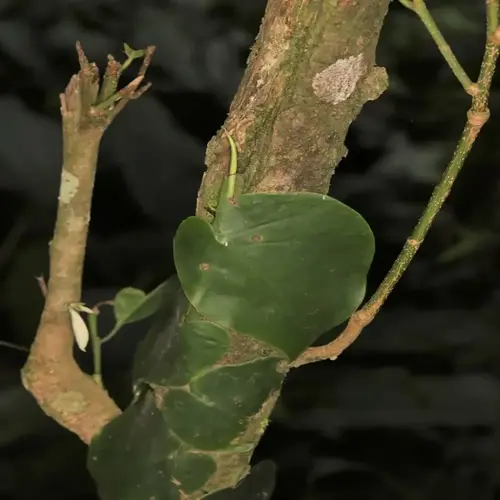
My golden pothos sat by the north-facing kitchen window. It trailed long enough to brush the counter. The small heart-shaped leaves ran down the cabinet in a soft green line. But one vine I had pinned up a short moss support pushed out leaves nearly twice as wide. Same plant, same room, two very different looks.
Both ways work, so pothos climbing vs hanging comes down to the look you want and the leaf size you like. A climber on a support grows broader, more dramatic foliage. A hanging plant gives you long, soft vines that spill down. Neither hurts the plant, and you can switch between them whenever you feel like a change.
The reason for the size gap sits in how pothos grows in the wild. It is a climber by nature, and it pulls itself up trees using short brown aerial roots along each vine. These roots grip bark, brick, or a damp pole. When you set a pothos on a support, those roots latch on and the plant reads it as a tree, so it shifts into mature mode and grows bigger leaves.
Let a vine dangle instead and it stays in its juvenile form. The leaves stay smaller, but the vine keeps stretching out longer. So a hanging pot trades leaf size for length and that full, cascading curtain so many people want from this plant. I watched my own counter-trailing vine stay petite for years while the one on the pole kept getting bolder.
- Aerial roots grip a moss pole or trellis for upright growth.
- Vines tend to mature into larger leaves over time.
- Takes more vertical space and some training of the vines.
- Vines cascade freely from a shelf or hanging pot.
- Leaves stay smaller but vines grow long and full.
- Easy to display in tight spots with no support needed.
The numbers back up how far this plant can go. NC State notes that pothos climbs by aerial roots and can reach up to 40 feet (12 m) on a support in the right conditions. Its leaves run 3 to 6 inches (7.6 to 15 cm) across, and the bigger end of that range shows up most on well-fed climbers. Light matters more than the form you pick. Give the plant bright indirect light and the variegation stays strong whether it climbs or hangs. Too little light, and the bright streaks fade either way.
Pick your form based on your space and your eye. If you have a bare wall or a corner that needs height, a moss pole or trellis gives you that upright shape and those broad, glossy leaves. Tuck a support into the pot and guide the vine onto it, then mist the pole so the roots grip. If you want the soft, trailing pothos vines look instead, set the plant on a high shelf or in a hanging basket and let it drape.
Either way, trimming keeps the plant full. Snip any vine that gets too long and root the cuttings in water for free new plants. I keep a jar of cuttings on the same kitchen sill, and they root in about two weeks. Cutting just above a leaf node also pushes the plant to branch, so both your climber and your hanging pot fill in thicker over time.
One last tip from my own setup. If you train a climber, mist the moss pole every few days so it stays damp. The aerial roots grip a moist pole far better than a dry one, and that grip is what coaxes out the bigger leaves. There is no wrong choice here, only the version that fits your room and your eye best.
Read the full article: Pothos Propagation: A Complete Guide