
Introduction
The japanese cedar lives a double life. In Japan it guards temple gates as a quiet symbol of the country. Yet that same tree dumps so much pollen each spring that more than a third of the population now fights hay fever. Most plant guides skip that twist and hand you the same flat list of facts.
This tree is no minor ornamental. Known as sugi, it is the national tree of Japan, and its proper name is Cryptomeria japonica. It grows hardy across USDA zones 5 to 9 and climbs to 50 to 70 feet tall at maturity. That makes it one of the more striking choices you can plant for height and year-round green.
Here is the gap I want to close. Short articles tell you it is an evergreen conifer and stop there. This guide goes deeper. You will learn how to care for the tree and which cultivar fits your yard. You will see how to build a fast privacy screen as a Leyland cypress replacement. You will also find out why the foliage turns bronze each winter without being sick.
You also get the parts no quick read bothers with, from the 650-year-old giants still standing in Japan to the science behind that famous spring pollen. Let's start with the care basics that keep this tree healthy.
Japanese Cedar Care Guide
Good japanese cedar care comes down to four things you get right at planting: soil, light, water, and food. Nail those early and the tree mostly takes care of itself. It earns its low-maintenance reputation once the roots settle in.
Start with the soil, because everything else builds on it. This tree wants moist acidic well-drained soil with a pH below 6.0, and the acid is not a small detail. Sweet or alkaline ground turns the foliage pale and yellow, while acidic soil keeps it that deep, rich green you bought the tree for. Well-drained matters just as much, since soggy roots invite rot that no amount of feeding will fix.
Light is the easy part. Give it full sun for the densest, fullest growth, though it handles partial shade without much complaint. Plant it too deep in shade and the branches thin out and stretch toward the light. One spot most guides skip is air movement. The tree likes open, breezy spots. Good airflow dries the foliage and keeps fungal leaf problems down. Just shelter it from strong, drying winds that scorch the needles.
Give Japanese cedar an open spot with good air circulation but shelter from strong, drying winds, which Clemson notes the tree dislikes.
Watering follows a simple arc. In the first season or two, water deep and consistent so the roots reach down instead of staying shallow. After that the tree becomes moderately drought tolerant, and you can ease off and let it ride on rainfall. The one exception is a real dry spell. Clemson points out it still needs irrigation during drought, so give it a long soak when the ground stays parched for weeks.
Feeding is light work here. Use a slow-release fertilizer made for acid-loving evergreens. One dose in spring carries the tree through the season. It also protects the low pH the roots prefer. Skip the heavy nitrogen, since soft, rushed growth is weak growth that storms break off.
Match all of this to your climate before you plant. Japanese cedar thrives across USDA hardiness zones 5 to 9. That covers most of the country. The right cultivar for your spot still depends on the room you have and the look you want. That choice is where we head next.
Size, Shape and Growth Rate
So how big does japanese cedar get? A full tree form reaches 50 to 70 feet (15 to 21 m) tall at maturity. It spreads 20 to 30 feet (6 to 9 m) wide, and Clemson Extension puts the top end near 80 feet. That mature size matters before you plant. This tree needs room to fill out for decades.
The shape is the easy part to picture. A single tree grows into a tall pyramidal form, a clean conical pillar built around one central leader that runs from the ground to the tip. That same central leader is what lets one tree stand alone as a specimen or line up with others as a screen, so the form does double duty in the yard.
The japanese cedar growth rate is where the confusion starts, and it is worth slowing down on. The extension consensus is modest. NC State calls it medium, and Clemson calls it slow to medium. Plant tags at the nursery often promise something faster. You will see claims of 12 to 18 inches a year, and sometimes several feet a year on the boldest labels.
Both can be true, and that is the trap. Those quick numbers depend on the cultivar, your soil, and your water, so treat them as a best case and not a promise. A Yoshino in rich, moist ground with full sun will outpace a slow dwarf in a dry spot. Plan around the slow to medium figure from the extension offices and let any extra speed be a bonus.
Not every japanese cedar wants to be a tower. Dwarf cultivars like Globosa Nana stay rounded mounds. They reach only 3 to 4 feet (about 1 metre) tall, a different plant for a different job. The table below sorts the main types by mature size. Use it to match a form to the space you actually have.
Pick the row that fits your spot, then trust the mature size over the growth rate when you plan. A compact Black Dragon tops out near 8 to 10 feet (2.4 to 3 m) and works in a small yard. A full tree form needs open ground that lets a 70-foot pillar breathe.
Best Cultivars to Choose
One squat Globosa Nana mound has held the same dry corner of my front border for 7 years. The roots there choke out most plants. Yet it still looks as tidy as the day I dropped it in. That spot ate two bigger plants first. A young Yoshino sulked and a fuller tree form browned out in a season. The dwarf just rounded itself off and got on with the job.
That little win taught me the real lesson behind japanese cedar cultivars. The named variety you pick matters far more than the species label on the tag. Each one brings a different size, shape, and even color, so you match the plant to the job instead of forcing one tree to do everything.
Most plant lists just throw variety names at you with no help deciding. The 4 cultivars below cover the jobs you actually have, from a 40 ft privacy wall down to a knee-high mound for a tight border. Read each one against your own yard before you buy.

Yoshino
- Size: Reaches 30 to 40 ft (9 to 12 m) tall and 20 to 30 ft (6 to 9 m) wide with a dense pyramidal form.
- Growth: A fast grower for the species, which is why nurseries push it for quick privacy screens and hedges.
- Best use: Widely recommended by Clemson as an excellent replacement for the disease-prone Leyland cypress.
- Foliage: Holds blue-green needles that take on a light bronze cast through the coldest winter months.
- Why choose it: The go-to cultivar when you want fast, dense, year-round screening from a single reliable variety.
- Consider: Give it room to reach full width so the lower branches stay full to the ground for privacy.

Radicans
- Size: Grows tall and narrow at 40 to 45 ft (12 to 14 m) with a columnar, upright habit.
- Growth: Vigorous and upright, making it a strong choice for narrow planting strips along property lines.
- Best use: Excellent for tight privacy screens where width is limited but height is welcome.
- Foliage: Shows noticeably less winter bronzing than many cultivars, staying greener through the cold.
- Why choose it: Ideal when you want a slim, evergreen wall that keeps its color in winter.
- Consider: Space plants to allow the narrow crowns to knit together into a continuous screen over time.
Black Dragon
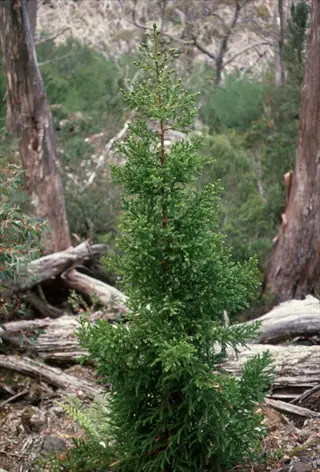
- Size: A compact, slow grower reaching only 8 to 10 ft (2.4 to 3 m) tall with a dense, irregular cone.
- Growth: Slow and tidy, so it suits smaller landscapes where a full-size tree would overwhelm the space.
- Best use: Works as a living sculpture, accent plant, or focal point near patios and entryways.
- Foliage: New growth emerges light green and matures to a strikingly dark green, deepening the dragon name.
- Why choose it: Perfect when you want the Japanese cedar look at a manageable, small-yard scale.
- Consider: Place it where its dark, dense form contrasts against lighter plants for the best effect.
Globosa Nana
- Size: A true dwarf staying just 3 to 4 ft (0.9 to 1.2 m) tall and wide in a neat rounded mound.
- Growth: Very slow and compact, holding its tidy globe shape with little or no pruning.
- Best use: Excellent for borders, foundation plantings, rock gardens, and large containers.
- Foliage: Soft blue-green needles form a fine-textured cushion that may bronze lightly in winter.
- Why choose it: The right pick when you love the foliage but have no room for a towering tree.
- Consider: Give it well-drained soil in a spot where its rounded form can be appreciated up close.
Here is the fast way to choose. Want a quick screen? Plant Yoshino. Got a narrow strip and hate winter brown? Radicans stays greener and slim. Need a focal point by the patio? Black Dragon holds at 8 to 10 ft. Tight on space? A dwarf japanese cedar like Globosa Nana fits where nothing else will.
Size is only half the choice though. Cultivar also sets the color, so a golden japanese cedar changes the whole look of a bed. Types like Sekkan and Golden Promise push out creamy yellow new growth. That color lights up a shady corner. Use them as a single accent, not a full hedge.
Privacy Screens and Hedges
I paced my back fence line with a tape measure and a row of young Yoshino cedars resting in their pots on the grass. My first plan put them in one straight line at 15 ft apart, and the gaps between the small crowns looked like missing teeth. So I split the row into two staggered lines, and the trees closed those holes far faster than the single row ever would.
That afternoon taught me the real trick. Spacing and layout beat buying bigger trees every time, and a privacy screen built this way fills in within a few seasons. Japanese cedar makes one of the best living fences you can plant because it stays green all year and shrugs off deer and rabbits.
Most nurseries sell this conifer as a leyland cypress replacement, and for good reason. Leyland cypress grows fast but then dies back from canker and blight once it gets crowded. Japanese cedar gives you the same dense wall without the disease problems that wipe out a Leyland hedge after a decade.
Getting the spacing right is where most people go wrong with a hedge. Extension sources put the mature width of this tree at 20 to 30 ft, so a single specimen needs room. For a row, retailers say to plant screening cultivars about 10 to 15 ft (3 to 4.5 m) apart. That gap is close enough for the crowns to knit into a solid face.
For a solid evergreen wall, space screening cultivars like Yoshino about 10 to 15 ft (3 to 4.5 m) apart, closer for a faster fill and wider for individual specimens.
Loosen a wide planting area and work in organic matter so the rich, moist, acidic, well-drained soil that Japanese cedar prefers extends well beyond each root ball.
Plant each cedar with the top of the root ball level with the surrounding soil, keeping the central leader upright so the trees grow into a uniform screen.
Water deeply after planting and mulch around each tree, then keep the soil consistently moist through the first seasons while the roots establish.
Allow the crowns to knit together over a few seasons. Light shearing keeps a tidy face, but never top the trees, which ruins the natural form.
Plant for the year-round privacy you want in five years, not the bare fence you see today. This fast-growing evergreen screen pays off if you wait. Space and stagger the row with care. The trees turn into a green wall that asks almost nothing of you once the roots take hold.
Problems and Winter Bronzing
My first winter with a young Japanese cedar, the whole tree went rusty reddish-brown almost overnight. I was sure I had killed it. I checked the soil, second-guessed my watering, and braced myself to dig it out come spring. Then by late May the needles greened right back up on their own, like nothing had happened.
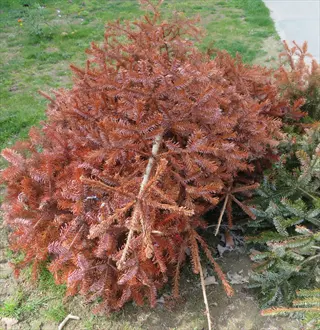
That color shift is winter bronzing, and it is the single most common reason people panic. If you have been asking why is my cryptomeria turning brown, the answer is usually the season, not a disease. The needles bronze to reddish-brown in cold weather and re-green as growth resumes in spring.
Some cultivars bronze hard and others barely change. If the rusty look bothers you, plant Radicans, which holds its green color far better through winter. Knowing this difference up front saves you a lot of needless worry over a tree that is doing exactly what it should.
Real japanese cedar problems do exist, and they are worth knowing apart from harmless color. NCSU and Clemson list leaf spot, leaf blight, and other fungal disease as the main health issues. The good news is the tree is usually insect-free, so you rarely fight bugs on top of everything else.
Winter Bronzing
- What it looks like: Foliage shifts from green to a reddish or purplish bronze across the colder months.
- Why it happens: This is a normal seasonal response to cold in many cultivars, not a sign of disease or dieback.
- What to do: Wait for spring; the foliage greens back up on its own as temperatures rise and growth resumes.
- Prevention: Choose low-bronzing cultivars such as Radicans if winter color bothers you in your landscape.
Leaf Blight And Leaf Spot
- What it looks like: Browning, spotting, or dieback of needles and small branches, often in humid conditions.
- Why it happens: Fungal diseases that NCSU and Clemson list as the most common health problems for the species.
- What to do: Prune out affected growth and improve air movement; chemical control is difficult on large trees.
- Prevention: Plant in a site with good air circulation and avoid crowding so foliage dries quickly after rain.
Root Rot In Wet Soil
- What it looks like: General decline, yellowing, and poor growth in trees sitting in soggy ground.
- Why it happens: Japanese cedar needs well-drained soil, and standing water around the roots invites rot.
- What to do: Improve drainage or plant on a slight mound so excess water moves away from the root zone.
- Prevention: Test drainage before planting and amend heavy clay with organic matter to keep roots healthy.
Wind And Drought Stress
- What it looks like: Scorched or browned foliage, especially after dry spells or exposure to strong winds.
- Why it happens: Clemson notes the tree dislikes high winds and needs irrigation during drought despite some tolerance.
- What to do: Water deeply during extended dry weather and shelter young trees from harsh, drying winds.
- Prevention: Site the tree away from wind tunnels and mulch the root zone to conserve consistent soil moisture.
Notice the pattern across these fixes. You stop most fungal disease before it starts through smart placement, not through a sprayer. Give the tree good air circulation and soil that drains well, and the foliage dries fast after rain so spores never get a foothold.
This matters for a simple reason. On a big mature tree, spraying barely works. The canopy is too tall to coat well. So pick the right spot when you plant, and you skip the problem. That beats chasing leaf blight up a 60-foot tree later on.
Culture, History and Science
The tree in your yard carries a story most plant tags skip. The sugi is the national tree of japan, and the Japanese have revered it for centuries. They plant it around shrines and temples, where the tallest trunks line the path to the front gate.
Yale Nature Walk puts the cultural weight in plain words. The tree is fundamental to the country's national identity. You find it at places of worship all over the islands. Some giant ones at Nikko rank among the biggest trees in all of Japan.
There is a sharp twist to this love story. The same tree that Japan honors at its shrines also drives a nationwide hay fever season every spring. That second identity comes down to one government program and a lot of pollen.
After the war, Japan launched a huge post-WWII tree planting push to rebuild its timber supply. Crews covered the mountains with sugi. Over the years those trees grew into a wall of male cones. Each February through April they release pollen by the ton.
Post-World War Two
A government tree-planting program established vast sugi plantations across Japan, greatly increasing the supply of cedar pollen.
1998
Reported sugi pollinosis prevalence stood at about 11.7% of the population in the epidemiology literature.
2008
Prevalence had climbed to roughly 26.5% as the maturing plantations released ever more pollen each spring.
2019
Prevalence reached about 38.8%, so more than one third of Japanese people were affected by the national affliction.
February to April
Each year the pollen season peaks, and many people in Japan wear facemasks and eyeglasses to limit symptoms.
That climb is hard to ignore. Sugi pollinosis went from 11.7% of the population in 1998 to 38.8% by 2019. So more than one third of Japanese people now react to the pollen. What drove the jump? Researchers blame two things. One is the aging plantations. The other is a warmer climate.
In our opinion the reason why sugi-pollinosis became a common disease in the last half century is the increased number of cedar pollens, with global climate change and forest growth caused by the tree-planting program of the Japanese government after World War II playing substantial roles.
Here is the part that matters for your yard. The sugi pollen allergy problem is a mass-plantation story, not a single-tree one. One sugi in your garden is a tiny pollen source. Next to a whole mountain of male trees it barely registers. So a specimen or a screen at home carries little of that risk.
The science gives the tree a third role too. These plantations lock away lots of carbon. A study in Botanical Studies found that carbon sequestration keeps building beyond 90 years of age. So your tree stores carbon long after most conifers slow down. That makes it a quiet helper for the climate, not just a screen for your fence line.
5 Common Myths
Many people believe Japanese cedar is a true cedar related to the cedars of Lebanon or the Atlas Mountains.
It is not a true cedar; Cryptomeria japonica belongs to the cypress family, Cupressaceae, and is the only species in its genus.
Gardeners often assume a Japanese cedar turning reddish-brown in winter is dying or seriously diseased.
Winter bronzing is normal seasonal color for many cultivars, and the foliage greens back up again as warmer spring weather returns.
Some shoppers think any Japanese cedar will grow several feet a year like fast-growing privacy trees promise.
University extensions describe the growth rate as slow to medium; only certain cultivars grow quickly, and fast-growth claims are often marketing.
A common belief is that Japanese cedar needs constant spraying and intensive care to stay healthy.
It is generally low maintenance, typically insect-free, and resistant to deer and rabbits once established in suitable soil.
People assume topping a tall Japanese cedar is a safe way to keep its height under control.
Topping destroys the natural form, removes the central leader, and produces weak, crowded regrowth that rarely looks or grows well.
Conclusion
The japanese cedar rewards you for getting a few basics right. Give it rich, acidic, well-drained soil and a spot with full sun to partial shade, and you have a tree that asks for very little after that. It grows well across USDA zones 5 to 9, which covers most of the country. This is a low maintenance evergreen once its roots take hold, and the work you skip is the reason so many gardeners pick it.
Match the cultivar to your space and the rest falls into place. A full-size Cryptomeria japonica climbs to 50 to 70 feet, so it suits a back corner or a screen line rather than a tight bed. Dwarf forms stay knee-high for years and fit a patio pot or a foundation planting. Size is the one choice that drives everything else, and picking it first saves you from fighting the tree later.
Hold on to a couple of facts that calm the usual worries. Documented specimens in Japan reach around 650 years old, so this is a tree you plant for the next owner of your house, not just for next summer. And when the foliage turns coppery in the cold, that winter bronzing is normal seasonal color, not a disease. The green returns in spring on its own.
There is a second story worth knowing. This is the revered national tree of Japan, the "sugi" planted at shrines and temples. Yet the same heavy pollen makes it a top cause of hay fever there. That dual nature is part of what makes the tree so fun to grow. It is loved and a bit of a pest at once.
For most yards, the japanese cedar is a long-lived, low-trouble evergreen. As a leyland cypress replacement, it is the healthier swap. It shrugs off the blights and the breakage that take down so many fast screens. Decide how much room you have, then pick the form that fits. You end up with a privacy screen or a lone tree that should outlast you by centuries.
Glossary
- Central leader
- The single dominant upright main stem of a tree that gives Japanese cedar its conical, pyramidal shape.
- Cryptomeria japonica
- The scientific name for Japanese cedar, the single species in its genus and the national tree of Japan.
- Cupressaceae
- The cypress plant family that Japanese cedar belongs to, despite its common name suggesting it is a true cedar.
- Monoecious
- A plant that bears both male and female reproductive parts on the same individual tree.
- Sugi
- The Japanese name for Japanese cedar, a tree revered in Japan and planted around places of worship.
- Sugi pollinosis
- Hay fever caused by Japanese cedar pollen, described as Japan's national affliction affecting more than a third of the population.
- USDA hardiness zones
- A map-based system rating how cold a region gets; Japanese cedar grows in zones 5 through 9.
- Winter bronzing
- The normal seasonal shift of Japanese cedar foliage to a reddish-brown color in cold weather, which greens up again in spring.
External Sources
Frequently Asked Questions
What is special about Japanese cedar?
Japanese cedar is the national tree of Japan, a long-lived evergreen conifer with reddish exfoliating bark, fragrant timber, and deep cultural meaning.
How fast do Japanese cedars grow?
Extension sources describe the growth rate as slow to medium, though faster-growing cultivars are marketed for privacy screening.
Does Japanese cedar like sun or shade?
Japanese cedar grows best in full sun but tolerates partial shade and dappled light.
Do Japanese cedars turn brown in winter?
Many Japanese cedars bronze to a reddish-brown in cold weather; this is normal seasonal color, not disease.
What are the common problems with Japanese cedar?
The main problems are leaf blight, leaf spot, and other fungal diseases, plus harmless winter bronzing.
What is the lifespan of a Japanese cedar tree?
Japanese cedar is long-lived, with documented specimens in Japan around 650 years old.
Is Japanese cedar good for privacy screening?
Yes, Japanese cedar is widely recommended as a dense, evergreen privacy screen and a healthier replacement for Leyland cypress.
What happens if you cut the top off a Japanese cedar?
Topping a Japanese cedar removes its central leader, spoils the natural pyramidal shape, and triggers weak, bushy regrowth.
Is Japanese cedar better than Leyland cypress?
Japanese cedar is often the better long-term choice because it resists the diseases that frequently kill Leyland cypress.
Why does Japanese cedar cause hay fever in Japan?
Massive post-war sugi planting created huge volumes of cedar pollen, making sugi hay fever Japan's most common disease.