
Introduction
Type moon gardening into a search bar and you get two very different answers back. One crowd wants to time their planting to the moon's phases. The other wants a glowing white flower bed they can sit in after dark. Both groups use the same words, and that mix-up sends a lot of new gardeners down the wrong path.
This guide covers both meanings, and it brings in the science too. The moon's gravity here on Earth is about 300,000 times weaker than Earth's own pull. That is far too faint to lift sap or move soil water, so the old tide-and-sap story falls apart fast. You deserve the honest version, and that is what you'll get.
The first meaning is about when you plant. Planting by the moon ties your sowing, pruning, and harvesting to the 29.5-day lunar cycle, a tradition people call lunar gardening. The second meaning is about what you plant. A moon garden is a night garden of white blooms and silver leaves that catches faint light and glows once the sun goes down.
I've planted by both ideas and read the studies behind them. So you'll get a clear breakdown of each, a fair look at the research, and a real verdict on whether timing matters. Let's sort out what these two ideas mean before you pick up a single seed packet.
The Two Meanings of Moon Gardening
Here is the moon gardening meaning that trips up almost everyone who searches for it. The term points to two different things at once, and most articles only tell you about one. That is why two people can read about the same hobby and picture two completely different gardens.
The first meaning is a timing practice. People who follow planting by the moon time their sowing, pruning, and harvesting to the moon's phases. Older farmers did the same thing with an almanac. This is also called lunar gardening, and it cares about when you work, not how the garden looks.
The second meaning is a design style. A moon garden is a space built from white flowers, silver leaves, and fragrant night bloomers that seem to glow once the sun drops. You also see it called a twilight garden or a night garden, and you enjoy it after dark from a patio or a quiet path. Vita Sackville-West made the idea famous with her 1930s White Garden at Sissinghurst, still the garden most people copy today.
Neither meaning is wrong, and plenty of gardeners do both. You can follow the lunar calendar to plant a bed and then fill that bed with pale, scented plants for the evening. The table below lays the two side by side so you can see the split at a glance.
- A timing practice that schedules sowing, transplanting, pruning, and harvesting around the moon's phases.
- Rooted in old farming tradition and the lunar calendar rather than the look of the garden.
- Focuses on WHEN you work, using the roughly 29.5-day lunar cycle as a guide.
- Often paired with an almanac or moon planting calendar to track the four phases.
- A design style using white flowers, silver foliage, and fragrant night bloomers that glow by moonlight.
- Made famous by Vita Sackville-West's 1930s White Garden at Sissinghurst.
- Focuses on WHAT you plant and WHERE, so the space looks and smells its best after dark.
- Enjoyed in the evening, often near a patio or path with soft seating and gentle light.
If a page only talks about phases and crops, it means planting by the moon. If it talks about white flowers and fragrance at night, it means a moon garden. This guide covers both.
Now that the split is clear, let's start with the timing side. The next part walks you through the four phases of the lunar cycle and what gardeners traditionally do during each one.
Planting by the Four Moon Phases
The lunar cycle runs about 29.5 days from one new moon to the next. Tradition splits that span into four moon phases that each last close to a week. You get the new moon, the first quarter, the full moon, and the last quarter. Each one comes with its own set of garden tasks.
The first half of the cycle is the waxing moon, when the light grows from new moon to full moon. Old garden lore puts above-ground crops in this window, so you sow leafy greens and fruiting plants while the moon fills out. The second half is the waning moon, when light fades from full moon back to new moon, and that half goes to root crops, transplanting, and pruning.
It helps to think of the four phases as four jobs. At the new moon you start seeds and sow leafy crops like lettuce and spinach. At the first quarter you plant fruiting crops such as tomatoes and beans. The full moon is for root crops, transplanting, and harvesting. The last quarter is your rest week, the time to weed, prune, and feed the soil.
I sowed lettuce and beans one waxing week in my central Missouri Zone 6 bed. The bed sits off the back patio. Then I set the carrot seeds back on the shelf for the waning week. The lettuce went in by the porch light while the moon climbed toward full. The carrots waited their turn, and that rhythm kept my whole spring planting on a tidy schedule.
Keep in mind that these phase and task pairings are a long-standing tradition, not a proven method. The next section weighs what the research actually shows. For now, treat the four-phase plan as a simple calendar. It tells you what to do each week and brings order to your sowing. You can try it without expecting magic from the sky.
The Science: Does It Really Work?
So does moon gardening work? This is where most guides go quiet or wave at folklore. The honest answer comes from peer-reviewed journals. It splits into two very different stories, and people tend to blur them together.
The first story is about gravitational pull. The old idea says the moon lifts soil moisture and sap through your plants the way it pulls ocean tides. A 2020 Agronomy review looked at more than 120 studies and found no consistent link between moon phase and plant life. The moon's pull on Earth is about 300,000 times weaker than Earth's own gravity, so it cannot move water inside a stem.
Think of it this way. The moon's gravity is like a whisper shouted from across a packed stadium. It is real, but it is far too faint for your tomato plant to hear over everything else. So on the gravity question, the moon gardening science is settled, and the answer is no.
Light is a different matter. This is the part that asks is lunar gardening real and gives more than a flat no. Moonlight is roughly 128,000 times dimmer than sunlight. So it cannot feed your plants through photosynthesis. But a 2023 study from Ben-Gurion University found plants treat full-moon light as a signal, not as food.
Gravity Is Far Too Weak
- The finding: A 2020 Agronomy review of more than 120 references found no consistent relationship between moon phase and plant life.
- The scale: The moon's gravitational pull on Earth is about 300,000 times weaker than Earth's own gravity, so it cannot meaningfully move sap or water inside a plant.
- What it means: The popular idea that the moon lifts moisture through plants like ocean tides is not supported by the physics.
Moonlight Is Too Dim to Feed Plants
- The finding: Full-moon illuminance is roughly 128,000 times less than sunlight, far too little to drive photosynthesis.
- The scale: University extensions in Illinois, Florida, and Washington all echo this skepticism about light as an energy source.
- What it means: Moonlight cannot power plant growth the way the sun does, so it is not an energy source for your crops.
But Light Can Act as a Signal
- The finding: A 2023 Plants study from Ben-Gurion University found full-moon light is perceived by plants as a signal, not an energy source.
- The detail: Five hours of full-moon light more than doubled nuclear volume in test cells, and mustard seedlings gained more weight over three nights of exposure.
- What it means: Dim light can still carry information a plant detects, which is a real but modest effect separate from the unproven planting-by-phase tradition.
The Honest Bottom Line
- The verdict: Planting strictly by moon phase has no consistent scientific support, so treat it as tradition rather than a proven method.
- The upside: Lunar gardeners often give their gardens extra care and attention, and that attentiveness alone can help the garden thrive.
- What it means: Trying the schedule is harmless and can build good habits, as long as you do not expect guaranteed bigger harvests.
Here is how to hold both truths at once. The light study is real science. But it measured cells and seedlings in a lab. It did not test the folk rule that says plant beans on a waxing moon. That timing rule still has no consistent proof behind it. So treat it as tradition, not a guarantee.
I planted by a lunar calendar for two full seasons and weighed every harvest. My yields did not jump. But I was out checking my beds far more often, and the plants loved that closer attention. A phase schedule pushes you outside on a regular rhythm. That extra care helps any garden, moon or no moon. So try it because you enjoy the habit, not because it promises a bigger harvest.
The moon controls both the tides and the transformation of werewolves, but there is little evidence in these studies that it affects tree growth.
How to Start Moon Gardening
Learning how to start moon gardening is easier than the folklore makes it sound. You have two paths, and you can pick one or run both at once. The first path times your planting to the moon's phases. The second turns a corner of your yard into a glowing night garden you enjoy after dark.
Start small. One raised bed or a few containers gives you room to learn without much risk. For the phase path, you track the lunar cycle of roughly 29.5 days and group plants by type. Above-ground crops like beans and lettuce go in during the waxing weeks. Root crops like carrots and onions go in as the moon wanes. Grab a printed moon planting calendar or an almanac so you always know which week you are in.
The night garden path is simpler still. Pick a spot you can see at dusk from a patio, a window, or a favorite chair. Then fill it with white flowers, silver foliage, and fragrant bloomers that wake up after sunset. Moonflower is the plant most people start with. Sow the seeds indoors in April. Move the seedlings outside in May. You will get those big white blooms by late June, not in September.
Decide whether you want to plant by the moon's phases, design a glowing night garden, or do both. Each path starts a little differently.
For phase planting, mark the four phases across the roughly 29.5-day cycle using an almanac or moon planting calendar so you know which week you are in.
Sort what you grow into above-ground crops and root crops, then match each group to its traditional waxing or waning week.
For a night garden, choose a place you can see at dusk from a patio or window, where pale flowers will catch the evening light.
Fill the bed with white flowers, silver foliage, and night-fragrant bloomers like moonflower, started indoors in April for late June flowers.
Place a bench or chairs nearby and keep any path lighting subdued and amber so the space stays restful and pollinator friendly.
Both paths reward a little patience more than any special gear. Tape your moon planting calendar to the shed wall, or sketch a quick map of your night bed so you know what blooms where. Once your spot is ready, the next step is choosing the right plants. The list below covers the white flowers and night bloomers that look best once the sun goes down.
Best Plants for a Moon Garden
The best moon garden plants all do one of three jobs. Some bring white flowers that catch faint light, some bring silver foliage that glows soft and gray, and some hold their scent for after dark. White and silver surfaces bounce back even a sliver of moonlight, so the bed reads clearly at night. Fragrance works the other way and peaks once the sun drops. Combine all three and your garden lights up and smells alive long after dusk.
One June dusk a six-inch white bloom unfurled on the moonflower trellis off my back patio. It opened in minutes while a hummingbird moth hung in the air beside it. That bed sits in my central Missouri Zone 6 yard, and the vine had climbed most of the trellis by then. The moth worked the open flower while two more buds twisted loose below it. Night bloomers like this earn their spot at the center of the bed.
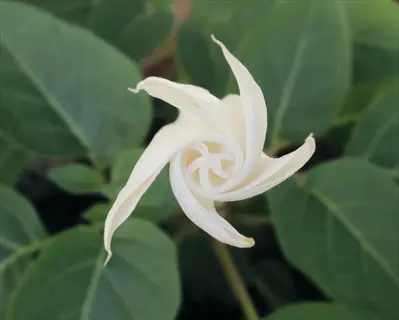
Moonflower (Ipomoea alba)
- Bloom: Large white flowers up to 6 inches (15 cm) across open at dusk and close the next morning.
- Size: A vigorous annual vine that climbs up to 15 ft (4.6 m) tall and 3 to 6 ft (0.9 to 1.8 m) wide in a single season.
- Fragrance: Strongly scented in the evening, making it a centerpiece for any moon garden.
- Pollinators: Pollinated by night-feeding hummingbird moths drawn to the white blooms and scent.
- Care: Grows easily on a trellis or arch; start seeds indoors in April for flowers by late June.
- Zones: Perennial in USDA Zones 9A to 11 and grown as an annual in cooler regions.
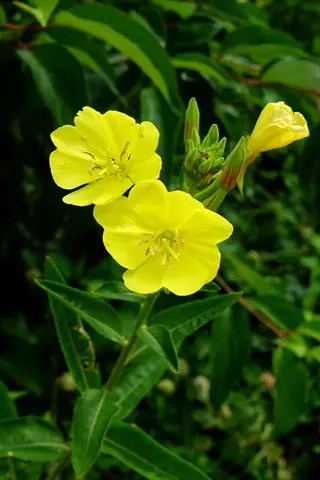
Evening Primrose
- Bloom: Pale yellow to white flowers that open in the evening and glow softly at dusk.
- Fragrance: Lightly scented blooms that draw night pollinators to the garden.
- Pollinators: A key food source for nighttime moths and other evening visitors.
- Habit: An easygoing plant that fills space and reblooms through the warm season.
- Care: Tolerant of poor soil and full sun, making it low effort for beginners.
- Use: Best planted in drifts where its evening flowers can be seen together.
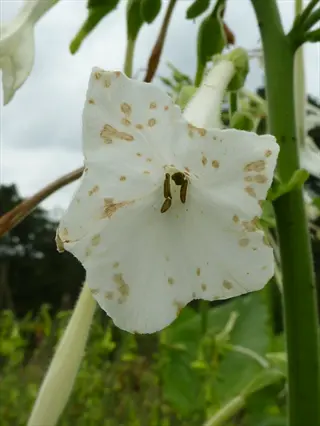
White Nicotiana (Flowering Tobacco)
- Bloom: Star-shaped white flowers held above the foliage that show up clearly after dark.
- Fragrance: Releases a sweet scent in the evening that carries across the garden.
- Pollinators: Attracts night-flying moths with its pale color and strong fragrance.
- Habit: Upright stems that add gentle height among lower plants.
- Care: Prefers rich, moist soil and grows well as an annual in most regions.
- Use: Site it near seating or a path so the evening fragrance is easy to enjoy.
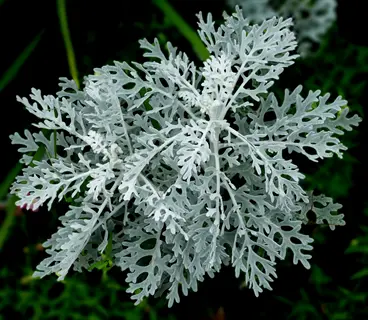
Dusty Miller (Silver Foliage)
- Foliage: Soft, silver-gray leaves that reflect moonlight and brighten the garden at night.
- Role: Grown for foliage rather than flowers, providing a glowing contrast to white blooms.
- Habit: A compact, mounding plant that works well at the front edge of a bed.
- Care: Thrives in full sun and tolerates dry conditions once established.
- Texture: Lacy leaves add soft texture that catches even faint evening light.
- Use: Pair it with white flowers to make both the silver and the white stand out.
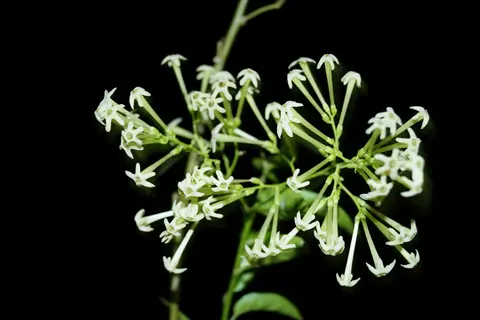
Night-Blooming Jasmine
- Bloom: Small, tubular flowers that open after dark and release fragrance through the night.
- Fragrance: One of the most intensely scented night plants, noticeable from a distance.
- Habit: A shrubby plant that can be grown in the ground or in a large container.
- Care: Prefers warmth and full to partial sun; protect it where winters are cold.
- Pollinators: Its strong night scent draws moths and other evening pollinators.
- Use: Plant it near a patio or window so the fragrance reaches your seating area.
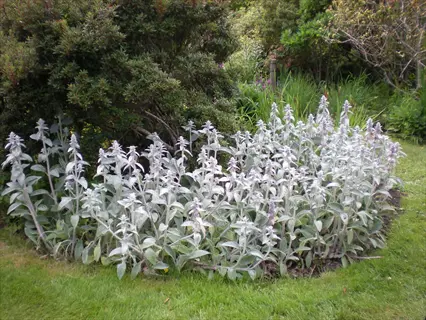
Lamb's Ears (Silver Groundcover)
- Foliage: Fuzzy, silver-white leaves that softly reflect moonlight along the ground.
- Role: A low groundcover that ties a moon garden together beneath taller white flowers.
- Habit: Spreads gently to form a soft, pale carpet at the edge of a bed or path.
- Care: Drought tolerant and easy to grow in full sun and well-drained soil.
- Texture: Velvety leaves add inviting texture that contrasts with glossy blooms.
- Use: Edge a path with it so the silver foliage lights the way at dusk.
Build the bed in layers and you get the most from each plant. Put a vigorous vine like the moonflower at the back, where it can climb up to 15 ft (4.6 m) tall on an arch or trellis in one season. Drop the fragrant plants near a bench or window so the scent finds you, and edge the front with silver leaves that line the path. Mix the heights and you read the whole bed at a glance after dark.
Start with three or four of these and add more as you learn your space. A pale drift of evening primrose, one shrub of night blooming jasmine, and a row of silver foliage will already glow on a clear night. The rest is just play.
5 Common Myths
The moon's gravity pulls water up through plants like it pulls ocean tides, so it strongly affects how seeds grow.
The moon's gravity on Earth is about 300,000 times weaker than Earth's own gravity, far too weak to move sap or meaningfully affect a plant.
Moon gardening is scientifically proven to increase your harvest, with studies confirming much bigger yields from lunar timing.
No Tier 1 source supports specific yield gains. Authoritative reviews found no consistent lunar effect, so treat planting by phase as tradition.
A moon garden and planting by the moon are exactly the same thing, just two names for one gardening method.
They are different. A moon garden is a white night garden you view by moonlight, while planting by the moon times tasks to lunar phases.
Moonlight has no measurable effect on plants at all because it is far too dim to matter to living cells.
A 2023 study found full-moon light, while dim, acts as a signal that altered plant cells and boosted mustard seedling growth in tests.
You can only enjoy a moon garden during a full moon, since that is the only time flowers are visible.
White flowers and silver foliage reflect even faint light, and many night bloomers open at dusk, so a moon garden glows on most clear evenings.
Conclusion
By now the two sides of moon gardening should feel clear. One side is timing your work to the moon's phases, the old habit of planting by the moon that calendars still print today. The other side is the moon garden itself, a planted space of white flowers and silver leaves built to glow after dark.
Here is the honest verdict on lunar gardening. Careful reviews of more than 120 studies found no steady proof that the moon's phase drives how plants grow. A 2023 study did add one real nuance worth keeping in mind. Full moonlight acts as a faint signal that plant cells can sense, which nudged seedlings to grow a bit heavier. That is a small light effect, not a green light for the folk planting rules.
Both paths stay friendly for beginners and carry almost no risk. A lunar planting calendar gives you a gentle rhythm that gets you outside on a schedule, and steady attention is what feeds any garden. A night garden pays you back in a different way, with evening scent and pale blooms you can enjoy once the workday ends. You lose nothing by trying either one.
The two ideas also fit together in one space. I plant my own white bed and still glance at the phase calendar before I sow, more out of habit than belief. You can lay out a moon garden of moonflowers and pale evening primrose. Then sow and tend it on a phase calendar if the ritual appeals to you. Start small. Plant a single moonlit bed near a window, or sow one tray during a waxing moon week, and let the garden show you what you make of it.
Glossary
- Above-ground crops
- Plants harvested for the parts that grow above the soil, such as leafy greens, beans, and tomatoes.
- Biodynamic gardening
- A traditional method that schedules garden tasks around lunar and astrological cycles rather than proven plant science.
- Lunar cycle
- The roughly 29.5-day span it takes the moon to pass through all its phases and return to the same point.
- Moonflower (Ipomoea alba)
- A vigorous climbing vine with large fragrant white flowers that open at dusk and are pollinated by night moths.
- Root crops
- Plants grown for the parts that develop below the soil, such as carrots, beets, and onions.
- Silver foliage
- Leaves with a silver or gray cast, such as dusty miller, that reflect faint light and glow in a night garden.
- Waning moon
- The half of the lunar cycle when the lit part of the moon is shrinking each night, from full moon to new moon.
- Waxing moon
- The half of the lunar cycle when the lit part of the moon is growing larger each night, from new moon to full moon.
External Sources
Frequently Asked Questions
What is a moon garden?
A moon garden is a garden of white flowers, silver foliage, and fragrant night bloomers designed to be enjoyed in the evening and reflect moonlight.
What is the meaning of moon gardening?
Moon gardening has two meanings: timing garden tasks to the moon's phases, and planting a night garden of white, glowing, fragrant flowers.
How do you start a moon garden?
Pick a spot you can see at night, plant white and silver plants plus night-fragrant bloomers, add seating, and keep any lighting soft and amber.
What are the benefits of a moon garden?
A moon garden offers evening beauty, strong fragrance, support for night pollinators like moths, and a relaxing space to enjoy after dark.
What flowers are best for a moon garden?
The best flowers are white or pale and fragrant, such as moonflower, evening primrose, white nicotiana, and angel's trumpet.
Which plant smells good at night?
Night-fragrant plants include moonflower, night-blooming jasmine, evening primrose, flowering tobacco, and mock orange.
Does planting by the moon really work?
Top science finds no consistent proof that moon phase reliably affects plant growth, though one 2023 study showed full-moon light can act as a signal.
What should you plant during a full moon?
By tradition, the days right after a full moon (the waning period) favor root crops, bulbs, transplanting, and pruning.
What is the best moon phase for planting?
Traditionally, the waxing moon suits leafy and above-ground crops, while the waning moon suits root crops, though science does not confirm this.
How do you make a moon planting calendar?
Track the 29.5-day lunar cycle, mark the four phases, group plants by above-ground or root type, and assign tasks to each phase.