
Introduction
Your soil drains too fast and dries out by noon. So you drag the hose out every day just to keep things alive. A keyhole garden fixes both problems at once. It bundles a garden bed and a compost bin into one round, raised mound. You feed kitchen scraps into a basket at the center. That one spot then waters and feeds the whole bed for you.
Picture a circular, waist-high raised bed, about 6 to 8 feet (2 meters) across, with a notch cut into one side so you can reach the middle. At the heart of it sits a central compost basket made of wire mesh. You pour water and food waste into that basket, and the nutrients spread out to the roots from there. That's the whole idea behind keyhole gardening, and it's simpler than it sounds.
This design didn't start as a backyard trend. It came out of southern Africa as a tool to fight hunger, and the evidence backs that up. A 2024 study looked at 2,014 households in Lesotho. It found keyhole gardens raised the odds of food security by 30.60%. Numbers like that are why home gardeners worldwide now build them for water-wise gardening.
This guide gives you the honest version. You'll see the real costs, the downsides, and the research right next to the build steps. That way you can decide if this bed fits your yard. And you'll know before you spend a whole weekend on it.
What Is a Keyhole Garden
A keyhole garden is a round raised bed with a wedge cut out of one side and a compost basket sitting right in the middle. The shape gives it the name. Look down at the bed from above and you see a circle with one pie slice missing, and that missing slice is the path you stand in to reach the center.
The design has four working parts. First comes the outer wall that holds everything in place. Inside that wall sits the soil bed, which slopes down toward the edges. At the heart of it stands the central compost basket, a wire mesh tube you fill with scraps. The fourth part is the keyhole notch, the wedge-shaped access path that lets you walk in close without stepping on your plants.
SDSU Extension lays out the standard build. It is a compact circular raised bed about 6 to 8 feet (around 2 meters) across and 2 to 3 feet tall. The keyhole notch runs about 2 feet wide, and the basket sits dead center. That waist-high height means you tend the whole bed without bending down, and the small footprint fits a patio or a spot of rocky ground.
Now the part that makes it work. You water and feed through that center basket, not over the top of the soil. Pour water and kitchen scraps into the basket and both spread outward to the roots from the middle. The soil itself is packed with organic matter, so it acts like a sponge and holds moisture near the plants instead of letting it drain away.
This setup was built for hard ground. The bed sits on top of the earth, so you can put one on rocky, shallow, dry, or compacted soil that would defeat a normal in-ground row garden. You are not fighting the dirt below. You build your own good soil up high and let the basket keep feeding it.
The keyhole design combines composting, water conservation, and space efficiency.
How to Build a Keyhole Garden
The dead back corner of my yard grows kale now. By midsummer that rock-hard patch was full of chard, bush beans, and three kinds of lettuce. They all spilled over a waist-high stone wall about 6 feet (2 meters) across. I had fought that corner for two springs straight. My shovel bounced off the clay, the one tomato I forced in there sulked and died, and I gave up and let it go to weeds. Then I built the bed on top of the bad ground instead of digging into it, and the corner finally paid me back.
That is the whole trick to how to build a keyhole garden. You raise the soil rather than fix the dirt below, so a compacted or rocky spot stops being a problem. The steps below walk you through it in order, and none of it needs a kit.
Pick a sunny, level spot and mark a circle 6 to 8 feet (about 2 meters) wide. Cut a 2-foot wedge out of one side for the keyhole notch, which gives you a path to reach the middle. Stand a cylinder of wire mesh about 1.5 feet wide at the center to act as your central compost basket. You feed kitchen scraps and water into this basket, and the nutrients spread out to the roots.
Now raise the retaining wall to a waist-high 2 to 3 feet tall around the circle. This is where you save money. Stone, brick, concrete block, or even sand-filled bottles all work, so scavenged and recycled materials keep the cost near zero. That low-cost build is a big reason humanitarian programs spread the design across drought-hit regions.
Pick a sunny, level spot, then mark a circle 6 to 8 feet (about 2 meters) across with a 2-foot wedge notch for access.
Stand a cylinder of wire mesh about 1.5 feet wide in the middle; this becomes the compost basket you feed and water through.
Stack stone, brick, block, or sand-filled bottles around the circle to a waist-high 2 to 3 feet, leaving the notch open.
Line the base with cardboard, then layer coarse material, grass, and paper, topped with equal parts sand, topsoil, and compost.
Slope the soil gently down from the center basket, then plant, setting the hungriest leafy crops closest to the basket.
The fill is its own small recipe. Line the base with cardboard, then build up in lasagna layering fashion with coarse material, grass, hay, and newspaper. Top it all with a soil mix of equal parts sand, topsoil, and compost, and the bed is ready to plant.
Slope that top layer so it runs gently down from the center basket toward the walls. Water and nutrients then travel outward and down to every plant. Set your hungriest leafy crops nearest the basket, and you have a working bed by the end of one weekend.
Benefits Backed by Research
Most garden blogs hand you a tidy list and ask you to take it on faith. The benefits of keyhole gardens are different. Real researchers measured them. Groups like the FAO and Concern Worldwide studied this bed as a serious food security tool, not a backyard trend.
That gives you something rare in garden advice. Each claim below ties back to a study or a field test with real numbers. So you can decide if this bed fits you based on evidence, not hype from someone selling a kit.
Stronger food security
- What it means: A central, well-fed bed produces steady vegetables close to home, lowering the chance of skipped meals.
- The evidence: A 2024 Lesotho study of 2,014 households linked keyhole gardens to a 30.60% likelihood of food security.
- The detail: The same study reported moderate food insecurity down 11.02% and severe food insecurity down 41.62%.
Long-lasting fertile soil
- What it means: Feeding the center basket recycles kitchen and garden waste straight into the root zone year after year.
- The evidence: The FAO Lesotho fact sheet reports the bed keeps soil fertile for roughly five to seven years.
- The detail: It can support at least five vegetable varieties at a time, which raises dietary diversity at low cost.
Water efficiency
- What it means: You water into the central basket, so moisture spreads to the roots instead of evaporating off bare surface.
- The evidence: Extension sources describe the high organic matter acting like a sponge that retains water near the roots.
- The detail: Reported water savings vary widely by source, so treat it as clearly more efficient than a conventional bed, not a fixed percentage.
Access and low effort
- What it means: The waist-high wall lets you tend the bed without bending or kneeling, which suits limited mobility.
- The evidence: FAO notes the design needs less labor, less water, and no costly fertilizers or pesticides versus a regular garden.
- The detail: A 2008 FAO evaluation found some households earned about $50 a month in peak season by selling surplus.
Stack these findings together and a clear picture forms. You get steady soil fertility for five to seven years. You get room for at least five crops at once. And water-wise gardening sends moisture straight to the roots. That mix of dietary diversity and saved effort is why aid groups scaled the bed across Lesotho.
Treat the water-savings claims you see online with caution. Sources cite 30%, 50%, 70%, and even 80% with no rigorous benchmark, so the honest takeaway is more efficient, not a guaranteed number.
Best Plants and Smart Layout
Figuring out what to plant in a keyhole garden comes down to one idea. The closer a plant sits to the central basket, the more food and water it gets. Hungry, deep-rooted plants belong nearest the middle. There, moisture and nutrients spread out from the compost. Tougher, thirstier-for-less plants go on the dry outer rim. Get that order right and a small bed feeds you for months.
The best crops for keyhole garden beds are compact and fast. The FAO found that one bed can support at least 5 vegetable varieties at once. That mix of greens, roots, and herbs gives you a steadier supply and a more varied plate. You are not growing one big crop here. You are layering several small ones in tight rings.
My first summer, the lettuce and chard next to the center basket bolted and crowded into a tangle. Out on the dry rim, the carrots and onions stayed small and stunted. The bed was the same waist-high stone-walled circle, about 6 feet (2 meters) across. It baked in the hot back corner of my yard. I dug everything up in July and swapped it. Hungry leafy greens went tight around the basket. The tougher herbs and onions moved out to the rim. By August the greens were lush and the onions had finally sized up.
Companion planting does real work in a circle this small. Onions and garlic on the rim add natural pest resistance for the whole bed. Marigolds are the classic flower for keeping bugs off your vegetables. Dense, tight spacing works here too. The central basket feeds everything at once, so plants sit shoulder to shoulder without starving.
Here is where each type of plant goes, and why each choice pays off in a compact bed like this one.
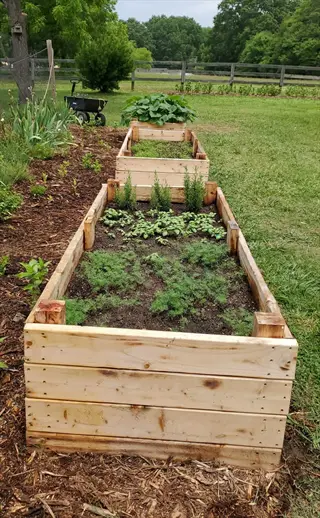
Leafy greens near the center
- Why here: Lettuce, kale, spinach, and Swiss chard are nutrient hungry, so they belong closest to the central basket.
- Feeding: They draw on the steady moisture and nutrients radiating outward from the compost basket in the middle.
- Harvest: Cut-and-come-again greens give repeat pickings through the season instead of one single harvest.
- Spacing: Dense intensive planting works because central feeding supports tight, productive spacing in a small bed.
- Diversity: Mixing several greens helps you reach the five-plus vegetable varieties the FAO links to better diets.
- Tip: Keep these greens watered through the basket so they stay tender rather than turning bitter in heat.
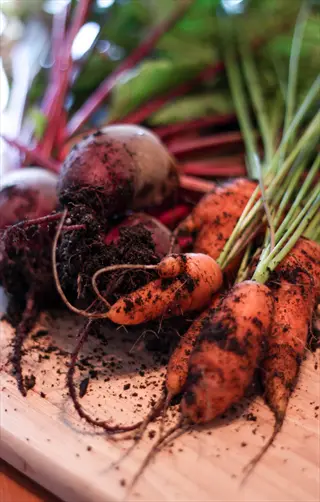
Root crops in the mid zone
- Why here: Carrots, beets, and radishes do well in the loose, fed soil between the center and the outer wall.
- Soil: The sand, topsoil, and compost mix gives roots the loose structure they need to size up cleanly.
- Spacing: Thin seedlings early so each root has room, since crowding gives small, twisted, or forked crops.
- Rotation: Move root crops to a different arc each season to keep pests and nutrient drain in check.
- Speed: Radishes mature fast and make a good first crop while slower beets and carrots fill in.
- Harvest: Pull roots as needed rather than all at once, which keeps the bed producing longer.
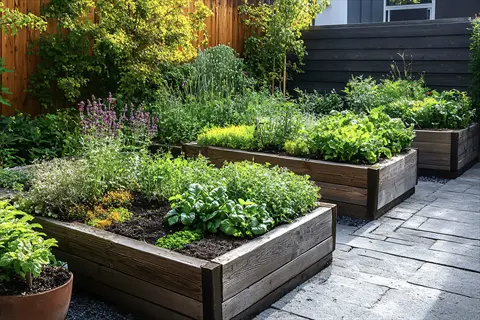
Herbs and alliums on the rim
- Why here: Onions, garlic, and tougher herbs tolerate the drier outer edge farthest from the basket.
- Pest help: Onions and garlic add natural pest resistance that protects neighboring vegetables.
- Companions: Marigolds are a classic companion plant that helps deter pests around the bed.
- Toughness: Rim plants face the least feeding and moisture, so choose hardy, drought-tolerant types here.
- Flavor: A ring of culinary herbs keeps seasonings within easy reach at the waist-high edge.
- Balance: Spreading alliums around the rim guards the whole bed rather than one single spot.
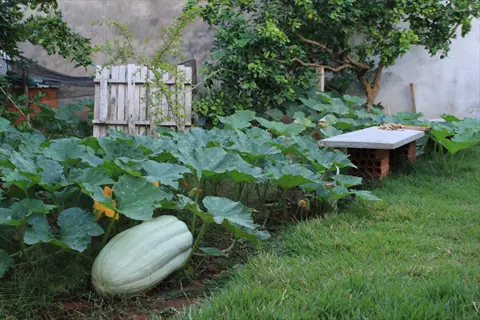
Crops to keep out
- Skip sprawl: Squash, pumpkins, and melons send out long vines that overrun the compact circular bed.
- Skip tall corn: Corn grows tall, shades its neighbors, and roots too deep for a raised keyhole bed.
- Skip big tomatoes: Large indeterminate tomatoes crowd and shade the bed and need more support than it offers.
- Why it matters: Oversized crops steal light and root room from the productive greens and roots you want.
- Better fit: Compact, fast, leafy, and root crops use the central feeding far more efficiently.
- Exception: A small determinate or patio tomato near the edge can work if you keep it pruned and contained.
Think in rings, not rows. Put your leafy greens by the basket, slot root crops in the middle band, and ring the outside with herbs and alliums. That simple order does most of the work, and it leaves you with a bed that keeps producing while you pick a little from each zone every week.
Honest Cons and Disadvantages
Every bed has tradeoffs, so here are the real keyhole garden disadvantages in plain terms. SDSU Extension lists these challenges right next to the perks. You deserve that same honest read before you dig.
The biggest of the cons of keyhole gardening is the front-loaded work. You pay for the bed once in labor, materials, and time, and that initial cost of effort lands all at the start. The payback comes slow but steady, since the soil stays fertile for 5 to 7 years before you rebuild.
After the build, the bed asks for steady upkeep. You feed the basket, you water through it, and that maintenance never fully stops. Soil temperature also swings more in a raised bed than in the ground, so cold regions need season covers to keep roots happy through a frost.
The round shape carries its own quirks too. Corners get wasted because the bed has none, and sprawling crops like pumpkins or melons fight the curved space. The layered fill breaks down slow, and the surface sinks as it settles. Here is each strength paired with its honest counterpoint so you can weigh the bed for your own yard.
- Waist-high bed is easy to reach with no kneeling or bending.
- Central basket recycles waste and keeps soil fertile for years.
- Works on rocky, dry, or compacted ground where in-ground beds fail.
- More water-efficient than a conventional bed once established.
- Upfront build takes real labor, materials, and time.
- Needs steady composting and watering to keep performing.
- Soil temperature swings, and cold regions need season covers.
- Round shape wastes corner space and rejects sprawling crops.
The layered fill breaks down slowly and the soil level sinks over the first year. Keep topping up the bed with compost and soil so the surface stays at a comfortable working height.
Cost, Climate and Care
Your keyhole garden cost can swing from almost nothing to the price of a bought kit. The FAO notes the bed needs no costly fertilizers or pesticides, so the wall is your one real expense. Scavenge stone, block, brick, or even sand-filled bottles and you can build the whole thing for free.
If you buy a raised-bed kit instead, you'll pay more up front but skip the heavy lifting. Either way, the running cost stays near zero. You feed the bed with kitchen scraps you already toss out, and you water through one central spot instead of soaking a whole plot.
Climate adaptation is where this design earns its reputation. The same bed handles drought and frost with small tweaks. Use the guide below to match your build to your weather.
Stone and brick walls do more than hold soil. They soak up heat through the day and give it back at night, acting as thermal mass. That stored warmth buys you weeks of extra growing time into autumn. It's the same reason the design produces even under frost in Lesotho's highlands, where nights drop hard.
Daily keyhole garden maintenance is short and simple. You water and feed through the central basket, then refill the basket as it sinks down. Top up the surface soil as it settles over the months. Plan to replace or rebuild the wire basket every one to two years, since the mesh rusts and weakens over time.
It was a hot, dry July morning, and I was tipping kitchen scraps into the central basket of my waist-high stone bed in the back corner. The thing sits about 6 feet (2 meters) across, and I followed the scraps with a full watering can poured straight down the middle. The greens packed around the basket stayed perky and green in the heat. The unmulched rim, just a foot away, had already gone limp by mid-morning. Water down the center reaches the roots while the edges bake.
Get the watering rhythm right and the rest takes care of itself. A bed that drinks from its core and feeds from your scraps asks little of you. And the season extension from those warm walls is real. You keep harvesting long after a flat plot has given up for the year.
5 Common Myths
A keyhole garden is just a fancy raised bed with no real advantage over a plain rectangular box of soil.
The central compost basket sets it apart, feeding moisture and nutrients outward from the middle, which a standard raised bed does not do.
Keyhole gardens were invented by a modern lifestyle brand as a trendy backyard kitchen-garden layout for social media.
The design originated in southern Africa, credited to Lesotho through C-SAFE and an earlier CARE project in Zimbabwe, as a food-security tool.
Because there is compost in the middle, a keyhole garden always smells bad and draws pests no matter how you manage it.
A balanced basket with dry and green material stays odor-free, and feeding only plant scraps keeps pest and rodent risk low.
Keyhole gardens only work in hot, dry climates like the African regions where they first became popular.
The thermal mass of stone walls extends the season into cold weather, and the design adapts to arid, wet, cold, and temperate climates.
A keyhole garden needs rich, deep, perfect soil to start, so it is useless on rocky or compacted ground.
The bed is filled and fed from above, so it performs on rocky, shallow, arid, or compacted ground where in-ground beds struggle.
Conclusion
A keyhole garden asks a lot of you up front. You stack the walls, layer the fill, and set the central compost basket before a single seed goes in. But that one hard weekend buys you years of easy growing. Once the bed is built, it feeds itself through your kitchen scraps and holds water far better than a flat plot. This is the trade at the heart of the design, and it runs through every benefit below.
The proof here is unusually solid for a backyard method. The strongest point comes from a 2024 Lesotho study of more than 2,000 homes. It tied keyhole gardening to a 30.60% chance of food security. The FAO found the soil in these beds stays fertile for 5 to 7 years before it needs a real refresh. Few raised bed methods come with numbers like that.
So the bottom line is plain. A keyhole raised bed pays back the hard build with years of low-maintenance, water-wise gardening. You can reach it all without bending or kneeling. It shines on poor ground, where rocky or compacted soil would sink most gardens. The waist-high walls and the keyhole notch put every plant within arm's reach, which matters more each year you garden.
This design started as a humanitarian fix for hungry families and now grows food in backyards across the world. That long, well-documented track record is its real edge. Looking forward, weigh your own soil, your climate, and how easily you move, rather than chasing the hype. If those line up with the build cost and the steady composting, you'll get a bed that earns its keep for the better part of a decade.
Glossary
- Anaerobic soil
- Waterlogged soil with little oxygen, often sour-smelling, which signals poor drainage and failing soil health.
- Central compost basket
- A wire-mesh cylinder set in the middle of the bed that you fill with kitchen scraps and water through, so moisture and nutrients spread to the surrounding soil.
- Food security
- Reliable, ongoing access to enough nutritious food, used in the research as the main measure of how well keyhole gardens help households.
- Indeterminate tomato
- A tomato variety that keeps growing tall and producing all season, which makes it too large and sprawling for a compact keyhole bed.
- Keyhole garden
- A roughly circular, waist-high raised bed with a wedge-shaped access notch and a central compost basket that feeds water and nutrients outward to the roots.
- Keyhole notch
- The wedge-shaped path cut into one side of the bed that lets you stand close enough to reach the central basket.
- Lasagna layering
- Building the bed in stacked layers of coarse material, grass, paper, and soil rather than digging, so it breaks down into rich growing medium over time.
- Thermal mass
- Heat stored in the stone or brick walls of the bed during the day and released slowly, which helps extend the growing season into cold weather.
External Sources
Frequently Asked Questions
Do keyhole gardens actually work?
Yes. Peer-reviewed Lesotho research links keyhole gardens to a 30.60 percent likelihood of food security, and FAO reports document real soil and harvest gains.
What are the cons of keyhole gardening?
Main drawbacks include the upfront build effort and cost, the need for steady composting and watering, soil-temperature swings, and poor fit for sprawling crops.
- Upfront build labor and material cost
- Ongoing composting and watering needed
- Soil temperature swings in cold regions
- Round shape limits sprawling crops like squash
Do keyhole gardens smell?
A well-balanced central basket should not smell. Odor usually means too much wet green material and not enough dry brown material for airflow.
What plants are good for keyhole gardens?
Leafy greens, root crops, herbs, and alliums grow well. Place nutrient-hungry leafy plants nearest the central basket for the strongest feeding.
- Leafy greens like lettuce, kale, spinach, and chard
- Root crops like carrots, beets, and radishes
- Herbs and onions or garlic for pest resistance
How big should a keyhole garden be?
The standard keyhole garden is 6 to 8 feet (about 2 meters) across and 2 to 3 feet tall, with a roughly 2-foot keyhole notch and central basket.
Do keyhole gardens have to be round?
No. Round is the classic shape, but the key feature is the central compost basket and access notch, so square or rectangular layouts also work.
Do compost heaps attract rats?
They can, mainly when meat, dairy, or cooked food is added. A central basket fed only plant scraps and kept moist stays much lower risk.
Is October too late to plant a keyhole garden?
Not necessarily. The bed's stone walls hold warmth and extend the season, so cold-hardy greens like kale and spinach can still establish in many regions.
What vegetables should not be grown in a keyhole garden?
Avoid sprawling, deep-rooted, or very large crops like squash, pumpkins, corn, and big indeterminate tomatoes that crowd the compact circular bed.
- Sprawling vines like squash and pumpkins
- Tall, root-heavy crops like corn
- Large indeterminate tomatoes that shade the bed
How can you tell if garden soil has gone bad?
Warning signs include a sour or rotten smell, water that pools instead of draining, no visible worms or life, compaction, and stunted, pale plants.
- Sour, rotten, or chemical smell
- Water pools or drains very slowly
- No worms or visible soil life
- Plants stay stunted, pale, or wilted