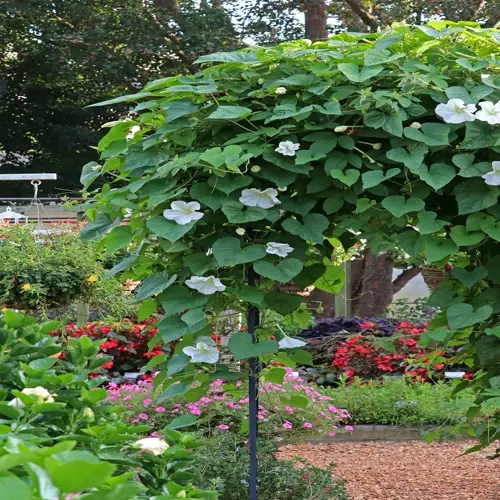

The clearest permaculture garden example is a backyard food forest, a small patch that grows food the way a real woodland grows trees. Picture a corner of a yard with an apple tree over waist-high berry shrubs. Below them sit mint and thyme, and strawberries run across the ground. Every level holds a plant, and each plant earns its spot.
This is what people mean by a food forest example. The tall fruit tree forms the canopy. Berry shrubs fill the middle. Herbs, greens and ground cover crowd the soil so weeds never get a foothold. You end up with four or five layers of food stacked in the footprint of a single tree.
The reason it works is that each plant does a job for the others. The deep tree roots pull up minerals. Beans and clover at ground level pull nitrogen from the air and feed it back to the soil. Flowering herbs bring in bees and the wasps that eat pests. Fallen leaves rot into mulch and feed the next season. You copy how a forest runs itself, so the garden needs little outside input once it settles in.
You can also look at the Three Sisters bed, a classic permaculture garden example. Native farmers grew it this way for hundreds of years. Corn grows tall and gives the beans a pole to climb. The beans feed the soil with nitrogen. Squash sprawls below with broad leaves that shade out weeds and hold water in the dirt. Three crops share one bed and help each other instead of fighting for space.
Most home gardens start smaller with a single guild. A guild is one fruit tree with a ring of helper plants around it, and it is the building block of any food forest. Here is how the parts of a basic apple guild split up the work.
The Fruit Tree
- Main crop: The apple or pear gives you the harvest and forms the center of the whole guild.
- Shade and shelter: Its branches protect smaller plants below from harsh midday sun and wind.
- Deep roots: It reaches 6 feet down or more to pull up minerals the shallow plants cannot reach.
Helper Plants
- Soil feeders: Clover and comfrey add nitrogen and nutrients, so you skip most store-bought fertilizer.
- Pest control: Daffodils and garlic ring the trunk and keep grass and rodents away from the roots.
- Bug magnets: Yarrow and dill bring in bees and the good bugs that hunt aphids for you.
Ground Cover
- Living mulch: Strawberries or creeping thyme cover bare soil and lock in moisture during dry spells.
- Weed block: A thick mat of low plants leaves no open dirt for weeds to take hold.
- Bonus food: You still pick berries and herbs from the same square foot that feeds the tree.
Small-space backyard permaculture uses the same ideas on a city lot or even a patio. Many urban gardeners map their yard into zones, putting the herbs and salad greens they pick daily right by the back door. Less needy plants like fruit trees and a compost pile sit farther out where you only visit them once in a while. This zone layout cuts your daily walking and keeps the busiest crops within arm's reach.
If you want the simplest version to copy, do not redesign your whole yard at once. Pick one tree you already own and build a single guild around it this season. Plant clover, a few herbs and some ground cover in a ring out to the drip line. You learn how the system feels on a small scale, and you can add a second guild next year once the first one proves itself.
Read the full article: Permaculture Garden: A Complete Guide