Bulb · Cannaceae
Canna Lily
Canna × generalis
Hand it full sun, rich moist soil, and summer heat, and the canna pays you back with bold leaves and flame-bright flowers right up to frost.
Full sun
Every 2–5 days
50–95°F · 10–35°C
70–120 days
Overview
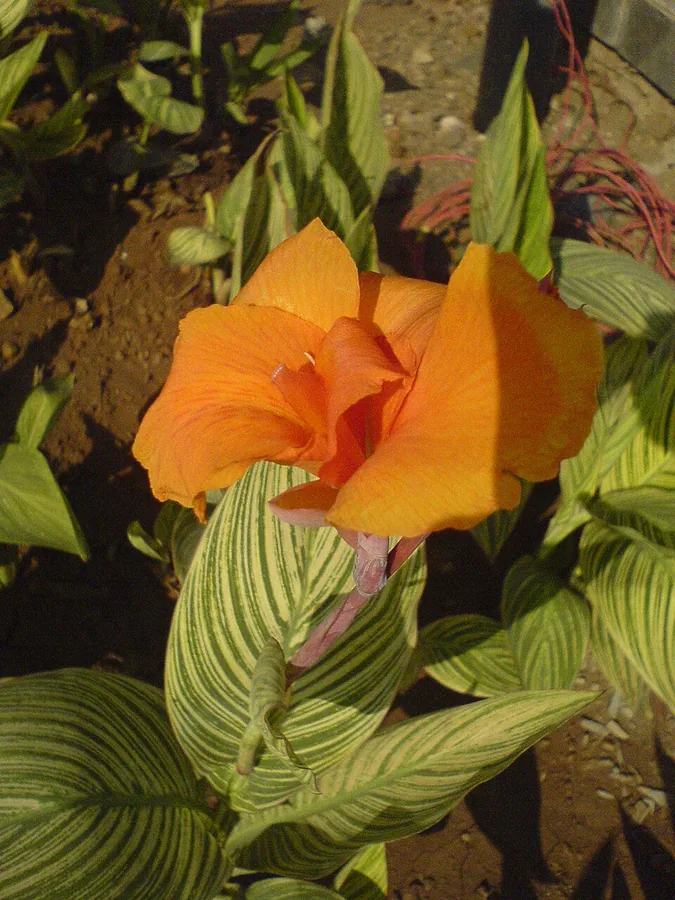
The canna lily gives a temperate garden a tropical feel, with wide paddle-shaped leaves and tall spikes of bold flowers. And despite the name, it's not a true lily at all. It's a rhizome-rooted perennial in the family Cannaceae, more closely related to gingers and bananas. It grows fast and gets big, ranging from a knee-high bedding plant all the way up to a giant pushing 8 feet (240 cm) tall.
Heat and water are exactly what this plant loves. Give it full sun and rich, moist soil, keep the water coming through the hot months, and it'll bloom from midsummer right up to the first frost. It powers through conditions that make pickier plants wilt, which is a big reason gardeners turn to it to anchor a bed or fill out a large pot.
Hardiness is the one real catch. In zones 7 to 10 the rhizomes can stay in the ground over winter, but anywhere colder you'll need to lift and store them once frost knocks the plant back. Dividing those rhizomes every couple of years keeps the clump healthy and gives you free new plants in the bargain.
Care
The short version: full sun, rich soil kept evenly moist, and lots of warmth. Feed it monthly while it's growing, split the clump every few years, and dig up the rhizomes for winter anywhere the ground freezes.
Light
Canna really wants full sun, at least six hours a day, to put on its best show of flowers. It'll get by in partial shade or partial sun, but you'll see fewer blooms and the stems tend to stretch and lean toward the light.
Water
Keep that soil evenly moist, especially while it's actively growing and during hot stretches. Canna is one of the rare garden plants that's okay with a little standing water, yet an established clump can also coast through a short dry spell. In the summer heat, plan to water every 2 to 5 days.
Soil
Give it rich, moist, well-drained ground with plenty of organic matter mixed in. It's pretty easygoing about pH and will take anything from 6.0 to 8.0, but drainage is the thing that really counts, because soggy soil will rot the rhizomes.
Temperature
Canna loves the heat and grows happily anywhere from 50°F to 95°F (10°C to 35°C). Cold is another story though, it has zero tolerance for it, so the first frost knocks it flat and you'll need to lift the rhizomes wherever winters freeze.
Humidity
Ordinary outdoor humidity is just fine, no number to fuss over here. Thanks to its tropical background, it never seems to mind muggy summer air.
Feeding
Feed it once a month with a balanced all-purpose fertilizer through spring and summer while it's growing hard. For a clump in the ground, a soil test is your best bet for figuring out how much it really needs.
Pruning
Snip off the spent flower stalks to keep fresh blooms coming and the plant looking neat. Then, after the first fall frost in cold zones, cut the foliage back to 2 to 3 inches (5 to 8 cm) before you dig the rhizomes up for storage.
Repotting
Canna doesn't ask for regular repotting, but a crowded clump does need dividing every 2 to 3 years. Keep an eye out for dense growth, fewer flowers, or rhizomes poking up out of the soil, all clues that it's outgrown its spot.
Size & spacing
Depending on the type, plants run from 18 inches to 1.5 to 8 feet (46 to 239 cm) tall, so it pays to check the variety before you decide where it goes. Space the rhizomes 1.5 to 3 feet (45 to 90 cm) apart so those big leaves have room to open up.
When to plant
Canna lives on warmth and can't handle frost at all. Where winters are cold, get the rhizomes going indoors about a month before the last frost, move them outside once the soil warms up, and you'll see flowers from midsummer through the first fall frost.
Northern hemisphere
Southern hemisphere
Typical months for a temperate climate: start earlier in warm zones, later where spring frosts linger.
- Sow: Start rhizomes indoors in pots 3-4 inches deep about 4-6 weeks before the last frost in cold zones.
- Plant: After the last frost when soil has warmed, planting rhizomes 3-4 inches deep and 18-36 inches apart.
- Harvest: Blooms mid-summer through the first fall frost (about July to September).
Hardiness
USDA hardiness zones: 7–10
Temperature: down to -18°C
Troubleshooting
Most canna headaches come down to one of two things: soggy soil or a few familiar pests, and they tend to show up either on the leaves or on the rhizomes. Spot it early and you can usually rescue the plant, or at least the rest of the clump. Find what matches below, then jump on it before it spreads.
Mushy rhizomes and growth that stalls or flops over
What you're seeing here is rhizome rot, and soil that stays too wet is nearly always behind it. Dig up a rhizome and you'll meet soft, brown, foul-smelling tissue, sometimes paired with bud rot or bacterial blight. Toss the rotted bits, replant only the firm pieces in soil that drains well, and back off on the water.
Fix:
- Lift and discard rotted rhizomes
- Replant healthy firm sections in well-drained, organically rich soil
- Reduce watering and improve drainage
New leaves coming in streaked, mottled, or twisted
If you've got yellow streaking and warped leaves that won't straighten out no matter how you water or feed, you're likely looking at canna mosaic virus or aster yellows. Once a plant catches it, there's no fixing it. Pull it, destroy it, keep the sap-feeding bugs under control, and never take cuttings from a rhizome you think might be carrying the virus.
Fix:
- Remove and destroy infected plants to limit spread
- Control insect vectors
- Do not propagate from infected rhizomes
Leaves that are chewed, holed, or rolled tight
When leaf edges are rolled up or webbed, the canna leaf roller is usually hiding inside, and it's the most common offender. The bigger ragged holes and the slime trails? That's Japanese beetles, slugs, and snails. Just pick the pests off by hand, pull the wrecked leaves, and tidy up plant debris so fewer of them survive into next season.
Fix:
- Hand-pick caterpillars, beetles, slugs, and snails
- Remove and destroy rolled or damaged leaves
- Apply an appropriate labeled control if infestation is heavy
Toxicity
Good news if you've got pets or little ones: the canna lily is safe. The name throws people off, but it isn't a true lily and has none of the poison those plants carry. The ASPCA lists it as non-toxic to cats, dogs, and horses, and that starchy rhizome is actually eaten as food in some countries.
Safe for
People · Cats · Dogs · Horses · Rabbits · Livestock · Birds
Cats None
Totally fine around cats. The ASPCA puts canna on the non-toxic list, so a curious nibble isn't going to poison anyone.
Dogs None
Nothing to worry about with dogs either. If one chews a leaf or digs up a rhizome, the worst that happens is maybe a mild tummy upset from the roughage.
Horses None
Horses can graze right next to canna and be perfectly fine, since the ASPCA flags it as non-toxic to them too.
Rabbits Safe
There's no known toxin in the foliage, so rabbits wandering the garden are no problem at all.
Livestock Safe
Cattle, goats, and sheep won't be poisoned by canna; the plant simply doesn't hold anything that bothers grazing animals.
Birds Safe
Birds are perfectly safe around canna, and those hard seeds just pass right through them.
People Safe
No worries for kids or adults. In fact, the rhizome is eaten as a starchy food in some parts of the world.
No special handling required for toxicity; wear gloves if sensitive when dividing rhizomes.
Varieties
Cannas come in everything from short bedding plants to towering giants, in colors that run from soft cream to fiery red. A handful of names keep popping up, so these are the ones worth getting to know.
Tropical Series
A small, seed-grown line bred to stay compact enough for pots and bedding spots.
South Pacific Scarlet
An award-winner started from seed that puts out bright scarlet blooms.
Canna indica (Indian Shot)
The wild type, with flame-red flowers and hard round seeds that earned it the Indian Shot nickname.
How to propagate
Canna is easiest and most dependable to multiply by division, which keeps a variety true, though if you've got patience you can also grow it from those hard, shot-like seeds.
DivisionEasy
Spring at planting time, or in fall when lifting rhizomes for storage; divide crowded clumps every 2-3 years. · 2 to 6 weeks
Division is the simplest way to get more canna, and it's the only way to keep a variety true to itself. Split the rhizomes in spring, or while you're lifting them in fall, just make sure every piece has at least one eye, then leave the cut surfaces to dry for a few days before replanting. Do this with a crowded clump every 2 to 3 years and the new pieces settle in within about 2 to 6 weeks.
SeedModerate
Spring, started indoors. · Several weeks to germinate
Going the seed route is slower and a bit of a gamble. Those hard-coated seeds, the very ones that earned the Indian Shot name, want a nick and a soak before they'll wake up, and even then they take several weeks to germinate. Start them indoors in spring, but know that seed-grown plants may not come true to type.
Myths
The canna lily is a true lily and is just as toxic to pets as other lilies.
Here's the thing: canna isn't a lily at all. It sits in the family Cannaceae rather than Liliaceae, and the ASPCA lists it as non-toxic to cats, dogs, and horses. That shared name is really the only link it has to the lilies that actually hurt pets.