Bulb · Araceae
Caladium
Caladium bicolor
Big, painterly leaves that pop brightest in the shade.
Partial shade
Every 2–4 days
61–86°F · 16–30°C
60–90 days
Overview
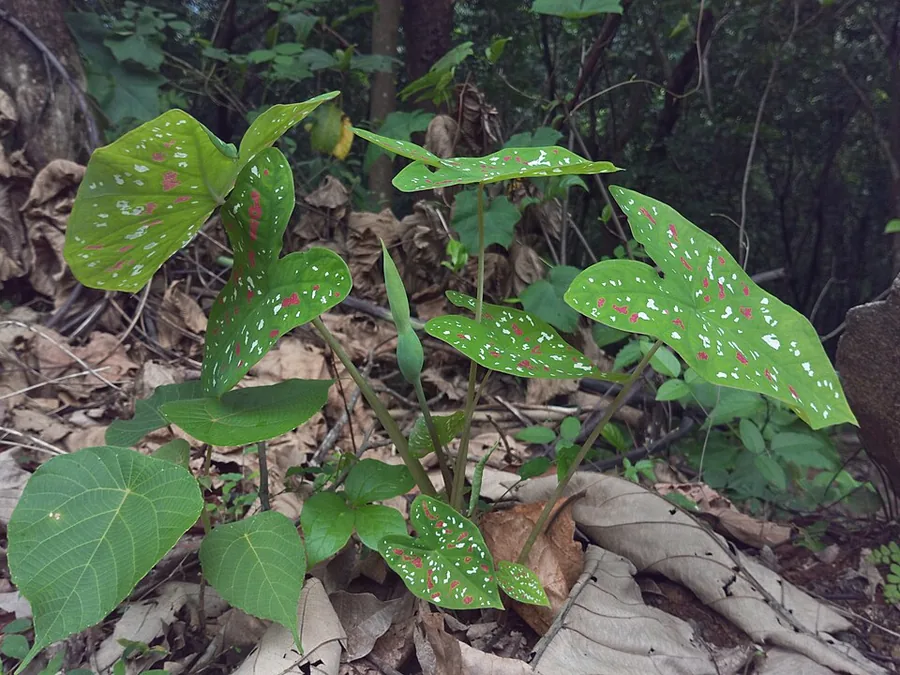
Caladium is one of those plants you grow purely for the leaves, and what leaves they are: broad, heart-shaped, and splashed with red, pink, white, and green. The trick most folks get wrong? These tropical beauties color up best in partial or dappled shade, not full sun, which is where so many people slip up.
Treat it as a warm-season grower that fills out fast. From a tuber, the foliage reaches full size in one season, then the plant slips into winter dormancy. It works happily as a container plant indoors or a bedding plant outside, hitting roughly 12 to 30 inches (30 to 76 cm) tall and just as wide.
It's rated moderate to grow mainly because timing and warmth really matter. Tubers want warm, well-drained soil and steady moisture, and they sulk or rot if you rush them into cold ground. Worth knowing up front: every part holds calcium oxalate crystals, so keep it clear of curious pets and kids.
Care
The short version: give caladium partial or dappled shade, warm temperatures, and soil kept evenly moist but never soggy. Feed lightly, since heavy feeding washes the color out toward green, and don't plant tubers until the ground warms to 60°F to 70°F (16°C to 21°C). Remember it's a tropical that goes dormant in winter, and that all parts are mildly toxic if chewed.
Light
Aim for partial or dappled shade, which is exactly where the leaf color comes in deepest. A spot with 2 to 4 hours of gentle sun suits it nicely, while bright indirect light, partial sun, and even full shade are all tolerated. Just keep it clear of harsh afternoon sun, which scorches the fragile leaves and fades the bright tones.
Water
Think of caladium as a water guzzler while it's actively growing. Keep the soil evenly moist to the touch, watering about every 2 to 4 days, but never let it sit waterlogged, since soggy soil rots the tubers. As the leaves start yellowing into dormancy, ease off the watering.
Soil
Go with fertile, well-drained soil that's rich in organic matter. Caladiums lean slightly acidic, so shoot for a pH of 5.5 to 6.0. Good drainage really is the make-or-break factor, because tubers sitting in heavy, wet soil are the ones that rot.
Temperature
This is a tropical through and through, comfiest between 61°F and 86°F (16°C to 30°C). Cold is its weak spot, so don't plant out or move it anywhere chilly. Once temperatures dip in autumn, expect the foliage to fade as the plant heads into dormancy.
Humidity
Caladiums love it humid, so aim for high humidity at 60% or more. In a dry room the leaf edges can suffer, so grouping plants together or sitting them near a humid spot helps keep them happy.
Feeding
A light touch wins here. Through the growing season, spring into summer, feed every two weeks with a balanced liquid fertilizer for containers, or reach for a slow-release low-phosphorus formula. Easy does it, though, because too much fertilizer fades the reds and whites to green.
Pruning
There's not much to it. Just snip off any yellowing or damaged leaves right at the base. Here's a handy trick: cut out the prominent central bud on a tuber before you plant it, and you'll get more shoots and leaves for a fuller look.
Repotting
Plan to replant each year when you set out stored tubers in spring. Established clumps, on the other hand, do best left alone. Watch for crowded or stunted leaf emergence, tubers lifting at the soil surface, and leaves shrinking in size and vigor as the season wears on.
Size & spacing
Give each plant some elbow room. Caladium reaches about 12 to 30 inches (30 to 76 cm) tall and spreads to a similar width. When planting tubers, set them eye-side up around 2 inches deep and space them 8 to 12 inches apart so they have room to fill in.
When to plant
Caladiums run on warmth, so timing is everything here. Start tubers indoors ahead of the season if your winters are cold, then move them outside only once frost is long gone and the soil has warmed up properly.
Northern hemisphere
Southern hemisphere
Typical months for a temperate climate: start earlier in warm zones, later where spring frosts linger.
- Sow: Start tubers indoors 4-6 weeks before the last frost in a warm spot, keeping the medium about 70 degrees F, to get a head start in cold-winter regions
- Plant: After all danger of frost has passed and soil reaches at least 60-70 degrees F (late spring to early summer)
- Harvest: Grown for foliage, which reaches full size in one season; insignificant arum-type spathe flowers may appear in summer
Hardiness
USDA hardiness zones: 9–10
Temperature: down to -7°C
Troubleshooting
Most caladium headaches trace back to two things: cold or wet soil at planting, and too much sun once the leaves are up. Here's how to spot the usual problems and sort them out.
When tubers just sit there and rot instead of pushing up shoots
Nine times out of ten, soil that's cold and wet is why caladium tubers stall out or rot before anything sprouts. Hold off planting until the ground stays put at 60°F to 70°F (16°C to 21°C), loosen things up so the soil drains and stays moist without going soggy, and chuck any tuber that's gone soft. Want to keep fungal tuber rot out of the bed altogether? Start with clean, disease-free stock.
Fix:
- Wait to plant until soil is consistently 60-70 degrees F
- Improve drainage and reduce watering so soil is moist but not saturated
- Discard soft or rotted tubers and start with disease-free stock
Leaves dropping their red, pink, and white for plain green
If those bright markings start washing out toward green, the culprit is usually too much direct sun or a heavy hand with the fertilizer. Tuck the plant into partial or dappled shade, away from harsh afternoon light, and ease feeding back to just a touch once or twice a season. Shade is what keeps the color rich, so the deeper the dapple, the bolder those leaves get.
Fix:
- Move to partial or dappled shade with protection from hot afternoon sun
- Reduce fertilizer to a light application once or twice in the season
Chewed-up edges and holes all over the leaves
When caladium foliage looks gnawed, it's usually slugs and snails doing the damage. They come out after dark and leave shiny slime trails as proof. Pick them off by hand at night or put down some bait, then clear out the damp corners where they like to hide. Now, if the leaves look torn rather than chewed, that's more likely wind or hail roughing up the brittle foliage, so a sheltered spot does wonders.
Fix:
- Hand-pick slugs and snails or use baits per label
- Site out of strong wind to protect brittle leaves
Toxicity
Every part of a caladium carries insoluble calcium oxalate crystals, so a bite brings on fast mouth and gut irritation. The good news is the effects are usually mild and stay local, but it's still smart to keep the plant and any stored tubers out of reach.
Toxic to
Cats · Dogs · Horses · Rabbits · Livestock · Birds · People
Cats Toxic
Bite into a leaf and a cat feels the sting right away, pawing at its face and drooling heavily. Expect the lips, tongue, and throat to puff up, often with vomiting and trouble swallowing close behind.
Dogs Toxic
A dog that chews any part gets a sharp burn in its mouth, lots of drool, and a swollen tongue. Most quit pretty fast, though vomiting and a skipped meal can hang around for the rest of the day.
Horses Toxic
Those crystals set a horse's mouth and lips on fire the moment they touch, so you'll see pain, drooling, and hard swallowing. Since horses can't vomit, the soreness just stays put right where the plant got bitten.
Rabbits Toxic
Rabbits run into the very same needle-like crystals, which scald the mouth and gut and kill their appetite. Best move? Keep the plant and any stored tubers well beyond their reach.
Livestock Toxic
Grazers like goats, sheep, and cattle end up with a sore mouth and gut if they nibble the leaves. Most spit it back out quick since the burn hits instantly, but it's smart to keep these plants clear of pasture.
Birds Toxic
The oxalate raphides bother a bird's mouth and crop the same way they bother mammals, so pet birds should never get anywhere near the leaves or sap.
People Caution
None of this plant is edible. One bite and your lips and mouth burn instantly, with drooling and swelling, and the sap can leave skin itchy too. So wash your hands after handling and keep it away from kids.
Keep plants and stored tubers out of reach of pets and children; wash hands after handling sap.
Helpline numbers

United States
ASPCA Animal Poison Control: (888) 426-4435 (fee applies)
Poison Control: (800) 222-1222



Canada
Poison Centres: 1-844-764-7669
Varieties
Caladiums come in two broad camps, the wide fancy-leaved kinds and the slimmer strap-leaved ones, plus loads of named cultivars. Here are a few worth knowing.
Candidum
An old-school fancy-leaved pick, loved for nearly white leaves traced with strong green veins.
Pink Cloud
A named fancy-leaved cultivar on NC State's list, showing off softly pink-tinted foliage.
Lance-leaved (strap-leaved) types
Narrower and usually staying under 12 inches tall, these handle more sun than the fancy-leaved sorts do.
How to propagate
Making more caladiums is genuinely easy, and it all happens through the tubers. You can either divide a big one or pull off the little daughter tubers it grows on its own.
DivisionEasy
Late winter to early spring before planting, while tubers are dormant · 4-6 weeks to sprout in warm soil; full size in one season
Split tubers in late winter or early spring while they're still dormant. Slice a big one into chunks, making sure each piece keeps at least one eye, let the cut faces dry and callus, then set them eye-side up around 2 inches deep. Given warm soil, the pieces push up shoots in 4 to 6 weeks and grow to full size inside that single season.
Offsets & pupsEasy
At lifting in autumn or replanting in spring · One growing season to reach mature size
Caladiums also grow their own daughter tubers right around the parent. Dig up the clump in autumn, or when you replant in spring, pop the offsets loose, and plant them out solo, where they'll need just one growing season to reach mature size.
Myths
Caladiums need full sun to develop their bright leaf colors.
Actually, it's the opposite. Color shows up deepest under partial or dappled shade, while too much direct sun fades the reds, pinks, and whites toward green and scorches those delicate leaves.
You can plant caladium tubers in early spring like other hardy bulbs.
Caladiums are tropical, so they'll rot or stall in chilly ground. Hold off until the soil hits at least 60°F to 70°F (16°C to 21°C) before tucking the tubers in, which usually lands in late spring rather than the season's first warm day.