Houseplant · Araceae
Black-gold Philodendron
Philodendron melanochrysum
Give it warm, humid air and a pole to climb, and this velvet-leaved philodendron rolls out deep, glittering foliage.
Bright indirect
65–85°F · 18–29°C
USDA 10–12
Overview
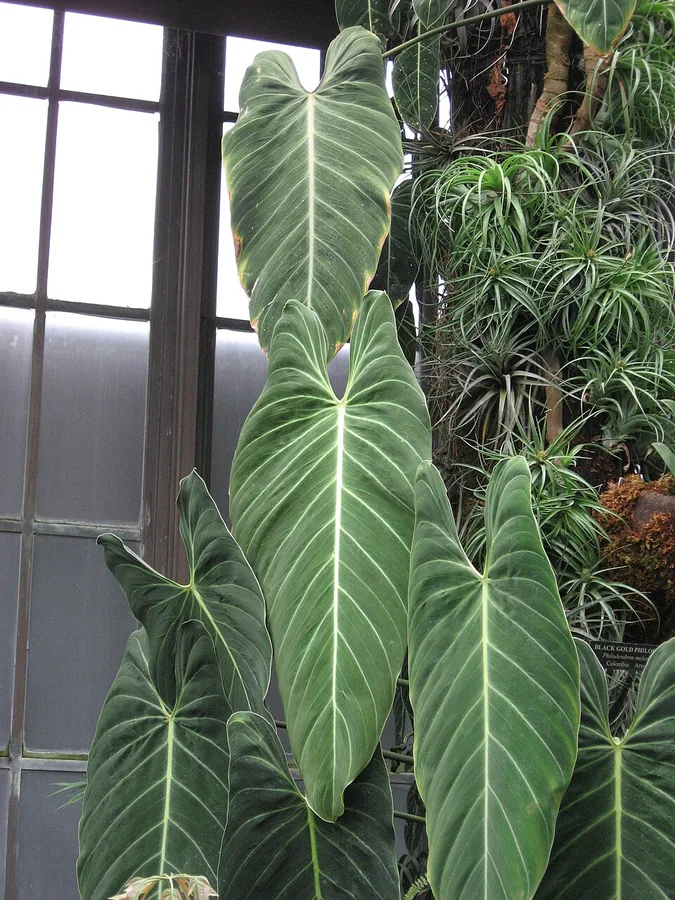
People grow the black-gold philodendron for those long, drooping leaves, which start out coppery bronze and settle into a near-black velvet laced with gold veins. It's part of the arum family, and out in the wild it climbs the wet forests of Colombia, hauling itself up tree trunks to reach the light. It wants to do the exact same thing at home, so give it a moss pole or slab to grab onto and the leaves grow to their full size.
Think climbing aroid here, not a tidy little tabletop plant. The stems stretch fast when it's warm, and the leaves get bigger the higher it climbs, which is exactly why the support matters so much. Give it bright indirect light, steady warmth, and humid air, and you get one of the boldest leaf textures around.
Sure, it asks for a bit more than your average philodendron, mostly around humidity and even moisture. But nail those two and it's pretty easygoing about everything else. Let the air dry out or the roots stay soggy, though, and those velvet leaves won't be shy about letting you know.
Care
The short version: it's happiest with bright indirect light, cozy warmth from 65°F to 85°F (18°C to 29°C), plenty of humidity, and a chunky mix that drains well and stays lightly damp without going soggy, plus something tall to scramble up.
Light
Give it bright indirect light, the kind you get near a window with a sheer curtain over it. It'll put up with medium light and even low light for a while, but direct sun scorches those velvety leaves, so keep it back from the glass.
Water
Keep the mix evenly moist but never soggy, and never let the pot sit in water. Soggy roots are the quickest way to lose this plant, since bad drainage brings on root rot. So let the surface dry out a little between waterings instead of keeping it wet.
Soil
Go with a well-draining potting mix high in organic matter so water runs right through. It likes things a bit acidic, with a pH at or below 6.0, and a chunky aroid blend with bark and perlite keeps air around the roots.
Temperature
Warmth is what it's after, ideally between 65°F and 85°F (18°C to 29°C). It won't tolerate cold drafts or chilly windowsills at all, so keep it well away from doors and vents in winter.
Humidity
This one wants high humidity, and that's where its tropical side shows. The drier the air, the more likely you'll see brown tips and spider mites, so group it with other plants or run a humidifier nearby.
Feeding
Feed it monthly through the spring and summer growing season with a dilute water-soluble fertilizer, roughly a 3:1:2 or 3:1:3 ratio, or a slow-release feed. Keep it light, because overfeeding curls and browns the leaf tips.
Pruning
Train and prune the climbing stems to keep the size and shape in check. Most of all, give it a moss pole or slab to climb, since that natural climbing habit is what pushes the leaves to their biggest and best.
Repotting
Repot whenever it outgrows the pot and the roots start crowding things, and you can do it any season. Just bump it up one pot size into fresh well-draining mix rather than jumping to a much bigger container.
Troubleshooting
Most of the trouble with this plant comes back to watering and humidity, and the good news is the leaves let you know early. Learn to catch that first browning tip or speckled leaf and you can jump in before it spreads. Find what matches below, then act while it still makes a difference.
Yellow, floppy leaves and dark, mushy roots
Yellow, floppy leaves and roots that feel dark and mushy? That's root rot, and it comes from soil that just won't dry out. Back off the watering and dump whatever's pooled in the saucer. Then repot into fresh well-draining mix and snip off any roots that have gone soft.
Fix:
- Reduce watering frequency and empty standing water from the saucer
- Repot into fresh well-draining mix and trim away rotted roots
Speckled, bronzy leaves with fine webbing
See fine speckling and thin webs under the leaves? Dry air has let spider mites move in, and they feed on the undersides. Give the foliage a good rinse, wipe the leaves down, and treat with insecticidal soap or horticultural oil. And here's the easy part: keep the humidity up and they'll find the plant a lot less appealing.
Fix:
- Rinse foliage and wipe leaves
- Treat with insecticidal soap or horticultural oil
- Raise humidity
White cottony patches, sticky spots, or little bumps along the stems
Little cottony clusters mean mealybugs, soft huddled insects are aphids, and hard waxy bumps are scale, and all of them leave a sticky honeydew behind. Dab them off with a swab dipped in alcohol, then follow up with insecticidal soap or horticultural oil. And move the plant away from the rest of your collection until it's totally clean.
Fix:
- Wipe pests off with an alcohol-dipped swab
- Treat with insecticidal soap or horticultural oil
- Isolate the affected plant
Silvery flecks with tiny dark specks
Silvery patches dotted with tiny black specks? That's thrips, skinny little insects that scrape away at the leaf surface. Pull off the leaves that got hit worst, then treat with insecticidal soap or a suitable insecticide. And keep it apart from your other plants while you get the numbers down.
Fix:
- Remove heavily infested leaves
- Treat with insecticidal soap or an appropriate insecticide
- Isolate the plant
Crispy brown tips and curling leaf edges
Crispy tips usually come down to a fertilizer salt buildup, but dry air or hard sun can do it too. Just run plain water through the pot to rinse those salts away, and ease up on the feeding. Then bump up the humidity and keep it in bright indirect light, well out of direct sun.
Fix:
- Flush the soil to leach excess fertilizer salts and reduce feeding rate
- Raise humidity (group plants, pebble tray or humidifier)
- Move to bright indirect light out of direct sun
Clear brown or black spots on the leaves
Those round spots, sometimes with a yellow ring around them, are fungal or bacterial leaf spot, and wet leaves are what get them started. Pick off the spotted leaves and get some air moving around the plant. And water down at the soil so the leaves stay dry.
Fix:
- Remove affected leaves
- Avoid wetting the foliage and improve air circulation
Toxicity
Heads up, this one's toxic. Every part holds insoluble calcium oxalate crystals, the same irritant you find all over the arum family, and chewing any of it burns the mouth and throat. So keep it out of reach of cats, dogs, horses, and little kids, and wash your hands after you prune or take cuttings.
Toxic to
Cats · Dogs · Horses · Rabbits · Livestock · Birds · People
Cats Moderate
If a cat bites a leaf, it gets an instant sting from the calcium oxalate crystals right in the mouth. You'll want to watch for lots of drooling, pawing at the face, a puffy tongue and lips, and trouble swallowing, and sometimes a bit of vomiting too.
Dogs Moderate
One chew and a dog's mouth, tongue and lips start burning and swelling, and the drool really starts flowing. Plenty of dogs will gag, throw up, or paw at the muzzle once that irritation gets going.
Horses Moderate
Those same crystals leave a horse's mouth and throat sore, so it drools and doesn't want to eat. And since horses can't vomit, that discomfort and the trouble swallowing tend to stick around.
Rabbits Toxic
The leaves and stems have those same irritating crystals, so this isn't something a rabbit should nibble on. If one does chew it, its mouth can get sore and swollen, and it might turn its nose up at food for a bit.
Livestock Toxic
Grazers like goats, sheep and cattle react to the calcium oxalate with a sore mouth, drooling, and an upset gut. So keep this plant well out of reach of anywhere your stock can get to.
Birds Toxic
A nosy bird that pecks at the leaves gets that same burning irritation in its beak and mouth. Honestly, it's best to keep pet birds away from it completely.
People Caution
No part of this plant is meant for eating. Chew a leaf and it burns the mouth and throat, and handling the cut stems can leave your skin itchy or sore, so wash your hands after and keep it away from little kids.
Sap and cell contents contain calcium oxalate raphides; chewing or sap contact can irritate the mouth, throat and skin (contact dermatitis)
Helpline numbers

United States
ASPCA Animal Poison Control: (888) 426-4435 (fee applies)
Poison Control: (800) 222-1222



Canada
Poison Centres: 1-844-764-7669
How to propagate
Making new plants from this philodendron isn't hard at all. You can root a stem cutting, or air-layer one of the thicker climbing stems.
Stem cuttingsModerate
Any season (active growth in spring-summer is most vigorous) · Buds break in about 3-5 weeks and roots form in about 4-6 weeks
Snip off a stem cutting with at least one node and a leaf still on it, then stand it in a moist medium to root. You can do this any time of year, though it'll move fastest during the spring and summer growth. Just don't rush it, because the buds break in about 3 to 5 weeks and the roots show up in roughly 4 to 6 weeks.
Air layeringModerate
Any season · Several weeks for roots to form before severing
Got a thick climbing stem? Air-layering is the safer bet. Wrap a node in damp sphagnum moss and just leave it alone for several weeks until roots poke through, then cut the stem right below the new roots and pot it up.
Myths
Philodendrons are totally fine to have around pets.
Not quite. The ASPCA lists philodendron as toxic to cats, dogs and horses, and every part is packed with insoluble calcium oxalate crystals. A pet that chews a leaf ends up with a burning, swollen mouth, loads of drool, and trouble swallowing. So treat it as a keep-out-of-reach plant, not a safe one.
Without some direct sun, this philodendron loses its color.
Nope, what it really wants is bright light filtered through a curtain, and direct sun just scorches those velvety leaves. Most philodendrons even get along fine in low light, so there's really no reason to leave it cooking on a hot windowsill.
Extra fertilizer means quicker, fuller growth from a philodendron.
If only, right? Pile on the fertilizer and the leaf tips just curl and brown as the salts build up. A dilute, regular feed is really all it wants, and a slightly hungry plant bounces back way more easily than an overfed one.