Shrub · Lamiaceae
Bluebeard
Caryopteris × clandonensis
Give bluebeard a hard cut every spring and you'll get a haze of blue flowers back, right as the rest of the garden's winding down.
Full sun
Every 7–14 days
USDA 5–9
24–35 in · 60–90 cm
Overview
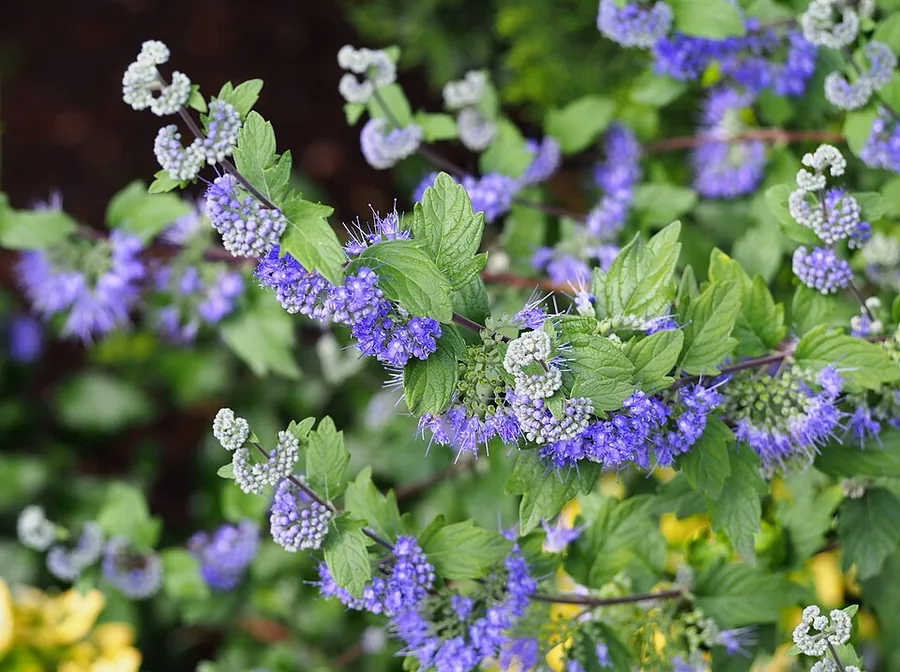
Bluebeard is a small deciduous shrub that's grown for the cloud of blue flowers it throws out in late summer. It's part of the mint family, and it stays nice and neat at 2 to 3 feet (60 to 90 cm) tall and about the same wide, so it's easy to slot into a border or a sunny corner. Brush past those gray-green leaves and you'll catch a clean little scent.
What really makes this shrub stand out is when it shows up. The flowers open from July into September, well after most shrubs are done, and they bring in bees and butterflies right when other nectar's getting scarce. And because it blooms on new wood, it just rebuilds itself every year after a hard spring cut.
Once it's settled in, bluebeard barely asks for anything. Give it full sun and lean, fast-draining soil and it'll shrug off heat and drought no problem. Its one real weak spot? Wet feet, so the quickest way to lose one is to leave it sitting in soggy ground.
Care
The short version: full sun, lean and well-drained soil, a deep drink only when the top of the soil dries, and a hard cut back to 6 to 12 inches every late winter or early spring.
Light
Give bluebeard full sun, ideally 6 or more hours a day. It'll take a bit of partial shade, but shade is the quickest way to end up with weak, floppy stems and only a few flowers.
Water
Once it's established, this is a drought-tolerant shrub, so it won't ask for much. Water it deeply, but only when the top half of the soil's dried out, roughly every 7 to 14 days, and never let it sit in standing water, because that rots the crown and roots.
Soil
Plant it in average, loose, well-drained soil, either loamy or sandy. Rich ground actually does more harm than good here, and wet feet are the one thing it just can't survive, so drainage matters way more than fertility.
Temperature
Bluebeard's hardy across a big range, from about -20°F to 100°F (-29°C to 38°C). At the colder end it might die back to the ground over winter and resprout in spring, which honestly suits its bloom-on-new-wood habit just fine.
Humidity
Plain old outdoor humidity is all it needs, so there's nothing to keep an eye on. Good airflow and dry roots matter way more to it than any moisture in the air.
Feeding
Keep feeding light. A single balanced feed or some compost in spring is plenty, and overdoing it just gets you soft, floppy stems that flop over and don't flower well.
Pruning
This is the one job that really matters. Cut the whole plant back hard to 6 to 12 inches (15 to 30 cm) in late winter or early spring before new growth starts, since all the flowers come on the fresh wood that follows.
Repotting
Bluebeard's a ground plant, so it rarely needs repotting. If you do keep one in a pot, only bump it up a size when the roots circle around or water runs straight through.
Size & spacing
Plants make a tidy little mound of 2 to 3 feet (60 to 90 cm) tall and roughly the same across. Give each one about that much room so air can move around and the rounded shape fills in.
When to plant
Bluebeard runs on a pretty simple yearly rhythm. Pop new plants out in spring once the frost's gone, cut established shrubs back hard before they wake up, and the blue flowers turn up from midsummer into early fall.
Northern hemisphere
Southern hemisphere
Typical months for a temperate climate: start earlier in warm zones, later where spring frosts linger.
- Plant: spring after last frost
- Harvest: late summer to early fall (July-September)
Hardiness
USDA hardiness zones: 5–9
Temperature: down to -29°C
Troubleshooting
Bluebeard doesn't give you much grief, and what little it does almost always comes back to soggy soil or not enough sun. Spot the early signs below and the fix is usually just better drainage, more light, or a well-timed prune.
Wilting and black lower stems when the soil is already wet
Wilting and blackened stems on a plant that's getting plenty of water? That's crown and root rot, and it shows up when the roots are stuck sitting in soggy ground. Dig down a bit and you'll likely find dark, mushy roots and soil that's still wet ages after you watered. Pull out the worst plants, work some grit into the bed or shift the shrub somewhere raised and quick draining, and back right off the watering.
Fix:
- Remove and discard severely affected plants
- Improve drainage by amending soil with grit or replanting in a raised, well-drained site
- Reduce watering frequency
Hardly any flowers on floppy, weak stems
Floppy stems and barely any flowers usually come down to too much shade, a skipped spring prune, or soil that's too rich. Here's the thing: bluebeard flowers on new wood, so move it into full sun, give it a hard cut in late winter or early spring, and ease off the feeding. Lean soil and a bright spot, and the blooms come right back.
Fix:
- Site in full sun (6+ hours)
- Cut back hard in late winter or early spring to force vigorous flowering new growth
- Avoid overfeeding and overly rich soil
Toxicity
Good news if you've got animals around: bluebeard is safe. The ASPCA lists it as non-toxic to pets, and there's nothing on record about it hurting livestock, birds, or people. So plant it wherever curious noses like to wander.
Safe for
People · Cats · Dogs · Horses · Rabbits · Livestock · Birds
Cats None
Got a cat? No worries here, since a little nibble won't poison it. About the worst that could happen is a queasy stomach for a day if it really goes to town on the leaves, and that's true of pretty much any plant.
Dogs None
Dogs are fine around bluebeard, because there's no toxin in it that bothers them. If one chews a stem, you might see a bit of loose stool, but that sorts itself out.
Horses Safe
You can plant it right where horses graze and not give it a second thought, since there's nothing in it known to hurt them.
Rabbits Safe
Rabbits are perfectly safe around it, and honestly they tend to walk right past the scented leaves anyway.
Livestock Safe
Cattle, goats, and sheep have nothing to fear from this shrub, and those strong-smelling leaves rarely tempt a grazer to bother with it.
Birds Safe
Birds are totally safe near bluebeard. And since the late summer flowers pull in bees and butterflies, the shrub turns into a pretty lively little spot in the garden.
People Safe
None of the plant is poisonous to people. It's not something you'd grow to eat, so there's no reason to taste it, but a stray leaf won't do you any harm.
No special handling required; as with any plant, ingestion of large amounts may cause mild gastrointestinal upset.
Varieties
A handful of named cultivars cover most of what you'll see at the nursery, and they mostly differ in flower shade, leaf color, and size. These are the ones worth knowing about.
Dark Knight
A compact little 2 to 3 foot mound that's covered in deep blue to bluish-purple flowers.
Longwood Blue
One of the taller ones at about 4 feet, with violet-blue flowers that pop against silvery gray-green leaves.
Worcester Gold
Those golden-yellow leaves next to light lavender-blue flowers make for a really striking two-tone look.
Blue Mist
It got its name from those soft powder-blue flowers.
How to propagate
Bluebeard's easy to multiply, and which way you go just depends on whether you want an exact copy or you're fine with a little variation.
Stem cuttingsEasy
Late spring to summer · Several weeks to root
Want more bluebeard? The easiest way is softwood or semi-hardwood cuttings taken in late spring or summer. Just strip a healthy shoot, pop it into moist mix, and it'll root over the next several weeks into a copy of the parent plant.
SeedModerate
Spring · Weeks to germinate
Sure, you can sow seed in spring and it'll sprout over a few weeks, but named cultivars won't come true from seed. You'll get mixed results, so when folks want a specific variety, they usually stick with cuttings.
Myths
Pruning bluebeard hard in spring means no flowers that year.
Worried a hard spring cut will cost you the flowers? It won't, because bluebeard blooms on the new wood it grows each season, so cutting it back takes nothing away. It actually pushes out stronger flowering stems, and that's exactly why the yearly chop is the usual advice.