Vegetable · Brassicaceae
Cauliflower
Brassica oleracea Botrytis Group
Keep it cool, fed, and never thirsty, and cauliflower rewards the effort with a tight, heavy head.
Full sun
Every 3–7 days
45–75°F · 7–24°C
55–100 days
Overview
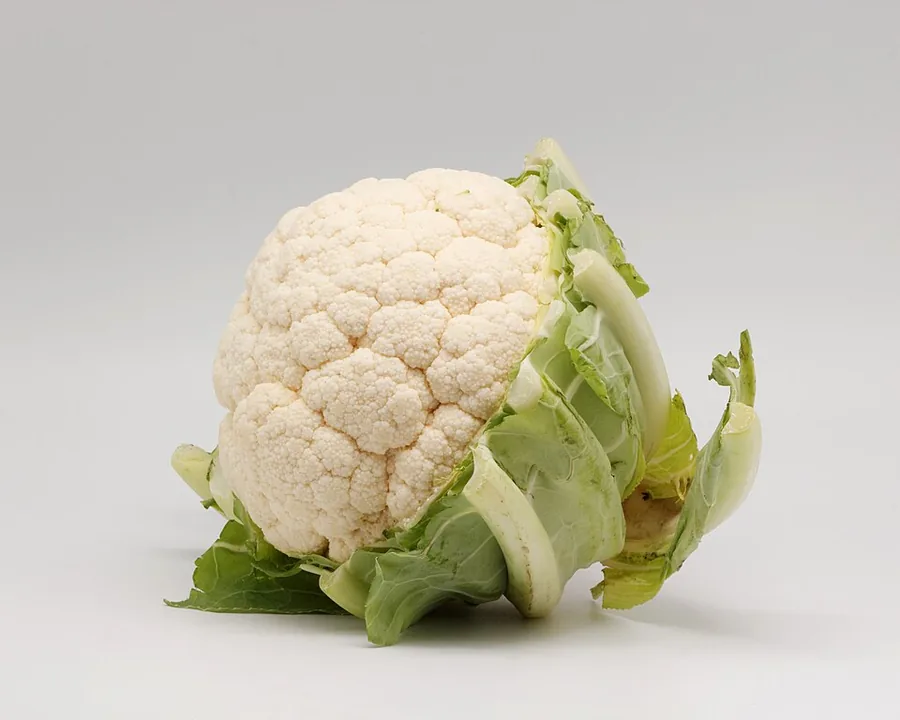
Cauliflower is a cool-weather cousin in the cabbage family, and it's grown for the packed white head, the curd, that sits at the heart of a rosette of wide leaves. Its roots go back to the same wild plant behind cabbage, broccoli, and kale, but growers steered this branch toward a single tight bundle of unopened flower buds. Catch it at just the right moment and you get a firm, mild head. Wait too long and it loosens in a hurry.
It really does live up to its name as one of the more demanding brassicas. From the seedling stage all the way to harvest it wants cool, even weather, and it doesn't forgive a misstep along the way. One cold snap, a hot stretch, or a couple of dry days can put the brakes on growth and hand you a marble where a full head should be.
Color's a big part of the fun these days. Besides the usual white, you can grow orange, purple, and lime-green Romanesco kinds, and those colored ones keep their pigment best in full sun rather than tucked under tied leaves. Match the type to your season and how patient you are, and the harvest will follow.
Care
The short version: give it full sun, soil that's rich and evenly moist at about pH 6.0 to 7.0, a heavy feed, and most of all cool, unbroken growth from seedling right through to harvest.
Light
Cauliflower likes full sun, six hours a day or more if you can swing it, though a bit of afternoon shade is okay where spring heats up fast. The colored kinds especially lean on that sun to develop their orange, purple, or green pigment.
Water
Even moisture is the whole game here. Aim for around 1 inch (2.5 cm) of water a week and don't let the plants dry out, since just one bout of drought stress can wreck the curd or set off buttoning. Sandy soil drains faster than clay does, so it'll need watering more often.
Soil
Go with rich, fertile, well-drained loam mixed with compost or aged manure, the kind that stays moist without turning into a swamp. A pH of 6.0 to 7.0 keeps the nutrients reachable and helps head off the hollow stem that acidic soil can cause.
Temperature
It's a cool-season crop that's happiest between 45°F and 75°F (7°C to 24°C). Long days above 86°F (30°C) or warm nights will abort or warp the curd, so plan the crop to slip past any real heat.
Humidity
Plain old outdoor humidity of about 40% to 70% works just fine, and there's no target you need to fuss over. What counts more is air moving through the bed, because damp, packed-in leaves are an open door for disease.
Feeding
Cauliflower is a heavy feeder. Mix a balanced fertilizer like 5-10-10 into the bed before you plant, then side-dress with nitrogen around 3 to 4 weeks after transplanting, and keep enough boron on hand so the curd stays free of browning.
Pruning
You won't prune it for shape, but white types do want blanching: when the curd hits 2 to 3 inches, tie the outer leaves up over it to keep it pale, unless your variety blanches itself. Let orange, purple, and Romanesco kinds soak up the sun instead, and pinch off any beat-up outer leaves.
Repotting
Cauliflower isn't a houseplant, so forget about a repotting routine. Start the seed in cells or flats and shift each plant just once into the garden about 4 to 6 weeks after sowing, before the seedling hardens off and turns woody.
Size & spacing
Plants top out at 12 to 24 inches (30 to 60 cm) tall and spread about the same. Set them 18 to 24 inches (45 to 60 cm) apart so each rosette gets the elbow room to size up a full head while air still moves down the row.
When to plant
Cauliflower lives for cool weather and doesn't get along with frost or heat. Get seed started indoors and move young transplants outside a couple of weeks ahead of the last spring frost, or in mid- to late July if you're after a fall crop, then pick the heads while it's still cool out.
Northern hemisphere
Southern hemisphere
Typical months for a temperate climate: start earlier in warm zones, later where spring frosts linger.
- Sow: Spring crop: start seed indoors about 4-6 weeks before the last frost (around April in cold climates). Fall crop: start seed in July, indoors or direct-seeded.
- Plant: Transplant 2-3 weeks before the average last spring frost, or mid- to late July for a fall crop; space plants 18-24 inches apart.
- Harvest: Harvest the curd when full-sized, firm, and still tight/white, before the florets begin to separate; cut with a few wrapper leaves attached.
Hardiness
USDA hardiness zones: 3–10
Temperature: down to -40°C
Troubleshooting
Almost every cauliflower problem comes down to the same thing, a hiccup in steady growth, and it tends to turn up in either the head or the leaves. Once you can spot these warning signs early, you can jump in before a little setback costs you the whole crop. Find what matches below, then act while there's still time to help.
Yellow V-shapes on leaf edges or lumpy, twisted roots
Two soilborne problems can look like this. Black rot etches yellow V-shaped wedges along the leaf edges and darkens the veins, while clubroot bloats the roots into knotted lumps that can't pull up water, leaving the plant to wilt. There's no fix for either once it takes hold. Yank out and destroy anything infected, only ever plant clean transplants, keep at least four years between any cabbage-family crop in that spot, and pick resistant varieties when you can.
Fix:
- Remove and destroy infected plants
- Use clean, disease-free transplants
Heads form way too small, way too soon
What you're seeing is buttoning, and it happens when something interrupts a young plant: a cold spell, too much heat, a dry patch, or a start that sat cramped in its cell for too long. Instead of growing a proper head, the plant rushes out a tiny curd and calls it done. Want to dodge it? Set out healthy young transplants right on schedule, keep them moving without any stalls, and skip starts that have gone root-bound or too hardened.
Fix:
- Keep plants growing vigorously with steady water and nutrients
- Replace stressed plants; avoid root-bound or over-hardened transplants
Grainy, fuzzy curd that's coming apart
This one's called a ricey curd, and warm weather is nearly always the reason behind it. When it gets too hot, those little flower buds start stretching out and splitting up before you've had the chance to cut the head. The fix is mostly about timing: aim for the head to finish in cool weather, grab it the second it's full, and go easy on the nitrogen.
Fix:
- Harvest promptly before florets separate
- Time the crop so the curd matures during cool weather
Holes chewed in leaves with little green worms underneath
Nine times out of ten you're dealing with cabbageworms, cabbage loopers, and diamondback moth larvae, those velvety green caterpillars that leave dark droppings and ragged leaves wherever they go. Flea beetles pitch in too, peppering the foliage with tiny shot-holes that hit young seedlings hardest. So what helps? Pick the worms off by hand, bring in Bt once they start winning, and tuck young plants under a floating row cover.
Fix:
- Handpick caterpillars
- Apply Bt (Bacillus thuringiensis)
- Cover young plants with floating row cover
Curd turning brown or a stem gone hollow and dark
Usually this points to boron deficiency, which discolors the florets and leaves the inner stem brown or hollowed out. Soil that's too acidic and watering that comes and goes both make it worse. Before you reach for any boron, get a soil test done first, hold the pH where it should be, and water on a regular rhythm.
Fix:
- Correct boron based on a soil test
- Maintain proper pH and even moisture
Toxicity
Cauliflower is a regular old vegetable with nothing poisonous in it, so you're free to grow and harvest it around kids and pets without a worry. Being a brassica, it does carry goitrogens and some gas-prone fiber, so a big raw helping might unsettle a pet's stomach, but it isn't toxic in any way.
Safe for
People · Cats · Dogs · Horses · Rabbits · Livestock · Birds
Cats None
There's no toxin in cauliflower that affects cats, so if yours sneaks a bite of leaf or curd, it's perfectly fine.
Dogs None
It's safe for dogs to eat. A big serving of the raw plant might give them a touch of gas, but there's nothing risky about it.
Horses None
It won't poison horses, but being a brassica it can feel heavy on the gut, so it's best offered in just small amounts.
Rabbits None
Leaves and curd are fine for rabbits in moderation. A big helping can bring on gas, though, so keep the portions modest.
Livestock None
Cattle, goats, and sheep can graze on it with no poisoning worries, because the plant doesn't hold any harmful compounds.
Birds None
Backyard hens and other birds can happily peck away at the leaves and curd without any issue.
People Safe
It's a kitchen regular that you can enjoy raw or cooked with zero risk, and the whole plant is fine to handle and harvest.
As a brassica it contains goitrogens and can cause gas/bloating; large quantities may cause mild, temporary digestive upset in pets, but the plant is not poisonous.
Varieties
There's a lot more to cauliflower than plain white. A handful of names show up in most home gardens, ranging from early dependable hybrids to the bright colored types.
Snow Crown
If you want an early, easygoing white hybrid that shrugs off a little warmth and finishes in about 50 to 60 days, this is a top choice for spring.
Amazing
Here's a white type that wraps itself, so you can skip most or all of the hand-blanching, and it copes well across a broader range of conditions.
Cheddar
You get an orange, beta-carotene-rich curd here, and it deepens its color out in full sun instead of under tied-up leaves.
Graffiti
This bright purple head gets its color from natural anthocyanins, which means you'll want to leave it unblanched.
Romanesco
Its lime-green curd twists into an eye-catching fractal shape, and like the colored types it wants sun rather than blanching to keep that color.
Companions
Cauliflower's worst neighbors are its own relatives, the other cabbage-family crops that pass the same pests and soil diseases back and forth.
Keep apart
Other brassicas (cabbage, broccoli, Brussels sprouts, kale, turnip): Share the same pests and soilborne diseases (cabbageworms, clubroot, black rot); extension guidance is to rotate and avoid planting them together for several years.
How to propagate
Cauliflower starts from seed, and the whole knack is in the transplant: grow sturdy young plants and get them outside before they ever lose their momentum.
SeedModerate
Start indoors about 4-6 weeks before transplanting; sow in early spring (around April) for a spring crop and in July for a fall crop. · Transplant-ready in about 4-6 weeks; curd harvest roughly 55-100 days after transplanting.
You'll almost always grow cauliflower from transplants instead of sowing it right into the bed, because that keeps the young plants strong and helps them sidestep the growth checks that bring on buttoning. Get seed going indoors about 4 to 6 weeks early, and plan on roughly 55 to 100 days from transplant before there's a head worth cutting.
Myths
You always have to tie cauliflower up so it turns white.
These days a lot of cultivars blanch themselves, folding their leaves right over the head, so only certain white types still call for hand-tying. Orange, purple, and Romanesco kinds need full sun to color up and must never be blanched.
Cauliflower and broccoli are basically the same plant.
They do come from one species, Brassica oleracea, but you can't swap one for the other. Cauliflower belongs to the Botrytis Group and broccoli to the Italica Group, which are two distinct cultivar lines.
Cauliflower's easy since it's just another cold-tough crop.
Actually it's one of the trickiest brassicas to pull off. It demands steady, cool conditions and reacts badly to both heat and any check in its growth, and that's exactly what sets off buttoning and ricey curds.