Shrub · Oleaceae
Common Jasmine
Jasminum officinale
Hand it warmth, sunshine, and something solid to climb, and this vine pays you back all summer with perfume.
Full sun
Every 5–10 days
USDA 7–10
20–40 ft · 6.1–12.2 m
Overview
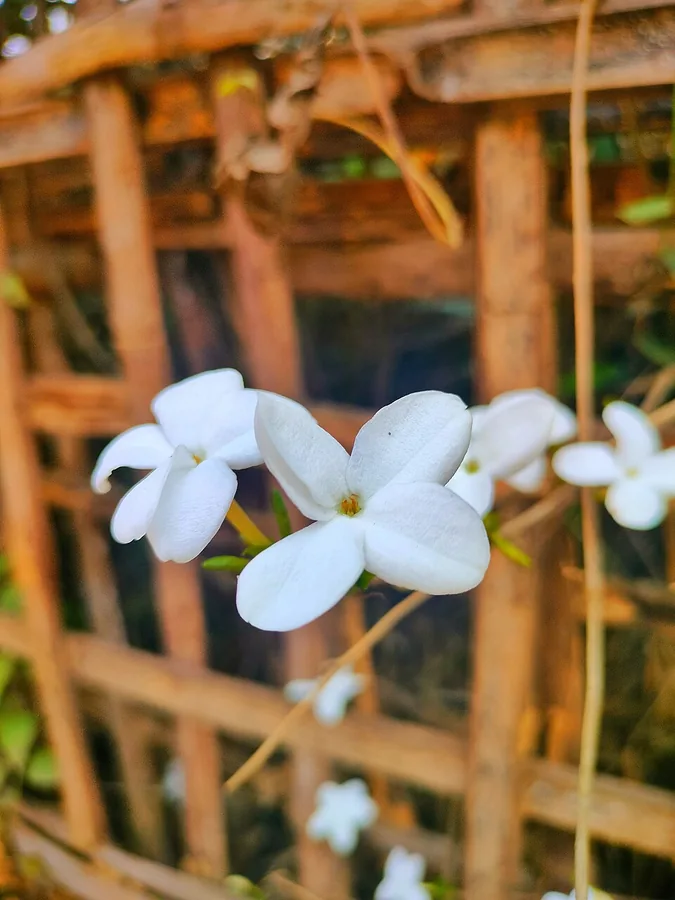
Common jasmine is a fast, twining shrub that people grow for the sweet white flowers it sends out from summer into fall. A member of the olive family, it climbs hard once it settles in and easily clears head height where winters stay mild. Train it on a wall or trellis and a plain support turns into a curtain of fragrant bloom.
This is the true jasmine, the one perfumers and tea makers reach for, and you shouldn't mix it up with the toxic plants that borrow the name. Out in the garden it's happy in zones 7 to 10, and where it's colder it makes a great container plant you can bring indoors for winter. Either way, it wants bright light and something to climb on.
What it asks for is a bit of patience, not endless fussing. Keep it steadily moist through the growing season, prune at the right moment, and feed it across spring and summer, and you'll get months of evening fragrance in return. Leave out the support or shortchange it on light, though, and you'll end up with a tangle of leaves and barely any flowers.
Care
The short version: give it plenty of sun (partial shade works too), something sturdy to scramble up, soil that stays damp during the growing season, a monthly feed across spring and summer, and a trim as soon as the flowers finish.
Light
Common jasmine blooms best in full sun, though it'll handle partial shade and manage on bright indirect light indoors. More direct light means heavier flowering, so hand it the sunniest spot you've got.
Water
Keep the soil moist through the growing season, watering every 5 to 10 days as it dries out. Established plants brush off a bit of drought, but steady moisture is what gives you the best flowering. Then ease back through the winter rest from October to March.
Soil
Set it in moist, fertile, well-drained loam with plenty of organic matter mixed in. It's not picky about acidity, taking a pH anywhere from 6.0 to 7.5.
Temperature
It copes with a wide range, from a hard 5°F (-15°C) at the cold end up to 100°F (38°C) in summer heat. That cold tolerance is exactly why it can grow outdoors through zones 7 to 10.
Humidity
Outdoors it doesn't fuss much, but indoors it likes high humidity, ideally 50% or more. Dry household air is what brings on spider mites, so a humid spot keeps the plant in a better mood.
Feeding
Feed it monthly through spring and summer with a balanced liquid fertilizer. Want more flowers? Switch to one higher in phosphorus, and stop feeding altogether once growth slows down for winter.
Pruning
Prune right after flowering and never before, because jasmine blooms on old wood and an early cut carries the buds away with it. It takes hard pruning well, so cut it back firmly to keep its size and shape in check. Indoor plants need that hard pruning plus a trellis to climb.
Repotting
For container plants, repot every 1 to 2 years in spring. Keep an eye out for roots circling the pot or poking through the drainage holes, water running straight through, and growth that's slowing, all clues it's ready for a bigger home.
Size & spacing
Given the room and the time, it climbs 20 to 40 feet (6 to 12 m) tall and spreads 7 to 15 feet (2.1 to 4.6 m) wide. Plan for a strong support and plenty of space, because this is a vigorous climber, not a neat little shrub.
When to plant
Common jasmine lives for the warm half of the year. Pop young plants out in spring once the last frost is behind you, let them climb and fill in through the warm months, and the fragrant flowers turn up from summer into fall.
Northern hemisphere
Southern hemisphere
Typical months for a temperate climate: start earlier in warm zones, later where spring frosts linger.
- Plant: spring, after the last frost
- Harvest: summer into fall
Hardiness
USDA hardiness zones: 7–10
Temperature: down to -18°C
Troubleshooting
Most jasmine trouble boils down to one of two things: a pest moving in, or a plant that just won't flower. Both show up plainly once you know the signs, and both can be fixed. Find your match below, then act before it sets the plant back.
Sticky tips and twisted new growth covered in soft little bugs
What you're seeing is sap-feeding by aphids or mealybugs, the ones that gather on soft tips and drip the sticky honeydew that sooty mold later feeds on. For a light run-in, just hit them with a strong jet of water, then coat whatever's left in insecticidal soap or horticultural oil. Got mealybugs tucked into the leaf joints? A cotton swab dipped in rubbing alcohol sorts them out, and a weekly repeat finishes them off.
Fix:
- Spray off light infestations with a strong stream of water
- Apply insecticidal soap or horticultural oil to coat the pests
- Dab mealybugs with a cotton swab dipped in rubbing alcohol
- Repeat treatment weekly until controlled
Yellow flecks across the foliage plus thin webs or crusty little bumps
Warm, dry indoor air is exactly what spider mites love, while scale and whitefly turn up as crusty bumps or little clouds of fliers. Bump up the humidity and rinse the leaves to set the mites back, then treat the undersides with horticultural oil or insecticidal soap. Scale lifts off with an alcohol-dipped swab, and a few repeat rounds wrap it up.
Fix:
- Raise humidity and rinse foliage to discourage spider mites
- Apply horticultural oil or insecticidal soap, coating leaf undersides
- Scrape or wipe off scale with alcohol-dipped swabs
- Repeat applications as directed until pests are gone
Plenty of leaves but hardly a flower to be found
So the leaves look fantastic but the blooms just won't show up? Usually that comes down to too little light, pruning at the wrong time, or too much nitrogen. Jasmine flowers on old wood, which means cutting before it blooms snips away the exact growth that holds the buds. Shift it somewhere brighter and warmer, wait to prune until after it flowers, and move to a feed higher in phosphorus to coax the flowers back.
Fix:
- Move the plant to a brighter, warmer location with plenty of direct light
- Prune only after flowering to preserve old growth that carries blooms
- Switch to a fertilizer higher in phosphorus and lower in nitrogen
Toxicity
Good news on this front: true jasmine is safe. The ASPCA lists Jasminum species as non-toxic to cats, dogs, and horses, so plant it wherever pets and children roam. The only real catch is making sure of its identity, since toxic look-alikes like Carolina jessamine borrow the jasmine name, so confirm the botanical name before you buy.
Safe for
People · Cats · Dogs · Horses · Rabbits · Livestock · Birds
Cats None
True jasmine sits on the ASPCA's safe list, so if a nosy cat nibbles a leaf or swats at the flowers, there's nothing to worry about.
Dogs None
A dog can push past it or chew on a loose vine and come away just fine, because no part of true jasmine is poisonous to them.
Horses None
Horses are in the clear with this plant too. The ASPCA clears true jasmine for them right alongside cats and dogs.
Rabbits Safe
If a rabbit tastes the leaves, true jasmine poses no toxic risk, though rich greens are always best offered in moderation.
Livestock Safe
Grazers like goats, sheep, and cattle won't be poisoned by true jasmine should they reach the vine.
Birds Safe
There's no chemical danger to birds here, whether they perch among the climbing stems or pick at the blooms.
People Safe
Nothing toxic for people either. The fragrant flowers even get used to scent tea, so a home with kids can stay easy around it.
Safe around pets and children. Be sure the plant is a true Jasminum and not a toxic look-alike such as Carolina jessamine (Gelsemium sempervirens), which is highly poisonous.
Varieties
Common jasmine shows up in a handful of named forms, and a few of its relatives get sold under the jasmine name as well. Here are the ones worth being able to tell apart.
'Affine' (also sold as 'Grandiflorum')
You get larger flowers on this one, often pink-flushed while still in bud, plus a fragrance that's especially strong.
'Fiona Sunrise' ('Frojas')
Its golden-chartreuse foliage frames the fragrant white flowers, giving a brighter look than the plain species.
'Inverleith'
Here the buds and the open flowers alike take on a strong red flush, so it shows more color than the white-flowered forms.
Jasminum sambac (Arabian jasmine)
This tender cousin has rounded leaves and provides the flowers for jasmine tea, but cold hardy it is not.
Jasminum nudiflorum (winter jasmine)
It puts out yellow flowers on bare green stems in late winter, though don't expect any scent from it.
Jasminum polyanthum (pink jasmine)
A houseplant favorite among the jasmines, with pink buds that open into very fragrant white flowers.
How to propagate
Common jasmine is easy to multiply, whether you root a summer cutting or just peg a low stem onto the soil and let it root on its own.
Stem cuttingsModerate
Summer, from semi-ripe current-season growth · 4-8 weeks to root
Snip semi-ripe cuttings from this season's growth in summer, dip the cut ends in rooting hormone, and keep them warm and humid. Roots usually show up in roughly 4 to 8 weeks, though it does take a careful touch to see them through.
LayeringEasy
Spring to summer · A few months to one season
Want the easy way? Go with layering. Pin a low, bendy stem down onto the soil in spring or summer so it can root while the parent still feeds it, then cut it loose once it's anchored, which usually happens within a few months to a full season.
Myths
If it's sold as jasmine, it's all the same harmless, sweet-smelling plant.
Only Jasminum species count as true jasmine, and plenty of toxic plants happen to share the name. Carolina jessamine (Gelsemium sempervirens) is poisonous through and through, while star or Confederate jasmine (Trachelospermum) and night-blooming jasmine (Cestrum) are entirely different plants. Check the botanical name before you trust that a jasmine is harmless.
Those jasmine blooms are toxic, so pets shouldn't go anywhere near them.
That worry usually traces back to mixing it up with toxic look-alikes. True jasmine, including Jasminum officinale, sits on the ASPCA's non-toxic list for cats, dogs, and horses, which makes it a safe pick around animals.