Shrub · Adoxaceae
Arrowwood Viburnum
Viburnum dentatum
An easygoing native shrub that gives you spring flowers, blue-black berries, and fiery fall color without much fuss at all.
Full sun
Every 5–10 days
USDA 2–8
5–10 ft · 1.5–3 m
Overview
Looking for a shrub that won't give you a hard time? Arrowwood viburnum is about as easy as they come. It's a native of eastern North America, tough enough to shrug off winters down to -40°F (-40°C), and it'll grow in just about any soil you've got. The name's a fun bit of history too, since Native peoples once cut its straight young stems to make arrow shafts.
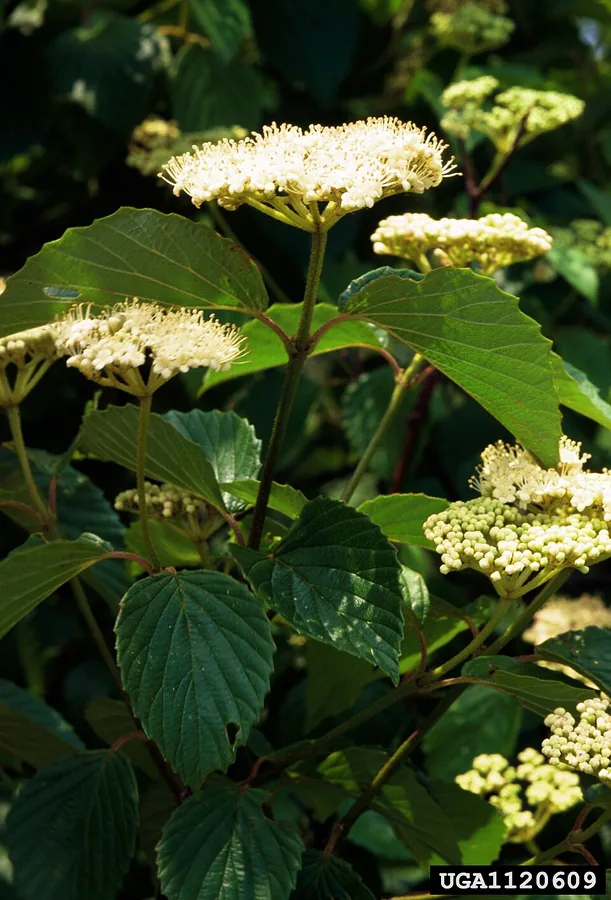
Here's the part that makes it worth the space: it gives you something to look at three times a year. Flat-topped creamy-white flower clusters open in late spring, blue-black berries follow into fall, and then the leaves go out in yellow, orange, and red. Birds strip the fruit as it ripens, so you'll get wildlife dropping by, not just a nice-looking plant.
It grows into a rounded, multi-stemmed shrub of 5 to 10 feet (1.5 to 3 m), and it'll sucker at the base into a thicket if you let it. The one real catch? A beetle, which is covered down below. Stay on top of that and arrowwood pretty much takes care of itself.
Care
The short version: pop it in full sun to part shade in just about any well-drained soil, keep it watered while it settles in, and keep an eye on the twigs for viburnum leaf beetle eggs over winter.
Light
Arrowwood's happiest in full sun to part shade. Full sun gets you the heaviest flowering, fruit, and fall color, but a spot with some afternoon shade still does well and looks right along a woodland edge.
Water
Try to keep the soil consistently moist, watering deeply while the shrub's settling in and through any drought. Once it's established it can handle the odd dry stretch, so figure on watering every 5 to 10 days, give or take, depending on heat and soil.
Soil
Hardly any shrub is this laid-back about soil. Arrowwood's happy in clay, loam, sand, or shallow rocky ground as long as it drains, and it'll take a wide pH from 5.5 to 8.0, acidic right through to alkaline.
Temperature
This is a seriously cold-hardy native that comes through from -40°F to 100°F (-40°C to 38°C), which covers USDA zones 2 through 8. Winter cold just isn't a problem, so you can plant it almost anywhere in the temperate range.
Humidity
Humidity? Not something you need to think about with this outdoor shrub. Air movement matters more, since open, breezy growth keeps the leaves dry and helps keep pests away.
Feeding
It barely needs feeding in decent ground. A balanced slow-release fertilizer or compost in early spring is plenty, and an established shrub in good soil often does just fine with nothing at all.
Pruning
Prune right after flowering in late spring to shape or thin things out, and pull suckers if you'd rather it didn't spread. The big job, though, is winter scouting: cut out and burn any twigs carrying viburnum leaf beetle eggs between October and spring.
Repotting
This is a landscape shrub, not really a container plant, so repotting hardly comes up. If you're holding one in a nursery pot for a bit, move it on once the roots start to circle or water runs straight through without soaking in.
Size & spacing
Picture a rounded shrub 5 to 10 feet (1.5 to 3 m) tall and about as wide, with a spread of 6 to 10 feet (1.8 to 3 m). Give it that much room, or even a bit more if you want a second plant close by for pollination.
When to plant
Arrowwood's a woody, fully hardy shrub, so there are no seeds to fuss with indoors. Just set new plants out in spring or fall, look for flowers in late spring, and let the berries color up from late summer into fall for the birds.
Northern hemisphere
Southern hemisphere
Typical months for a temperate climate: start earlier in warm zones, later where spring frosts linger.
- Plant: Spring or fall
- Harvest: Creamy-white flat-topped flower clusters in late spring (roughly March-May depending on region), followed by blue-black berries in late summer to fall
Hardiness
USDA hardiness zones: 2–8
Temperature: down to -46°C
Troubleshooting
Arrowwood's a rugged plant, and most of what goes sideways shows up on the leaves. One pest does the real damage and the other's mostly just annoying. Find what matches below, then jump on it before the leaf beetle in particular gets too far ahead of you.
Leaves chewed to lace, with just the veins hanging on
Seeing leaves reduced to a net of veins? That's the viburnum leaf beetle, and arrowwood happens to be its number one favorite. The larvae get going in spring and the adults take over, so a bad year can leave a shrub almost bare. Snip off the egg-carrying twigs over winter, flick the larvae off smaller plants, and let the lady beetles and lacewings handle whatever's left.
Fix:
- Prune out and destroy egg-infested twigs between October and spring before eggs hatch
- Hand-remove or knock larvae off small plants
- Encourage natural predators such as lady beetles, lacewings, assassin bugs, and spined soldier bugs
- Treat heavy larval infestations with an appropriate labeled insecticide if needed
Sticky, speckled leaves and a little cloud of white flies
If a puff of tiny white flies lifts off when you brush the leaves, that's a whitefly colony tucked underneath, leaving the foliage speckled and sticky with honeydew that grows a black film of sooty mold. Just hit the leaves with a strong stream of water to knock them loose, then go over the undersides with insecticidal soap. It honestly looks worse than it is and rarely does any real harm.
Fix:
- Spray foliage with a strong stream of water to dislodge insects
- Apply insecticidal soap or horticultural oil to leaf undersides
- Encourage natural predators
Toxicity
Got pets or kids in the mix? You're in luck, because arrowwood viburnum is non-toxic from top to bottom. The ASPCA lists it as safe for cats, dogs, and horses, and the berries feed the birds rather than hurting them. They're too tart for people to enjoy raw, but they won't poison anybody either.
Safe for
People · Cats · Dogs · Horses · Rabbits · Livestock · Birds
Cats None
Worried about the cat? No need, since the ASPCA lists viburnum as non-toxic to cats and a nibbled leaf is nothing. If one really goes to town on the foliage, the worst it'll get is a passing upset stomach, just like with any plant.
Dogs None
Dogs are fine here too, since the ASPCA has it listed as safe. A curious pup can chew the leaves or berries without harm, though a big greedy mouthful might bring on some mild, short-lived stomach upset.
Horses None
Horses can hang out and graze right next to this shrub without any trouble, because viburnum doesn't carry any toxin known to affect them.
Rabbits None
Wild rabbits already browse arrowwood foliage, and there's zero poisoning risk. With a pet rabbit, it's still smart to bring in any new green slowly so its digestion stays settled.
Livestock None
Cattle, goats, and sheep can browse the leaves and twigs without any worry. It's a common native shrub along pasture edges, and there's no record of it poisoning stock.
Birds None
For birds it's even better than safe, because those blue-black berries are a prized fall snack that brings songbirds in to feed on the ripe fruit.
People None
Nobody's getting poisoned, but don't expect much from the raw berries, since they're tart and astringent and not worth eating by the handful. Honestly, just leave the fruit for the birds.
No special handling required; as with any plant, ingesting large amounts of foliage or berries may cause mild stomach upset in pets.
Varieties
Most garden arrowwoods you'll run into are named selections, picked for a tidier size, heavier fruit, or better fall color. Here are the ones you're most likely to come across.
Blue Muffin
A compact little pick at 5 to 7 feet that throws a heavy crop of blue berries, especially if there's a second arrowwood nearby to cross-pollinate it.
Chicago Lustre
A vigorous, upright type with glossy dark green leaves that you can count on to bloom late in the season.
Autumn Jazz
A vase-shaped shrub that's all about the fall show, when the leaves turn vivid yellow, orange, and red.
Companions
Arrowwood fruits far better with a second, different arrowwood nearby to pollinate it, and pairs well with shade plants at its feet. Keep it away from other beetle-prone viburnums.
Plant near
A different arrowwood viburnum cultivar: Provides cross-pollination that dramatically improves berry set.
Native ferns and shade perennials: Fill the shaded base of the shrub and thrive in the same moist, well-drained soil.
Keep apart
Other highly VLB-susceptible viburnums (e.g. V. opulus): Clustering preferred hosts together can concentrate viburnum leaf beetle pressure.
How to propagate
You can multiply arrowwood three ways, from quick and easy to slow and stubborn. Cuttings and layering give you an exact copy of the parent; seed is a long project for the patient.
Stem cuttingsModerate
Early to mid summer · 6 to 10 weeks to root
Want an exact copy of a named cultivar? Cuttings are your best bet. In early to mid summer, take softwood cuttings from the fresh new growth, dip the cut ends in rooting hormone, and keep them somewhere nice and humid. Roots usually show up over the next 6 to 10 weeks.
SeedDemanding
Collect ripe fruit in fall · Several months to over a year (needs warm then cold stratification)
Seed is the slow road, so it's really one for the patient. Grab ripe fruit in fall, but know there's complex double dormancy going on that wants a warm spell and then a cold one. That means germination can drag out anywhere from several months to over a year, and it comes up unevenly.
LayeringEasy
Spring to summer · One growing season or more
This is the easy one, and the shrub practically does half the work itself. Anytime from spring through summer, pin a low branch down to the soil and let it root over a full growing season or so. You'll also get natural suckers popping up around the base, and those can be dug and divided.
Myths
The berries are poisonous to pets and people.
Good news, that's just not true. The ASPCA lists viburnum as non-toxic to cats, dogs, and horses, so the blue-black fruit isn't a danger to the animals around your garden. The berries are valuable bird food, not a hazard, though they're way too tart for anyone to enjoy raw by the handful.
One arrowwood viburnum will always fruit heavily on its own.
A single shrub on its own usually sets a pretty thin crop. Cross-pollination from a second, genetically different arrowwood bumps fruit set up sharply, so if you want a full show of berries, plant two or more of different cultivars or seedlings.