Shrub · Adoxaceae
Elderberry
Sambucus canadensis
Hand it sun, steady moisture, and a second cultivar close by, and elderberry pays you back with heavy clusters of dark fruit.
Full sun
Every 3–7 days
USDA 3–9
5–12 ft · 1.5–3.7 m
Overview
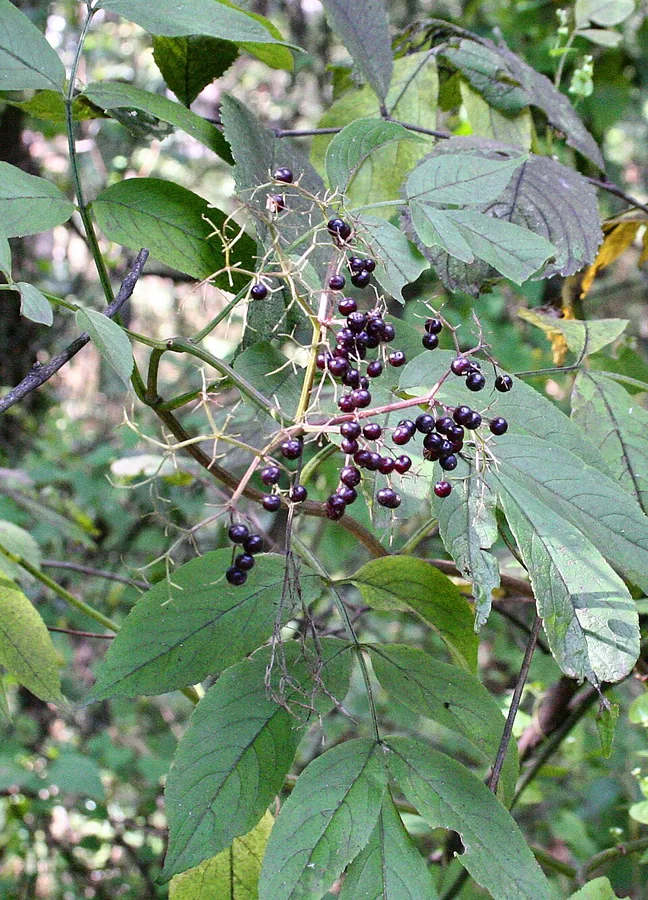
Elderberry is a quick, laid-back shrub that pulls its weight twice in a year, throwing up wide, creamy flower heads in June and then dark berry clusters that ripen from August into September. It sits in the genus Sambucus and grows wild across much of North America, often turning up along damp ground and the edges of fields. Leave it be and it'll reach 5 to 12 feet (1.5 to 3.7 m), spreading out just as far into a multi-stemmed thicket.
This is a tough, low-maintenance plant that handles cold all the way down to zones 3 through 9 and takes poor soil, soggy ground, and partial shade in stride. There's one rule it won't bend on, though, and it's worth knowing right away: only the fully ripe berries, and only after cooking, are safe to eat. The leaves, stems, bark, roots, and any raw or unripe fruit carry cyanogenic compounds that'll make people and animals sick.
Growing it for the berries? Then you'll want a second cultivar nearby, because one plant by itself sets a thin crop. Two different cultivars blooming at the same time pollinate each other and pack the canes with fruit. Give it space, keep the water coming, and cut it back each winter, and an elderberry rewards you quickly.
Care
The short version: full sun to part shade in rich, evenly moist soil, with a balanced spring feed, a hard dormant-season pruning each winter, and a second cultivar nearby for a full crop.
Light
Elderberry sets its best fruit in full sun, where the heavy flower heads and berry clusters can fully develop. It'll get by in partial sun and even partial shade, but the more shade you give it, the lighter the crop you'll see.
Water
Keep that soil evenly moist, since the shallow, fibrous roots dry out quickly and the plant notices most while it's flowering and fruiting. Water it deeply through any dry stretch, every 3 to 7 days depending on the weather, but don't let the ground sit waterlogged.
Soil
Go for rich, moist, well-drained loam, though elderberry is easygoing and adapts to clay, sand, and ground that runs wet or dry. It's comfortable across a broad pH range of 5.5 to 7.5, so most garden soil works just fine.
Temperature
This is one seriously hardy shrub, handling winter chill down to -29°F (-34°C) and summer heat up to 95°F (35°C). That spread covers most temperate gardens with no fuss at all.
Humidity
Average humidity somewhere around 40% to 70% is all it asks for, and outdoor air almost never comes up short. Crowded, stagnant air is what brings on powdery mildew, so airflow counts for more than how much moisture is floating around.
Feeding
Feed it just once in early spring as it's waking up, with a balanced or nitrogen-rich mix like 10-10-10 or composted manure. For a plant this energetic, one seasonal feeding does the trick.
Pruning
Prune during the dormant season, in late winter. On established plants, cut the dead, weak, and 3-plus-year-old canes back to the base to encourage the vigorous 1 to 2 year wood, and some growers just take the whole plant down to the ground each year. Tug out root suckers while you're at it so it doesn't run wild.
Repotting
Elderberry wants to be in the ground, not a pot, so repotting barely comes up. But if you do have to keep one in a container, shift it before the roots circle around, or it'll stall and droop right after you water.
Size & spacing
A grown plant reaches 5 to 12 feet (1.5 to 3.7 m) tall and spreads roughly as wide, 6 to 12 feet (1.8 to 3.7 m). Give each shrub plenty of breathing room so air can move through and mildew stays away.
When to plant
Elderberry follows the calendar of the seasons. Pop in dormant bare-root plants or cuttings in early spring once the hard frosts are behind you, look for those creamy flower heads in June, and harvest the dark, ripe berries from August into September.
Northern hemisphere
Southern hemisphere
Typical months for a temperate climate: start earlier in warm zones, later where spring frosts linger.
- Sow: Late winter, only after 60-90 days of cold-moist stratification; seed is slow and erratic, so cuttings are preferred
- Plant: Early spring after the last hard frost, using dormant bare-root plants or cuttings
- Harvest: Flowers in June; dark berry clusters ripen August to September
Hardiness
USDA hardiness zones: 3–9
Temperature: down to -40°C
Troubleshooting
Elderberry is a sturdy thing, and most of what bothers it is pretty mild. Powdery mildew and aphids mess with the looks more than the plant itself, while cane dieback and berry-hungry birds call for a faster move. Find what matches what you're seeing below and step in before a little issue snowballs.
One cane fades and dies while the rest look fine
If a single cane gives up on its own, the likely culprits are cane borers or fungal dieback in old or beaten-up wood. Just cut that cane off right at the base and get rid of it. Keeping up with yearly dormant pruning, where you clear out anything over 3 years old, usually stops this from ever becoming a thing.
Fix:
- Cut out and destroy affected canes at the base
- Remove old (3-plus-year) and damaged canes during dormant pruning
A dusty white layer spreading over the foliage
What you're seeing is powdery mildew, a fungus that loves crowded, shady growth where the air doesn't move. Want to clear it? Open the plant up by thinning and pruning the canes, pull off the worst-looking leaves, and only reach for a labeled fungicide or horticultural oil if it keeps spreading. On a healthy shrub it's pretty much just a cosmetic nuisance.
Fix:
- Thin and prune canes to improve air flow
- Remove and dispose of badly affected leaves
- Apply a labeled fungicide or horticultural oil if severe
Gooey, twisting shoot tips covered in little bugs
Say hello to aphids, which love the soft new growth that a heavy nitrogen feed tends to produce. Knock them loose with a firm spray of water, and if a few stubborn ones cling on, treat with insecticidal soap or horticultural oil. Honestly, lady beetles and lacewings will mop up the stragglers if you just let nature do its thing.
Fix:
- Spray off with a strong jet of water
- Apply insecticidal soap or horticultural oil
- Encourage lady beetles and lacewings
Whole berry clusters disappearing right as they ripen
Birds spot ripe elderberries way before you do, and they can clean off a cluster in a matter of hours. So toss some netting over the plant as soon as the fruit starts darkening, and grab whole cymes the second they're ready. The cultivar Bob Gordon gives you a hand here too, because its clusters flop down and dangle where birds can't easily get at them.
Fix:
- Net plants as fruit begins to ripen
- Harvest whole cymes promptly when berries darken
- Grow cultivars with drooping clusters such as Bob Gordon
Toxicity
Here's where elderberry asks you to be careful. The leaves, stems, bark, roots, and any raw or unripe berries carry cyanogenic glycosides that release cyanide and upset the stomach, and they're toxic to people and animals alike. Only the fully ripe berries, once they've been cooked, are safe to eat, so keep children, pets, and livestock clear of every green part of the plant.
Toxic to
Cats · Dogs · Horses · Rabbits · Livestock · Birds
Safe for
People
Cats Moderate
If a cat nibbles the leaves, stems, or raw berries, you'll typically see drooling first, then vomiting, with diarrhea and a dull, low-energy mood close behind. The real danger comes from a big mouthful of the green plant, since the cyanide it sets free can leave the cat weak.
Dogs Moderate
Keep an eye out for vomiting, diarrhea, and a dog that loses interest in food and gets sluggish after getting into the plant. It's usually just an upset stomach, but a big serving of raw berries or leaves can take the symptoms up a notch.
Horses Toxic
The leaves and woody bits are bad news for a horse, and the cyanide they release can turn up as drooling, colicky pain, struggling to breathe, and stumbling. The safest move? Fence elder out of any pasture or paddock a horse can get to.
Rabbits Toxic
Never hand a rabbit the foliage, stems, or raw berries. Even a little of the green plant can set off gut stasis and a fast downhill slide, so keep the whole shrub well away from them.
Livestock Toxic
Cattle, goats, and sheep that browse the leaves or unripe fruit can end up with cyanide poisoning, and in the worst cases that means bloat, trembling, and collapse. Watch out for wilted prunings tossed over a fence, since that's an easy way for stock to get poisoned.
Birds Caution
Wild birds happily eat the ripe berries with no problems and help scatter the seed, which is a big reason the plant fruits so generously. That said, the green parts and raw, unripe fruit still carry cyanide, so don't offer any of it to cage birds.
People Cooked ripe fruit safe
Fully ripe berries that have been cooked are a safe, well-loved kitchen ingredient, and cooked or processed flowers are fine to use too. Eat them raw though, along with any leaves, stems, bark, or roots, and you're in for nausea, vomiting, and diarrhea, so always cook the fruit and toss the green parts.
Keep children and pets from chewing leaves, stems, bark, or unripe berries. Never eat raw berries or any green parts; always cook ripe berries and discard stems and leaves before eating.
Helpline numbers

United States
ASPCA Animal Poison Control: (888) 426-4435 (fee applies)
Poison Control: (800) 222-1222



Canada
Poison Centres: 1-844-764-7669
Varieties
Most folks growing at home stick with a few tried-and-true cultivars, and since the plant needs a pollination buddy, they usually go in as pairs. Here are the ones worth knowing by name.
Adams
An old, hard-working American selection that bears large fruit clusters, and it's usually set next to York so the two can pollinate each other.
York
If you're after size, York produces some of the biggest berries around and serves as a dependable pollinizer for Adams.
Bob Gordon
A high-yielding Missouri cultivar with clusters that turn over and hang down as they ripen, which tucks a fair bit of the fruit away from hungry birds.
Sambucus nigra (European black elder)
Counted here as an alias, this European species gets taller and more tree-shaped, and it's the parent behind plenty of the ornamental and medicinal types.
Companions
Elderberry's most useful neighbor is another elderberry. A second cultivar that blooms at the same time is what turns a light crop into a heavy one.
Plant near
A second, different elderberry cultivar (for example Adams with York): Cross-pollination between two cultivars that bloom at the same time increases fruit set and yield.
How to propagate
Elderberry is about as easy as it gets to multiply, and three of the four methods are nearly impossible to mess up. Most growers skip seed altogether and just make free copies of a plant they already own.
Stem cuttingsEasy
Hardwood cuttings in late winter while dormant; softwood cuttings in early summer · Roots in a few weeks; transplantable within one season
Hands down the simplest way to get a new elderberry going. Snip pencil-thick cuttings with 2 or 3 nodes, keep them evenly moist, and they'll root within a few weeks. A cutting you take this year is good to move to its spot by the end of that very same season.
DivisionEasy
Dormant season, late winter to early spring · Establishes within one growing season
Because elderberry sends up rooted suckers all around the parent clump, you can just dig and separate them while the plant's dormant. Each chunk arrives with its own roots and gets comfortable over a single growing season.
LayeringEasy
Spring to summer · Roots over one season before severing
The plant's long, bendy canes make layering a breeze. Just pin a low cane down onto the soil from spring through summer, let it spend a whole season rooting where it meets the ground, then snip it loose as its own new plant.
SeedDemanding
Sow after 60-90 days of cold-moist stratification · Slow and erratic; 1-2 or more years to a plantable shrub
Seed is the long, patient route. It needs 60 to 90 days of cold, moist stratification before it'll even sprout, sprouting comes up uneven, and you're looking at 1 to 2 years or more before you've got a plantable shrub. Seedlings can come out different too, so if you want to keep a named cultivar true, cuttings are the way to go.
Myths
Every part of an elderberry is deadly poison, so none of it can be eaten.
People eat the fully ripe berries and flowers all the time once they've been cooked, and there's a long history of doing so in both the kitchen and medicine. Only the leaves, stems, bark, roots, and raw or unripe berries are toxic, and a quick cook on the ripe fruit takes care of the issue.
Ripe elderberries are fine to eat straight off the bush.
Raw and unripe berries hold cyanogenic glycosides that can leave you queasy, throwing up, and dealing with diarrhea. They are safe only after cooking, and that's exactly why nobody grabs handfuls fresh off the plant.
One elderberry bush is enough for a full crop.
A single plant is only somewhat self-fruitful, so on its own it gives you a skimpy harvest. Plant two or more cultivars that bloom at the same time and you'll watch the fruit set and yield jump way up.