Houseplant · Crassulaceae
Mexican Snowball
Echeveria elegans
Hand it bright sun and dry roots, and the Mexican snowball keeps a tight silver rosette going for years.
Full sun
50–77°F · 10–25°C
USDA 9–11
2–4 in · 5–10 cm
Overview
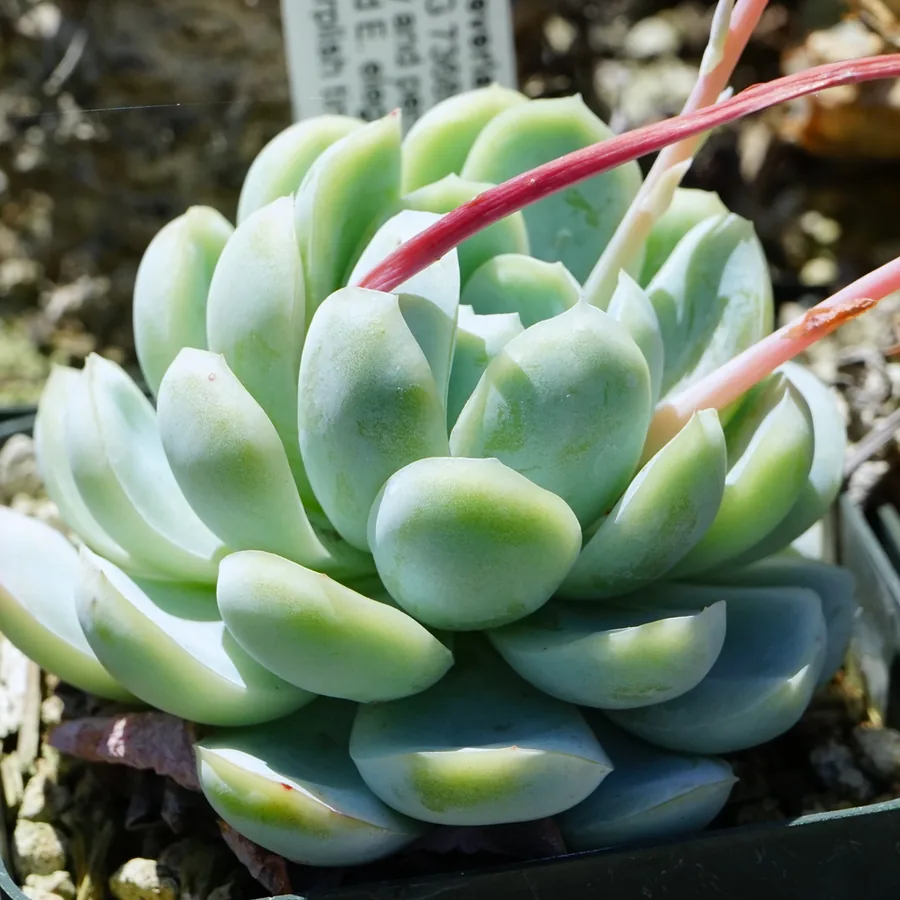
The Mexican snowball is a little succulent that gathers pale, blue-green leaves into a snug rosette with a soft silvery dusting on top. It hails from the rocky highlands of Mexico, and that pretty much sums up its wish list: fast drainage, lots of light, and not much else. Standing 2 to 4 inches (5 to 10 cm) tall and reaching about 20 inches (50 cm) wide, it's small enough to perch on a sunny windowsill.
Put it in the right place and it's tough to kill, which is half its charm. It grows slowly, lives on as a perennial, and gradually forms a clump as pups pop up around the base. Indoors, it wants the brightest window you've got, and come spring it might raise a thin stalk of small, bell-shaped flowers above the leaves.
Nearly every issue circles back to the same culprit: water. This is a plant designed to ride out dry spells, so the fastest way to kill it is to keep the soil wet. Nail the watering and hand it strong light, and that frosted rosette stays full and tight with hardly any effort from you.
Care
The short version: hand it the brightest light you've got, set it in a gritty fast-draining mix, and only water once the soil has gone completely dry.
Light
Give it full sun or the sunniest place you can find, and it'll keep that tight, compact rosette. Bright indirect light is okay too, but go any dimmer and it starts to stretch and fade. Through winter indoors, a grow light helps it hold its shape.
Water
Wait until the soil is completely dry between drinks, then soak it through and let the water run off. Ease way back in winter while growth is on pause. Always aim for the base instead of pouring into the rosette, because water caught between those leaves is a shortcut to rot.
Soil
Set it in a gritty cactus or succulent mix that drains in a hurry and never turns soggy. A pH of 6.0 to 7.0 is right where it likes things. Drainage matters more than anything else, so reach for a pot with a hole and steer clear of heavy, moisture-holding potting soil.
Temperature
It feels best between 50°F and 77°F (10°C to 25°C). Plain room temperature suits it all year, and since it can't handle a hard frost, bring it indoors before the chill arrives.
Humidity
This succulent is happy with low humidity and dry leaves, which makes it a breeze for most homes. Leave the mister in the cupboard, because muggy air and wet foliage just open the door to rot.
Feeding
Feed it lightly from spring through summer while it's growing, roughly once a month. Go with a balanced fertilizer cut to half strength or a low-nitrogen cactus feed. It asks for very little, and too much food just triggers soft, pest-prone growth.
Pruning
There's barely anything to fuss over here. Strip off the dried lower leaves and trim away finished flower stalks to keep things neat. Pulling the odd offset now and then tidies up the clump and hands you new plants to raise.
Repotting
Move it to a new pot every 2 to 3 years, or sooner if offsets start to crowd it out. Keep an eye out for roots sneaking through the drainage holes, soil that dries faster than it should, or growth that's stalled. Step up to fresh gritty mix in a pot just one size bigger.
Size & spacing
It stays petite, topping out at just 2 to 4 inches (5 to 10 cm) tall while spreading to roughly 10 to 20 inches (25 to 50 cm) across as it clumps. That low, wide shape makes it a great fit for a shallow dish or a windowsill pot.
Troubleshooting
With this succulent, trouble nearly always begins down at the roots or with the light. Learn to read the rosette and you'll spot most problems early, before a soft base or a long, stretched stem sticks around for good. Find your match below, then step in while it can still make a difference.
See-through, soft leaves over a darkening, mushy base
That's root and crown rot, and it shows up when water lingers in soil that can't drain. The bottom leaves go glassy and yellow, the stem turns squishy, and the roots end up brown and slimy. Here's the move: hold off on watering and let things dry, then lift it out, trim off every rotted root and any soft spot, and let those cuts dry over before you replant into fresh gritty mix with good drainage. And if the base is already lost? You can still rescue it by rooting a healthy top.
Fix:
- Stop watering and let the plant dry out
- Unpot, cut away rotted roots and tissue, and let cuts callus
- Repot into fresh gritty mix in a pot with drainage
- Re-root a healthy rosette top if the base is lost
Fuzzy white clumps tucked down between the leaves
Those cottony little patches are mealybugs, soft pests that tuck themselves into the leaf joints and the heart of the rosette and leave a sticky film behind. Grab a cotton swab dipped in 70 percent isopropyl alcohol and wipe each one away, then set the plant apart from your other succulents so they can't hop over. Keep checking every few days until the rosette comes up clean, and if you think root mealybugs are hiding below, treat the soil too.
Fix:
- Wipe off pests with a cotton swab dipped in 70 percent isopropyl alcohol
- Isolate the plant from other succulents
- Repeat treatment every few days until clear
- Treat soil if root mealybugs are suspected
Loose rosette and a bare stem tilting toward the window
What you're seeing is etiolation, which is just the plant straining toward light it can't find. That neat silvery rosette loosens up, the stem grows long, and fresh leaves spread apart and lean off to one side. So what helps? Shift it to your sunniest spot or straight into full sun, build up the brightness little by little so the leaves don't burn, and if the stretching has gotten really bad, cut off the tidy top and root it again.
Fix:
- Move to the brightest spot available or full sun
- Acclimate gradually to stronger light to avoid scorch
- Behead and re-root the compact top if severely stretched
Bleached brown marks on the leaves facing the sun
This is sunburn, and it happens when the plant gets hit with strong light before it's had a chance to adjust. You'll spot dry, faded patches on whichever side catches the sun after a move outside or to a brighter window. Ease it back into gentler, filtered light until the new growth has settled. Don't pull the scarred leaves off, though: they won't bounce back, but they still shade the rosette beneath them.
Fix:
- Move to slightly filtered light until new growth adjusts
- Leave scarred leaves in place; they will not heal but protect the rosette
Toxicity
If you share your home with animals, here's the good news: the Mexican snowball is non-toxic and pet-safe. Echeveria isn't on the ASPCA's poisonous list, so a nosy cat, dog, or any nibbler risks nothing worse than maybe a mild stomach upset from eating a plant that isn't food.
Safe for
People · Cats · Dogs · Horses · Rabbits · Livestock · Birds
Cats None
Fine to have around cats. The ASPCA leaves it off the toxic list, so a curious bite won't poison your cat.
Dogs None
Nothing toxic here for dogs. Chewing a fleshy leaf could leave a dog with a slightly upset tummy, like any plant that isn't dinner, but there's no real harm in it.
Horses Safe
Safe for horses. The plant holds nothing that would poison one that grazes on a rosette.
Rabbits Safe
No risk to rabbits at all. The leaves are toxin-free, even if that thick succulent flesh isn't really their usual fare.
Livestock Safe
Goats, sheep, and cattle can mingle with it just fine, since there's nothing poisonous in it to bother them.
Birds Safe
Birds are safe near it. A pecked leaf carries no toxic danger.
People Safe
Harmless for people. It isn't a food plant, but touching it or even a stray taste won't hurt you.
Varieties
A handful of named E. elegans forms show up among collectors, and each one puts its own spin on that pale rosette. Here are the ones worth getting to know.
Echeveria elegans var. kesselringiana
A tidy little form that keeps its rosettes tighter and smaller than the usual species.
Echeveria elegans 'Potosina'
Think fuller, rounder leaves in a deeper blue-green, all bunched into a tighter rosette.
Echeveria elegans 'Albicans'
A frosted, much whiter look gives this one a really pale, silvery rosette.
How to propagate
Has any plant ever been more giving? This one practically gifts you new plants, whether from the pups it sends up on its own or from a single leaf set down on soil.
Offsets & pupsEasy
Spring through summer · 2-4 weeks to root once detached
Want the simplest route? Just let the plant do its thing. Through spring and summer, E. elegans keeps sprouting offsets, or pups, all around the parent. Pop off a rooted pup, give it its own pot, and it'll settle in as a fresh plant in about 2 to 4 weeks.
Leaf cuttingsEasy
Spring through summer · 4-8 weeks to form roots and a tiny rosette
Leaves are an option too, and they're free. During spring or summer, gently twist off a whole healthy leaf so it comes away clean, let the broken end dry over, then set it on top of gritty mix. Tiny plantlets sprout from the base, and they take 4 to 8 weeks to grow roots and a small rosette of their own.
Myths
Cats and dogs can be poisoned by Echeveria.
Echeveria, E. elegans and all, doesn't appear on the ASPCA's toxic list, and it's a popular pick for pet-friendly homes. A pet that gorges on it could end up with a mild stomach upset, just like with any non-food plant, but there's no actual poison at work.
Because succulents like Echeveria store water, they do well in low light.
Storing water and needing light are two separate things. E. elegans wants bright light or full sun to keep its tight rosette, and tuck it in a dark corner and it'll etiolate, stretching into a loose, leggy mess.
A regular misting keeps succulents in good shape.
E. elegans prefers low humidity and dry leaves, so misting actually does it a disservice. Water pooling in the rosette is an open invitation for rot, and that's exactly what this plant doesn't need.