Ornamental · Ranunculaceae
Larkspur
Consolida ajacis
Tall blue spikes to brighten a cool spring garden, gorgeous to grow but poisonous in every part.
Full sun
Every 3–7 days
30–75°F · -1–24°C
USDA 2–11
Overview
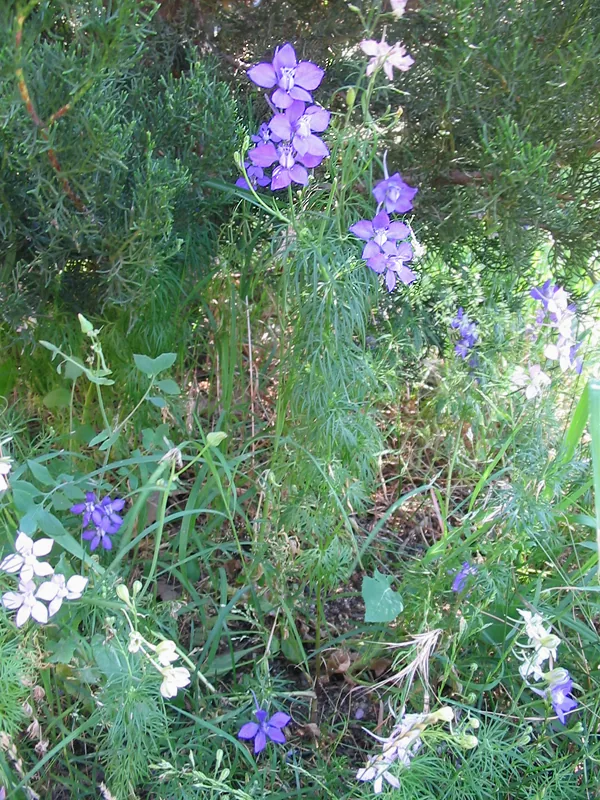
Want tall, airy blue for the cool stretch of the year? That's larkspur. It's an annual in the buttercup family, and it's a close cousin of the perennial delphiniums people so often mix it up with. From June to August it throws up spike-like racemes of spurred flowers over soft, ferny leaves, and while most plants come out blue, you'll get the odd pink or white too.
The trick with larkspur is timing, because it's a cool-season hardy annual that only really loves the mild window between frost and full-blown heat. Sow it right where it's going to bloom and it takes off fast, often hitting 2 to 4 feet before summer heat calls time. If you're in a cold zone, just start it before the last frost; if you're somewhere mild, sow in fall and let it overwinter for an earlier show.
One big caveat, though: larkspur is toxic from root to seed. The same diterpenoid alkaloids that make it one of the deadliest plants on western cattle ranges are just as risky for pets, kids, and people, so it needs a spot where curious mouths simply can't get to it.
Care
The short version: give larkspur full sun, loose well-drained soil, and steady moisture, sow it early so it blooms before the heat, and deadhead to keep the spikes coming.
Light
Give larkspur full sun for the strongest, straightest spikes, though it'll put up with a little partial shade. Sun keeps the air around the leaves dry too, and that's what holds powdery mildew back.
Water
Keep the soil evenly moist but never soggy, watering somewhere around every 3 to 7 days depending on the weather and your soil. The roots rot in wet, waterlogged ground, so good drainage matters just as much as staying on top of the watering.
Soil
Plant it in loose, moderately rich, well-drained soil. Larkspur isn't picky about pH and does fine on alkaline ground, anywhere from 6.5 to 8.0, as long as the water drains away instead of sitting there.
Temperature
It's a cool-weather plant, happy from about 30°F to 75°F (-1°C to 24°C). A light frost? No problem. But it packs it in once summer heat settles in, which is why sowing early pays off.
Humidity
Regular outdoor humidity is fine, so there's no number to worry about. Air movement is what counts, because still, damp air around crowded plants is what invites powdery mildew in.
Feeding
Work a balanced fertilizer into rich, organic soil at planting and that's pretty much it. Larkspur isn't a big eater, and good ground at the start carries it right through its short, fast life.
Pruning
Deadhead the spent spikes and you'll coax more bloom over a longer stretch. As the heat builds and the plant starts to fade, go ahead and cut it back instead of letting it sit and sulk.
Size & spacing
Plants run 2 to 4 feet (61 to 122 cm) tall and stay slim at 12 to 18 inches (30 to 46 cm) across. Thin or space the seedlings about 9 to 12 inches apart so air moves freely and mildew stays away.
When to plant
Larkspur is all about the cool half of the season, and it's got no use for summer heat. If you're in a cold climate, sow indoors 8 to 10 weeks before the last frost or direct-sow in early spring, and if you're somewhere milder, sow outdoors in fall for a jump on things. Either way, you're after bloom from June to August, before the heat settles in and shuts the plant down.
Northern hemisphere
Southern hemisphere
Typical months for a temperate climate: start earlier in warm zones, later where spring frosts linger.
- Sow: Northern climates: sow indoors 8 to 10 weeks before last spring frost
- Plant: Sow outdoors in fall in southern climates, or early spring before last frost in northern climates; space 9 to 12 inches apart
- Harvest: Blooms June to August in spike-like racemes
Hardiness
USDA hardiness zones: 2–11
Temperature: down to -46°C
Troubleshooting
Larkspur is an easy plant with a pretty short list of problems, and most of them come down to heat or crowding. Learn to spot the early signs on the leaves and get your sowing timed right, and you'll dodge nearly all of it. Find what matches below, then step in while it still does some good.
Plants wilt and fade out as summer heats up
Here's the thing: larkspur is a cool-season hardy annual, so it naturally bows out once the heat really lands, and that comes early in the deep South. If a plant's fading from heat, there's no bringing it back, so don't fret over it. What actually works is timing, so sow in fall or very early spring to get the flowers done before the worst of summer, and toss in a little afternoon shade if things get hot where you are.
Fix:
- Provide afternoon shade in hot-summer climates
- Sow in fall or very early spring so bloom finishes before peak heat
White powdery dust on the leaves and stems
See a chalky film on the leaves? That's powdery mildew, a fungus that turns up when plants sit shoulder to shoulder in still, muggy air. Open the planting up so a breeze can get through, water down at the base instead of over the leaves, and pull off anything that's already dusted. Keep the bed in full sun and the fungus won't have much of a chance.
Fix:
- Improve air circulation by thinning and spacing plants
- Avoid overhead watering
- Remove and discard affected foliage
Chewed, holed, or distorted leaves
A handful of pests like larkspur leaves, and you've probably got some mix of aphids, slugs, snails, leaf miners, and mites. Flip a few leaves and check the undersides for clusters, go looking for slime trails after dark, and keep an eye out for the pale squiggly tunnels miners leave. From there it's easy enough: pick off slugs and snails, knock aphids and mites loose with a hard spray of water, and yank any leaf that's really overrun.
Fix:
- Hand-pick slugs and snails
- Wash off aphids or mites with a strong water spray
- Remove heavily infested leaves
Toxicity
Treat every part of this plant like poison, plain and simple. The flowers, leaves, stems, and especially the seeds carry diterpenoid alkaloids that block nerves and muscles, which is exactly why larkspur is such a killer of range cattle. It's every bit as dangerous to cats, dogs, horses, rabbits, birds, and people, so keep it well away from anyone, animal or human, who might take a bite. Nothing on this plant is safe to eat.
Toxic to
Cats · Dogs · Horses · Rabbits · Livestock · Birds · People
Cats Severe
Every bit of this plant is trouble for a cat, and the seeds and young growth pack the most punch. The diterpenoid alkaloids go after the nerves and muscles, so a cat can start drooling, cramping, trembling, stiffening up, and going weak, and if it gets bad that slides into convulsions, heart failure, and death once breathing stops. Don't wait around on this one.
Dogs Severe
A dog that chews any part of larkspur runs into the very same neuromuscular poison. You might see heavy drooling, constipation, cramping, muscle tremors, and a wobbly, fading walk that can drop into collapse, convulsions, and deadly breathing failure. Get to the vet right away instead of waiting to see how it plays out.
Horses Severe
Horses are really sensitive to this, and the alkaloids act fast. Early on it's colic, constipation, extra drooling, and stiffness, and then it can move to the horse going down and convulsing, with heart failure and fatal breathing trouble in the worst cases. Call the vet the moment you suspect a bite.
Rabbits Severe
Think a rabbit's too small to worry? The same alkaloids that take down far bigger animals are just as bad for a bunny. There's no part it can safely nibble, and even a little can bring on tremors, weakness, paralysis, and death, so keep larkspur well away from any hutch or run.
Livestock Severe
For cattle, larkspur is about as dangerous as range plants get, and they'll eat it readily and die by the numbers every year. Poisoned animals go weak and trembly, lose their footing, hang back from walking, and eventually go down, often bloated, with a fast uneven heartbeat and labored breathing. Managing the grazing is what really keeps a herd safe.
Birds Severe
Birds don't get a pass from the alkaloids that poison mammals, and the seeds are the biggest risk to anything that pecks around. It's safest to treat the whole plant as off limits, since even a little can bring on the tremors, weakness, and paralysis this toxin causes. A bit of care keeps the local birds out of harm's way.
People Caution
No part of larkspur is food, and yes, it can poison people too. Swallow any of it and you're looking at vomiting, muscle weakness, a weak pulse, and trouble breathing, so keep seeds and foliage away from kids and pull on gloves before you handle the plant.
Seeds and young foliage are most toxic; keep all plant parts away from children, pets, and grazing livestock and wear gloves when handling.
Helpline numbers

United States
ASPCA Animal Poison Control: (888) 426-4435 (fee applies)
Poison Control: (800) 222-1222



Canada
Poison Centres: 1-844-764-7669
Varieties
Most of the larkspur you'll find for gardens and bouquets is grown for the color and length of its spikes. Here are a few named types you're likely to run into.
Stiletta Indigo Blue
It's a cut-flower favorite, all tall, straight spikes packed with indigo-blue blooms.
Cannes Deep Blue
This one's grown for the vase, with deep blue, spurred flowers riding long, sturdy stems.
White-flowered forms
These are the rarer white versions of a plant that's usually blue and only now and then goes pink or white.
How to propagate
Larkspur grows easily from seed, and honestly seed's the only practical way, since it really doesn't like having its roots messed with.
SeedEasy
Sow outdoors in fall (mild climates) or early spring; seeds benefit from cool conditions to germinate · Germination in roughly 2 to 3 weeks under cool soil conditions
The simplest way to grow larkspur is to sow it right where you want it, since it hates being moved and does best planted in place. Put the seeds out in fall if your climate's mild or in early spring if it isn't, give them the cool spell they need to sprout, and you'll usually see germination in about 2 to 3 weeks. Once the seedlings come up, thin them to 9 to 12 inches apart so each spike has elbow room.
Myths
Larkspur is harmless to animals once it's done flowering.
Not quite. The plant does get a bit less potent as it ages, but it never actually turns safe. The seeds stay highly poisonous, and livestock still die from larkspur late in the season, so a plant past bloom is nothing to relax around.
Larkspur is only a problem for cattle, not pets or people.
Wish that were true, but no. The diterpenoid alkaloids hit cats, dogs, horses, and humans just as hard as cattle. For a person, swallowing it can mean vomiting, muscle weakness, a weak pulse, and respiratory paralysis, so this is a whole-household worry, not just something out on the ranch.