Ornamental · Asteraceae
Blazing Star
Liatris spicata
Pop the corms in once and blazing star keeps sending up tall purple spikes for the bees every summer.
Full sun
USDA 3–8
2–4 ft · 0.6–1.2 m
Overview
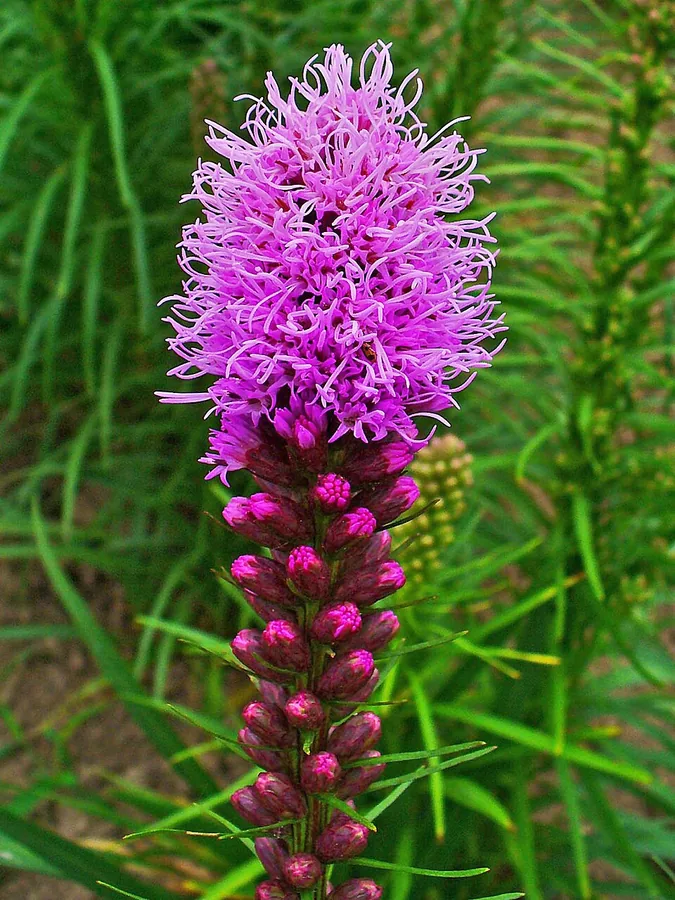
Blazing star is a North American prairie native, and instead of the wide, flat flowers you see on most garden plants, it goes for tall, skinny spikes. Every stem is loaded with dense purple buds that open into a soft, fuzzy column, and once a patch is in bloom, it'll pull butterflies and bees in from clear across the yard. It grows from a corm, comes back on its own every single year, and asks for barely anything once it's in the ground.
Want to know what really makes it stand out? It's the way it blooms. Most spike flowers open from the bottom up, but blazing star opens from the top down, so the tip's fading while the base is still coming along. Its grassy foliage and stiff stems hand a bed those vertical lines that most perennials just can't manage, whether you go for the full-height species or a shorter one like 'Kobold'.
It's an easy plant if you've got a sunny, well-drained spot for it. Give it full sun and ground that drains, and it'll shrug off heat, drought, and even lousy soil once the roots are down. The one thing it won't put up with is wet feet in winter, which rots the corm quicker than any bug or disease ever could.
Care
The short version: full sun and average, well-drained soil, regular water that first season and a lot less after, and a spot that never stays soggy through winter.
Light
Go with full sun for blazing star. It'll get by in partial shade, sure, but the stems stretch and weaken there and end up leaning over, so the more sun it gets, the sturdier and more upright it stands.
Water
Water it through that first growing season to help the roots settle in. After that it's pretty drought tolerant and won't need much, and honestly it'd much rather run dry than sit wet, especially over winter.
Soil
It'll take just about any well-drained soil, whether that's loam, sand, or clay, and it even puts up with poor ground. A pH anywhere from 6.0 to 8.0 works fine, so the thing that really counts is drainage, not how rich the soil is.
Humidity
Plain outdoor air is all it wants, so there's no number to worry about here. What matters way more is good airflow, since crowded, still conditions are exactly what let powdery mildew and rust get going.
Feeding
This is a lean-soil prairie plant, so it's not a heavy feeder. One light feeding before growth kicks off in spring is plenty, and piling on fertilizer just gives you soft, floppy stems that can't hold their flowers up.
Pruning
Cut the spent flower stalks once they're done, but leave the foliage and hollow stems standing through winter so they can shelter native bees and feed songbirds, then cut them back in early spring. Tall stems in rich, moist soil might want a stake.
Size & spacing
Plants get to 2 to 4 feet (60 to 120 cm) tall in a narrow clump. Space them about 12 to 15 inches apart so air moves freely and each spike has the room it needs to stand up.
When to plant
Blazing star's a tough perennial that's happy in zones 3 to 8. Set out the corms or young plants in early spring, or plant container-grown stock again in early fall, and you'll get flower spikes in mid- to late summer.
Northern hemisphere
Southern hemisphere
Typical months for a temperate climate: start earlier in warm zones, later where spring frosts linger.
- Sow: Early spring; seed germinates in 20-45 days and benefits from 4-6 weeks cold moist stratification
- Plant: Plant corms or container plants in early spring; container-grown plants may also be set out in early fall, spaced 12-15 inches apart
- Harvest: Blooms mid- to late summer (July-August), with dense purple flower spikes opening from the top down
Hardiness
USDA hardiness zones: 3–8
Temperature: down to -40°C
Troubleshooting
Here's the thing about blazing star: it barely has any real problems, and almost all of them come back to one issue, ground that holds too much water. Keep half an eye on the stems and leaves through the season, and jump in early before a little fungus or a soggy corm gets out of hand. Just match up what you're seeing below, then act while it still does some good.
Sudden wilting with a soft, rotting corm
This one's the serious one, but it's also easy to dodge. Soggy, poorly drained ground brings on stem and corm rot, and soil that stays wet all winter is almost always what's behind it. You can't save a rotted plant, so dig it out along with the bad soil around it. The real answer is drainage, so keep blazing star out of anywhere that sits wet.
Fix:
- Improve drainage and avoid wet sites
- Remove and discard affected plants and surrounding infected soil
Tall flower stems that flop or bend over
Ever notice stems tipping over just as they hit full height? That's soft, weak growth brought on by soil that's too rich or too damp, and a shady spot only makes it worse. Move the plant into full sun and leaner ground, prop up the tallest stems with a stake, or go with a naturally short cultivar like 'Kobold' that stands up fine on its own.
Fix:
- Stake or provide support for tall stems
- Site in full sun and average, well-drained soil rather than rich, moist beds
- Choose compact cultivars such as 'Kobold'
A white powdery coating showing up on leaves
That chalky film is powdery mildew, a fungus that likes to show up late in the season when plants are packed together and the air isn't moving. The fix is pretty simple: give the clump some breathing room by spacing or thinning it, and pull off the worst leaves so there's less for the fungus to spread to.
Fix:
- Improve air circulation by spacing and thinning plants
- Remove and dispose of badly affected foliage
Orange to brown pustules dotting the leaves
Flip a leaf and spot raised, rust-colored bumps underneath? Those are rust fungi. Snip off and toss the marked leaves before the spores get around, and open the planting up a bit so air can move and the leaves dry off quickly after it rains.
Fix:
- Remove and destroy infected leaves
- Improve spacing and air circulation
Toxicity
Great news if you've got pets or kids: blazing star is safe all around. The ASPCA lists it as non-toxic to cats, dogs, and horses, and there's nothing in the leaves, stems, or corms that'll poison people or grazing animals. About the worst a big mouthful does is bring on a passing stomach upset.
Safe for
People · Cats · Dogs · Horses · Rabbits · Livestock · Birds
Cats None
Good news for cat folks: the ASPCA lists blazing star as non-toxic to cats, so a little nibble is no big deal. If a cat really goes to town on any plant it might throw it back up, but that's just the rough leaves at work, not poison.
Dogs None
Dogs are in the clear too, since there's nothing toxic in the leaves, stems, or corms. About the worst a nosy dog gets from a big mouthful is a bit of a mild upset stomach.
Horses None
Horses can graze right next to blazing star and be totally fine, because there's nothing in it that's poisonous to them.
Rabbits None
Rabbits and other little pets can munch the foliage without any trouble. It's a wildflower they'd bump into out in the meadow anyway, right?
Livestock None
Cattle, goats, and sheep have nothing to fear from blazing star out in the pasture, since it doesn't carry any toxins that bother grazing animals.
Birds None
Birds do just fine around it, and honestly they love it, since songbirds like goldfinches go after the ripe seed heads all through fall and winter.
People None
Nothing about blazing star is poisonous to people either. It's grown for the flowers, not the dinner table, so there's no reason to eat it, but a stray touch or taste won't do any harm.
Varieties
Most of the named blazing stars are picked for their color or for a tidier, more manageable height. Here are the ones you're most likely to run across.
Kobold
This one's a compact, deep-purple pick that stays short enough to hold itself up, which makes it a no-brainer for the front of a border.
Floristan White
It's a white-flowered form that gardeners grow mostly for cutting, since those clean spikes really last once they're in a vase.
Floristan Violett
Here's a violet-flowered pick with stems tough enough to cut and carry, which is exactly why florists keep coming back to it.
Alba
It's a pure white form that tops out around 18 inches, so it's shorter than the species and slips easily into a small bed.
How to propagate
Want more blazing star? You can either split up an established clump or start from seed, though one of those gets you flowers way faster than the other.
DivisionEasy
Spring, just as leaves emerge · Establishes over one to two seasons; clumps can be divided every few years
Splitting up an established clump is the surest way to end up with more plants, and it's not hard at all. In spring, right as the leaves start poking up, dig the clump and pull or cut the corms and tuberous roots apart, just making sure each piece keeps at least one eye. The new bits come up looking just like the parent, though they take their sweet time, needing a season or two to really fill in.
SeedModerate
Early spring indoors or direct sow, or fall sow outdoors · Seedlings typically bloom in their second or third year
Seed's the patient route. It sprouts in 20 to 45 days, but only once a cold spell has woken it up, so either give the seed 4 to 6 weeks of cold, moist chilling first or just sow it outside in fall and let winter handle it. After that? A seedling still needs its second or third year before it finally sends up a flower spike.
Myths
Blazing star is poisonous to dogs and cats.
You can let that one go, because the ASPCA puts blazing star on the list of plants that are not toxic to dogs and cats. Sure, like with any plant, a pet that eats a big mouthful might get a mild upset stomach, but there's no actual poison to worry about.
Liatris spikes open from the bottom up like most spike flowers.
Nope, blazing star does the exact opposite of nearly every other spike flower out there. It blooms from the top of the spike downward, so the tip's already fading while the lowest buds are still just opening up.