Shrub · Apocynaceae
Mandevilla
Mandevilla × amabilis
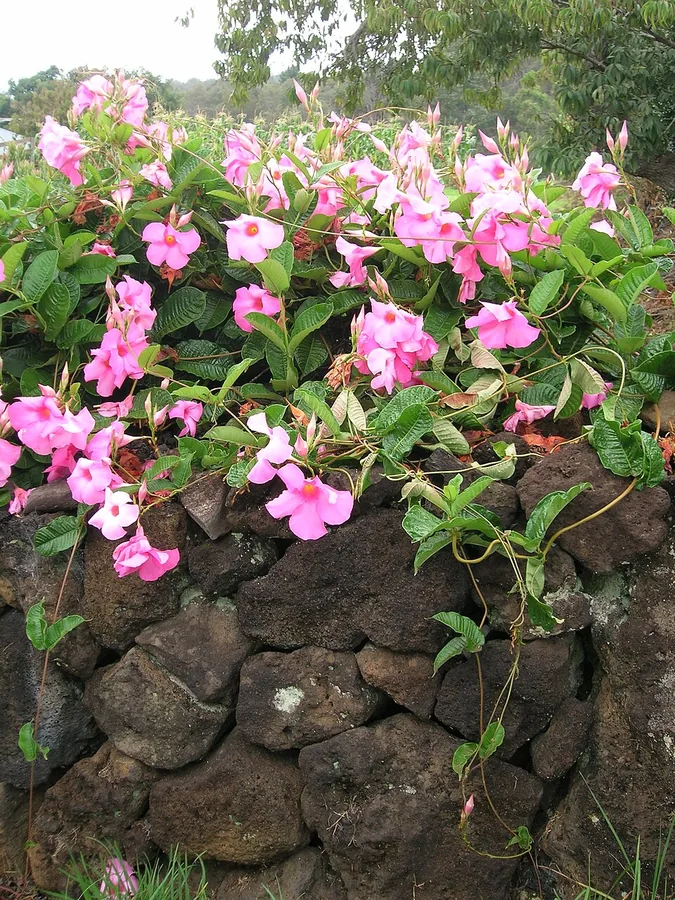
Give it sun and summer warmth, and mandevilla just keeps climbing and throwing trumpet blooms into fall.
Full sun
Every 3–7 days
45–90°F · 7–32°C
USDA 10–11
Overview
Want a vine that flowers all summer? Mandevilla's a fast-growing tropical from the dogbane family, and it throws big trumpet flowers from summer right into fall. It's from the warm parts of the Americas, so it only stays outside through winter in zones 10 and 11. Anywhere colder, you just grow it in a pot for the summer and bring it in before it gets cold.
At the garden center you'll run into two versions, and honestly either one's great. There's the tall twining kind sold as Mandevilla that'll climb a trellis or post way over your head, and the bushier, mounding kind sold as Dipladenia that stays tidy in pots and baskets. Both want the exact same stuff: heat, sun, and steady water through summer.
So what's the catch? Just the sap. Cut a stem and it bleeds a milky sap that stings skin and eyes, so it's smart to keep gloves nearby when you prune. Other than that, give it light and warmth and it's happy, paying you back with months of color.
Care
The short version: full sun for the best flowers, steady water through the summer heat with a drier rest in winter, rich soil that drains well, and a bloom feed every couple of weeks once it's growing.
Light
Mandevilla flowers best in full sun, so shoot for 6 or more hours of direct light a day. Can it live in part shade or bright indirect light? Sure, but the dimmer the spot, the more you'll trade flowers for leaves.
Water
Through summer, keep the soil evenly moist but never soggy, which usually means watering every 3 to 7 days, and more when it's hot or it's in a pot. Once winter rolls around, ease off and let the soil dry out more between waterings while the plant takes a rest.
Soil
It likes rich, well-drained ground with some humus mixed in, or a peat-based mix if it's in a container. It's not picky about acidity and handles anything from a pH of 6.0 to 8.0, but it'll rot in soil that stays wet, so drainage is the thing to get right.
Temperature
It's a warm-weather plant, happiest between 45°F and 90°F (7°C to 32°C), and you'll see growth slow down as the air cools. Frost will finish it off, though, so bring it inside before nights drop below 50°F (10°C).
Humidity
Coming from the tropics, mandevilla likes high humidity. When it's indoors for winter, group it with other plants or set the pot on a pebble tray so the air around it doesn't dry out.
Feeding
Feed it every two weeks through spring and summer while it's actively growing. Go for a high-phosphorus bloom fertilizer like 10-20-10, because too much nitrogen just gives you leaves instead of flowers.
Pruning
Prune in late winter or early spring before new growth starts, cutting out the old crowded stems and shortening the rest, and pinch young plants to help them bush out. Just glove up first, since the cut stems ooze that irritating milky sap.
Repotting
Bump it up a pot size every 1 to 2 years, or sooner if roots start circling, water runs straight through, or growth and bloom stall out. A pot that drains well beats a big one every time, so don't overthink the size.
Size & spacing
Depending on the type, mandevilla goes from a tidy 3 feet to a towering 3 to 10 feet (0.9 to 3 m), and it spreads 3 to 4 feet (91 to 122 cm) wide. Got a climbing form? Give it a trellis or post to run up.
When to plant
Mandevilla runs on warmth and won't put up with frost, so timing's pretty simple. Start seed or wake up overwintered plants indoors in late winter, wait to move them outside until nights stay above 50°F (10°C), and the flowers show up from summer through fall.
Northern hemisphere
Southern hemisphere
Typical months for a temperate climate: start earlier in warm zones, later where spring frosts linger.
- Sow: late winter to early spring
- Plant: after last frost when nights stay above 50 degrees F
- Harvest: summer through fall
Hardiness
USDA hardiness zones: 10–11
Temperature: down to -1°C
Troubleshooting
Most of the time, mandevilla trouble is one of two things: pests on plants that wintered indoors, or a vine that's all leaf and no flower. Catch it early and you can usually turn it around before it spreads. Find what matches below, then act while it still does some good.
Wilting yellow leaves with soft dark roots in soggy soil
If the soil's always wet and the leaves wilt anyway, you're probably looking at root rot from overwatering. Slide the plant out and check the roots, because healthy ones are firm and pale while rotted ones go dark, soft, and smelly. Stop watering, repot into fresh fast-draining mix, trim off the dead roots, and make sure that pot drains freely from here on out.
Fix:
- Stop watering and let the soil dry out
- Repot into fresh, fast-draining mix and trim away rotted roots
- Ensure the container has drainage holes and discard standing water
Fine webbing and speckled, yellowing leaves
See tiny moving dots and a silvery speckle on the leaves? That's usually spider mites, and they love the warm, dry air around plants wintering indoors. Tap a leaf over white paper to double-check for specks, then give the foliage a hard rinse, especially underneath. After that, hit it with insecticidal soap or horticultural oil, bump up the humidity, and keep it away from your other plants until it's clear.
Fix:
- Rinse foliage with a strong spray of water, especially leaf undersides
- Treat with insecticidal soap or horticultural oil, repeating per label
- Raise humidity and isolate the plant to limit spread
Cottony fluff and sticky film on stems and joints
Sticky honeydew and little white cottony bits? Those are mealybugs, scale, aphids, or whitefly, and they all go for an overwintering vine. Take a look at the stem junctions and leaf undersides to figure out which one it is. Dab mealybugs and scale with an alcohol-soaked swab, spray the rest with insecticidal soap or horticultural oil, and cut off anything that's really overrun.
Fix:
- Wipe off mealybugs and scale with a cotton swab dipped in rubbing alcohol
- Spray with insecticidal soap or horticultural oil, repeating as needed
- Remove heavily infested growth and isolate the plant
Loads of leaves but hardly any flowers
A mandevilla that's all green and no flower is almost always just short on sun, since it needs full sun to bloom well. Cool nights and too much nitrogen push it toward leaves too. Move it into at least 6 hours of direct sun, keep it warm, and switch to a high-phosphorus bloom feed like 10-20-10, and the flowers should come.
Fix:
- Move the plant to a full-sun location
- Switch to a high-phosphorus bloom fertilizer such as 10-20-10
- Keep it warm, as bloom slows in cool conditions
Toxicity
Mandevilla's in the dogbane family, and it bleeds a milky sap that nobody, pet or person, should be eating. Chew the foliage and pets get a mild upset stomach, and the sap stings skin, eyes, and mouths. None of it's edible, so keep it away from grazing animals, pets, and little kids, and pull on gloves before you cut it.
Toxic to
Cats · Dogs · Horses · Rabbits · Livestock · Birds · People
Cats Mild
If a cat nibbles a leaf, it usually just gets a mild upset stomach with drooling and maybe a little throwing up. That milky sap can leave its mouth sore too, so it's best kept out of reach.
Dogs Mild
A dog that chews the foliage will probably drool and bring a bit back up. And if it touches the cut sap, that can redden the muzzle or irritate the mouth, so wipe it off and keep the clippings away.
Horses Mild
That same irritant sap can upset a grazing horse, usually just drooling and a mild stomach ache. The good news? Most horses taste the bitter leaves once and leave it alone after that.
Rabbits Mild
A rabbit that samples the leaves might drool and lose interest in food for a bit. Keep clippings out of the hutch and hand it safer greens instead.
Livestock Caution
Grazing animals hardly ever pick this bitter, sappy plant on purpose, but a really hungry one could end up with an irritated mouth and a queasy gut. Fence it off where stock roam and you're covered.
Birds Caution
There's not much on record about birds getting hurt, but the irritant latex is reason enough to keep it out of reach. So play it safe with curious pet birds around the foliage.
People Caution
None of the plant's meant to be eaten, and swallowing the foliage can irritate the mouth and stomach. The milky sap's the bigger headache, though, since it stings skin and eyes, so wear gloves and wash up after pruning.
Wear gloves when pruning or handling cut stems because the milky latex sap can irritate skin and eyes; wash hands after contact and keep cuttings away from pets and children.
Helpline numbers

United States
ASPCA Animal Poison Control: (888) 426-4435 (fee applies)
Poison Control: (800) 222-1222



Canada
Poison Centres: 1-844-764-7669
Varieties
There are loads of named mandevilla hybrids out there, but a few keep showing up. Here are the ones worth knowing by name.
Alice du Pont
A classic big vining type whose deep pink trumpet flowers can take it to around 20 feet outdoors.
Sun Parasol series
A popular bunch of free-flowering hybrids in tons of colors, from compact little mounds to real climbers.
Red Riding Hood
A vigorous vine that blooms in a deep rose-red.
Dipladenia (Mandevilla sanderi forms)
The bushier, mounding trade forms with smaller glossy leaves, still sold as Dipladenia but grouped under Mandevilla these days.
How to propagate
Want more mandevilla? Cuttings are the easy way to go, though you can start it from seed too if you're patient.
Stem cuttingsModerate
Spring through summer · 4-8 weeks
Cuttings are the go-to way to copy a mandevilla, and they're pretty reliable. In the warm season, snip softwood tips off new growth, strip the lower leaves, and root them in a well-drained mix, where a dip of rooting hormone helps your odds and roots take hold in 4 to 8 weeks. Wear gloves while you're at it, since those cut stems ooze the same irritating milky sap.
SeedModerate
Late winter to early spring · Several weeks to germinate
You can also grow mandevilla from seed sown in late winter to early spring, but heads up, it takes several weeks just to sprout. Most folks skip it, because cuttings root faster and keep your favorite named cultivar true to type.
Myths
Dipladenia is a completely different plant from Mandevilla.
Nope, they're really the same group. Dipladenia's just the old genus name, and these plants all sit under Mandevilla now. The trade keeps the two words around to flag a difference in habit, not genus: the tall twining types get sold as Mandevilla and the bushy, mounding Mandevilla sanderi forms as Dipladenia.