Shrub · Apocynaceae
Oleander
Nerium oleander
A tough, drought-proof shrub that blooms all summer, with one big catch: every part is dangerously poisonous.
Full sun
Every 7–14 days
USDA 8–10
5–20 ft · 1.5–5.9 m
Overview
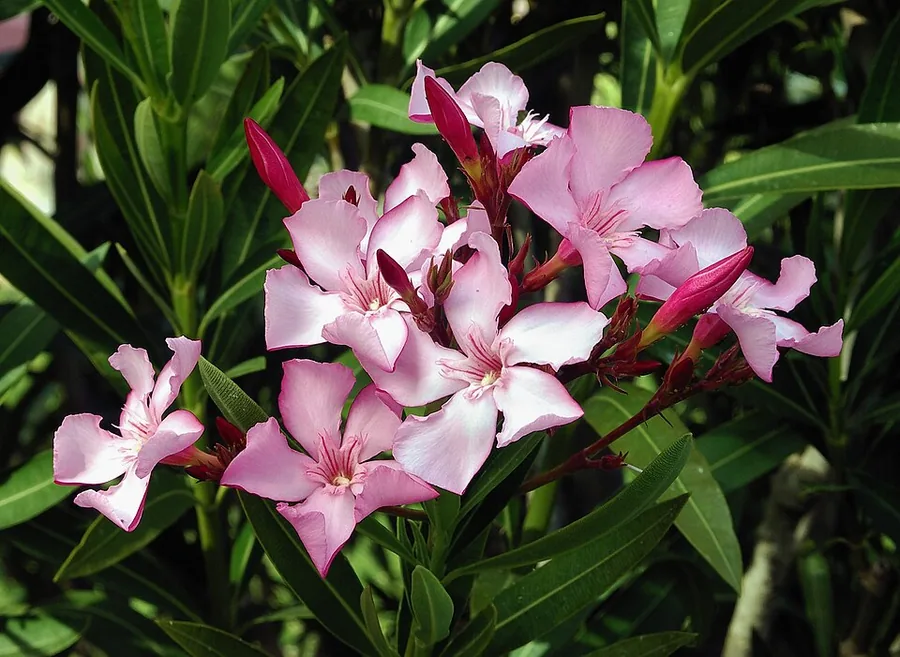
Oleander is a fast-growing evergreen that thrives right where fussier plants throw in the towel, brushing off drought, salt spray, and poor soil like they're nothing. In a warm-climate garden it pays its way with months of pink, white, or salmon flowers from late spring deep into summer. Leave it be and it'll climb to 20 feet (6 m) tall, but it takes a hard cutback just as happily, which is why so many people grow it as a hedge or screen.
So what's the catch? The same toughness that makes it easy also makes it dangerous. All of it, root to flower, carries cardiac glycosides that go after the heart, and it's one of the most poisonous shrubs people plant near a home. That toxin doesn't fade in dried leaves, in the smoke from burning clippings, or in the water a cut stem's been standing in.
None of that has to put you off, though. Just grow it where its toughness pays off and its poison can't reach the wrong mouth. Keep it clear of pastures, play areas, and vegetable beds, handle it with gloves, and never burn the trimmings. Give it that respect and you'll get one of the longest, most reliable bloom seasons of any shrub out there.
Care
The short version: full sun and well-drained soil, water deeply but let it dry between drinks, and prune to shape once it's finished flowering. It barely asks for anything once it's settled in, but every part of it is poisonous, so keep the gloves handy.
Light
Oleander wants full sun to really flower, though it'll get by in partial shade with fewer blooms to show for it. The more direct sun it gets, the fuller the plant and the bigger the flush of bloom, so a bright spot's worth it.
Water
Water it regularly while it's getting established, then let the top half of the soil dry out before you water again. A grown oleander is genuinely drought-tough and handles poor, salty ground just fine, so it only needs watering every 7 to 14 days at most. Ease right off through winter for anything you're keeping in a pot.
Soil
It's not picky about soil at all, growing in clay, loam, sand, or shallow rocky ground, even where it's poor or salty. What really matters is good drainage, not rich soil, and it's happy across a wide pH band of 6.0 to 7.8.
Temperature
Oleander shrugs off real heat, up to about 100°F (38°C), no problem. It'll take a light freeze down to roughly 19°F (-7°C), but a harder cold snap can damage or kill it, which is why folks move container plants in or overwinter them cool.
Humidity
Average outdoor humidity suits it fine, and there's no number you need to hit. It puts up with dry air and coastal salt spray, so honestly, this is one thing you can just leave alone.
Feeding
Feed it seasonally from spring through summer with a balanced general-purpose fertilizer. Plants in the ground barely need it once they've settled, while potted ones do like a regular light feed through the growing season.
Pruning
Prune it lightly to shape after flowering, from late summer into early fall. Buds form on new growth, so cutting back later than early fall will cost you next year's bloom, which is easy to avoid once you know. Deadhead the spent flowers, keep gloves on for the whole job, and never burn the clippings.
Repotting
A potted oleander wants moving up every 2 to 3 years, or sooner if roots circle the pot, water runs straight through, or growth stalls. Bump it into a slightly bigger pot with fresh, well-drained mix, gloves on.
Size & spacing
Plants run from about 5 to 19.5 feet (1.5 to 6 m) tall and spread 6 to 10 feet (1.8 to 3 m) wide, so a full-size hedge really does need some room. Dwarf cultivars stay a lot smaller and fit nicely in a large container.
When to plant
Oleander's happiest at the mild end of the temperate range, roughly zones 8 to 10. Start cuttings or seed in late winter to early spring, move the young plants outside once the last frost's gone, and the flowers just keep coming from late spring through late summer.
Northern hemisphere
Southern hemisphere
Typical months for a temperate climate: start earlier in warm zones, later where spring frosts linger.
- Sow: late winter to early spring
- Plant: spring after last frost
- Harvest: late spring through late summer
Hardiness
USDA hardiness zones: 8–10
Temperature: down to -12°C
Troubleshooting
Oleander's an easygoing plant that rarely causes headaches, and when something does crop up it almost always shows on the leaves, not the whole shrub. Find what you're seeing below and jump on it early. And keep your gloves on for any job that means touching the plant.
Leaves eaten down to nothing but the veins
When a branch goes to lace almost overnight, that's the oleander caterpillar at work, since it feeds in groups and moves fast. Don't panic, though, because it's an easy one to sort out. Glove up and pick the orange, black-tufted caterpillars off by hand, then snip off any branch that's really overrun. If it gets away from you, a dose of Bacillus thuringiensis will handle a bad outbreak.
Fix:
- Hand-pick and destroy caterpillars (wear gloves)
- Remove and dispose of heavily infested branches
- Apply Bacillus thuringiensis (Bt) for severe infestations
Tacky leaves going black with tiny bugs hiding underneath
See a sticky feel and a black film spreading over the leaves? That's usually bright yellow oleander aphids on the new growth, and sometimes scale or mealybugs join in. They drip sugary honeydew, and that's what the sooty mold feeds on. Knock the lighter groups off with a hard spray of water first, then hit the rest with insecticidal soap or horticultural oil. Do it again a while later to break the cycle, and the mold rinses right off once the bugs are gone.
Fix:
- Spray off light infestations with a strong jet of water
- Apply insecticidal soap or horticultural oil to affected growth
- Repeat treatment to break the pest cycle and wash off sooty mold
Spotted leaves starting to drop
Brown or yellow spots with clean edges? That's typically a fungal leaf spot, though sooty mold from insect honeydew can leave similar-looking marks, so take a closer look first. Pull off the spotted leaves and tidy up whatever's dropped around the base. Then open the plant up so air moves through it, and try to keep water off the leaves, because dry foliage gives the spores a lot less to work with.
Fix:
- Remove and destroy affected leaves
- Improve air circulation and avoid overhead watering
- Clean up fallen debris around the plant
Toxicity
This is one of the more dangerous plants you can grow near a home, and it's worth being clear-eyed about it. Every part holds cardiac glycosides that can stop a heart, and the poison sticks around in dried leaves, in burning smoke, and in vase water. A single leaf has killed children, and it's rapidly and often fatally toxic to cats, dogs, horses, livestock, and birds. Keep it well away from anyone who might taste it, and never burn the clippings.
Toxic to
Cats · Dogs · Horses · Rabbits · Livestock · Birds · People
Cats Severe
If a cat nibbles any part of this plant, that's a real emergency, no waiting around. You'll likely see drooling, vomiting, diarrhea, and belly pain first, then an irregular or racing heartbeat, weakness, and collapse. Even a small taste can be fatal, so treat any contact as urgent.
Dogs Severe
Dogs are in the same boat, and just one chewed leaf or stem is enough to be dangerous. That first drooling, vomiting, and diarrhea can turn into scary heart rhythm changes, tremors, and a sudden collapse. Head straight to the vet instead of hoping it passes.
Horses Severe
Horses are incredibly sensitive to this one, and only a few leaves can be deadly. Colic, drooling, and diarrhea show up along with a badly abnormal heartbeat, muscle tremors, and collapse. And dried clippings that blow into a paddock? Just as lethal as the living plant.
Rabbits Severe
The heart toxins are rough on rabbits, and even a tiny bit can stop the heart. You'll see gut pain, a refusal to eat, weakness, and a faltering pulse. There's no safe nibble here, so keep oleander well out of their reach.
Livestock Severe
Cattle, goats, and sheep get poisoned by fresh green leaves and by dried clippings raked into hay, no difference. Vomiting, colic, diarrhea, and a staggering heartbeat lead to collapse and sudden death. A lot of livestock deaths come from animals eating trimmings tossed over a fence, so don't do that.
Birds Severe
Birds aren't spared either, and the same heart toxin can kill them fast. Watch for weakness, a ruffled stillness, an erratic heartbeat, and sudden death. Keep poultry and pet birds away from every part of the plant.
People Caution
No part of oleander is edible, and a single leaf has been enough to kill a child. Swallowing any of it can bring on vomiting, a dangerously irregular heartbeat, and death, and the sap irritates skin too. Wear gloves, never burn the clippings, and keep kids well away.
Wear gloves when handling or pruning; never burn clippings; wash hands after contact; keep all plant parts, prunings, and vase water away from pets, children, and livestock.
Helpline numbers

United States
ASPCA Animal Poison Control: (888) 426-4435 (fee applies)
Poison Control: (800) 222-1222



Canada
Poison Centres: 1-844-764-7669
Varieties
Oleander comes in a bunch of flower colors and a few sizes, from little dwarf forms to tall hedging types. Here are some of the cultivars you're most likely to run into.
Hardy Pink
It's a pink-flowered pick that takes more cold than most, which makes it the safer bet if your zone's right on the edge.
Petite Salmon
This one's a compact dwarf with soft salmon blooms that stays well under the size of the wild species, so it's handy for tight spots and big pots.
Sister Agnes
Want fast height? This vigorous white-flowered cultivar grows tall in a hurry and has long been a go-to for screens and hedges.
How to propagate
Oleander's really easy to multiply, and cuttings are by far the surest way to copy a plant you love. Whichever way you go, wear gloves, because every part you handle is poisonous.
Stem cuttingsEasy
Late spring through summer · 2-4 weeks to root
Cuttings are the easy, no-fuss way to make more oleander, and the new plants come out just like the one you took them from. Snip softwood or semi-hardwood stems from late spring through summer, and they'll root in about 2 to 4 weeks, even sitting in plain water on a windowsill. Just keep your gloves on the whole time, because the cut stems and their sap are poisonous.
SeedModerate
Late winter to spring · Several weeks to germinate; seedlings vary
Seed's the slower, less predictable way to go, but it's fun if you're curious. Sow from late winter into spring and the seeds take several weeks to sprout, and the seedlings often look nothing like the parent. Handle them gently and keep the gloves on, since they carry the same toxin as the rest of the plant.
Myths
Only the leaves are dangerous, so the flowers, smoke, and vase water are harmless.
Here's the thing: every part of oleander is poisonous, from the bark, flowers, and fruit right through to the leaves, roots, sap, seeds, and stems. Drying it out doesn't make it safe, the smoke from burning clippings is toxic to breathe, and even the water a cut stem sat in can poison someone. A single leaf can be enough to kill a child or a pet.