Houseplant · Crassulaceae
Mother of Thousands
Kalanchoe daigremontiana
An easy succulent that grows its own babies along every leaf edge, though you'll want it well away from pets.
Bright indirect
50–86°F · 10–30°C
USDA 9–11
12–35 in · 30–90 cm
Overview
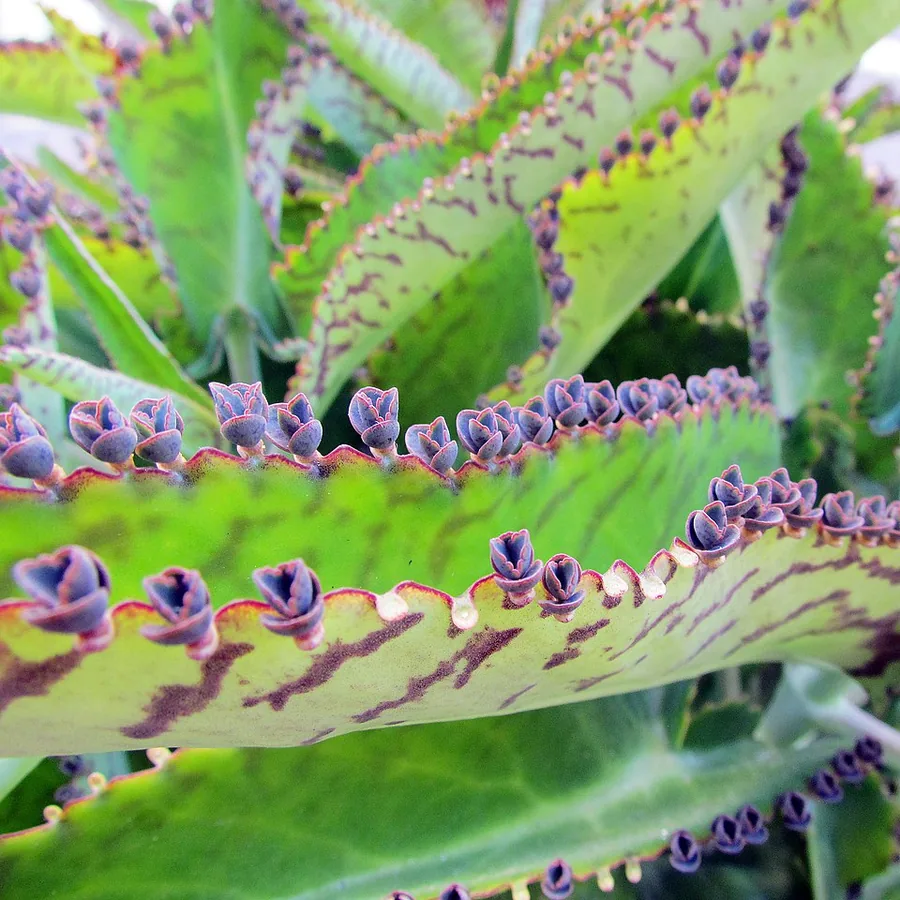
One look at mother of thousands and the name clicks. Run your eye along the scalloped edge of any leaf and there's a whole row of tiny ready-made plantlets, each one already growing little roots. It comes from the dry southwest of Madagascar, so like most succulents it keeps water tucked away in its plump, blue-green leaves and doesn't ask for much back.
As a houseplant it's about as hard to kill as they come, and easy to pass around too. Give it a bright window and a gritty pot, and it'll grow steadily into an upright plant of 12 to 35 inches (30 to 90 cm). Here's the catch, though: the same trait that makes it fun is a bit of a handful. Those plantlets drop off and root in whatever pot they can reach, so it spreads fast and has naturalized in warm regions where it really shouldn't have gotten loose.
There's one thing that sets it apart from an easygoing succulent like jade. Every part of it holds bufadienolides, cardiac glycosides that are toxic to pets and people alike. So is it a good pick for you? In a home with no animals or small kids, absolutely, as long as it lives somewhere they can't reach.
Care
The short version: bright indirect light, a gritty fast-draining mix, and water only once the soil's dried out completely. Feed it lightly in the growing season, keep it warm, and pick off the plantlets before they take over.
Light
Give it bright indirect light and it'll stay compact and nicely colored. It can handle some partial sun, but harsh afternoon glare scorches the leaves, and too little light leaves it looking pale and stretched out.
Water
Water it the way you'd water any succulent. Soak the soil right through, then let it dry out completely before the next drink, and back off even more through winter dormancy. Standing water is the fast track to root rot, which this plant is prone to, so when in doubt, wait.
Soil
Pot it up in a gritty cactus or succulent mix that drains in seconds. Regular potting soil hangs onto way too much water around the roots, so a pot with a drainage hole matters just as much as the mix does.
Temperature
Keep it somewhere between 50°F to 86°F (10°C to 30°C), which is really just most rooms year round. It isn't frost hardy, though, so if it's spent the summer outside, bring it in well before the cold shows up.
Humidity
Low humidity is exactly what it's after, so there's no number to chase and no reason to mist. The ordinary dry air in most homes suits it way better than anywhere steamy.
Feeding
Feed it lightly from spring through summer, about once a month, with a diluted balanced or cactus fertilizer. It does fine on very little, so go easy, and just skip feeding through its winter rest.
Pruning
Pinch back any leggy stems to tidy it up and snip off spent flower stalks. The job that really counts is pulling the tiny plantlets off the leaf edges before they drop, or you'll be finding seedlings in every pot nearby.
Repotting
Bump it up a pot size every 2 to 3 years, or sooner if it's crowding its container. Roots poking out the drainage holes, the plant lifting out of the pot, and water rushing straight through are all telling you it's time.
Size & spacing
Indoors it gets to 12 to 35 inches (30 to 90 cm) tall with a spread of 12 to 24 inches (30 to 60 cm). Give it a bit of elbow room so the plantlets it drops don't just root right into whatever's sitting next to it.
Troubleshooting
Almost everything that goes wrong here comes back to water or light. Too much water rots the roots, and too little light stretches it out pale and thin. Find what matches below and fix the actual cause, not just the symptom you're looking at.
Soft black stems and drooping even though the soil is wet
If it's drooping while the soil still feels wet, that's root rot, and it usually comes down to too much water in a mix that just won't dry out. Pop the plant out and take a look: rotted roots are brown, soft, and smell bad. Trim off everything that's gone, repot into a dry gritty mix, and skip watering until it firms up again.
Fix:
- Cut away all rotted tissue
- Repot into dry gritty succulent mix
- Withhold water until the plant recovers
White cottony fluff and a sticky film on the leaves
Those little white cottony clumps tucked into the leaf joints? Those are mealybugs, and the sticky film is what they leave behind. Dab each one with a cotton swab dipped in isopropyl alcohol, then follow up with insecticidal soap to catch the rest. And whenever a new plant comes home, give it a check and keep it off to the side for a bit before it mingles with the others.
Fix:
- Wipe with isopropyl alcohol on a swab
- Treat with insecticidal soap
Dry brown patches showing up on the leaves
See dry brown patches on the side that faces the window? That's harsh afternoon sun scorching the leaves. Just move it into bright indirect light and out of that hot midday glare. If you'd still like it somewhere sunnier, ease it into direct sun bit by bit so it has time to get used to it.
Fix:
- Move to bright indirect light
- Avoid the hot midday sun
Pale stretched growth with big gaps between the leaves
When it goes pale and leggy, with leaves spread way apart, it's just reaching for more light. The tell is new growth that leans toward the window. Give it a brighter spot with bright indirect light, and turn the pot every now and then so it grows nice and even instead of all to one side.
Fix:
- Move to a brighter spot with bright indirect light
- Rotate the pot periodically
Toxicity
The safe move is to treat this plant as toxic to every animal at home. All of it holds bufadienolides, cardiac glycosides that bring on drooling, vomiting, and diarrhea, and in any real amount can throw off the heartbeat. No part of it is safe to eat, and the sap can irritate skin, so keep it well out of reach of pets and small children.
Toxic to
Cats · Dogs · Horses · Rabbits · Livestock · Birds · People
Cats Toxic
A cat that nibbles a leaf will usually start drooling and throwing up, with loose stools not far behind. It's a bigger mouthful you really have to worry about, because the bufadienolides can mess with the heartbeat, so keep it somewhere a cat can't get to.
Dogs Toxic
With a dog, you'll see lots of drooling, vomiting, and diarrhea within a few hours of a chew. Since a good mouthful brings that same heart-rhythm risk, it's smarter to call the vet than to sit and wait it out.
Horses Toxic
Horses don't handle the cardiac glycosides well at all. You'll see drooling and an upset gut first, and a real dose can throw the heartbeat off badly enough to put a horse's life at risk.
Rabbits Toxic
Keep it well away from any rabbit. The same toxin upsets the gut and strains the heart, and since a rabbit's so small, it doesn't take much to land it in real trouble.
Livestock Toxic
If it gets loose in pasture, cattle, goats, and sheep can all be poisoned by it. They'll get an upset stomach first, and then dangerous heart trouble once they've eaten any real amount.
Birds Toxic
For birds, treat it as completely off-limits. They're so small that even a nibble of the leaf can hand over a meaningful dose of those heart-acting glycosides.
People Caution
No part of this one is meant to be eaten, and the bufadienolides make even a taste a bad idea. The sap can bug your skin too, so slip on gloves when you handle it and keep it up away from little kids.
Sap can cause contact dermatitis; wear gloves when handling the plant or removing plantlets.
Helpline numbers

United States
ASPCA Animal Poison Control: (888) 426-4435 (fee applies)
Poison Control: (800) 222-1222



Canada
Poison Centres: 1-844-764-7669
Varieties
Past the species itself, there's really just one variety worth knowing, a hybrid that took the parent's spreading habit even further.
Kalanchoe × houghtonii
It's a cross of K. daigremontiana and K. delagoensis with slimmer leaves, and it spreads even more than its parent, so much that it's become a global invader.
How to propagate
You'll never have trouble making more of this one. If anything, the tricky part is getting it to stop, since it propagates itself whether you pitch in or not.
Offsets & pupsEasy
Spring · 2-4 weeks
The plantlets around the leaf edges fall off with tiny roots already there and take hold wherever they land, usually settling in within 2 to 4 weeks in spring. It's about as easy as propagation gets, which is the same reason it spreads all over the place. So sweep up any you don't want before they root.
Leaf cuttingsEasy
Spring to summer · 3-6 weeks
Just lay a whole leaf on gritty mix in spring or summer, and over the next 3 to 6 weeks it'll sprout plantlets and roots along the edges. Keep the mix barely damp, though, because too much water rots the leaf before it ever gets going.
Myths
Mother of thousands is safe around pets because it is a common houseplant.
Common doesn't mean safe, though it's easy to assume it does. The ASPCA lists it as toxic to cats and dogs because of bufadienolides, cardiac glycosides that upset the gut and can throw off the heartbeat. Keep it out of reach of every animal in the house.
The plantlets are harmless and will not spread.
Here's the thing: each tiny plantlet drops off with roots of its own and settles in wherever it lands. That's exactly why it spreads so fast and naturalizes across warm regions, so it's worth sweeping up the fallen ones instead of leaving them.