Herb · Lamiaceae
Rosemary
Salvia rosmarinus
Give it plenty of sun and quick-draining soil, go easy on the water, and this Mediterranean herb just keeps going.
Full sun
Every 7–14 days
USDA 7–11
2–6 ft · 0.6–1.8 m
Overview
Think of rosemary as a sun-lover that never really left home. It's a woody evergreen herb from the dry Mediterranean hills, and it still lives like it. Sure, it's part of the mint family, but forget everything you know about thirsty mint, because this one wants things lean and sunny, not rich and wet.
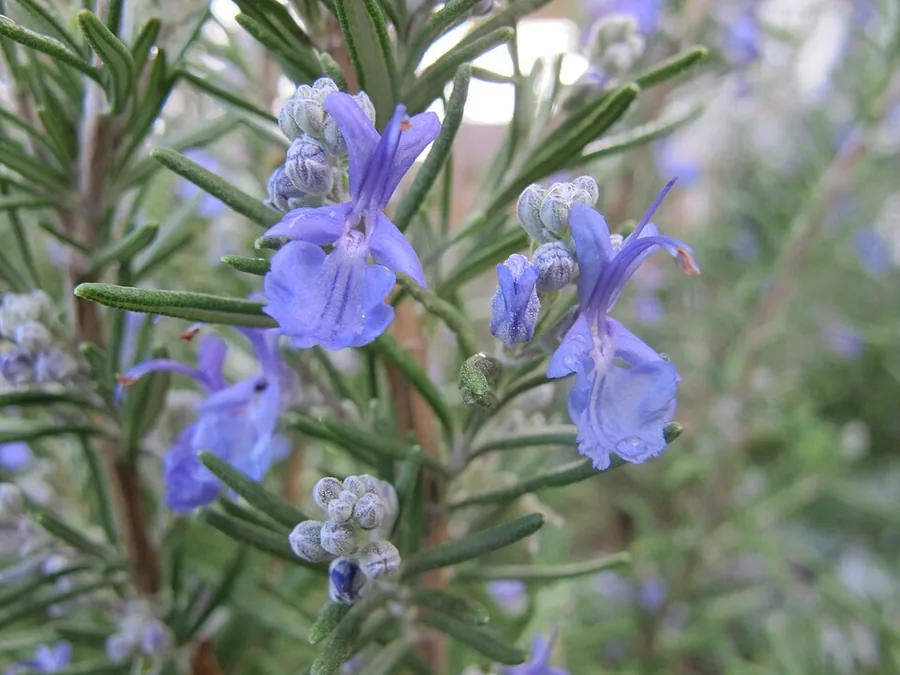
Plant it once and it sticks around, since it's a perennial that lasts for years, building up woody stems covered in narrow, needle-like leaves. In late winter and spring you'll get little blue flowers, and sometimes pink or white ones. Living in zones 7 through 11? It can stay outside all year. Colder than that, and it's happy in a pot you bring indoors.
Here's the thing that trips people up: rosemary is way more likely to die from too much love than too little. Overwater it and the soggy soil does it in. So keep the soil lean, water it now and then, and honestly, that's most of the job.
Care
The short version: lots of sun, soil that drains fast, and water only once it's really dried out. Go light on feeding, leave room for air to move around it, and keep it on the dry side all year.
Light
Rosemary wants full sun, and lots of it, ideally 6 to 8 hours a day. It'll hang on in part shade, but the growth gets thin and leggy and the flavor drops off. Stuck growing it inside? Just give it the brightest window you've got.
Water
This is where rosemary usually meets its end, so tread lightly. Let the top half of the soil dry out before you water again, which lands around every 7 to 14 days, and back off even more once it's settled in. Not sure if it needs a drink? Wait. It almost always does better dry than soggy.
Soil
Go for light, sandy soil that drains fast. Rosemary shrugs off poor, rocky ground, but heavy clay holds water and rots the roots, so work in some grit or sand if your soil stays wet. It likes a pH of 6.5 to 7.0, right around neutral.
Temperature
Rosemary puts up with a lot, roughly 10°F to 86°F (-12°C to 30°C), though how much cold it takes really depends on the cultivar. A hard freeze can finish off the tender ones, so in cold zones either grow a hardy type or just move the pot inside for winter.
Humidity
It likes the air on the dry side, around 30% to 50% humidity, which fits its dry-country background. Damp, stale air is what brings on powdery mildew, so good airflow does way more for it than any moisture you'd add.
Feeding
Rosemary's a light feeder, and it honestly tastes better a little hungry. One small helping of balanced fertilizer or compost in spring is plenty. Pile on more and you'll get soft, sappy growth instead of that great fragrance and flavor.
Pruning
Trim it lightly after it flowers and keep snipping sprigs through the season to keep it full and bushy. Just one rule you can't break: don't cut back into old leafless wood, because it's slow to sprout again and might not come back at all.
Repotting
Bump a potted rosemary up a size every 1 to 2 years, or whenever the roots start circling, water drains through in a flash, or new growth stalls out. Use a gritty, fast-draining mix and a pot with actual drainage holes.
Size & spacing
24–71 in (60–180 cm) tall
When to plant
Rosemary takes its time, so don't rush it. Seed started indoors in late winter is a bit of a gamble, which is why most people just buy plants and set them out after the spring frosts are done. In mild spots you can snip sprigs whenever, and those little blue flowers show up from late winter into spring.
Northern hemisphere
Southern hemisphere
Typical months for a temperate climate: start earlier in warm zones, later where spring frosts linger.
- Sow: 10-12 weeks before last spring frost (germination is slow and erratic)
- Plant: after danger of frost has passed in spring
- Harvest: Small blue (occasionally pink or white) flowers in late winter to spring; leafy sprigs can be harvested year-round in mild climates.
Hardiness
USDA hardiness zones: 7–11
Temperature: down to -18°C
Troubleshooting
Nearly every rosemary hiccup comes down to one of two things: too much water at the roots, or not enough air around the leaves. Catch it early and it's usually a quick fix. So find your symptom below and step in while it still makes a difference.
A plant wilting and yellowing even though the soil's still wet
If rosemary is flopping in wet soil, it isn't thirsty, it's got root rot from overwatering or bad drainage. Dig down a little and you'll find soft, brown roots that smell kind of sour. Stop watering, repot it into a gritty, fast-draining mix, and grab a few healthy cuttings just in case it doesn't make it.
Fix:
- Stop watering and allow soil to dry
- Repot into fast-draining gritty mix and trim rotted roots
- Take healthy stem cuttings as a backup if the plant is failing
Fine webbing and a dull, speckled look on the leaves
See faint webbing and pale speckles? That's usually spider mites, and they hit indoor or stressed plants hardest in dry winter air. Flip a leaf over and you might catch the tiny mites moving around in the threads. Hose the foliage down hard, follow up with insecticidal soap or horticultural oil, and get more air moving around it.
Fix:
- Rinse foliage with a strong stream of water
- Apply insecticidal soap or horticultural oil
- Increase airflow and reduce plant stress
Brittle brown stems dropping their leaves after a rough winter
Bare, snappy wood after a cold snap is winterkill, and it hits tender cultivars in borderline zones the hardest. Want to know what's still alive? Scratch the bark, green underneath means it's fine, dry and brown means it's gone. Cut the dead stems back to living tissue in spring and let the plant push out new growth from whatever pulled through.
Fix:
- Prune out dead wood back to living tissue in spring
- Allow plant to regrow from healthy stems
A dusty white film creeping over the leaves
That white powder? It's powdery mildew, a fungus that shows up when the air around the plant goes still. You'll mostly see it on crowded indoor rosemary in stale winter air. Give the plant more room, drop the humidity, and pick off the worst of the coated leaves, and it'll sort itself out.
Fix:
- Improve air circulation and spacing
- Reduce humidity and avoid overhead watering
- Remove and discard affected foliage
Toxicity
Got pets or little kids? You're fine here. Rosemary is non-toxic all around, the ASPCA says it's safe for cats, dogs, and horses, and it's the same herb you'd cook with. The only thing to keep out of reach is the concentrated essential oil, which is a totally separate product and not for eating.
Safe for
People · Cats · Dogs · Horses · Rabbits · Livestock · Birds
Cats None
Rosemary's totally safe for cats, and the ASPCA has it on its non-toxic list. A curious nibble won't hurt a thing, though most cats aren't into that strong smell anyway.
Dogs None
Dogs can chew the leaves no problem, and the herb even shows up in some pet foods as a natural preservative. It'd take an unusually big helping to cause even a mild, passing tummy upset.
Horses Safe
Horses can graze on rosemary safely. That aromatic foliage isn't really their thing, so they hardly ever eat more than a taste.
Rabbits Safe
A bit of fresh rosemary is fine for rabbits as part of a varied diet. Just keep hay and greens as the main event, with the herb as a little extra.
Livestock Safe
Goats, sheep, and cattle can browse rosemary without any trouble. Those pungent leaves usually keep most stock from eating much of it anyway.
Birds Safe
It's no danger to backyard hens or pet birds either. Toss a sprig in the run and it's totally harmless, even if it mostly gets ignored.
People Safe
Rosemary's a kitchen staple, safe to cook with and eat for grown-ups and kids alike. The one thing to keep separate is that concentrated essential oil, which is a different product and not for eating.
Highly concentrated rosemary essential oil is a separate product that can irritate skin or be harmful if ingested in quantity, but the culinary herb and growing plant are non-toxic.
Varieties
Rosemary comes in a bunch of shapes, from low mats that trail over an edge to tall, upright bushes. A few cultivars really matter, though, especially if you're picking for cold winters or for cooking.
Arp
One of the toughest cultivars in the cold, shrugging off winters that would knock back most rosemary.
Hill Hardy
An upright, cold-tough pick that keeps going in those marginal northern spots where a lot of rosemary just won't.
Tuscan Blue
A strong, upright grower with deep blue flowers, and it's a favorite both for cooking and for clipping into low hedges.
Prostratus
A low, trailing groundcover type that spills nicely over walls and pots, though it doesn't take the cold as well as the upright kinds.
How to propagate
Stem cuttingsEasy
Spring to summer from softwood or semi-ripe growth · 4-8 weeks to root
Cuttings are hands down the easiest way to get more rosemary, and it's what most gardeners go with. In spring or summer, snip 8 to 15 cm pieces of soft or half-ripe growth, pull off the lower leaves, and stick them in a gritty, well-drained mix, where they'll root in about 4 to 8 weeks.
SeedDemanding
Indoors 10-12 weeks before last frost · Several weeks to germinate, then a full season to establish
Growing from seed? Bring some patience. Sow indoors 10 to 12 weeks before the last frost, but don't be surprised by slow, patchy sprouting and a low success rate, with weeks to germinate and a whole season before plants really settle in. That's exactly why most folks just take cuttings instead.
Myths
Rosemary needs frequent watering to stay healthy.
Once it's established, rosemary handles dry spells no problem and barely needs watering. It's soggy soil, not drought, that kills most plants, so a light hand really is the way to go here.
The rosemary plant is toxic to pets because rosemary oil can be harmful.
You can relax about that one. The ASPCA lists the growing plant and the culinary herb as non-toxic to cats, dogs, and horses. Only the concentrated essential oil, which is a separate product, carries any irritation risk, and that's just not what your pet runs into out in the garden or on the plate.