Shrub · Rosaceae
Rugosa Rose
Rosa rugosa
This is the rose that laughs off salt spray and brutal cold, blooms all summer, and then loads up on red hips.
Full sun
Every 7–14 days
USDA 2–7
4–6 ft · 1.2–1.8 m
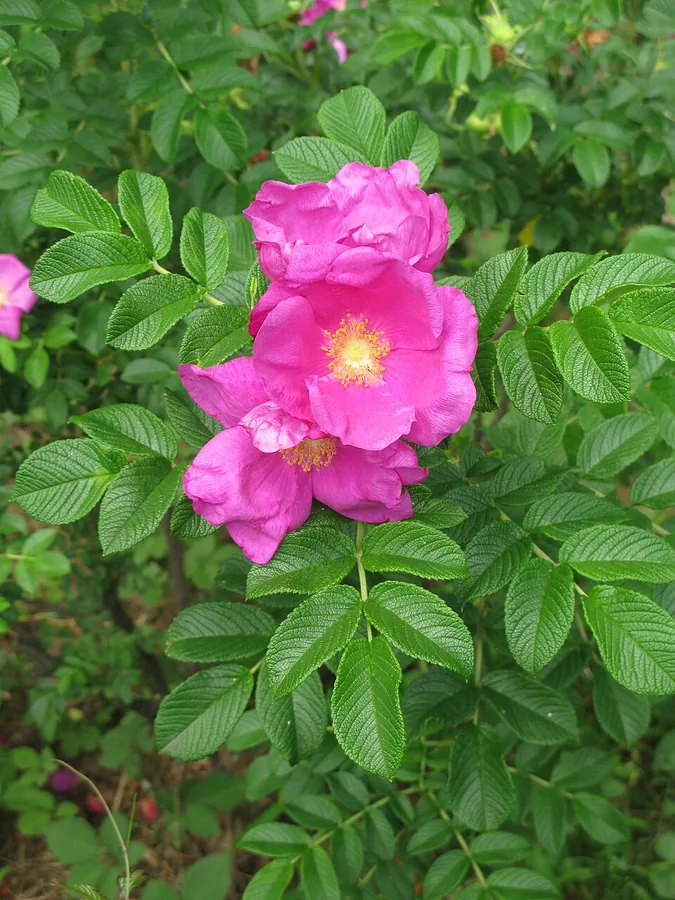
Overview
Want a rose that pretty much takes care of itself? That's the rugosa rose in a nutshell, a shrub that asks for next to nothing and still gives you fragrant flowers and loads of bright hips. It's originally from the coasts of eastern Asia, and it loved the seaside so much that folks started calling it the beach rose. You can pick it out easily too, thanks to its wrinkled, leathery leaves and stems that are absolutely covered in prickles.
What really sets it apart is how tough it is. It handles salt spray, drought, and bitter cold near the bottom of its range, holds banks and dunes together with its roots, and shrugs off most of the diseases that give other roses trouble. The flowers come single or double, running from white to pink to a deep reddish purple, and they're fragrant enough that you'll catch the scent from across the yard.
There's a catch, though. This rose suckers like crazy and can spread into dense thickets, and along parts of the North American coast it's jumped the garden fence and crowded out native plants. So plant it where you can keep it reined in, and you've got one of the easiest roses around, plus red hips that are edible and packed with vitamin C once fall rolls in.
Care
The short version: give it full sun and just about any soil, even the sandy or salty kind. Water it well while it's getting established, then let it fend for itself, go easy on the fertilizer, and prune in late winter to shape it and keep the suckers from wandering.
Light
Give it full sun and you'll get the most flowers and the healthiest leaves out of it. It'll put up with partial shade, sure, but a shady, crowded spot stays damp, and that's when you start seeing spotted leaves.
Water
While it's young and settling in, water it deeply and often so the roots dig down. Once it's established, though, it's genuinely drought tolerant and won't mind a dry stretch. Just water at the base in the morning instead of over the top, since wet leaves are basically an invitation for disease.
Soil
Here's the easy part: this rose grows in almost anything, whether that's sandy coastal grit, heavy clay, or plain poor dirt. It does lean toward moist, well-drained, slightly acidic loam, and any pH from 6.0 to 7.5 keeps it happy.
Temperature
Cold really isn't an issue here. This shrub takes a wild -51°F to 86°F (-46°C to 30°C), and that's exactly why it thrives up north where most roses would've thrown in the towel.
Humidity
There's no humidity number to fuss over, so you can forget about that one. What actually matters is air movement, because still, crowded air is what lets those leaf diseases move in.
Feeding
Go light with the food, because this rose actually prefers lean soil. A single feed of balanced or rose fertilizer in spring does the trick, and honestly, too much feeding does more harm than good.
Pruning
In late winter to early spring, shape it up and cut out any dead or weak canes. While you're at it, pull or dig the suckers, or the plant'll just keep creeping outward year after year.
Repotting
You'll rarely grow a rugosa in a pot, so repotting isn't usually on the list. But if you do keep one in a container, bump it up when the roots start circling the base or poking out the drainage holes, or when it wilts right after every watering.
Size & spacing
Figure on a rounded shrub around 4 to 6 feet (120 to 180 cm) tall and just as wide, so give it that much elbow room. And remember, the roots will try to grab even more space through their suckers.
When to plant
Pop a rugosa rose in the ground in spring or fall and it'll settle in fast. The flowers show up in late spring and keep going all summer, and then, right when the season's winding down, those showy red hips ripen and hang on well into winter.
Northern hemisphere
Southern hemisphere
Typical months for a temperate climate: start earlier in warm zones, later where spring frosts linger.
- Plant: Spring or fall
- Harvest: Blooms late May to July with intermittent rebloom until frost; showy red-orange hips ripen August into winter.
Hardiness
USDA hardiness zones: 2–7
Temperature: down to -46°C
Troubleshooting
Honestly, this rose doesn't run into much trouble. Most of what you'll deal with is either suckers popping up where you didn't plant them or a bit of spotting on the leaves. Spot the early signs below and you can nip things in the bud before they get out of hand.
A weird red cluster of extra-thorny shoots
A tight, twisted broom of red shoots with way too many prickles usually means rose rosette disease, a virus spread by tiny eriophyid mites, and unfortunately there's no cure once it takes hold. The best move is to dig out and destroy the plant right away so it doesn't reach your other roses. If it's milder, though, that clustered, stressed growth might just be aphids, scale, thrips, or spider mites, which a strong blast of water or a bit of cane-cutting will handle.
Fix:
- Promptly remove and destroy plants showing rose rosette symptoms to protect nearby roses
- Treat heavy insect infestations with a strong water spray or appropriate control
- Remove and dispose of badly infested canes
New shoots showing up where you didn't plant them
No need to worry, this is just the rugosa rose doing its natural suckering thing, which is the same trick that lets it fill in so fast. Its shallow roots keep sending up new canes away from the crown, so dig and cut them as they appear, or set up a root barrier from the get-go. Gardening near dunes or wild areas? A tidy named cultivar is the safer bet.
Fix:
- Cut and dig out suckers as they appear
- Install a root barrier or plant in a contained bed
- Choose a better-behaved named cultivar instead of the straight species
Spotted, blistered leaves dropping early
Rugosa brushes off most rose diseases, but rust, black spot, and powdery mildew can still sneak in when things get damp, shady, and crowded. Pull off the marked leaves and rake up whatever's fallen so the spores have nowhere to hide over winter. Then thin out the canes for airflow and water at the base in the morning instead of over the top.
Fix:
- Remove and dispose of affected leaves and fallen debris
- Improve air circulation by thinning canes
- Water at the base in the morning rather than overhead
Toxicity
Good news on the safety front. Every part of the rugosa rose is non-toxic to cats, dogs, horses, and people, and the hips are edible and loaded with vitamin C. The only thing that'll actually get you is physical, those sharp prickles on every cane, so keep the gloves handy and skip the worry.
Safe for
People · Cats · Dogs · Horses · Rabbits · Livestock · Birds
Cats None
There's no toxic compound in here, so if a curious cat nibbles a petal or leaf, it's totally fine. The only thing to keep an eye on is those sharp prickles, which can scratch a paw or mouth.
Dogs None
A dog can chew the leaves, flowers, or ripe hips and won't get poisoned at all. Just keep it away from the thorny canes, because a bristling stem is really the only hazard here.
Horses None
Horses can graze the foliage and hips no problem. The catch is those dense prickles, which can prick a soft muzzle when they reach in for a bite.
Rabbits None
Rabbits can browse the leaves and stems safely, and the hips make a nice little treat. Nothing in the plant is poisonous to them.
Livestock None
Cattle, goats, and sheep can all graze the shrub without any harm. The only downside is the thorny canes, which put animals off more than they actually hurt them.
Birds None
Birds go nuts for the red hips and spread the seed all over, which is part of how this rose turns invasive. Eating any part of it won't hurt them one bit.
People None
The hips are edible and rich in vitamin C, great in teas, jams, and syrups, and yes, the petals are edible too. Just wear gloves near the canes, because those sharp prickles are the one thing that bites back.
Stems are densely covered in sharp, needle-like prickles that can cause scratches and puncture wounds; wear gloves and long sleeves when handling or pruning.
Varieties
Most rugosa roses you'll find for sale are named cultivars, each one bred for a particular flower color, scent, or a neater shape. Here are the ones you're most likely to bump into.
Hansa
It's a strong grower with double, reddish-purple flowers that smell fantastic and turn into big red hips.
Blanc Double de Coubert
This one's a tough, disease-resistant shrub with semi-double, pure white blooms that are seriously fragrant.
Frau Dagmar Hastrup
It's a compact pick, with single silvery-pink flowers that ripen into a heavy crop of big red hips.
F.J. Grootendorst
Its little red flowers are fringed like a carnation and cluster together in bloom that barely ever stops.
How to propagate
Want more rugosa roses? You've got options. Dig up one of its many suckers, root a cutting over summer, or take the slow road and grow it from the seed tucked inside the hips.
DivisionEasy
Late winter to early spring or fall · 1 to 2 seasons
Since rugosa grows on its own roots and throws up suckers all the time, the simplest way to get more is to just cut a rooted sucker off the parent and replant it in late winter to early spring or in fall. Give it a season or two to settle in, and it'll grow on as a copy of the original.
Stem cuttingsModerate
Summer (softwood or semi-hardwood) · Several weeks to root, then 1 to 2 seasons to establish
Nurseries usually go the cutting route, taking them in summer from healthy current-season growth as softwood or semi-hardwood. They root over several weeks and then need a season or two to fill out into a good, solid shrub.
SeedModerate
Sow cleaned seed from ripe hips in fall, or stratify and sow in spring · 1 or more years
Every ripe hip is stuffed with 20 to 120 seeds, so you won't be short on material, but this way takes patience. Sow cleaned seed in fall, or cold-stratify it and sow in spring, and then be ready for slow, uneven sprouting and a year or more before the seedlings really get going.
Myths
The rugosa rose is a well-behaved native you can plant anywhere along the coast.
Not quite. It's actually from eastern Asia, not North America, and it's escaped gardens to become invasive along the coasts of New England, Virginia, and parts of Canada. Out there it forms dense thickets that crowd out the native dune plants, which is why it's on Maine's advisory list and why it's best kept away from wild ground.
Since roses are non-toxic, the whole plant is completely safe to handle.
The eating part checks out, the leaves, flowers, and hips really are safe for people and pets, so there's no poison to stress about. The canes are a different story, though, since they're packed with sharp, needle-like prickles that'll scratch and puncture, so throw on gloves and long sleeves before you prune.