Ornamental · Saxifragaceae
Foamflower
Tiarella cordifolia
A shade-loving native that throws up frothy white spires in spring and blankets the ground the rest of the time.
Partial shade
Every 3–7 days
USDA 3–9
5–12 in · 13–30 cm
Overview
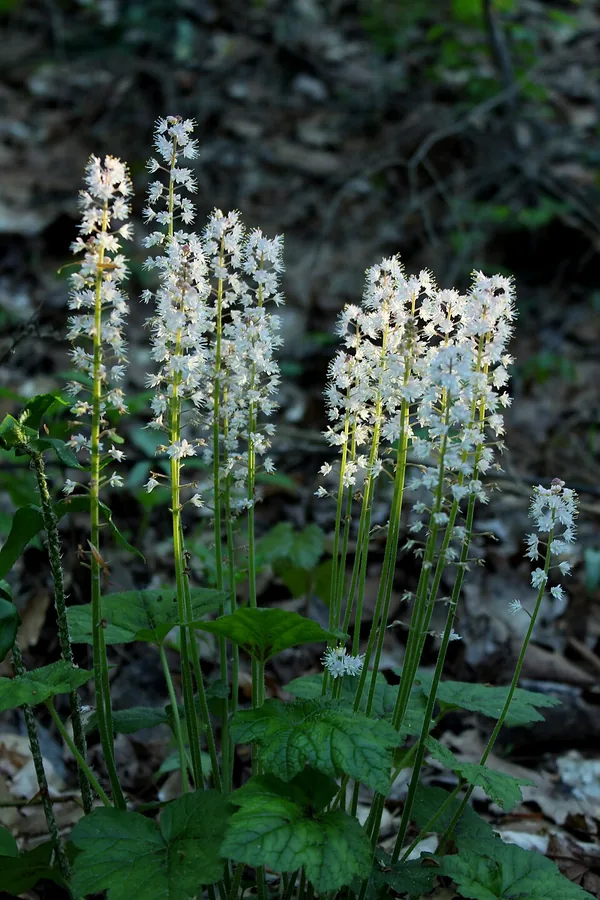
Ever had a shady spot where nothing seems happy? Foamflower's your friend there. In spring it sends up thin spikes packed with tiny flowers, white fading to pink, that seem to hover over the leaves like a bit of froth, and that's exactly where the name comes from. It's a woodland native from eastern North America, part of the saxifrage clan, and it wanders along the ground on rhizomes and stolons until it's woven a low, leafy carpet.
Honestly, the leaves are the best part. They're heart-shaped and usually lobed, and they hang around as semi-evergreen foliage right through winter, with lots of forms turning bronze or deep red along the veins once it gets cold. It's tough too, hardy across USDA zones 3 to 9, and it'll keep flowering in that dry, gloomy shade where hardly anything else bothers.
So what does it actually want? Not much: shade, steady moisture, and good rich woodland soil. Give it that and it pretty much takes care of itself, spreading a little further each year. Deer won't touch it, there's barely anything on the pest list, and once a clump's settled you can split it every other spring for free plants. Not a bad deal, right?
Care
The short version: part to full shade, rich humusy soil that stays evenly moist, decent drainage over winter, and almost no feeding if the woodland soil's any good.
Light
Give foamflower part shade to full shade and it'll be thrilled. It's a woodland plant, so it's right at home under trees or tucked against the north side of the house, and it's one of the rare flowering ground covers that actually does well in heavy shade.
Water
Keep the soil consistently moist and don't let it dry out, because this one has zero drought tolerance. Watering every 3 to 7 days works for most spots, but back off in winter, since soil that stays soggy through the cold can rot the crown.
Soil
It wants rich, humusy soil that holds moisture but still drains, basically the soft leaf-litter you'd find on a forest floor. Shoot for a pH of 6.0 to 7.0, so slightly acidic to neutral, and work in plenty of compost or leaf mold before you plant.
Humidity
Don't overthink humidity, because normal outdoor air is fine. What foamflower actually cares about is steady soil moisture, way more than whatever the air's doing.
Feeding
This one's a light eater, and it does great in good woodland soil without much fuss. A thin layer of compost or a balanced fertilizer once during the growing season is plenty, and piling on more won't get you anywhere.
Pruning
There's not much to prune, just a quick cleanup. At the start of the growing season, cut off any ragged or winter-beaten leaves, and fresh ones will pop up to take their place.
Size & spacing
These stay pretty low, around 5 to 12 inches (13 to 30 cm) tall, and slowly widen to 12 to 24 inches (30 to 60 cm) across. Set them about a spread apart and they'll grow together into one solid ground cover.
When to plant
Foamflower just follows the woods, so it's easy to plan around. Pop new plants in during spring or early fall while the soil's still cool and damp, and then the flower spikes come up in spring and peak in May before the leaves take over for the rest of the year.
Northern hemisphere
Southern hemisphere
Typical months for a temperate climate: start earlier in warm zones, later where spring frosts linger.
- Sow: Late winter; seed germination can be slow and plants are largely self-incompatible.
- Plant: Spring or early fall in shaded, moist sites.
- Harvest: Blooms in spring, peaking in May, with spikes of small white to pink flowers.
Hardiness
USDA hardiness zones: 3–9
Temperature: down to -40°C
Troubleshooting
Good news: foamflower barely causes any headaches, and when something does go wrong it's almost always the soil being too dry or too wet. Keep half an eye on the leaves and crown, and you'll catch the early warning before it turns into a real problem. Just match what you're seeing below to the cause.
Crowns rotting and plants keeling over in winter
Here's the thing, it's sitting in wet ground all winter that gets foamflower, not the cold. Soggy, waterlogged soil kicks off crown and root rot, and you'll notice the crown has gone soft and discolored when it should be firm. A rotted crown's a goner, so don't agonize over it: dig out the bad bits, mix in some organic matter to help it drain, or just move the plant somewhere it won't sit in water.
Fix:
- Improve drainage by amending with organic matter
- Relocate to a better-drained site
- Remove and discard rotted crowns
Leaves wilting and going brown when it's hot and dry
If the leaves are wilting and browning in the heat, that's drought talking, because foamflower just can't handle dry soil and it browns quickly once the ground dries out. Poke a finger a few centimeters down to check, then give it a deep drink to get the moisture back. A layer of compost or leaf-mold mulch keeps that water around, and a little extra shade during the hottest stretch really helps.
Fix:
- Water deeply to restore even moisture
- Apply a layer of leaf-mold or compost mulch to retain moisture
- Provide additional shade in hottest part of day
Notched leaf edges and plants that start to give out
See neat, C-shaped bites out of the leaf edges? That's the black vine weevil at work. The adults chew the margins at night, but the bigger trouble is underground, where the pale, legless larvae munch the roots. Have a look at the edges, dig around for grubs, then soak the soil with beneficial nematodes and pick off or trap the adults after dark.
Fix:
- Remove and destroy affected debris
- Apply beneficial nematodes to soil for larvae
- Hand-pick or trap adult weevils at night
Toxicity
If there are pets or kids around, you can breathe easy, because foamflower is non-toxic all around. It's not on the ASPCA toxic plant list or Cornell's poisonous plants database, so go ahead and plant it in a shady bed without stressing about curious cats, dogs, or little ones.
Safe for
People · Cats · Dogs · Horses · Rabbits · Livestock · Birds
Cats Safe
Foamflower's totally fine around cats. It's not on the ASPCA toxic list or Cornell's poisonous plants database, so a curious nibble isn't going to cause any trouble.
Dogs Safe
There's nothing toxic on record for dogs. A dog that paws at the leaves or gulps one down will be okay, though eating a big pile of any plant can upset a stomach for a bit.
Horses Safe
No one's ever reported foamflower making a horse sick, and it doesn't carry anything known to hurt them.
Rabbits Safe
Rabbits can nibble away without any worry. There aren't any toxins in it, so a few chewed-up rosettes are really just a cosmetic thing.
Livestock Safe
Bigger grazers like cattle, goats, and sheep have nothing to worry about with this woodland ground cover.
Birds Safe
Birds that pick at the foliage or the bloom spikes are perfectly safe with foamflower.
People Safe
It's treated as non-toxic for people too. Nobody's growing it as a snack, but if a kid tastes a leaf, there's nothing in it that'll do any harm.
Varieties
Besides the plain wild species, there are a few named picks worth a look, mostly chosen for their cut-leaf foliage or a bit of pink in the flowers.
Oakleaf
Its leaves are deeply lobed like an oak's, which makes it easy to tell apart from the heart-shaped foliage of the regular species.
Montrose 13
It's a favorite for flowers that come in with a pink tint instead of plain white.
Cygnet
It's grown for its finely divided, really distinctly cut leaves.
How to propagate
Want more foamflower? It's genuinely easy, and splitting up a settled clump beats messing with seed for both speed and results.
DivisionEasy
Spring or early fall; benefits from being divided or transplanted at least every other year. · One growing season
Division is hands down the easiest, most reliable way to get more foamflower. Since it already spreads itself with rhizomes and stolons, you can just lift a clump in spring or early fall and tease the rooted rosettes apart, and each one's ready to grow into its own plant. The clumps are actually happier for it, so split or move them at least every other year, and a new division will settle in over one growing season.
SeedModerate
Sow in late winter to spring. · Multiple seasons to flowering size
Seed's the slower road, so you'll need some patience. Sow from late winter into spring, but don't be surprised if germination is slow and hit-or-miss, and it takes a few seasons before the plants are big enough to flower. Foamflower's also mostly self-incompatible, which just means you need more than one plant swapping pollen before you'll get any seed.
Myths
Foamflower needs full sun to bloom well.
Nope, it's a woodland plant through and through, and it's happiest in part shade to full shade. It makes a great ground cover for heavy shade, those dim corners where most flowering plants just sulk.
Foamflower is toxic to cats and dogs.
Not true, it's not on the ASPCA toxic plant list or the Cornell University poisonous plants database. It's considered non-toxic, so it's a safe pick for a shady bed where the pets like to hang out.