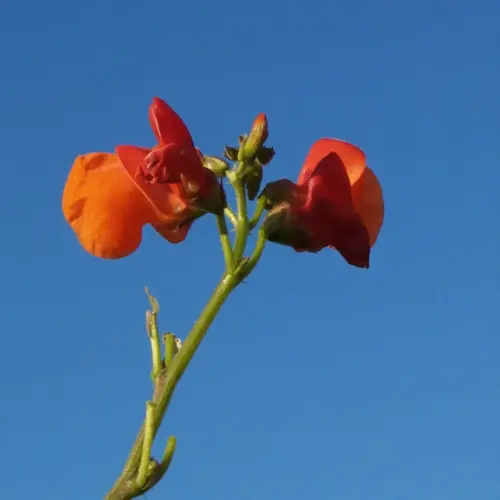

Most sweet pea vines need a sweet pea trellis or some other climbing support to grow well. Climbing types throw out thin tendrils that reach into the air and grab whatever thin support sits nearby. Without one to hold, the plant sprawls flat across the ground. Only the dwarf varieties skip this need, since they stay short and bushy enough to hold themselves up.
A tendril is a curling thread that grows off the stem and acts like a tiny hand. It feels around in the air as it grows, and once it touches something narrow, it coils tight and pulls the vine upward. This is why good support for sweet peas needs thin parts the tendril can wrap around. A smooth wide post gives the tendril nothing to grip, so the vine slides right off and falls back to the soil. You want any support no thicker than a pencil where the tendrils will reach it.
Your climbing sweet peas grow tall and fast once the weather warms up. Most reach 5 to 7 feet (1.5 to 2.1 m) by the end of the season, and a few push higher than that. A vine that size carries real weight, so your support has to stand firm through wind and summer rain. A flimsy stake bends over and drags the whole plant down with it, which sets your flowers back for weeks.
You have plenty of ways to hold these vines up, and most of them cost very little. Pick whichever option fits your space and the look you want in the bed. Each one below gives the tendrils thin parts to grab.
Net And Fence Options
- Trellis netting: A grid of thin squares gives tendrils plenty to grab and holds a full row of vines at once.
- Garden fence: Chain link or wire mesh works well since the vines climb the open gaps on their own.
- Wall mesh: Mount a panel of mesh a few inches off a sunny wall so air still moves behind the leaves.
Stake And Frame Options
- Bamboo pyramid: Push 6 to 8 canes into the soil in a circle and tie the tops together for a sturdy cone.
- Twig stakes: Tall branchy prunings, often called pea sticks, give the tendrils rough thin twigs to grip.
- String lines: Run vertical strings from a top bar down to the soil so each vine climbs its own line.
Where To Place Support
- Full sun spot: Set the frame where the vines get 6 hours of sun so the flowers keep coming all season.
- Open to air: Leave space around the support so breezes dry the leaves and keep mildew off them.
- Firm anchor: Sink stakes deep or tie the frame to a post so a tall vine cannot tip it in a storm.
Put your sweet pea trellis in place at planting time, not weeks later. Sweet peas start reaching within days, and a vine that flops on the ground gets a kink in the stem that never grows out. Setting the frame first also keeps you from spearing the roots with a stake. The young plant finds the support fast and starts climbing on its own.
Give each plant room so the vines do not tangle into one crowded mat. Space them 8 to 12 inches (20 to 30 cm) apart along the base of your support. Crowded vines block air flow, and damp still air invites mildew on the leaves. A little gap between plants keeps them dry and lets each one grab its own share of the frame.
Dwarf types change the math, since they were bred to stand without staking. The variety Supersnoop grows in a low mound about a foot tall and needs no sweet pea trellis at all. These suit pots, window boxes, and the front edge of a bed where a tall frame would look odd. For every climbing type, though, set up real support, and sweet pea netting ranks among the easiest picks to start with.
Read the full article: Sweet Pea Vine: Complete Grow Guide