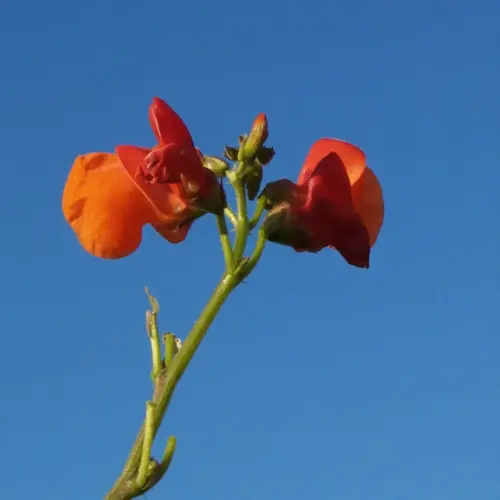

By early summer my back-fence Old Spice vines had grabbed the top of a six-foot netting panel and were waving loose tips at the sky. Two feet over, the Supersnoop row I planted the same week sat knee high and barely touched the soil staples. Same seeds bought the same day, two completely different plants.
That gap is the short answer. The sweet pea height you get depends almost entirely on the type you plant. Standard climbing types reach 5 to 7 feet (1.5 to 2.1 m) in one season, while compact bush and dwarf forms stay 8 inches to 3 feet (20 to 90 cm) tall. Pick the wrong one for your spot and you fight the plant all summer.
There is one detail that changes how you read those numbers. Climbing sweet peas are twining vines, so they grow as tall as whatever you give them to climb. Put up a four-foot trellis and the vine tops out near four feet. Give it a seven-foot net and it keeps going. The support is the real ceiling, not the plant's own ambition. They climb with curling tendrils, not sticky pads, so they need a thin frame to wrap around. A bare wall or a fat post gives them nothing to grab.
Once a vine reaches the top of its frame, the tips flop over and tangle into the netting below. The plant does not stop blooming, but the flower stems get shorter and the whole row starts to look like a hedge. That is your cue that the support ran out before the plant did. You can pinch those runaway tips back, and the side shoots lower down will keep pushing fresh flowers for weeks.
Spread matters as much as height when you plan a row. A single standard vine fills 2 to 8 feet (0.6 to 2.4 m) of width depending on how you train it. Let several plants run together along a fence and they knit into one solid screen. Pinch and tie a single stem up a string and it stays narrow. Space climbers about 6 inches (15 cm) apart along a net for that full curtain look. Give each plant more room if you want long, clean cutting stems instead of a thicket.
Match the support to the variety and the rest gets easy. For tall climbers, set up netting, a trellis, or a string line that reaches 6 to 7 feet (1.8 to 2.1 m) before you sow. The vines find it on their own within a few weeks and need only the odd tuck. Skimp on height and you cap your flowers early.
Dwarf sweet peas flip the whole plan. Types like Supersnoop, Bijou, and Cupani's bush forms hold themselves up and never ask for a stake. They work in pots, window boxes, and the front of a bed where a tall vine would block the view. Give them 8 to 12 inches (20 to 30 cm) between plants and let them mound.
So plan your sweet pea height around the space you actually have. Got a fence, an arch, or a sunny wall? Run climbers up a 6-foot net and let them stretch. Working with a balcony rail or a low border? Go dwarf and skip the framework entirely. Read the variety name on the packet first, and the height takes care of itself.
Read the full article: Sweet Pea Vine: Complete Grow Guide