
Introduction
The first thing you notice on a hyacinth bean vine is the color. Purple stems hold up green leaves laced with purple veins, and above them sit pink and lavender flowers. Then come the seed pods, glossy and deep magenta, hanging in clusters like polished jewels. This guide gives you the full picture, from planting all the way to safe eating.
This vine moves fast. On a sturdy trellis it climbs 10 to 25 feet and spreads 3 to 6 feet wide, and it can put on 20 feet in a single warm season. Plant a seed in late spring and you can have a wall of leaves and bloom by late summer. That speed is why the purple hyacinth bean has long been a favorite for screening a fence, an ugly view, or a bare arbor in a hurry.
Safety is the part you really want answered. A single buried line about the seeds being poisonous scares people off or leaves them guessing. So this guide pairs full care with a clear, sourced look at which parts are safe and which are not. You also get the exact steps to cook the seeds so they are fine to eat. Knowing the plant by its botanical name, Lablab purpureus, helps you check these facts for yourself.
You also get real history with this plant. Thomas Jefferson grew this fast growing flowering vine at Monticello in the early 1800s. That is how it picked up the nickname Jefferson bean. People in much of Africa and Asia still grow it for food and forage. But across the United States you will mostly see it as an ornamental. From here you will learn what the plant is, how to plant and care for it, and what its blooms and pods look like. You will also learn how to eat it without worry and why it earns a spot in your garden.
What Is Hyacinth Bean Vine
The plant behind every purple pod and pink bloom is Lablab purpureus. It belongs to the pea family, Fabaceae. It grows wild across tropical Africa, and that warm origin shapes how you grow it at home.
You will see this same vine sold under a pile of different names, which trips up a lot of new growers. The hyacinth bean plant also goes by Indian bean and Egyptian bean. Older seed packets list the synonym Dolichos lablab, too. They all point to one species, so do not let the name swap throw you off when you shop for seed.
Think of it as a flowering cousin of the garden bean. It twines up a support the same way pole beans climb a string, wrapping the stem around anything it can reach. Give it a trellis and it will pull itself up on its own, no tying needed.
This is a twining vine that climbs 10 to 25 ft (3 to 7.6 m) tall and spreads 3 to 6 ft (0.9 to 1.8 m) wide. The stems often carry a purple tint that hints at the flowers and pods to come. It lives as a true perennial only in USDA zones 10 to 11, so most U.S. gardeners grow it as a fast annual that dies back at the first frost.
One plant fills three very different roles. In the United States you will mostly see it grown as an ornamental for its color. But across much of Africa and Asia it is an important food and forage crop, and that is true above all in India. That dual life is part of what makes this such a rewarding vine to grow.
The vine's purple stems, leaf veins, flowers and seed pods place it firmly on my list of purple favorites in the garden.
How to Plant and Grow It
I pushed three 'Ruby Moon' seeds an inch into the warm soil along the hot back fence one late spring afternoon. A clematis had sulked in that exact spot the year before, and a climbing rose limped along before that. By late summer the vine had cleared the top of my 12 foot fence trellis and spilled purple pods back down the other side.
That spot bakes all afternoon, and the seeds loved it. If you want to know how to grow hyacinth bean, the first rule is simple. This vine wants heat and full sun, not coddling.
Wait for warm soil before you do anything else. The right planting time is after your last spring frost has passed and nights hold above 50 degrees Fahrenheit (10 degrees Celsius). Sow into cold ground and the seed just sits there or rots.
When you plant hyacinth bean seeds, set them 1 inch (2.5 cm) deep and about 6 inches (15 cm) apart in a sunny, well-drained bed. The seed coat is hard, so soak the seeds overnight or nick the coat with a file first. That small step speeds things up, and most seeds sprout in 7 to 10 days per the University of Arkansas Extension.
Be patient once the vine takes off. When you grow from seed, the first pod shows up in about 90 days, with flowers following in late summer. Gardeners in long, warm seasons can start seed indoors a few weeks early to get a head start on blooms.
Your planting window shifts with your climate. Temperate gardeners sow right after the last spring frost. Low-desert growers in Arizona plant in their own narrow warm windows instead. Check your local frost dates, then go by soil warmth over the calendar.
Hold off until all frost has passed and nighttime temperatures stay above 50 degrees Fahrenheit (10 degrees Celsius), because this is a frost-tender, heat-loving vine.
Soak the hard seeds overnight or nick the coat lightly with a file so water gets in and germination speeds up to roughly 7 to 10 days.
Plant seeds 1 inch (2.5 cm) deep and about 6 inches (15 cm) apart in full sun with well-drained soil at a pH of 4.5 to 7.5.
Set a sturdy 10 to 15 foot (3 to 4.6 m) trellis, fence, or arbor in place at sowing so the twining stems have something to grab as they shoot up.
Keep the soil evenly moist while seedlings establish, then be patient, since first pods appear around 90 days after planting and flowers follow in late summer.
Do not sow seed into cold spring soil. Hyacinth bean stalls or rots when nights are below 50 degrees Fahrenheit (10 degrees Celsius), so waiting for steady warmth gives faster, stronger growth.
Care, Water, and Feeding
Light and Heat
- Sun: Give the vine full sun of at least 6 hours of direct light each day for strong growth and the most purple flowers.
- Heat tolerance: It thrives where daily temperatures run from 64 to 95 degrees Fahrenheit (18 to 35 degrees Celsius) and shrugs off humid heat.
- Cold limit: It is frost tender and grown as an annual outside zones 10 to 11, so it stops once the first hard frost arrives.
Water and Soil
- Watering: Keep soil evenly moist while plants are young, then water deeply but less often once the deep taproot is established.
- Drought: A mature vine is drought hardy because its taproot can draw water from about 6.5 feet (2 m) below the surface.
- Soil: It adapts to clay, loam, or sandy soil as long as drainage is good, with a soil pH from 4.5 to 7.5.
Feeding
- Skip heavy nitrogen: As a nitrogen-fixing legume it makes much of its own nitrogen, so extra nitrogen fertilizer is usually unneeded.
- Why it matters: Too much nitrogen pushes lush leaves at the expense of the flowers and pods most gardeners want to see.
- If soil is poor: A light dose of a balanced or low-nitrogen feed at planting is enough to get a slow start moving.
Support and Spacing
- Trellis: Provide a sturdy 10 to 15 foot (3 to 4.6 m) support so the twining stems can climb without flopping.
- Airflow: Space plants and leave room around supports so air moves freely, which lowers the chance of fungal leaf problems in humid weather.
- Guiding: Gently tie or weave young stems onto the support at first, after which the vine twines and climbs on its own.
Good hyacinth bean care comes down to four things you can group in your head, sun, water, soil, and food. Get those right and the vine looks after itself. Most care posts give you one vague line about average soil and plenty of water, which leaves you guessing. The chart below splits each task into the exact numbers you need.
Start with light, because nothing else matters if the vine sits in shade. It wants full sun, which means 6 or more hours of direct light a day. Less than that and you get thin growth and far fewer purple blooms. The vine loves heat too. It takes daily temperatures from 64 to 95 degrees Fahrenheit (18 to 35 degrees Celsius) in stride.
Soil and watering work together. The vine takes clay, loam, or sand as long as you give it well-drained soil and a pH from 4.5 to 7.5. Young plants need steady moisture, so keep the bed evenly damp at first. Once that deep taproot sets, your watering can drop off a lot. The root reaches water about 6.5 feet (2 m) down, which makes a settled vine drought hardy through a long dry stretch.
The part almost nobody tells you straight is fertilizing. This vine is a nitrogen-fixing legume, so it makes much of its own nitrogen from the air. That means heavy feeding backfires. Pile on nitrogen and you get a wall of leaves and few of the flowers and pods you planted it for. In poor soil, one light dose of a balanced or low-nitrogen feed at planting is all it needs.
All this is why the vine shines in hot southern summers. Its strong heat and humidity tolerance keeps it lush and blooming while many other climbers wilt and stall. Pair that easy care with a fast growth rate and you have a screen that fills in quickly with very little fuss from you.
Looks, Blooms, and Pods
The 'Ruby Moon' pods glowed a glossy reddish-purple in the late afternoon sun along the back fence. I caught them from the kitchen window, slick and bright as wet plums, while the last few flowers above them had already faded. The purple pods had become the whole show.
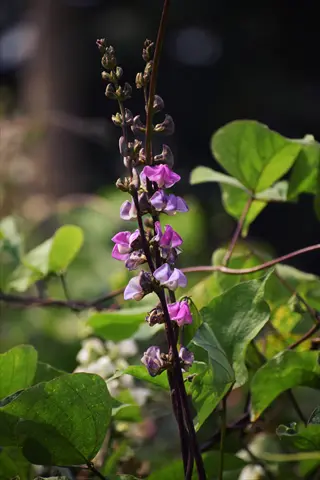
Most people grow this vine for the flower color, and that part delivers. You get fragrant, pea-shaped purple flowers in shades of pink, lavender, and purple, plus white on the paler types. They sit above trifoliate leaves on purplish stems, and the whole plant leans toward plum.
But the seed pods are the part that surprises people. After the blooms fade, glossy iridescent reddish-purple pods form on the same purple stems and often hang on long after the flowers quit. On a deep variety like 'Ruby Moon' the pods carry the color through fall on their own.
Named types let you pick by both flower and pod color. So it helps to know what sets each one apart before you buy seeds.

Ruby Moon
- Flowers: Carries lilac to rosy-purple pea-shaped blooms held above the foliage on dark, purple-tinged stems.
- Pods: Produces the glossy, iridescent reddish-purple pods that make this variety a favorite for both garden color and indoor display.
- Foliage: Shows trifoliate leaves with purple veining that deepen the overall plum tone of the whole vine.
- Vigor: Climbs fast and tall in a single warm season, easily covering a sturdy 10 to 15 foot (3 to 4.6 m) trellis.
- Use: Works beautifully as a privacy screen, an arbor cover, or a dramatic backdrop in a hot, sunny border.
- Season: Flowers from mid to late summer into fall, with the colorful pods often outlasting the blooms.
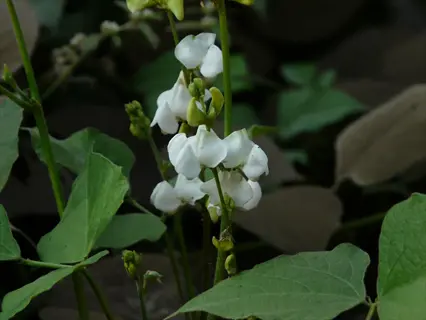
Silver Moon
- Flowers: Opens soft white to pale lavender blooms that give a cooler, gentler look than the deep purple types.
- Pods: Sets paler seed pods, offering a quieter color scheme for gardeners who want the vine without the bold plum tones.
- Foliage: Keeps the green, twining habit of the species with far less of the purple pigment seen in darker varieties.
- Vigor: Grows quickly and climbs strongly, matching the species habit of reaching well over 10 feet (3 m) in a season.
- Use: Pairs nicely with darker varieties or pastel flowers for a softer screen or trellis planting.
- Season: Blooms across summer and into fall, fading only when the first frost ends the season.
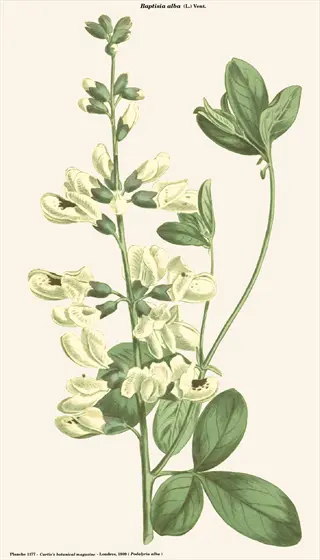
Alba
- Flowers: Produces clean white flowers, making it the choice for a bright, classic look on a trellis or arbor.
- Pods: Forms greener pods rather than the reddish-purple of the standard type, keeping the whole plant pale.
- Foliage: Shows fresh green leaves with little of the purple tint, so it reads as a green-and-white climber.
- Vigor: Twines vigorously and reaches the same impressive heights as other hyacinth bean varieties in warm weather.
- Use: Suits white or moon gardens and blends easily with almost any color planting around it.
- Season: Flowers through summer and fall, providing a long run of white bloom until cold weather arrives.
Giganteus
- Flowers: Bears the familiar purple-toned pea flowers but on an especially large, robust form of the vine.
- Pods: Produces sizable purple-tinged pods in keeping with its larger overall scale.
- Foliage: Carries big trifoliate leaves that create dense, fast cover on tall supports.
- Vigor: Lives up to its name with strong, rapid growth that can fill a large trellis or fence quickly.
- Use: Ideal where you need fast, heavy screening over a wide area in a single growing season.
- Season: Flowers in late summer and fall, giving bold color once it reaches full size.
The bloom time runs from mid to late summer and carries on through fall until frost. That gives you roughly two to three months of color on a vine that may not start until the nights cool a little. Once it gets going, the pods stretch the show even further.
You will see the mature height listed two ways. Some seed packets say 8 to 10 feet (2.4 to 3 m). Extension references put it at 10 to 25 feet (3 to 7.6 m). The gap comes down to the cultivar you plant and how long your warm season runs. A vine in a hot, long-summer spot climbs far higher than the packet hints.
Hyacinth bean often holds off flowering until late summer when nights cool a little. A vine that is all leaves in midsummer is usually on schedule, not failing.
Safe to Eat and Toxicity
So are hyacinth beans poisonous? The honest answer is yes and no. It comes down to which part you eat and how you cook it. NC State Extension rates the plant's toxicity as low. The trouble shows up only if you eat lots of the mature dried seeds raw.
Those dried seeds hold cyanogenic glycosides. The same compounds make raw kidney beans a bad idea. Think of a mature dried hyacinth bean as a raw kidney bean. It is fine once you boil it right, but not something to toss in your mouth straight from the pod.
Can you eat hyacinth beans? You can, and people across Africa, Asia, and India have done so for centuries. The safe parts are the young immature pods, shoots, leaves, and the edible flowers, which you cook like any garden vegetable. The mature dried seeds are the only part that needs the extra step below.
Young immature pods, shoots, leaves, and flowers can be cooked and eaten, while mature dried seeds need special handling before they are safe.
Raw mature dried seeds contain cyanogenic glycosides, the compounds responsible for the plant's low-severity toxicity, so they are not safe straight from the pod.
Boil mature dried seeds thoroughly and change the cooking water several times, which depletes the cyanogenic glycosides and makes the seeds safe to eat.
Cook young pods and tender greens like any vegetable; cooking is what makes hyacinth bean parts safe and improves how well the seeds are digested.
Because mature dried seeds hold cyanogenic glycosides, store and keep them away from dogs and small children who might chew on them.
The key step with mature dried seeds is to boil them and use two changes of water, draining the pot and refilling it a few times as they cook. That swap pulls the cyanogenic glycosides out and leaves you with a safe, protein-rich bean.
Cooking does more than make the seeds safe. It also makes them easier to digest. In one pig feeding study, boiling raised how well the seeds digested from 50% raw to 74% boiled. That jump shows heat changes the bean for the better. The same logic applies to your young pods and greens, where simple cooking is the safety switch.
No major source has put a number on the risk to dogs, so I won't pretend one exists. Still, since the dried seeds carry the same compounds that make them off-limits raw for people, the smart move is to keep dried seeds and pods away from dogs and curious kids. The growing vine itself is not the worry; the stored dry seeds are.
The plant parts are toxic due to the presence of cyanogenic glycosides, which are depleted during food preparation and cooking.
History and Garden Benefits
By late summer my bare air conditioner unit and the chain-link fence behind it had vanished under a wall of 'Ruby Moon'. Purple stems climbed the whole hot back line of the yard. Bees worked the little pea-shaped flowers from morning on. I had planted a clematis in that spot first, then a climbing rose. Both cooked in the afternoon heat and gave up by July. This vine just kept going. You can lean on it the same way in your own hot, problem corners.
That fast cover is the first of the hyacinth bean benefits you notice. The plant makes a real privacy screen in one warm season. It hides a fence, an AC unit, or any other eyesore fast. So you get cover while slower shrubs fill in. NC State Extension says the blooms pull in butterflies and hummingbirds too. You feed pollinators at the same time you block the view.
The vine works below the soil too. As a legume it does nitrogen fixation work. It adds about 20 to 140 kilograms of residual nitrogen per hectare. That is roughly 18 to 125 pounds per acre. The USDA lists it as a summer cover crop for food, forage, green manure, and wildlife. Its seeds run about 26% protein. Farmers across Africa and Asia have grown it for ages, not just for the flowers.
You also get some history with this vine. The plant reached European gardens by the early 1700s. Thomas Jefferson then grew it at Monticello in the early 1800s. That is how it earned the nickname Jefferson bean. Science is still catching up to that old name. A 2025 review calls it an underused food plant full of compounds linked to health. So your old-fashioned screen vine has far more to give than its good looks.
Fast Privacy Screen
- Quick cover: Its fast twining growth can hide a fence, an air conditioner unit, or another eyesore in a single warm season.
- Vertical color: It turns a bare wall or arbor into a sheet of purple stems, flowers, and glossy pods.
- Budget friendly: A packet of seed covers a large support cheaply, making it a low-cost solution for vertical screening.
Feeds Pollinators
- Flowers for wildlife: The fragrant blooms attract butterflies and hummingbirds, drawing helpful visitors into the garden.
- Bee favorite: Bees work the pea-shaped flowers, so the vine supports pollinators through late summer and fall.
- Habitat value: The USDA lists it as useful for wildlife, adding ecological value beyond its good looks.
Builds Soil As A Legume
- Nitrogen fixer: As a legume it adds roughly 20 to 140 kilograms of residual nitrogen per hectare, about 18 to 125 pounds per acre, to the soil.
- Cover crop: The USDA describes it as a cover crop for food, forage, green manure, and wildlife that helps break weed and disease cycles.
- Forage and food: Its forage carries about 18% crude protein and its seeds about 26% protein, valuable on farms worldwide.
Heritage And Health Interest
- Jefferson bean: Thomas Jefferson grew it at Monticello in the early 1800s, and it had reached European gardens by the early 1700s.
- Global food crop: It is an important food crop across parts of Africa and much of Asia, especially India, far beyond its ornamental use here.
- Studied food: A 2025 review calls it an underutilized plant with a diverse array of bioactive compounds linked to health benefits.
Hyacinth bean is a perennial bean from tropical Africa that is an important food crop in parts of that continent and much of Asia, especially India.
5 Common Myths
Many gardeners think every part of the hyacinth bean vine is deadly poison and should never be touched or eaten at all.
Only the mature dried seeds hold cyanogenic glycosides. Young pods, shoots, leaves, and flowers are edible once cooked, and handling the plant is fine.
People assume hyacinth bean is a true perennial that will regrow from the same roots in any garden across the country every spring.
It is perennial only in USDA zones 10 to 11. In cooler zones frost kills it, so it grows as an annual that may self-seed.
A common belief is that hyacinth bean vine grows fine in partial shade like many other leafy climbing garden vines.
It is a sun lover that needs at least six hours of direct light daily. Shade gives weak growth and very few of its purple flowers.
Some gardeners think the vine needs rich fertilizer and heavy feeding to climb tall and flower well through the season.
As a nitrogen-fixing legume it makes much of its own nitrogen, so heavy feeding is unneeded and can push leaves at the expense of blooms.
Many assume hyacinth bean is aggressively invasive and will take over a yard the way some runaway climbing weeds do.
In most regions frost ends it each year. It can self-seed from dropped pods, but it is easy to pull and rarely spreads out of control.
Conclusion
Let me recap the journey this guide has walked through. The hyacinth bean vine packs a lot into one season. It is a fast growing flowering vine that twines up your fence, throws out purple blooms, and feeds your soil at the same time. Few plants give you this much for so little work, which is what earns it real garden space for a new gardener.
The care facts stay simple. Give the vine full sun and a sturdy support that stands 10 to 15 feet tall (3 to 4.6 m), since this climber needs room to reach. Sow your seeds outside once nights warm past 50°F (10°C), water young plants while their roots settle, and then mostly step back. As a nitrogen fixer it feeds itself, so go light on fertilizer and let it do the rest.
You get a long show for that effort. The purple hyacinth bean opens pink and purple flowers from summer into fall. Then it sets glossy magenta pods that almost look fake against the green leaves. Those flowers pull in bees and hummingbirds all season. You can eat the young pods once they are cooked. But never eat the mature dried seeds raw. They hold cyanogenic glycosides and are only safe once you boil them with the water changed a few times.
Here is the plain takeaway. This one heirloom climber delivers a rare mix. You get fast purple color, real help for bees, and soil that the vine feeds as it grows. You will not find all of that in many other easy to grow plants. In most of the country you grow it as an annual. Yet it often drops seed and comes back on its own the next spring. As a reader, picture your bare fence in May, then the same spot in August. It is buried under leaves, purple flowers, and shining pods. That change happens in one short season from a few seeds.
Glossary
- Cover crop
- A plant grown mainly to protect and enrich the soil rather than for harvest.
- Cyanogenic glycosides
- Natural compounds in the plant's mature dried seeds that release cyanide and must be broken down by cooking before the seeds are safe to eat.
- Dolichos lablab
- An older botanical synonym still printed on some seed packets for the same hyacinth bean species.
- Fabaceae
- The pea or legume plant family, which includes beans, peas, and the hyacinth bean vine.
- Lablab purpureus
- The botanical name for hyacinth bean vine, a twining ornamental and food plant in the pea family.
- Nitrogen fixation
- The process by which legumes like hyacinth bean pull nitrogen from the air and add it to the soil through their roots.
- ornamental
- A plant grown mainly for its looks rather than for food or another practical use.
- Trifoliate leaves
- Leaves made up of three leaflets, the leaf shape seen on hyacinth bean vine.
External Sources
Frequently Asked Questions
Does hyacinth bean vine come back every year?
It is a tender perennial in USDA zones 10 to 11 but grows as an annual everywhere else, often returning from dropped seed.
Do hyacinth bean vines like sun or shade?
Hyacinth bean vines need full sun, meaning at least six hours of direct light each day, for the best flowering and vigor.
Is hyacinth bean vine toxic to dogs?
The mature dried seeds contain cyanogenic glycosides, so keep dried seeds and pods away from dogs that like to chew.
Is hyacinth bean easy to grow?
Yes, it is one of the easiest fast vines to grow from seed in warm weather with sun and a sturdy support.
How long does hyacinth bean vine bloom?
It blooms from mid to late summer through fall, often for two to three months until the first frost ends the season.
Does hyacinth bean need a trellis?
Yes, it twines and needs a sturdy support such as a trellis, fence, or arbor of about 10 to 15 feet to climb well.
Can you eat hyacinth bean vine?
Young pods, shoots, leaves, and flowers are edible cooked, but mature dried seeds must be boiled in changes of water first.
Are hyacinth beans invasive?
In most temperate gardens it is not invasive because frost kills it each year, though it can self-seed from dropped pods.
What are common hyacinth bean problems?
Common issues are Japanese beetles, fungal blight or rust in humid weather, and delayed blooming when nights stay warm.
What are the benefits of hyacinth bean?
It fixes nitrogen, attracts pollinators, screens eyesores quickly, and serves as forage, a cover crop, and a protein-rich pulse.