
Introduction
The ninebark shrub earns its place in your yard the hard way. It lives where most plants quit. It grew wild on gravel bars and rocky stream banks long before anyone planted it on purpose. That tough streak is the real reason to grow it, and the good looks are a bonus.
You may see it sold by its Latin name, Physocarpus opulifolius. It is one of the most forgiving plants you can put in the ground. This native shrub takes clay, sand, drought, salt, and poor soil that would kill a fussier plant. It grows fast and reaches 3 to 10 feet based on the cultivar. It also shrugs off most pests and disease.
Hardiness ratings shift a bit by source. NC State Extension lists zones 2a to 8b. University of Illinois Extension lists a tighter 2 to 6. Either way you get a plant that takes hard winters. It still gives you four-season interest, with spring flowers, bright leaves, red seed pods, and peeling winter bark. Newer types push that color from gold and copper to wine red and near black. That shift moved ninebark from a streambank plant to a shrub people plant out front.
Most ninebark guides stop at the variety list and a few care tips. They skim the wildlife value, the native habitat, and the erosion control story that make this plant worth your space. This guide grounds all of that in extension and government sources. You will learn what ninebark is and the best varieties to pick. You will see how to plant and prune it, why it is so drought tolerant, and how it feeds pollinators and holds a slope in place.
What Is the Ninebark Shrub
Six years ago I put a Diabolo ninebark in the damp back corner where my lawn meets the woods. I see that spot from the kitchen window each morning. Now it fills the frame with deep burgundy leaves and clouds of pale flowers. That same wet ground had killed a hydrangea before it. It killed a young dogwood too, and both rotted at the roots within a season.
So a ninebark shrub is a tough native. It shrugs off the soggy, wet soil that kills off fussier plants. You may see it sold under its real name, Physocarpus opulifolius. It belongs to the rose family, called Rosaceae. That is the same plant family that gives you apples and garden roses. It is a deciduous shrub, so it drops its leaves each fall and grows fresh ones in spring.
The odd name comes straight from the bark. Look at older stems, the kind thicker than about three quarter inch, or 2 cm across. The outer layer dries and lifts away in thin papery strips. People once counted the curling layers and got about nine, so they called it ninebark. This exfoliating bark only shows up on mature wood. A young plant will not peel for you in its first year or two.
The shrub earns its keep in all four seasons. White to pink flowers open in late spring to early summer, roughly May to July. Colorful leaves carry you through the summer. Then you get red to burgundy seed capsules. They take over in early fall, around September to October. When winter strips the leaves, that peeling bark stands bare against the snow. It gives you something to look at in the coldest months.
All this toughness traces back to where ninebark grows in the wild. It is native across central and eastern North America. You find it clinging to gravel bars, rocky stream banks, and bluffs. Plants from spots like that learn to handle lean soil, flooding, and drought. That is why your shrub holds up so well once you move it into a garden bed.
Ninebark is an attractive shrub with wide-spreading, graceful, recurved branches and bark peeling off in conspicuous thin strips.
Best Ninebark Varieties
At dusk I watch my golden Dart's Gold glow like a low lamp left on in a dim corner near the fence. Across the bed I can barely find the wine purple Diabolo in the damp back corner, where it reads almost black through the kitchen window. The two never look like the same plant, and that gap is the whole reason cultivar choice matters for you.
Breeders have pushed ninebark varieties way past plain green. You can now pick gold, copper, wine red, and leaves so dark they pass for black. That color is the main thing you are buying, so match the shade to the spot before you worry about anything else.
One rule holds across almost every cultivar. Foliage color runs most vivid in full sun and fades toward green in shade, so a dark purple foliage shrub loses its punch in a shady bed. Put the bold colors where the light hits and save shade for plants that do not depend on leaf color.
Size swings hard too. Clemson notes the dwarf 'Nanus' tops out at just 1 to 2 ft (0.3 to 0.6 m). Large types like Diabolo and Coppertina hit 8 to 10 ft (2.4 to 3 m). So a dwarf ninebark and a full size one are not the same shrub at different ages. You are buying different tools for different jobs, and you should pick by the space you have.
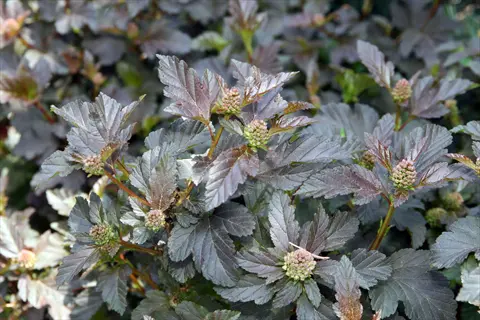
Diabolo
- Foliage: Deep wine purple to near black leaves that hold color best in full sun and fade toward green in heavy shade.
- Size: A large cultivar reaching about 8 to 10 ft (2.4 to 3 m) tall and wide, so give it real room.
- Flowers: Clusters of pale pink to white flowers in late spring contrast sharply against the dark foliage.
- Use: Works as a bold specimen, a dark backdrop for brighter plants, or a tall informal screen.
- Care: Vigorous and tough, though dark cultivars can show powdery mildew in damp, crowded sites.
- Why grow it: It is the classic dark ninebark that put colorful cultivars on the map for home gardens.
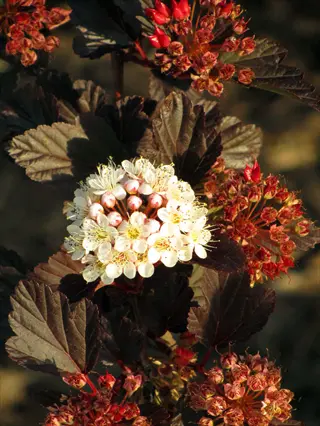
Summer Wine
- Foliage: Fine textured wine red leaves on a denser, more refined frame than the older Diabolo.
- Size: A mid size cultivar around 5 to 6 ft (1.5 to 1.8 m) tall and wide, fitting many borders.
- Flowers: Soft pink white blooms in early summer sit nicely against the burgundy leaves.
- Use: A versatile mixed border shrub that gives dark color without the bulk of a large cultivar.
- Care: Generally vigorous and adaptable, with good garden performance in full sun.
- Why grow it: It delivers rich color at a manageable size for an average yard.
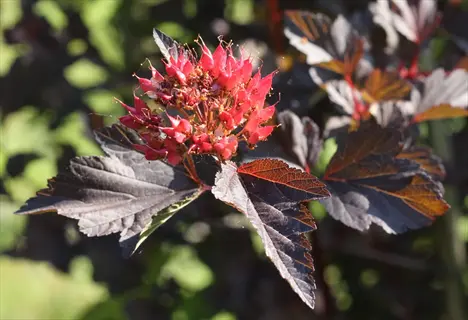
Tiny Wine
- Foliage: Small dark bronze to wine colored leaves on a compact, tidy habit.
- Size: A compact cultivar near 3 to 4 ft (0.9 to 1.2 m), one of the better choices for small spaces.
- Flowers: White to pink flowers appear along the stems in late spring to early summer.
- Use: Suits foundation plantings, low informal hedges, and large containers.
- Care: Easy and low fuss, needing little pruning to stay in shape at its small size.
- Why grow it: It brings dark ninebark color to tight spots where big cultivars will not fit.

Dart's Gold
- Foliage: Bright chartreuse to golden yellow leaves that light up a border, holding color best in sun.
- Size: A mid size cultivar roughly 4 to 5 ft (1.2 to 1.5 m) tall and wide.
- Flowers: White to pinkish flower clusters in late spring stand out against the gold foliage.
- Use: A bright accent plant that contrasts well beside dark purple shrubs and green foliage.
- Care: Gold foliage can scorch in intense afternoon heat, so some midday shade helps in hot regions.
- Why grow it: It is a long popular gold ninebark that adds glow to a planting.
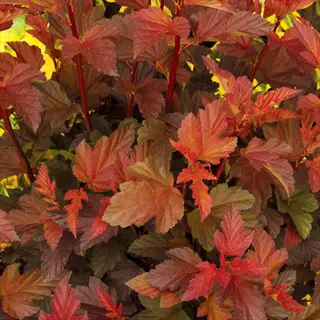
Coppertina
- Foliage: New growth emerges coppery orange and matures to rich red, giving a layered color effect.
- Size: A large cultivar reaching about 8 to 10 ft (2.4 to 3 m), similar in scale to Diabolo.
- Flowers: Pinkish white flowers in early summer add to the warm color palette.
- Use: A strong specimen or tall screen where its size and warm tones can be seen.
- Care: Vigorous and tough like other large cultivars, with the same general low needs.
- Why grow it: Its copper to red color shift offers a warmer alternative to purple cultivars.
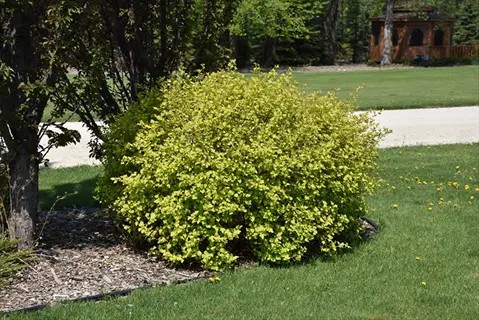
Nugget
- Foliage: Golden yellow spring foliage that mellows to lime green through summer.
- Size: A mid size rounded cultivar that fits hedging and border roles.
- Flowers: White flower clusters in late spring suit its bright leaf color.
- Use: Useful as a gold hedge or a bright filler in a mixed planting.
- Care: Clemson specifically notes 'Nugget' is susceptible to leaf spot, powdery mildew, and fire blight, so give it good air flow.
- Why grow it: It offers gold color, though its disease note makes siting and spacing important.
A few picks need extra care up front. Clemson flags 'Nugget' as prone to leaf spot, powdery mildew, and fire blight, so give it room and air flow rather than crowding it in a tight bed. Dark cultivars can also mildew in damp, packed spots, which is one more reason to space them well.
If you want one safe starting point, the Summer Wine sits in a sweet spot for most yards. It gives you the rich color of Diabolo ninebark at a size you can fit. You get that wine red tone without the bulk of a 10 ft shrub.
Where and How to Plant
Knowing where to plant ninebark comes down to one thing the shrub loves above all else. Give it full sun with 6 plus hours a day and the flower and foliage color turns most vivid, a point Clemson Extension makes clearly. The ninebark shrub still grows in part shade, but the rich burgundy and gold tones of cultivar leaves fade out without strong light.
The soil side is where this plant gets easy. NC State Extension reports that ninebark tolerates clay, loam, and sand. It runs from acidic to alkaline pH, and it handles ground that swings from dry to wet. That broad range means most garden soils work, so you skip the heavy amending other shrubs demand. Aim for well drained soil when you can, but a sticky clay slope will not stop it.
Why is ninebark so forgiving? It grows wild on harsh streambanks and rocky slopes, so it roots in fast on the difficult sites where fussier shrubs give up. That includes slopes, compacted soil, and spots near pavement. If you have a bank that keeps washing out or a corner where nothing takes, this is your plant.
Choose a full sun to part shade spot with room for the cultivar's mature spread; full sun gives the most vivid flower and foliage color.
Ninebark tolerates clay, loam, sand, and acidic to alkaline pH, and handles dry to wet ground, so most garden soils work without heavy amending.
Dig a hole as deep as the root ball and about twice as wide to loosen the surrounding soil for spreading roots.
Place the shrub so the root flare sits level with the surrounding soil, then backfill and firm gently to remove air pockets.
Space full size cultivars 5 to 10 ft (1.5 to 3 m) apart and compact cultivars 3 to 4 ft (0.9 to 1.2 m) apart for their mature size.
Soak the area well after planting and keep soil evenly moist through the first season until the shrub is established.
Spacing for planting ninebark follows the mature spread of the variety you pick. Set full size cultivars 5 to 10 ft (1.5 to 3 m) apart. Give compact cultivars 3 to 4 ft (0.9 to 1.2 m) so each one fills its space without crowding. The depth matters too. Leave the root flare level with the surrounding soil, like setting a bowl so its rim sits even with a tabletop rather than sunk below it.
Ninebark grows wild on rocky streambanks, so it is a strong pick for slopes, clay, and compacted soil where many shrubs struggle. Match the cultivar's mature size to the space to avoid heavy pruning later.
Pruning and Yearly Care
Good ninebark pruning comes down to one fact: this shrub flowers on old wood. The flower buds form on stems that grew last year, so the timing of your cuts decides whether you keep next spring's bloom or trade it away. Get that right and the rest of ninebark care is light work.
Last August a dusty gray film crept across the leaves of a crowded Diabolo in my back corner. The plant sat jammed against the fence after a humid stretch, and almost no air moved through it. I pulled out a third of the oldest stems that winter to open up the middle. By the next season the powdery mildew stayed gone and the new leaves came in clean.
That gap between the stems is what fixed it. Air flow keeps the leaves dry, and dry leaves give mildew nowhere to take hold. So your two big decisions each year are simple. You either shape the plant after it blooms, or you cut it back hard while it sleeps.
Knowing when to prune ninebark depends on your goal. Light shaping happens soon after the flowers fade in early summer. Hard renewal pruning waits for late winter while the plant is fully dormant. The table below splits the two jobs and adds the watering and pest notes you need through the year.
Light maintenance pruning
- When: Soon after flowering in early summer, since ninebark blooms on old wood and you avoid cutting off next year's buds.
- How: Remove dead, crossing, or wayward stems and lightly shape, taking only what you need to keep a natural form.
- Why: Light pruning preserves the older stems that carry the showy exfoliating bark for winter interest.
Renewal pruning
- When: In late winter while the plant is fully dormant, before new growth begins for the season.
- How: Cut an overgrown, tired plant close to the ground, or remove the oldest third of stems each year for gradual renewal.
- Why: Ninebark regrows fast from the crown, so hard cuts restore size and vigor but strip the bark interest for a few years.
Watering and feeding
- Watering: Keep new plants evenly moist the first season, then water only in extended drought once established, since ninebark is drought tolerant.
- Feeding: This tough native needs little fertilizer in average soil, so heavy feeding is a waste in most yards.
- Soil: It tolerates clay, sand, salt, compaction, and a wide pH range, which keeps care simple.
Pest and disease watch
- General health: Extension sources describe ninebark as a tough, trouble free shrub that stays free of serious insect and disease pests.
- Main issues: Powdery mildew and fire blight are the usual watch points, and both show up more in crowded, damp, low airflow spots.
- Management: Give plants room, prune for air circulation, and choose less susceptible cultivars in humid regions.
One trade-off matters before you reach for the loppers. Clemson notes that the showy peeling bark only forms on older stems thicker than about three quarter inch. Cut everything to the ground and you reset the clock on that winter bark show. That is why the slow route, taking out the oldest third of stems each year, works well if you want both fresh growth and the bark.
Overgrown plantings of ninebark can be rejuvenated by pruning plants to the ground in late winter.
Wildlife and Erosion Control
You want plants that earn their keep, and a good pollinator shrub does more than look pretty in spring. Ninebark does real work for your yard. Its late spring flowers feed native bees, honey bees, and butterflies right when many of them need an early meal.
The wildlife value runs deeper than the bloom. Clemson lists ninebark as a larval host plant for a few insects. The list names the spiraea leaf beetle, some moth caterpillars, and aphids. These bugs do not kill an established shrub. They feed the songbirds and other animals that need a steady insect supply, and that is the whole point of native shrub wildlife planting.
Ninebark also does jobs that most yard shrubs cannot. It grows wild on gravel bars and rocky stream banks, so it shrugs off the harsh, soggy, then dry spots that kill softer plants. That tough past is why USDA NRCS lists it for erosion control on banks and why Clemson treats it as a rain garden plant.
Pollinators and nectar
- Flowers: The late spring flower clusters are a nectar source for native bees, honey bees, butterflies, and even beetles.
- Value: This makes ninebark a useful addition to pollinator and wildlife gardens during the bloom window.
- Color note: Both white and pink or magenta flowered forms provide this nectar value.
Host plant and insects
- Insect hosts: Clemson names the spiraea leaf beetle, caterpillars of Eulithis molliculata, and aphids among species associated with ninebark.
- Impact: These insect associations are generally non fatal to established plants and are part of a healthy native food web.
- Ecology: Supporting host insects feeds the songbirds and other wildlife that rely on them.
Birds and habitat
- Food: The red to burgundy seed capsules feed game birds and small mammals into fall and winter.
- Cover: The dense, arching habit provides cover, shelter, and nesting habitat for birds.
- Structure: A clump of ninebark adds year round structure to a wildlife friendly planting.
Erosion control and rain gardens
- Slopes: USDA NRCS documents ninebark as effective for erosion control on banks, reflecting its wild streambank and gravel bar habitat.
- Rain gardens: Clemson presents ninebark as a rain garden plant suited to fluctuating moisture from dry to wet.
- Tough sites: Its tolerance of harsh conditions makes it practical for runoff zones and difficult slopes.
Picture the dense, arching habit as a living net spread across your slope. The branches slow the rain before it can rip your soil away, and the roots lock the bank in place. The same thicket gives birds cover and a safe spot to nest. So one tough shrub solves your runoff problem and feeds your wildlife at the same time.
Ninebark is a tough and adaptable plant that does well in slightly acidic, dry to medium, well-drained soil in full sun to part shade.
5 Common Myths
Ninebark is an evergreen shrub that keeps its leaves and provides solid green screening through the whole winter.
Ninebark is deciduous and drops its leaves in fall, but the peeling bark and seed capsules still give real winter interest.
Ninebark is a fussy, high maintenance shrub that needs rich soil, constant feeding, and frequent watering to survive.
Ninebark is tough and adaptable, tolerating clay, drought, salt, and poor soil, and it needs little feeding once established.
All ninebark shrubs grow into the same large size, so they only suit big yards with plenty of open space.
Cultivars range from one to two foot dwarfs up to eight to ten foot types, so there is a ninebark size for nearly any space.
Ninebark spreads by runners and will quickly take over a garden bed the way many invasive shrubs do.
Ninebark grows as a tidy clump from its own crown and does not run through a bed, so it is easy to keep in bounds.
You must prune ninebark hard every year right after it flowers or the plant will stop blooming entirely.
Pruning is optional, and light pruning preserves the showy bark, while hard renewal cuts are best done in late winter.
Conclusion
The ninebark shrub earns its spot in almost any yard. It gives you a lot and asks for little back. It is a true native shrub with four-season interest. You get spring flowers, bold cultivar foliage, red seed pods in fall, and peeling winter bark.
The headline numbers make the case on their own. This shrub is hardy in roughly zones 2 to 8, depending on the cultivar, and it grows fast. Mature size runs 3 to 10 feet (0.9 to 3 m) across the different forms. It shrugs off clay, drought, salt, and rough sites that kill fussier plants.
Planting stays simple, and ninebark care comes down to your goals. Prune lightly each year to keep that showy peeling bark, or cut an overgrown plant to the ground in late winter to bring it right back. On a slope or stream bank, the roots hold soil and the dense growth gives birds cover while the flowers feed native bees and butterflies.
That mix makes it a rare plant that fits two kinds of gardeners. Beginners get a low maintenance shrub that forgives mistakes. Design minded growers get foliage in gold, copper, wine red, and near black to play with. Picture your own space and match a cultivar to your light and room. You end up with a tough, colorful backbone that earns its keep for years.
Glossary
- Cultivar
- A plant variety bred and selected by people for specific traits such as leaf color or compact size.
- Deciduous
- A plant that drops all its leaves each fall and regrows them in spring rather than staying green year round.
- Exfoliating bark
- Bark that peels away in thin papery strips, which on ninebark gives the plant its winter interest and its name.
- Physocarpus opulifolius
- The botanical name for common ninebark, a deciduous shrub in the rose family native to North America.
- Powdery mildew
- A common fungal issue that coats leaves with a dusty gray-white film, worse in crowded, damp, low-airflow spots.
- Renewal pruning
- Cutting an overgrown shrub hard, often near the ground, so it regrows fresh, vigorous stems from the crown.
- Root flare
- The point where the trunk widens into the roots, which should sit level with the soil surface when planting.
- USDA hardiness zone
- A region rating based on average lowest winter temperature that shows where a plant can reliably survive the cold.
External Sources
Frequently Asked Questions
Where is the best place to plant ninebark?
A spot with full sun to part shade and room to reach its mature spread.
What is the prettiest ninebark variety?
It depends on the color you want, from wine red Diabolo to golden Dart's Gold.
Is ninebark a low maintenance shrub?
Yes, ninebark is one of the lower maintenance landscape shrubs once established.
Are ninebark shrubs toxic to dogs?
Major horticulture sources do not list ninebark as toxic, but caution is still sensible.
What is the lifespan of a ninebark shrub?
A healthy ninebark can live for decades, especially with renewal pruning.
Does ninebark spread or become invasive?
Ninebark forms a clump and does not run aggressively or behave invasively.
Can ninebark be kept small?
Yes, with dwarf cultivars or regular pruning you can keep ninebark compact.
What plants pair well with ninebark?
Spirea, weigela, coneflower, and ornamental grasses pair well with ninebark.
Will ninebark grow back if cut to the ground?
Yes, ninebark regrows vigorously after being cut to the ground in late winter.
How do you prepare ninebark for winter?
Very little, since ninebark is extremely cold hardy and needs minimal winter prep.