
Introduction
I planted a passionflower vine on a plain wire fence one spring. By summer a neighbor stopped on the sidewalk just to stare at it. The flower looks like a frilled clock face, with a fringe of purple threads spinning out around a green center like a tiny pinwheel. It seems like the kind of bloom that would need a greenhouse and a science degree to keep alive. It does not.
Here is the surprise. This plant is one of the easiest climbers you can grow. The plant most folks plant is Passiflora incarnata, a fast and tough perennial vine. It is hardy in USDA zones 5 to 9. It shrugs off cold winters by dying to the ground and coming right back each spring. Give it room and it climbs 12 to 24 feet (3.7 to 7.3 meters) in one season, so plan its spot first.
Sun, soil and a trellis are the easy part, and most guides end there. This one keeps going. You will get the full passion flower care routine from planting to pruning. You will also learn the parts that get skipped. That means the edible maypop fruit and the butterflies that need this vine. It also means the leaves that are mildly toxic to pets and the real science behind its use as a calming herb.
That last point matters because this plant lives a double life. It is a showy garden vine and an edible fruit producer, and it is also a traditional herb people brew into tea for stress and sleep. You will find both stories here in one place. Let's start where every healthy vine starts, with how to plant it and get it climbing fast.
How to Grow Passionflower Vine
By the second summer my back-fence arbor had vanished under green. Leaves and curling tendrils hid the whole wooden frame. The purple flowers opened a few feet above my head. It started as one small plant. I set it in well-drained soil against the wooden arbor by the kitchen window, gave it a place to climb, and mostly left it alone after that.
That is the heart of how to grow passionflower. This vine needs room and a strong support far more than it needs fussing. Get the spot right at planting time and the plant does the rest of the work for you. Pick wrong and you spend years fighting a tangle that wants to be somewhere else.
Start with light. Passionflower wants full sun, which means 6 or more hours of direct light each day, though it will take partial shade and still grow. More sun drives more flowers, so a south-facing fence or open arbor beats a shady corner every time. Plant it where it gets bright morning light and you will see the strongest bloom.
Soil is where this plant stays easy. It needs well-drained soil above all else, but it tolerates clay, loam or sand without complaint. Aim for a soil pH between 6.0 and 7.5 and you sit right in its comfort zone. The one thing it hates is soggy roots, so skip any low spot where water pools after rain.
Water a new vine well for the first season while the roots spread out and settle in. Once established it turns drought tolerant and shrugs off dry spells with little help from you. A loose layer of mulch keeps the roots cool and holds moisture during summer heat. After that first year you can water deeply only when the soil dries out.
Now give it something to climb. A passionflower grows as high and wide as whatever you hand it, so set it at the base of a strong fence, trellis or arbor from day one. Its tendrils grab and pull the plant upward on their own without any tying or training. Build the support sturdy before you plant, because a heavy, mature vine can pull down a flimsy frame.
Your USDA hardiness zones decide how the plant behaves through winter. In zones 5 to 7 treat it as a root-hardy perennial that dies to the ground in cold and resprouts from the roots each spring. In zones 8 to 9, and as far as 7B to 11 in Florida, it stays more woody and holds growth through milder winters. Either way, good passion flower care in the first season sets up the show for years to come.
Pruning and Winter Care
A passionflower vine grows fast, and it needs 12 to 24 feet of space to climb in a single season. That speed is great when you want quick cover on a fence, but it means pruning passionflower becomes a yearly job rather than a one-time chore. Cut it back hard each spring and the plant rewards you with denser growth and more blooms.
The plant turns woody and keeps its stems through mild winters, but it dies back to the ground when the cold gets hard. So your approach to overwintering depends on your zone. In zones 5 to 7 you cut the vine right back after frost kills the top growth, then pile a loose mulch over the crown so the roots stay safe and resprout in spring. In zones 8 to 9 the plant rarely dies back, and a lighter shaping is all you need to keep it tidy.
One November the back-fence arbor was a tangle of blackened, mushy stems after the first hard zone 7 frost hit overnight. The whole thing looked dead, like something you would rip out and toss on the compost pile. Then by the kitchen window the next May, fresh green shoots pushed up through the mulch right where the old vine had been. A frozen-looking passionflower is usually just sleeping below the soil.
Learning how to prune passion vine is only half the battle, because this plant also spreads underground through root suckers. New shoots pop up feet away from the main crown and march along your fence line if you let them. To control growth, pull or dig those stray suckers as soon as you spot them, and stay firm about it each season. The steps below walk you through a clean yearly prune.
Prune in late winter or early spring before strong new growth begins, once the worst cold has passed in your zone.
Cut away any blackened, frost-killed or broken stems back to healthy wood so the plant can focus energy on fresh shoots.
Thin crowded growth and shorten long stems to keep the vine inside its support and improve airflow through the canopy.
Dig or pull root suckers that pop up away from the main plant to stop the vine from spreading where you do not want it.
Do not feed heavily with high-nitrogen fertilizer to push growth. Excess nitrogen drives lush leaves at the expense of flowers and fuels even more aggressive spreading.
Flowers and the Maypop Fruit
The passion flower bloom is the whole reason most people grow this vine. Each flower spreads 1 to 3 inches (2.5 to 7.6 cm) wide with 7 to 20 petals and rays stacked in a wheel. So when does passion flower bloom for you? Expect the show from May to July, with fragrant new flowers opening across the vine all summer.
Here is the catch nobody warns you about. Each flower is a one-day bloom. It lives like a mayfly, opening for a single brilliant morning before it fades and drops by evening. You may catch only a few open at once on a healthy vine, and that is normal. The vine just keeps pushing out fresh ones, so you get weeks of color from blooms that each last a day.
May to July
Fragrant 1 to 3 inch flowers open across the vine, each lasting only about a single day before fading.
July to August
Pollinated flowers set egg-shaped green maypop fruits that swell along the stems as summer heats up.
September to October
Maypops mature to a yellowish color and soften; ripe fruit is edible fresh or made into jelly.
Late Fall
Top growth fades and dies back in cold zones while the roots stay alive underground for next year.
Fleshy, leathery, egg-shaped fruits called maypops appear from July to October and mature to a yellowish color with brown seeds in fall. They 'pop' when crushed.
Pollinated flowers turn into the maypop fruit, the egg-shaped green pods that swell along the stems through summer. They mature to a yellowish color from July to October, and the name fits because they pop when you crush them. NC State says the ripe fruit is edible fresh or made into jelly, so it counts as a fun garden snack you can pick straight off the vine.
Set your taste buds low first. This is an edible passion fruit, but UF/IFAS calls the native maypop edible and not very tasty. Treat it as a novelty, not dessert. The thrill is more about growing your own oddball fruit than chasing sweetness, so the kids will pop them open long before anyone fills a jelly jar.
One mix-up trips up new growers every year. The sweet passion fruit juice at the store comes from Passiflora edulis. That is a whole different species, not the native maypop you grew. So your home fruit will not taste like that tropical drink, and that gap is the plant doing exactly what it should.
Pests, Disease and Toxicity
A vigorous passion vine shrugs off most trouble, but a few passion flower pests still show up each season. Aphids gather on soft new shoots, while spider mites and caterpillars work the undersides of leaves. None of these will kill an established plant, yet knowing what you are looking at saves you from spraying the wrong thing.
The harder question for many gardeners is safety. The leaves and stems hold cyanogenic glycosides. That same plant chemistry makes the foliage toxic to pets. It sounds alarming, but it cuts both ways. The bitter leaves taste bad to many bugs and grazing animals. So the trait works as a built-in defense as much as a hazard.
Here are the issues worth knowing. They start with sap-sucking aphids and mosaic virus. Then come the poisonous leaves. Last are the friendly caterpillars you should leave alone.
Sap-Sucking Insects
- What to watch for: Aphids, spider mites and whiteflies cluster on tender new growth and the undersides of leaves.
- Damage: Heavy feeding causes curled, yellowing leaves and sticky honeydew that can lead to sooty mold.
- Control: A strong spray of water, insecticidal soap or encouraging beneficial insects usually keeps numbers in check.
Viral Diseases
- What to watch for: Mosaic virus and potyvirus show up as mottled, streaked or distorted leaves on affected vines.
- Spread: These viruses often move on the mouthparts of feeding aphids, which is another reason to control them early.
- Management: There is no cure, so remove badly affected plants and keep tools clean to avoid spreading it further.
Toxic Leaves and Stems
- Toxic principle: Leaves and stems contain cyanogenic glycosides, and NC State Extension rates the poison severity as medium.
- Who is at risk: The foliage can affect children, cats, dogs and horses, causing nausea, vomiting, drowsiness or irregular heartbeat.
- The exception: The ripe maypop fruit is edible, so the risk is from chewing the leaves and stems, not from the fruit itself.
Caterpillar Feeding
- What you will see: Stripped or skeletonized leaves in summer are usually the work of butterfly caterpillars, not a true pest.
- Who is responsible: Gulf fritillary and related caterpillars eat the foliage because this vine is their dedicated host plant.
- What to do: Leave them be if you want butterflies, since the vigorous vine almost always regrows the leaves they eat.
The one detail worth repeating is the split between fruit and foliage. The ripe maypop fruit is edible and the leaves and stems are the mildly toxic part. So you can grow this vine for its fruit and still want a fence between curious pets, kids and the leaves. Treat chewed summer foliage as a butterfly nursery, not a problem to fix, and reach for water or soap only when true pests pile up.
Keep dogs, cats and small children away from the leaves and stems, which are mildly toxic. Only the ripe maypop fruit is safe to eat.
A Butterfly Host Plant
Bright orange caterpillars dotted the leaves on the back-fence arbor I planted one August. Dark spines ran along their bodies as they chewed. Within two weeks the vine looked ragged and half-stripped. Then came the orange. Dozens of fresh butterflies lifted off the passion flower butterfly host plant. They drifted across my zone 7 North Carolina yard, and the chewed leaves made sense.
A host plant is where butterflies lay their eggs. The caterpillars feed there once they hatch. That makes it different from a nectar plant, which only feeds the adults. Your passionflower does both jobs. So a few chewed leaves on your vine are just the price of raising the next round of butterflies. If your foliage looks munched in midsummer, you are doing it right.
Passionflower is the main larval host plant for the Gulf fritillary. It feeds the variegated fritillary and zebra longwing too. The big sweet-smelling blooms then pull in bees, butterflies, and hummingbirds for nectar. Your vine plays two roles at once. It is a nursery for the young and a food bar for the adults. That is why you see it in so many a pollinator garden across the southeastern United States. Plant one vine and you attract butterflies all warm season.
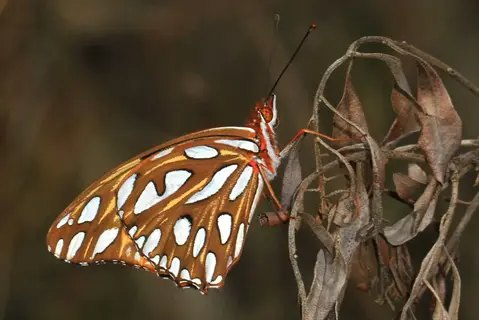
Gulf Fritillary
- Relationship: Passionflower is the dedicated larval host plant for the Gulf fritillary, which depends on it to reproduce.
- Caterpillars: Bright orange caterpillars with dark spines feed on the leaves before forming a chrysalis on the vine.
- Adults: The adult butterflies are a brilliant orange with silver-spotted undersides that catch the light in flight.
- Why it matters: Without passionflower vines nearby, this butterfly has nowhere to lay eggs and complete its life cycle.
- Garden value: One passionflower vine can bring this striking species into your backyard pollinator garden on its own.
- Timing: Expect caterpillar activity through the warm summer months when the vine is in full leaf.
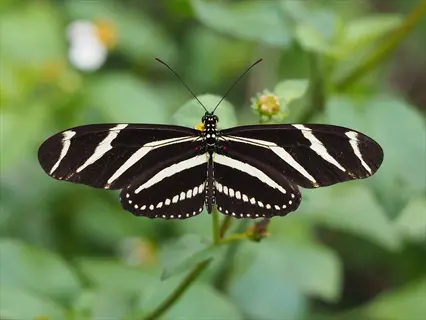
Zebra Longwing
- Relationship: Passionflower is also a host plant for the zebra longwing, a long-lived tropical butterfly.
- Appearance: Its long black wings are striped with pale yellow bands, giving it a slow, drifting flight pattern.
- Behavior: Zebra longwings are known for roosting together in groups and for an unusually long adult lifespan.
- Caterpillars: The caterpillars feed on passionflower foliage much like other fritillary species do.
- Range: This butterfly is especially common in the warm, humid gardens of the southeastern United States.
- Garden value: A passionflower vine can become a reliable nursery for this graceful, distinctive butterfly.
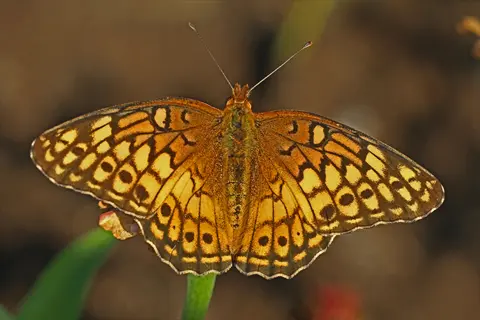
Variegated Fritillary
- Relationship: The variegated fritillary is another butterfly that uses passionflower as a larval host plant.
- Appearance: Adults are a warm orange-brown with a pattern of darker markings across the upper wings.
- Caterpillars: Its caterpillars feed on the foliage, adding to the vine's role as a butterfly nursery.
- Adaptability: This species ranges widely and uses several host plants, with passionflower among its favorites.
- Garden value: Including passionflower broadens the range of fritillary species a garden can support.
- Timing: Look for adults and caterpillars across the growing season when the vine is actively leafing out.
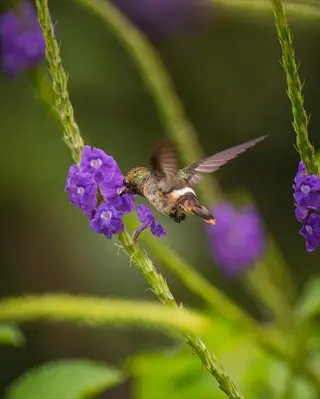
Bees and Hummingbirds
- Relationship: Beyond butterflies, the large fragrant flowers draw in bees and hummingbirds for nectar.
- Pollination: Bumblebees and carpenter bees are the main pollinators that move pollen between flowers.
- Hummingbirds: The showy blooms attract hummingbirds, especially in summer and into the fall.
- Songbirds: The plant and its fruit can also bring songbirds into the garden through the season.
- Garden value: A single vine becomes a busy hub of pollinator activity from late spring onward.
- Timing: Flower visitation peaks during the May to July bloom window when blooms are most plentiful.
Science-Backed Wellness Uses
I snipped a few dried leaves off my own trellis vine, steeped them, and got a cup that tastes like mild green hay. That same vine on your fence has a long history as a calming herb. People have brewed passionflower tea for generations to settle nerves and wind down at night. The science behind those old habits is real, but it is still early, so it helps to know what the studies actually found.
The strongest case is for passionflower for anxiety. A 2020 review in the journal Nutrients pulled together 9 clinical trials. The plant eased anxiety about as well as two calming drugs. Those drugs were oxazepam and midazolam. A 2013 dental trial backs this up. Patients given passionflower saw their worry drop 3.62 points, while the placebo group dropped just 1.47.
Why would a garden vine do this? It comes down to plant compounds called flavonoids. They seem to act on GABA, the brain chemical that quiets nervous signals. That is the same target many calming drugs hit. The evidence for passionflower for sleep is softer. It may stretch your total sleep time, but the results on falling asleep faster are mixed.
Now the honest part on safety. The federal NCCIH says only a small amount of research supports these uses, and the conclusions are not definite. Tea may be safe for up to 7 nights and a daily extract for up to 8 weeks. The common side effects are drowsiness, dizziness, and confusion, so skip it before you drive. Do not use it during pregnancy or close to surgery without a doctor's go-ahead.
No adverse effects, including memory loss or collapse of psychometric functions, have been linked to passionflower administration. The anti-anxiety effect of Passiflora incarnata is comparable to drugs such as oxazepam or midazolam.
This calming track record is why you spot passionflower in so many sleep teas and stress supplements on store shelves. Think of these passionflower benefits as promising rather than proven. The plant that climbs your fence is the same one in that bedtime blend, and a chat with your healthcare provider is the smart first step before you try it.
5 Common Myths
The whole passionflower plant is poisonous, so you should never let any part near people or pets.
Only the leaves and stems are mildly toxic from cyanogenic glycosides; the ripe maypop fruit is edible fresh or as jelly.
Passionflower is a tropical plant that cannot survive winter and must be grown as an annual everywhere.
Passiflora incarnata is a hardy perennial in zones 5 to 9 that dies to the ground in cold winters and resprouts each spring.
Passionflower is just a pretty ornamental vine with no real evidence behind its calming herbal reputation.
A systematic review of nine clinical trials found it reduced anxiety comparably to drugs like oxazepam and midazolam.
The maypop fruit you grow at home is the same passion fruit sold as commercial juice in stores.
Commercial passion fruit juice comes from Passiflora edulis; the native maypop from P. incarnata is edible but milder and less tasty.
Passionflower is risk-free because it is a natural herb, so anyone can take it freely without caution.
It should not be used during pregnancy, may interact with anesthesia, and can cause drowsiness, so some people must avoid it.
Conclusion
By midsummer my back fence had vanished. The passionflower vine I tucked in one spring swallowed 15 feet of wire in one season. The lacy purple blooms were everywhere. That is the deal with this plant. It asks for very little and gives back a lot. Plant it in full sun, give it well-drained soil and something to climb, and this fast, hardy perennial vine rewards you fast. Few plants this easy put on a show this wild.
Good passion flower care really comes down to space and patience. Each strange flower lasts only about a day, then fades. In its place an egg-shaped maypop fruit forms, and it ripens to edible by late summer. The vine is also a true butterfly host plant. It feeds Gulf fritillary caterpillars and pulls in bees and hummingbirds all season. Give it room to climb and it does the rest.
Two facts keep your household safe, and they matter. The leaves and stems hold cyanogenic glycosides and stay mildly toxic to kids, cats and dogs. So keep curious hands and paws away from the foliage. The ripe fruit, though, is fine to eat. The plant also has a real, if early, wellness story for anxiety and sleep. Small trials look promising, not settled. So talk to a healthcare provider first, and skip it during pregnancy or near surgery.
Not many plants work as an ornamental, an edible, a wildlife magnet and a calming herb all at once. That rare mix is what makes this perennial vine worth its room. Picture your own fence or arbor next summer. It drips with odd purple blooms and orange butterflies, and you will see why gardeners hand it the space.
Glossary
- Cyanogenic glycosides
- Natural plant compounds that can release cyanide, making the passionflower's leaves and stems mildly toxic.
- GABA
- A calming brain chemical that passionflower's flavonoids are thought to influence, which may explain its soothing effect.
- Larval host plant
- A plant on which a butterfly lays its eggs and whose leaves its caterpillars eat to grow.
- Maypop
- The edible, egg-shaped fruit of the passionflower vine that pops when crushed and ripens to yellowish in fall.
- Passiflora incarnata
- The botanical name for the native passionflower vine, also known as maypop or purple passionflower.
- Root sucker
- A new shoot that sprouts from a plant's roots away from the main stem, letting the vine spread outward.
- Tendril
- A slender, coiling stem that a climbing plant uses to grip and wrap around a support as it grows.
External Sources
Frequently Asked Questions
Do passionflower vines come back every year?
Yes. Passiflora incarnata is a hardy perennial in USDA zones 5 to 9 that dies back in cold winters and resprouts from the roots each spring.
Does passionflower grow fast?
Yes. Passiflora incarnata is a rapidly growing vine that can put on up to 20 feet (6 meters) of growth in one season.
Where should you plant a passionflower vine?
Plant it in full sun to part shade with well-drained soil at the base of a sturdy trellis, fence or arbor it can climb.
Do passionflower vines like sun or shade?
Passionflower prefers full sun with 6 or more hours of light, which drives the best blooming, though it tolerates partial shade.
Is passionflower vine toxic to dogs?
The leaves and stems are mildly toxic to dogs, cats and horses because they contain cyanogenic glycosides; NC State rates poison severity as medium.
Who should avoid taking passionflower?
Pregnant people should avoid it, and anyone near surgery should consult a provider, since passionflower may affect uterine contractions and anesthesia.
What is passionflower used for?
Passionflower is grown as an ornamental and edible garden vine and used traditionally as a calming herb for anxiety, stress and sleep.
Can you eat passionflower fruit?
Yes. The ripe egg-shaped maypop fruit is edible fresh or as jelly, though the leaves and stems should not be eaten.
Is passionflower vine invasive?
Native Passiflora incarnata can spread aggressively by root suckers but is not classed as invasive; P. edulis is flagged invasive by UF/IFAS.
Why is my passionflower not blooming?
Common causes are too little sunlight, too much nitrogen fertilizer, a plant that is still young, or inconsistent water.
- Not enough direct sun
- Too much nitrogen fertilizer
- Plant still too young
- Inconsistent watering