Tree · Cupressaceae
Bald Cypress
Taxodium distichum
A swamp native that just brushes off flood, drought, and city soil and goes rust-orange every fall.
Full sun
Every 7–14 days
USDA 4–11
50–70 ft · 15.2–21.3 m
Overview
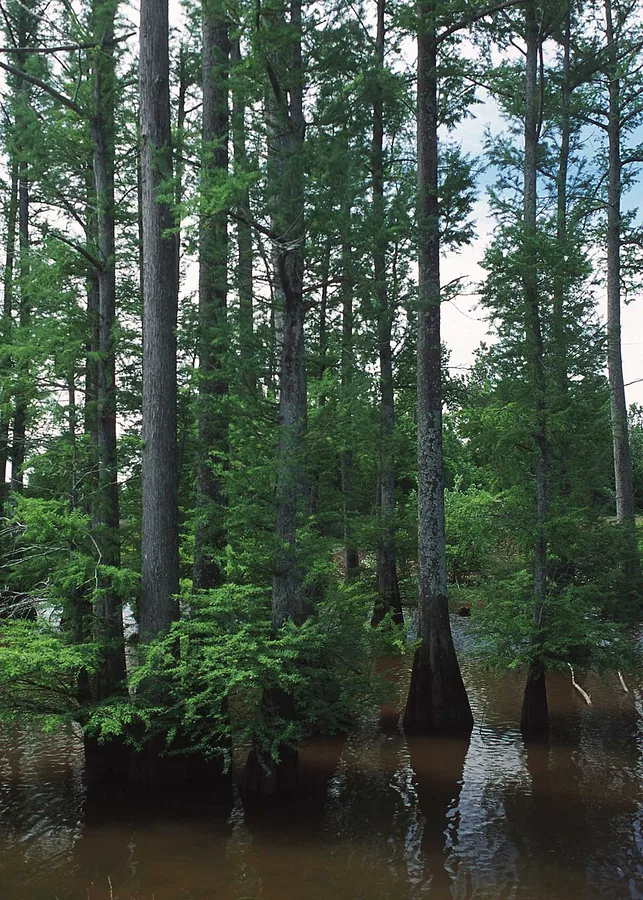
Looking for a big tree that won't run your life? Bald cypress is a great call. It's a tall, deciduous conifer from the swamps and river bottoms of the southeastern United States, and it's turned out to be one of the toughest trees you can plant. Here's the fun part: it drops every needle each winter, and that's where the bald in its name comes from. Once it's settled in, it barely asks for anything.
Don't let the swamp thing fool you, though. Sure, it'll happily sit in flooded ground for weeks, but once it's established it also takes drought, heavy clay, packed-down dirt, and rough city conditions in stride. That's why you'll spot it growing wild in a bayou and lining a downtown sidewalk, totally at home in both.
And it really earns its spot through the year. Soft, feathery green needles carry it through spring and summer, then they turn a warm russet to copper-orange before they let go, leaving a neat pyramid shape for winter. When it's growing in or near water, the roots push up little woody knees, and that's what gives it that unmistakable swamp-edge look.
Care
The short version: give it full sun and acidic, ideally moist soil, and keep it watered until it roots in. After that you're set, because bald cypress is hardy from zone 4 to 11, drought tolerant, and just about maintenance free.
Light
Bald cypress wants full sun for the best shape and growth, but it'll take partial shade without much fuss. The more sun it gets, though, the denser and more even the canopy fills in.
Water
When it comes to moisture, this tree is about as easygoing as they get. It thrives in wet, swampy, even flooded ground, yet it also grows just fine in ordinary or dry city soil once it's rooted. Water young trees regularly until they establish, and after that they handle drought on their own. One thing to watch: in a hot, dry summer with no watering, mites can brown the needles early.
Soil
It likes moist, acidic, sandy to loamy soil somewhere in the pH 4.5 to 6.5 range, but honestly it'll put up with clay, compaction, and poor drainage too. Just don't plant it on strongly alkaline ground, because once the pH climbs past about 7.5 the foliage yellows with iron chlorosis.
Temperature
This one's a real cold-hardy tree. It takes winter lows near -29°F (-34°C) and summer heat up to 104°F (40°C) without missing a beat, which covers USDA zones 4 through 11.
Humidity
Outdoor humidity? Not something you need to think about with an established tree. What matters way more is good airflow and enough water, since dry, stagnant heat is what brings the mites around.
Feeding
An established bald cypress barely ever needs feeding. But if growth looks weak, a balanced slow-release tree fertilizer in spring helps, and on alkaline soil a bit of chelated iron or some acidification will sort out the chlorosis.
Pruning
You're looking at very little pruning here. The tree builds its own strong central leader, so all you really do is take off dead, damaged, or crossing branches in late winter while it's dormant.
Repotting
Bald cypress is rarely a container plant, so repotting hardly ever comes up. Still, keep an eye out for roots circling or sneaking out the drainage holes, stunted new growth, or water running straight through the pot, since those all mean it's outgrown its space.
Size & spacing
Heads up, this is a big tree, hitting 50 to 70 feet (15 to 21 m) tall and 20 to 30 feet (6 to 9 m) wide. Give it plenty of room away from buildings and pavement, because that size and those spreading, knee-forming roots really need the space.
When to plant
No need to stress about timing here. Just pop it in the ground in spring or fall while the weather's mild, water it through its first couple of seasons, and let the fall show happen on its own as the needles turn copper and drop.
Northern hemisphere
Southern hemisphere
Typical months for a temperate climate: start earlier in warm zones, later where spring frosts linger.
- Plant: Spring or fall
- Harvest: Non-showy; sheds russet to copper-orange foliage in autumn, then bare ('bald') in winter
Hardiness
USDA hardiness zones: 4–11
Temperature: down to -34°C
Troubleshooting
Good news: a healthy bald cypress hardly ever causes drama, and most of what does come up is just cosmetic. The needles tell you what's going on, so yellowing usually means it's a soil thing, and browning usually means pests. Match what you're seeing below before you grab any treatment.
Pale yellow needles with green veins on new growth
If the new needles go pale yellow but the veins stay green, that's iron chlorosis, and it pops up when the soil's too alkaline for the tree to pull iron out of the ground. Usually it's a pH above 7.5, or tight, compacted soil, behind it. Acidify the ground with elemental sulfur over time, hit it with chelated iron when you want a quicker fix, and mulch to build up the organic matter.
Fix:
- Acidify soil with elemental sulfur over time
- Apply chelated iron as a foliar spray or soil drench
- Mulch and improve soil organic matter
Knobby green-to-brown galls on the twigs
Those weird little swellings? That's the cypress twig gall midge, whose larvae feed inside the foliage. Slice one open and you'll find small orange grubs in there. The galls drop in fall and overwinter on the ground, so rake them up and toss them, and don't sweat a light case, since a little does no real harm and predatory insects keep most of it in check.
Fix:
- Rake and destroy fallen galls in autumn to reduce overwintering larvae
- Tolerate light infestations; predatory insects provide natural control
Needles browning and dropping early in summer
When the needles brown, look stippled, and start dropping before fall, hot, dry weather has usually brought on twospotted spider mites. Want to be sure? Tap a branch over white paper and watch for tiny crawlers. Bagworms cause the same early drop in patches, so look for spindle-shaped silk bags hanging from the twigs and just pick them off, and remember steady water through a drought is your best defense against both.
Fix:
- Irrigate during droughts to reduce mite stress
- Hand-pick and destroy bagworm bags in late winter
- Use insecticidal soap or horticultural oil for heavy mite pressure
Toxicity
Got pets or little kids? You can breathe easy, because bald cypress is not toxic. It's not on the ASPCA or NC State Extension toxic-plant lists, and neither the soft needles nor the woody cones are known to poison animals or people. So if something takes a curious nibble, it's really no big deal.
Safe for
People · Cats · Dogs · Horses · Rabbits · Livestock · Birds
Cats None
Bald cypress isn't on any toxic-plant list for cats, so a curious nibble of the soft foliage won't poison one. Eat a whole lot of rough plant material at once and a cat's stomach might get a little upset, but there's nothing dangerous about the tree itself.
Dogs Safe
No part of the tree is known to harm dogs. The ASPCA doesn't flag it, so a dog that chews a fallen twig or some needles has nothing to worry about.
Horses Safe
Horses can browse near a bald cypress without any concern at all. The needles and woody cones just don't carry toxins that affect them.
Rabbits Safe
A rabbit grazing under the tree isn't at any poison risk. The fine foliage is harmless, though rabbits still do best on their usual grasses and greens.
Livestock Safe
Cattle, goats, and sheep can share a pasture with bald cypress no problem, since none of its parts are toxic to grazing animals.
Birds Safe
Birds nest and perch in bald cypress without any trouble. The seeds in the small cones are actually a food source for some, definitely not a hazard.
People Safe
The tree's no poisoning risk to people, and kids who handle the needles or cones are perfectly fine. None of it is meant for eating, but a little contact or the odd accidental taste won't do any harm.
No special handling precautions for toxicity; foliage and woody cones are not known to be poisonous to pets or people.
Varieties
The plain species gets pretty huge, so most folks go with a selection that fits the spot they've got in mind. These are the ones you're most likely to run into.
'Shawnee Brave' ('Mickelson')
Working with a tight spot? This narrow, almost columnar selection climbs 50 to 75 feet tall but stays at just 15 to 20 feet wide.
'Peve Minaret'
This one's a true dwarf with fine, fern-like foliage, and it takes ten years to reach about 6 feet tall and only 2 to 3 feet wide.
'Cascade Falls'
A weeping form grafted onto a standard, with branches that pour straight down into a mound roughly 8 to 12 feet tall and 5 to 8 feet wide.
Pond Cypress (Taxodium ascendens / T. distichum var. imbricarium)
A close swamp cousin with awl-like needles pressed against upward-reaching branchlets, a narrower shape, and the toughness to handle poorer, sandier wet ground.
How to propagate
Here's the deal: bald cypress sprouts easily from seed but fights you on cuttings, which is exactly why the named forms show up at the nursery a different way. Here's how each method really plays out.
SeedModerate
Sow stratified seed in spring · 1-2 growing seasons to a transplantable seedling
The cones ripen in fall, and the seed inside needs a cold, moist chill before it'll sprout, so collect it and stratify it over winter, then sow in spring. Keep the bed steadily moist, since that's what bald cypress seed wants most, and give it one to two growing seasons to grow into a seedling worth transplanting.
Stem cuttingsDemanding
Softwood cuttings in early summer · Several months to root, often low success
Want to give cuttings a shot? Take softwood cuttings in early summer, but go in expecting poor results. They can take several months to root and most just fail, which is why the named weeping and dwarf forms get grafted instead of struck from cuttings.
GraftingDemanding
Late winter onto seedling rootstock · 1 season to a viable grafted plant
Grafting in late winter onto a seedling rootstock is the standard way to reproduce cultivars like 'Cascade Falls' and the other weeping forms, and it gives you a viable grafted plant within a single season.
Myths
Bald cypress is just a dawn redwood and has to be planted in water to survive.
Nope, they're two totally different trees. Bald cypress carries its needles alternately in two ranks and can throw up woody knees, while dawn redwood sets its needles in opposite pairs and never does. And here's the thing: bald cypress doesn't need standing water at all. It grows just as well in ordinary moist or even dry upland and city soils, and the knees only really show up when it's standing in or beside water.