Tree · Cupressaceae
Juniper
Juniperus chinensis
Give it full sun and sharp drainage, and juniper pretty much takes care of itself for the rest of its long life.
Full sun
Every 7–14 days
USDA 3–9
1–59 ft · 0.3–18 m
Overview
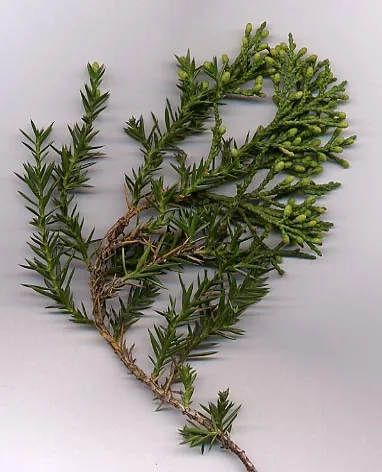
Looking for an evergreen that just won't quit? Juniper is about as tough as they come. It's in the cypress family and grows all over the northern hemisphere, brushing off cold, heat, drought, salt, and lousy ground that would finish off most shrubs. And the forms are all over the map, from flat groundcovers a foot high to upright trees reaching up to 59 feet (18 m), but they all wear that same aromatic, scale-like or needle-like foliage.
The best thing about juniper is how little it wants from you once it's settled. Give it sun and soil that drains, and it'll hold its color all winter, hold a slope in place, screen off a fence line, or just stand there looking sculptural on its own. On female plants, the berry-like blue cones take about two years to ripen, and they pull birds in through the cold months.
There's one thing you'll want to know before you dig in, though. Juniper grows slowly and won't resprout from bare old wood, so the shape you give it early on is basically the shape you're keeping. That's why it's smart to prune a little and often, rather than putting off one big cut for later.
Care
The short version: full sun and fast-draining soil are pretty much the whole deal. Water it through the first year to settle the roots, then mostly leave it be, feed it hardly ever, and only ever cut into green growth.
Light
Juniper wants full sun, ideally 6 or more hours a day, though it'll put up with a little partial sun. Push it into real shade, though, and the growth thins out, the color goes flat, and disease starts creeping in.
Water
Water a new juniper regularly through its first year so the roots can settle in. After that it's really drought tolerant and only needs a hand in a long dry spell, because the one thing it just won't forgive is soggy soil.
Soil
Sharp drainage matters way more here than rich ground does. Juniper handles sandy, rocky, even clay soil just fine as long as water moves through, and it's happy across a wide pH of 5.0 to 8.0.
Temperature
Not many shrubs are this tough. Juniper takes just about everything from -29°F to 100°F (-34°C to 38°C), holding onto its foliage through brutal winters and shrugging off summer heat like it's nothing.
Humidity
Outdoor humidity is whatever it is, and juniper couldn't care less. Air movement matters way more than any humidity number, because still, damp air around crowded foliage is exactly what the tip blights are waiting for.
Feeding
Here's an easy one: juniper barely needs feeding at all. If the growth looks off, a single light dose of balanced or slow-release fertilizer in spring is plenty, and going heavier just does more harm than good.
Pruning
Shape it lightly in late spring and only cut into green growth, because bare old wood won't push new shoots and you'll be left with a gap that stays. And pull off any dead, diseased, or blight-killed tips while the weather's dry.
Repotting
Container and bonsai junipers like fresh room every 2 to 3 years. Repot when you spot roots circling the pot, water running straight through, or growth slowing down with yellowing foliage.
Size & spacing
The forms range like crazy, spanning 1 to 59 feet (0.3 to 18 m) in height, with spreads of 2 to 20 feet (60 cm to 6 m). Match the cultivar to your space and leave each plant enough room for air to move through the canopy.
When to plant
You plant juniper rather than sow it, and the sweet spots are spring and fall, when the soil's easy to work and the weather's mild. Get plants in the ground then so the roots can settle before summer heat or winter cold shows up, and keep them watered through that first season while they're taking hold.
Northern hemisphere
Southern hemisphere
Typical months for a temperate climate: start earlier in warm zones, later where spring frosts linger.
- Plant: spring or fall
- Harvest: inconspicuous; blue berry-like female cones mature over about two years
Hardiness
USDA hardiness zones: 3–9
Temperature: down to -40°C
Troubleshooting
Put a juniper somewhere it likes and it'll stay trouble-free for years, so when something does go wrong, it usually comes back to wet soil or crowded, damp growth. Keep an eye on the new tips, the inner foliage, and the branches, and match up what you're seeing below before you grab a spray.
Whole plant thinning out and slowly fading
When a juniper's stuck in wet ground, Phytophthora root rot moves in and the foliage thins, dulls, and fades from the top down. The roots go dark and rotten, and once that's happened there's really no easy fix. So sort out the drainage, ease off the watering, and pull anything that's too far gone rather than nursing it along.
Fix:
- Improve drainage and stop overwatering
- Plant in raised beds and amend heavy clay with porous material such as ground pine bark
- Remove severely affected plants, as root rot is difficult to reverse
New tips fading out and dying back
This one's usually a pair of fungal tip blights. Phomopsis tip blight goes for soft new growth when it's warm and wet, and Kabatina tip blight takes year-old twigs in spring wherever there's a little wound to slip through. Wait for a dry day, prune well below the dead bits, wipe the shears between cuts so you're not carrying it around, and open the plant up so air can get through.
Fix:
- Prune out and destroy blighted tips well below the dead tissue during dry weather, disinfecting tools between cuts
- Improve air circulation by spacing and selective thinning
- Avoid overhead watering and wetting foliage
- Apply a labeled fungicide (mancozeb, thiophanate-methyl, or copper) protectively on new growth where blight is recurring
Needles going speckly and yellow, with a bit of webbing
Two little sap-suckers give you this look. Spruce spider mites speckle the needles and leave fine webbing when spring and fall turn cool, and juniper scale just sits there as tiny bumps, slowly yellowing everything. Want to know which one it is? Hold white paper under a branch and tap: if you see moving specks, it's mites, so hit them with a hard jet of water or insecticidal soap, and save the dormant oil spray in late winter for the scale.
Fix:
- Dislodge mites with a strong spray of water
- Apply insecticidal soap or a labeled miticide for heavy mite infestations and preserve natural predators
- Apply 2-3 percent horticultural oil as a dormant spray in late winter for scale, or treat crawlers with a labeled insecticide
Little spindle-shaped bags dangling off the branches
Those funny carrot-shaped bags? That's bagworms, caterpillars that eat while tucked inside a case they've stitched together out of bits of the plant. Let them go and a big batch can strip branches or take out the whole thing. So pick the bags off through fall and winter to get rid of the overwintering eggs, then give it a Bt spray in spring while the larvae are still tiny.
Fix:
- Handpick and destroy bags in fall and winter to remove overwintering eggs
- Apply Bacillus thuringiensis (Bt) in spring while larvae are young and small
- Use a labeled insecticide for heavy infestations of older larvae
Woody galls sprouting orange jelly horns in spring
Those weird galls are cedar-apple rust and a few close relatives, fungi that bounce back and forth between junipers and apple-family plants like crabapple and hawthorn. Here's the reassuring part: they barely bother the juniper, so you're really acting to protect the fruit trees nearby. Cut the woody galls off before they push out those orange horns, and try to keep junipers well away from apples and crabapples.
Fix:
- Prune out and remove woody galls before they produce orange horns in spring
- Plant rust-resistant juniper cultivars
- Do not plant junipers within a few hundred yards of apples, crabapples, or hawthorns
- Apply a labeled fungicide (mancozeb or propiconazole) where control is needed, though galls do little harm to the juniper itself
Toxicity
Juniper is an easy plant to have around animals and people. It's got none of the toxins on the standard poison lists, and its sharp, bitter foliage usually keeps pets and livestock from eating much anyway. The one thing worth remembering? The berry-like cones can mildly upset a stomach in quantity, and only a few species are the true culinary juniper that flavors gin.
Safe for
People · Cats · Dogs · Horses · Rabbits · Livestock · Birds
Cats Caution
Juniper isn't poisonous to cats, and honestly that sharp, aromatic foliage keeps most of them at arm's length anyway. If a curious one does chew through a bunch of the berry-like cones, the worst you'll probably see is a quick, mild tummy upset that clears on its own.
Dogs Caution
A dog can poke around a juniper without any real trouble, since there's nothing toxic listed for it. And if one grabs a mouthful of cones or oily foliage? Expect a bit of drooling or a loose stool for a day, and not much else.
Horses Caution
That strong terpene smell makes juniper taste pretty awful, so horses tend to just walk on by. One that grazes a big helping of berries might get a little gut irritation, but it's not something you'd call a poisoning risk.
Rabbits Caution
Rabbits rarely go for the resinous needles, and there's no toxin in juniper that puts them in danger. Just keep any nibbling on the light side, because the volatile oils can loosen the gut if a lot goes down.
Livestock Safe
Cattle, goats, and sheep mostly skip juniper thanks to that bitter, aromatic foliage, and it's not on the usual lists of plants that poison them either.
Birds Safe
Birds tuck right into the ripe blue cones and carry the seed off as they go, so the fruit's nothing but a good meal for them.
People Edible with care
You know the berries that flavor gin? Those come from just a few species, mainly Juniperus communis, so don't assume every landscape juniper is fair game, because some cones can upset your stomach. Stick to the known culinary species for the kitchen, and wear gloves for that prickly, oily foliage.
The aromatic foliage and berry-like cones may cause mild, self-limiting stomach upset if eaten in quantity, and the prickly juvenile needles plus juniper oils can mildly irritate skin, so wear gloves when pruning. This is irritation, not poisoning.
Varieties
Junipers come in more shapes than just about any other evergreen, from creeping mats to pencil-thin columns, so there's usually one that fits. These are the ones you're most likely to run into at the nursery.
'Hetzii'
It's a big, wide-spreading blue-green shrub that's right at home in large foundation plantings and screens.
'Sea Green'
It's a compact, fountain-shaped shrub whose arching branches and mint-green foliage make it a really easy low hedge.
'Spartan'
It's a slim, dense, dark green column that gets to about 15 to 20 feet tall but stays only around 5 feet wide, which makes it the classic upright screen.
'Hollywood' / 'Kaizuka'
It's a twisty, irregular upright with rich green foliage that folks like to grow as a living sculpture.
Juniperus scopulorum 'Skyrocket'
It's a pencil-thin blue-gray column, narrow enough to squeeze into the tightest spot as a vertical accent.
Juniperus squamata 'Blue Star'
It's a little mounding dwarf of 1 to 3 feet, stuffed with dense silvery blue-gray needles.
How to propagate
How you go about making more junipers depends on what you're after, since the named cultivars won't come true from seed and have to be cloned another way.
Stem cuttingsModerate
Late fall through winter from semi-hardwood to hardwood growth · Several weeks to a few months to root
Most cultivars come from cuttings, which is how they stay true to the parent. Just take semi-hardwood to hardwood pieces from late fall through winter, dip the ends in rooting hormone, and pop them into well-drained media, where they'll root over several weeks to a few months.
GraftingDemanding
Winter under glass · Weeks to months
Grafting's the go-to for upright tree forms and the fancy cultivars that won't root from cuttings. It's done in winter under glass and takes weeks to months to knit together, which is exactly why it stays with the skilled growers.
LayeringEasy
Spring · Several months to a year
Layering is easily the simplest way to go with the low, spreading kinds. Pin a trailing branch down to the soil in spring and it'll root right where it sits over several months to a year, which suits groundcover and shrub forms nicely.
SeedDemanding
After cleaning and cold stratification · Slow and erratic, often more than a year to germinate
Seed's mostly for raising the species rather than named cultivars, since those won't come true from it anyway. Clean the cones, give the seed a cold stratification, and then settle in to wait, because germination is slow and hit-or-miss and often takes more than a year.
Myths
The berries on any landscape juniper are fine to pick and eat, just like the ones that flavor gin.
Only a handful of species, mainly Juniperus communis, are actually grown as a culinary spice. Plenty of ornamental junipers carry berry-like cones that taste awful and can leave you with a mild stomach upset, so don't assume the berries on a landscape juniper are edible.
You can bring an overgrown juniper back by cutting it hard into the old bare wood.
Junipers just won't sprout again from old leafless wood, so a hard cut into bare branches leaves a dead hole that's there for good. Always prune into green, foliage-bearing growth and take the plant back a little at a time instead.