Tree · Cupressaceae
Italian Cypress
Cupressus sempervirens
Get it in the ground once in full sun and dry, well-drained soil, and this slim green column will keep its shape for decades.
Full sun
Every 7–14 days
USDA 7–10
39–69 ft · 12–21 m
Overview
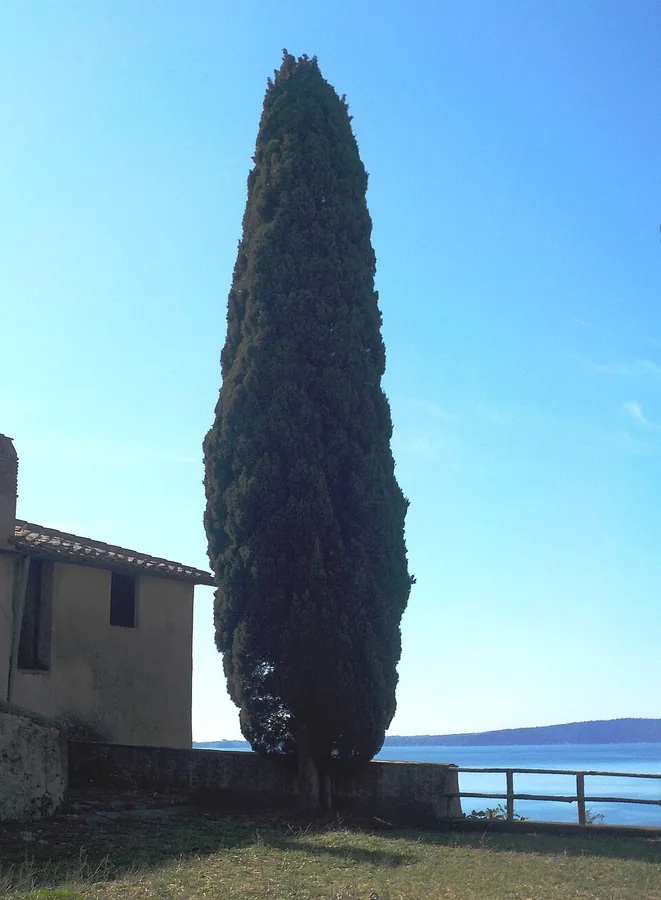
You know those tall, skinny green spires lining the driveways and framing the villas all over Tuscany? That's Italian cypress. It's an evergreen conifer that shoots straight up into a tight column instead of spreading out, and that's exactly why landscapers keep reaching for it. Given enough time, a grown tree climbs to 40 feet and beyond while staying just a few feet wide.
The best part is how little it asks of you. Once a young one has rooted in, it shrugs off drought, poor rocky ground, and alkaline soil, and it takes real cold right down to 0°F (-18°C). The one thing it just won't put up with? Wet feet, since soggy soil rots the roots and cancels out everything else you've done right.
It's a slow, long-lived tree, so a little patience goes a long way. Give it sun, sharp drainage, and room to shoot up, and it'll hold that sword-like shape for generations, no shearing needed.
Care
The short version: full sun, lean and sharply drained soil, and a good deep drink while it's young, then pretty much nothing once it's settled in. Skip the pruning, and just keep its feet out of standing water.
Light
Give Italian cypress full sun, all day if you can swing it. It's got no real patience for shade, and a tree that's short on light grows thin, starts to lean, and loses that dense column that made you want it in the first place.
Water
Water young trees regularly to get them rooted, and let the top half of the soil dry out between drinks. Once it's settled, the tree is very drought tolerant and barely needs a thing. What it can't handle is wet, poorly drained soil, which leads straight to root rot.
Soil
It's happiest in well-drained sandy loam, but it takes poor, rocky, sandy, and alkaline ground in stride too. Any pH from 6.0 to 7.8 works just fine. And honestly? Sharp drainage matters way more here than how rich the soil is.
Temperature
This is a seriously tough tree across a wide range, holding up from about 0°F to 104°F (-18°C to 40°C). It handles Mediterranean heat no problem and takes real winter cold, which is why it does so well through hardiness zones 7 to 10.
Humidity
Italian cypress likes low humidity and the dry air it's used to back in the Mediterranean. Damp, muggy climates aren't its thing, since moisture that sits on the foliage bumps up the odds of disease.
Feeding
You'll rarely need to feed it. Only if the growth looks weak should you give it a balanced slow-release fertilizer in spring, and even then, a light hand does the trick. A well-placed tree finds what it needs in lean soil.
Pruning
The move here is to just leave it be. The tree holds its natural columnar habit on its own, so don't shear it to keep the shape. Take out only the dead or diseased branches, cutting well below any canker with disinfected tools.
Repotting
Italian cypress is a landscape tree that's rarely repotted, so plant it in its forever spot and let it stay put. This slow grower really doesn't like being disturbed once its roots have dug in.
Size & spacing
Figure on a grown tree hitting somewhere around 40 to 70 feet (12 to 21 m) tall while staying narrow, anywhere from 3 to 20 feet (91 cm to 6 m) across depending on the form. Plan for that height, and give the crown a bit of room and some air.
When to plant
Italian cypress goes in best while its roots are already active. Plant it in spring or fall, with April and September being the easiest times to transplant, and water it deep through that first stretch so it can anchor before the dry season or the cold shows up.
Northern hemisphere
Southern hemisphere
Typical months for a temperate climate: start earlier in warm zones, later where spring frosts linger.
- Plant: Spring or fall (April and September are best for transplanting when roots are actively growing)
- Harvest: Non-flowering; produces round woody cones to 1.5 in across
Hardiness
USDA hardiness zones: 7–10
Temperature: down to -18°C
Troubleshooting
A healthy Italian cypress hardly ever gives you trouble, and it's usually stress that opens the door to the issues it does get. So keep an eye out for browning branches, thinning foliage, or anything odd dangling from the twigs, and step in early. Nearly everything below comes back to either too much water at the roots or too little getting to the canopy.
Brown flagging branches with oozing cankers on the stems
See dead branches sticking out like flags against all that green? That's usually cypress canker, typically Seiridium, and it goes after trees that are already stressed from drought. Check where the dead wood meets the stem and you'll find sunken cankers weeping resin. There's no spray that helps, so your best move is to prune well below each canker into clean wood, wipe your tools between cuts, and keep the tree watered so it's strong enough to push back.
Fix:
- Prune out diseased branches 3-4 in below the canker into healthy wood
- Disinfect pruning tools between cuts with a 10 percent bleach solution
- Destroy or discard all pruned material
- Reduce drought stress with regular deep irrigation to help trees recover
A tree that stalls and yellows in soggy ground
When a cypress in wet, packed soil starts thinning up top and fading to yellow or purple, you're most likely looking at Phytophthora root rot chewing through the roots and base. Dig down a bit and the roots will look dark and rotten. So get the drainage sorted and quit the overwatering right away, take out any tree that's too far gone, and don't pop a new cypress into that same tainted ground.
Fix:
- Improve drainage and stop overwatering
- Remove and destroy severely affected plants
- Do not replant cypress in contaminated soil
Foliage turning dull, speckled, and bronze
If the foliage looks stippled and bronzed, the odds are it's spider mites, and they really get going in cool, dusty, drought-stressed weather. Want to be sure? Hold some white paper under a branch, give it a tap, and watch for tiny specks moving around, usually with a bit of fine webbing. Knock them off with a strong blast of water, and go easy on the broad sprays, since those wipe out the lady beetles and predatory mites that keep the mites down for you.
Fix:
- Spray foliage with a strong jet of water to dislodge mites
- Preserve natural predators such as lady beetles and predatory mites by minimizing insecticide use
Small spindle-shaped bags dangling from chewed branches
Those 1 to 2 inch cone-shaped bags hanging off the twigs, all covered in scraps of the tree's own foliage, are bagworms, and there's a caterpillar in each one munching the branches bare. The easiest fix is to just pick the bags off and destroy them through winter and early spring, before the eggs get a chance to hatch. Miss a few? A spray of Bt in May, while the larvae are still little, sorts them out.
Fix:
- Handpick and destroy bags in winter and early spring
- Apply Bacillus thuringiensis (Bt) in May when larvae are small
Toxicity
Good news if you've got pets: Italian cypress is not toxic. ASPCA doesn't put it on the list of plants that poison cats or dogs, and it's safe around horses, livestock, and people too. A pet that chews a mouthful of the aromatic foliage might get a quick, mild stomach upset, but there's nothing dangerous in this tree at all.
Safe for
People · Cats · Dogs · Horses · Rabbits · Livestock · Birds
Cats None
Good news for cat people: it's safe for cats, and ASPCA doesn't call it toxic. If a curious cat chews the aromatic foliage, the most you'd see is some drool or a slightly upset tummy from all that greenery, and that's about it.
Dogs None
Your dog can hang out by this tree without worry. Even a real chewer is only looking at a quick bout of mild stomach upset, so there's honestly nothing to stress about.
Horses Safe
It's not toxic to horses either. Most of them steer clear of the resinous, strong-smelling foliage anyway, and a quick taste won't do a thing to them.
Rabbits Safe
Rabbits are in no danger around Italian cypress. That aromatic foliage tends to turn them off long before they'd ever eat enough to cause a problem.
Livestock Safe
Cattle, goats, and sheep can graze right next to it safely. The strong oils make the foliage taste off, and there's nothing in it that's known to poison farm animals.
Birds Safe
Birds can nest and perch in the branches with no risk at all. The little woody cones and the scale-like foliage just aren't a toxic problem for them.
People Safe
And for people, it's not poisonous either. It's not something you'd eat, so there's nothing here for the dinner table, but touching it or brushing past it in the yard is totally fine.
Foliage is aromatic when crushed; minor gastrointestinal upset is possible if large amounts are chewed.
Varieties
Most of the Italian cypress you'll see for sale is one of a handful of named forms, each picked for its shape, size, or foliage color. Here are the ones worth knowing about.
Glauca (Blue Italian)
It's a slim blue-green column of scale-like foliage that gets up to 40 to 60 feet tall but stays just 5 to 10 feet wide.
Stricta
This is the classic pencil-shaped Italian cypress, so narrow and tightly upright that it keeps its line without any help from you.
Swane's Golden
It's a trim columnar type that folks love for its golden-yellow foliage instead of the usual deep green.
Tiny Tower (Monshel)
It's a small, slow-growing dwarf that brings the columnar look to little gardens and tight spots.
How to propagate
You can grow Italian cypress from seed or from cuttings, but they don't give you the same thing. Seed is a bit of a gamble on shape, while cuttings copy the parent tree exactly.
SeedModerate
Sow in spring; seed of columnar forms may not come true to shape · 1-2 years
You can sow seed in spring, just be ready to wait a year or two for the young tree to settle in. Here's the catch, though: seedlings come out all sorts of shapes, so a packet won't reliably give you that narrow pencil form. That's exactly why the named cultivars get grown from cuttings instead.
Stem cuttingsModerate
Take semi-hardwood cuttings in summer to early fall · 1-2 years
Cuttings are how you keep a named cultivar true to that tight column, since the new plant copies the parent. Take semi-hardwood cuttings anywhere from summer into early fall, then give it a year or two to root in and start reaching up before you expect much.
Myths
Italian cypress will poison your cats and dogs.
You can let that one go, because ASPCA doesn't list it as toxic and it's treated as safe around pets. Sure, a dog or cat that chews down a lot of foliage might get a mild stomach upset, but the tree itself is not poisonous.
Italian cypress needs a regular shearing to stay in shape.
Not really, since the tree holds its tight, narrow column all by itself, so there's nothing to shear. Cut only dead or diseased wood, because every fresh pruning wound is basically an open invitation for canker.