Houseplant · Marantaceae
Calathea Orbifolia
Goeppertia orbifolia
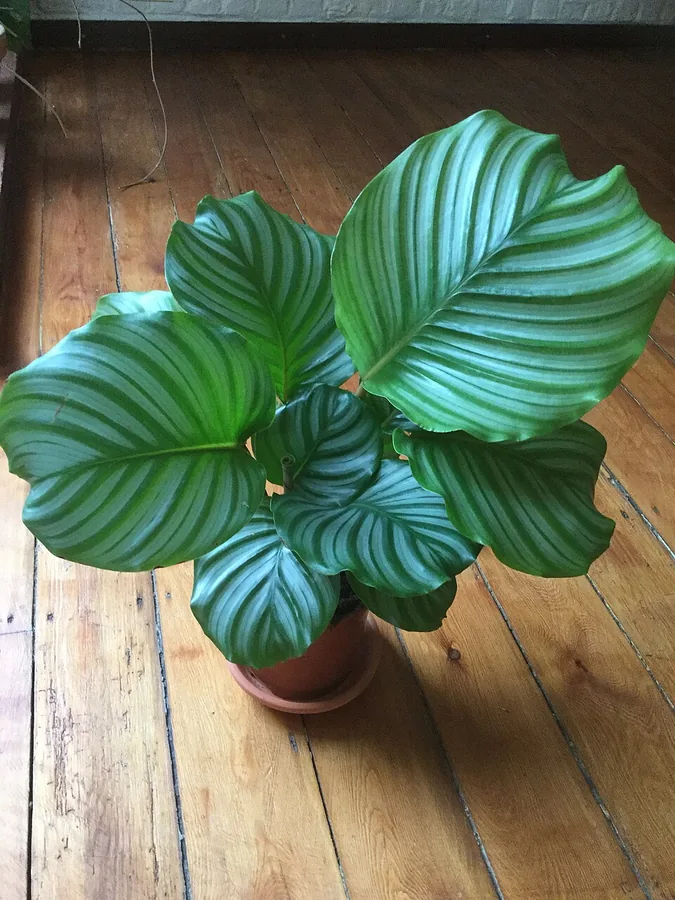
Big, round leaves with ribbon stripes that fold up at night, happy to reward you for getting the basics right.
Bright indirect
65–75°F · 18–24°C
USDA 11–12
2–3 ft · 0.6–0.9 m
Overview
So what is the draw here? It is all about the leaves. They are broad and almost perfectly round, washed in silver-green and striped like fine ribbon, and if you peek in the evening you'll catch the whole plant lifting and folding them together, which is exactly where the prayer plant nickname comes from. It grew up on the floor of an eastern Brazilian rainforest, and once you know that, most of what it wants makes sense.
It is part of the prayer plant family, the Marantaceae, and these days its official name is Goeppertia orbifolia after botanists shuffled the old Calathea genus around back in 2012. The name changed but the plant didn't, and honestly most growers and shops still just call it Calathea, so don't sweat which one you use.
Now, fair warning: this is a demanding plant. It likes clean water and damp air, and it'll pout the second either one slips. But get the light, water, and humidity dialed in and it pays you back with fast, lush growth and some of the prettiest leaves you can keep indoors. Worth the effort? For most people, absolutely.
Care
The short version: bright indirect light and no direct sun, distilled water or rainwater to keep the soil evenly moist, a warm room around 65°F to 75°F (18°C to 24°C), and humidity of at least 60%.
Light
Pop it somewhere with bright, indirect light and keep it out of direct sun, which bleaches those markings and burns the leaves. It'll cope with partial shade too, though growth slows down and the colors go a bit flat in a dark corner. A little early-morning or nicely diffused sun is about as much as it wants.
Water
Keep the soil evenly moist but never soggy, and ease off in winter when things slow down. And here's the part people miss: the water itself matters as much as how much you give. Use distilled water or rainwater, because the fluoride and salts in tap water are what burn those brown tips and edges onto the leaves.
Soil
Go with a moist but well-drained mix, something loamy or peaty that hangs onto water without turning to mud. A slightly acidic to neutral pH of 5.5 to 7.0 is the sweet spot. Basically you want soil that stays damp between waterings but still lets the extra drain away.
Temperature
Warm, steady rooms of 65°F to 75°F (18°C to 24°C) keep it happy. The one thing it really can't handle is cold drafts and sudden chills, so keep it away from doorways, vents, and icy winter windows.
Humidity
This is the big one. Aim for at least 60% humidity, which is more than most homes have on their own, so a humidifier really does the heavy lifting. A pebble tray and grouping it with other plants help too, and just remember dry air is the quickest way to get crispy tips and curled leaves.
Feeding
Through the growing season, spring into summer, feed it monthly with a balanced houseplant fertilizer at the usual strength. Then ease off over winter while it rests. It's not a hungry plant, and going overboard just leaves salt behind that scorches the leaf edges.
Pruning
Pruning is barely even a chore here. Just snip off any damaged, browned, or yellowing leaves at the base when you spot them, and that keeps things tidy while the plant puts its energy into fresh growth.
Repotting
Repot every 1 to 2 years in spring, or sooner if you notice roots circling the pot, water running straight through, or growth grinding to a halt. Just bump it up one pot size into fresh mix, since this plant doesn't like swimming in too much soil.
Size & spacing
Indoors it gets to about 2 to 3 feet (61 to 91 cm) tall and spreads 12 to 24 inches (30 to 61 cm) wide. Give it some elbow room so those big leaves can stretch out and air can move freely around them.
Troubleshooting
Here's the thing about this plant: almost every problem shows up on the leaves, and almost all of them come down to water quality, humidity, or light. So the leaves will basically tell you what's wrong if you look. Find your symptom below, then fix the actual cause instead of just trimming off the damage.
Yellowing, droopy leaves and soft roots
Soil that stays wet basically drowns the roots and brings on root rot, turning them brown and mushy instead of firm and pale. Slide the plant out, trim off every rotted root, and repot it into fresh, well-drained mix. After that, water just enough to keep it evenly moist and never let it sit soggy.
Fix:
- Remove plant and cut away rotted roots
- Repot into fresh well-drained mix
- Water only to keep evenly moist, never soggy
Faded leaf pattern and pale burn marks
When the bold pattern goes faint and pale burned spots show up on the sunniest leaves, that's just too much light, and direct afternoon sun is usually the one to blame. Move it into bright indirect light or partial shade, and the new leaves come back richly marked. Easy fix, really.
Fix:
- Move to bright indirect light or partial shade
- Avoid direct afternoon sun
Thin webbing and dotty little specks
Dry air rolls out the welcome mat for spider mites, and they like to hide on the leaf undersides where you'll spot faint webbing and a dusting of tiny moving dots. Rinse the foliage off, then treat with insecticidal soap or horticultural oil and repeat until they're gone. And keeping the humidity high? That's your best bet for keeping them away.
Fix:
- Rinse foliage
- Treat with insecticidal soap or horticultural oil
- Raise humidity
Those crunchy brown leaf tips
Nine times out of ten? It's the tap water. Fluoride, chlorine, and dissolved salts build up and scorch the leaf edges while the middle stays green. Switch over to distilled water or rainwater, get the humidity up to at least 60%, and trim those crispy edges if they're bugging you.
Fix:
- Switch to distilled water or rainwater
- Raise humidity to at least 60% with a humidifier or wet-pebble tray
- Trim damaged edges if desired
Leaves curling or rolling inward
Leaves rolling inward usually means the air's gone too dry or the soil got thirsty, and the edges often brown along with it. Bump the humidity up to at least 60% with a humidifier or pebble tray, and keep the soil consistently moist. Once the plant's comfortable again, those leaves tend to relax right back open.
Fix:
- Increase humidity to at least 60%
- Keep soil consistently moist
Brown or rusty spots dotting the leaves
Little spots that pop up after watering? That's water sitting on the foliage. Water at the soil instead of over the top, and skip the misting that leaves the leaves wet. A bit more air moving around the plant helps the surface dry off faster too.
Fix:
- Water at the soil level and avoid wetting leaves
- Improve air circulation
Toxicity
Good news if you've got pets: this is one of the safest plants you can keep around them. The ASPCA lists Calathea and the prayer plant family as non-toxic to cats, dogs, and horses, and NC State Extension says the same for Goeppertia orbifolia by name. So if a curious cat or dog grabs a bite? No poison, no panic.
Safe for
People · Cats · Dogs · Horses · Rabbits · Livestock · Birds
Cats None
Since the ASPCA lists this one as non-toxic to cats, a curious nibble is nothing to stress about. Sure, a cat that goes to town on any houseplant might bring it back up, but that's just a full stomach, not poison.
Dogs None
It's safe for dogs, and both the ASPCA and NC State Extension put it on the non-toxic list. So there's no need to fence it off or race to the vet if your dog sneaks a bite.
Horses None
Horses can graze right next to it without any worry, since the ASPCA rates the prayer plant family non-toxic to horses.
Rabbits None
There's nothing toxic here to hurt a rabbit. That said, leafy houseplants aren't really rabbit food, so let it be the odd nibble rather than a whole meal.
Livestock None
Goats, sheep, and the rest of the livestock crowd are totally fine around this plant, which has none of the toxins that make so many ornamentals risky out in the field.
Birds None
A pet bird picking at a leaf is in no danger, since there's nothing toxic in the plant, though it's smart to keep any fertilizer or leaf-shine residue off foliage a bird might reach.
People None
Handling it, or the odd accidental taste, is no poisoning risk at all for kids or adults. It's not something you'd grow to eat, but it sits firmly on the non-toxic list.
How to propagate
Want more of these? There's really only one way, and that's splitting the plant you've already got. Cuttings won't root, so division in spring is the way to go.
DivisionModerate
Spring · Several weeks to establish after potting up divisions
Division is your only option here, since this plant just won't grow from a leaf or stem cutting. Do it in spring, when you can lift the rootball out, tease it apart into clumps that each keep their own roots and leaves, and pot them up on their own. Give those divisions a few weeks of warm, humid, evenly moist conditions and they'll settle in and start growing all by themselves.
Myths
Calathea orbifolia is what botanists officially call it now.
Not these days, actually. Kew's Plants of the World Online now lists the accepted name as Goeppertia orbifolia, thanks to a 2012 reshuffle that moved a bunch of Calathea species over into the genus Goeppertia. It's the exact same plant, just with a new label slapped on it.
A common prayer plant this pretty can still make a cat or dog ill.
Nope, they're not. The ASPCA lists Calathea and the wider prayer plant family as non-toxic to dogs and cats, and NC State Extension says the same thing for Goeppertia orbifolia by name. This is honestly one of the safest plants you can have around pets.