Houseplant · Marantaceae
Prayer Plant
Maranta leuconeura
Keep it in soft water, damp soil, and humid air, and it'll fold its leaves shut like clockwork after dark.
Bright indirect
USDA 11–12
6–18 in · 15–46 cm
Overview
So where does the name come from? Watch it after sunset. All day the leaves lie flat and open, then once it's dark they lift up and fold together, and honestly they do look like two hands mid-prayer. It's part of the Marantaceae family and it grew up on the shady floor of Brazil's rainforests, which pretty much explains everything it's after indoors.
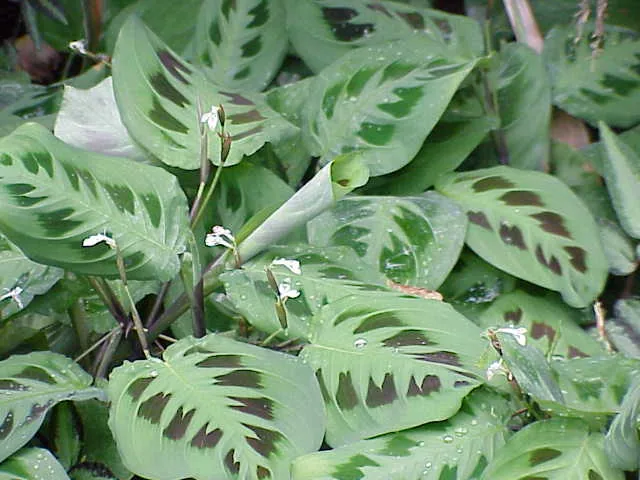
The leaves are the whole draw here. Each one's covered in bold markings, maybe red veins running in a herringbone, maybe dark little blotches like paw prints, all sitting on green. And it stays small, never more than 18 inches (46 cm) tall, so it's happy on a shelf, in a hanging pot, or right there on your desk.
People call it fussy, but that's a bit unfair, isn't it? It just has a few things it really cares about: soft water, soil that stays damp, and humid air. Give it hard tap water in a dry room, though, and the edges go brown. Sort those basics out and you've got a laid-back, pet-safe houseplant that closes its leaves up for you every night.
Care
The short version: bright light but no direct sun, rainwater or filtered water to keep the soil evenly moist, and a warm, humid spot that stays above 60°F (15.6°C).
Light
Pop it somewhere with bright, indirect light, just keep it out of direct sun, since that washes the markings out and scorches the leaves. It'll manage in medium or even low light too, but the color's at its best when the spot's bright and the harsh rays are filtered.
Water
Keep the soil evenly moist through spring and summer, then back off a bit from autumn into late winter and let it dry out slightly. What's really worth watching is the water itself, because it's touchy about fluoride, chlorine, and salts in tap water, and those burn the tips. Rainwater, distilled, or filtered water sorts that out.
Soil
Go for a moist, humusy, well-drained mix with a soil base. You want something that stays damp but doesn't turn to soup, since waterlogged roots are what kick off rot.
Temperature
Keep it warm, above 60°F (15.6°C). Cold drafts and chilly windowsills really aren't its thing, so nudge it away from doors and vents once winter sets in.
Humidity
It's after high humidity, and it'll tell you when the air's too dry by browning at the edges. So sit the pot on a tray of wet pebbles, run a humidifier, or huddle it up with other plants to keep the moisture around it.
Feeding
Feed it monthly with a balanced houseplant fertilizer through spring and summer, then ease right off from autumn to late winter. Go easy though, because too much feed burns the leaves just like hard water does.
Pruning
There's hardly any pruning to do. Just snip off any damaged, faded, or brown-tipped leaves to keep it looking neat, and that's pretty much it.
Repotting
Repot it in spring whenever the roots start crowding the pot or poking out the drainage holes. That's also the perfect moment to split it if you want more, since it comes apart easily while it's already out.
Size & spacing
It stays compact, about 6 to 18 inches (15 to 46 cm) tall and 6 to 24 inches (15 to 61 cm) wide. With that low, spreading shape, it's a natural for a hanging pot or the front of a shelf, where the leaves can spill over the edge.
Troubleshooting
Here's the thing about prayer plants: almost every problem lands in the leaves, and it's usually about water, light, or humidity, not some disease. So if you catch it early, you can normally sort out the cause before it gets worse. Find what matches below and tweak from there.
Wilting, yellow leaves and soft, mushy stems
If the soil's been soggy and the roots have gone brown and soft instead of firm and pale, that's root rot. Slip the plant out, cut off the rotted roots, and repot it into fresh, well-drained mix. From then on, only water when it actually needs it, and never let the pot sit in a puddle.
Fix:
- Remove from soggy soil and trim rotted roots
- Repot into fresh well-drained mix
- Water only when appropriate and ensure drainage
Fine webbing and tiny yellow dots on the leaves
Hot, dry air is basically an invite for spider mites, which hang out on the leaf undersides and leave behind faint webbing and little yellow specks. Give the leaves a good rinse, raise the humidity, and treat with insecticidal soap or horticultural oil. Keep it away from your other plants until they're gone.
Fix:
- Rinse foliage and raise humidity
- Treat with insecticidal soap or horticultural oil
- Isolate affected plant
Brown, crunchy tips along the leaf edges
Those crispy brown edges? That's leaf burn, and nine times out of ten it's the minerals in your tap water, not anything you got wrong. Fluoride, chlorine, and salt pile up at the edges, and heavy feeding in dry air makes it worse. So switch to rainwater, distilled, or filtered water, go easy on the fertilizer, and bump up the humidity.
Fix:
- Use rainwater, distilled or filtered/dechlorinated water
- Reduce fertilizer frequency and strength
- Raise humidity (humidified room or pot on a tray of wet pebbles)
- Trim damaged tips for appearance
Faded color and pale, bleached spots
When that lovely red and green fades and you spot pale, scorched patches, it's usually just too much direct sun. Remember, this one grew up in the shade, so strong light is a lot for it. Move it into bright indirect light and pop a sheer curtain over any harsh window, and the color should bounce back.
Fix:
- Move to bright indirect light out of direct sun
- Filter strong window light
Leaves that won't fold up at night
A happy prayer plant lifts and folds its leaves each evening like praying hands, so if they stay flat, it's usually about weak light or stress, not disease, and the color often still looks fine. Give it bright indirect light in the day and proper darkness at night, then check nothing's off with the watering, humidity, or temperature.
Fix:
- Provide adequate bright indirect light during the day and natural darkness at night
- Correct watering, humidity and temperature to reduce stress
Toxicity
Got pets? Good news, because the prayer plant is completely safe to have around. The ASPCA has it down as non-toxic to cats, dogs, and horses, with nothing poisonous in the leaves. Sure, a pet that scoffs a bunch of it might feel a bit off for a little while, but there's no real poisoning to worry about.
Safe for
People · Cats · Dogs · Horses · Rabbits · Livestock · Birds
Cats None
Cats are fine here. The ASPCA finds nothing toxic, so the worst that happens if one chews the leaves is a quick, mild bit of tummy trouble.
Dogs None
Dogs are safe too, since there's nothing poisonous in the foliage. A big mouthful might leave a dog a little queasy for a bit, but that's all.
Horses Safe
Horses get the thumbs-up from the ASPCA as well. No toxin means a curious nibble won't do them any harm.
Rabbits Safe
There's nothing toxic in it, so a rabbit's fine around the plant, though it shouldn't stand in for the hay and greens they normally eat.
Livestock Safe
Grazing animals aren't at any poisoning risk from the leaves, and being a tropical houseplant, it barely ever crosses their path anyway.
Birds Safe
Pet birds have nothing to fear from it. The leaves carry no toxins, so a little perching or pecking won't bother them.
People Safe
It's safe to keep around kids too. Nothing in it is poisonous, even though it's grown to look at rather than to eat.
Although non-toxic, ingestion of plant material can still cause mild gastrointestinal upset in pets
Varieties
There are a couple of named forms you'll run into most, and it's really the leaf markings that tell them apart. Here's the pair worth knowing.
var. erythroneura (Herringbone / red-veined prayer plant)
This is the showy one, with a bright red midrib and red veins fanning out in a herringbone across dark green leaves.
var. kerchoveana (Rabbit's-foot / rabbit tracks)
A paler green sort marked with two rows of dark blotches down each leaf, which is what gets folks calling them rabbit tracks.
How to propagate
Want more of them? Easy enough, and spring's the time to do it, whether you fancy splitting a clump or rooting a cutting.
DivisionEasy
Spring, at repotting · Several weeks
The easiest way to get more is to split the plant in spring while you're repotting it anyway. Just tease the clump into sections, making sure each bit keeps its own roots and shoots, then pot them up on their own. Give each one several weeks to settle before it starts growing again.
Stem cuttingsModerate
Spring to summer · Several weeks to root
It'll also grow from stem cuttings taken just below a node in spring or summer. Pop the cutting into moist mix and keep it warm and humid. It'll usually take several weeks to root.
Myths
Prayer plants are poisonous to cats and dogs.
Nope. The ASPCA lists the prayer plant and the wider Maranta group as non-toxic to cats, dogs, and horses, with no toxic principles at all. It's a genuinely safe pick for a home with pets, even if a big mouthful might leave one feeling a bit queasy for a while.
The leaves fold at night for religious reasons.
Not quite. The folding is just nyctinasty, a natural day and night sleep movement, nothing spiritual going on. Once it's dark, the leaves rise and close into a praying-hands shape, and yes, that's exactly where the name came from.