Bulb · Iridaceae
Montbretia
Crocosmia × crocosmiiflora
Pop the corms in once and crocosmia hands back arching sprays of fiery summer color that hummingbirds can't stay away from.
Full sun
Every 3–7 days
USDA 5–9
2–4 ft · 0.6–1.2 m
Overview
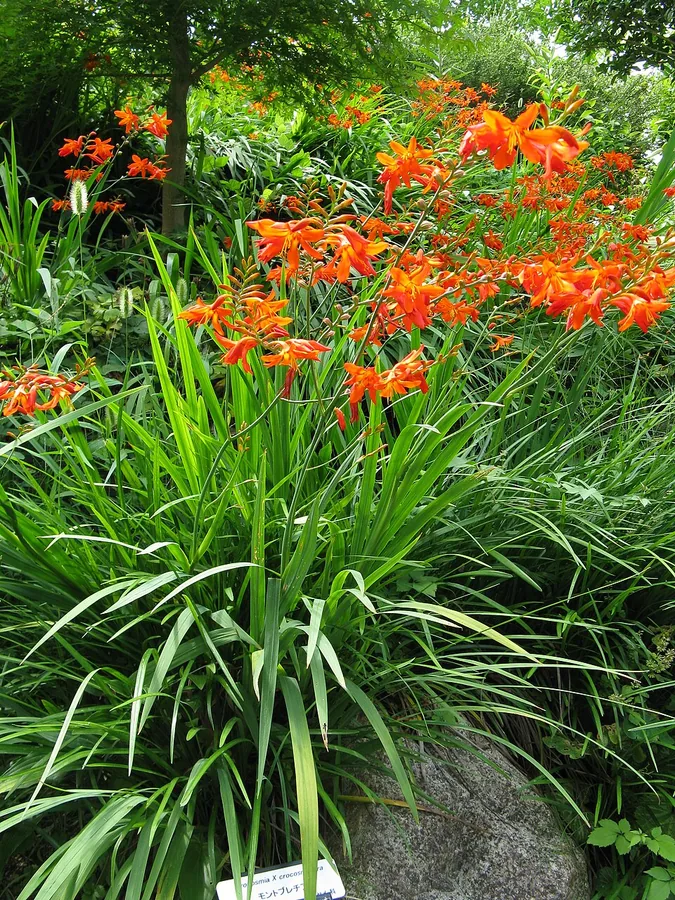
So what's crocosmia, exactly? It's a summer-flowering perennial in the iris family, often sold as montbretia, and it grows from a corm instead of a true bulb. It started out in southern Africa and won people over with its arching stems of tubular flowers in hot reds, oranges, and yellows that show up from June into August. The leaves stand upright and sword-shaped like a little iris, and the blooms run along one side of each stem.
Here's the easy part: it doesn't ask for much. Give it full sun to light shade and soil that drains, and the clump just keeps widening on its own, multiplying its corms in chains under the ground. That get-up-and-go is worth knowing about, though, because in mild spots crocosmia really spreads and has even gone wild along parts of the US Pacific coast, so every so often a clump needs a bit of reining in.
Want a plant the hummingbirds love? This is it, since the flowers are a real magnet for hummingbirds, and the whole thing is safe around pets, kids, and grazing animals too. As long as your winters land in zones 5 to 9, the corms just sit tight in the ground through the cold and bounce back stronger every year.
Care
The short version: full sun to light shade, soil that drains well but doesn't dry to dust, corms tucked a few inches down in spring, and a clump you lift and split every few years so the flowers keep coming.
Light
Crocosmia flowers best in full sun, but it'll take partial sun or light shade without complaint. The more sun it gets, the sturdier the stems stand and the heavier it blooms, so hand it an open spot if you've got one.
Water
Keep the soil evenly moist through the season, since this plant really doesn't like drying out. Here's the catch, though: it won't sit in soggy ground either, so drainage has to be good or the corms rot. Water every 3 to 7 days when it's dry, and ease up where the soil already holds moisture.
Soil
Plant it in humus-rich, well-drained soil, and don't sweat the type, because clay, loam, and sand all work as long as water moves through. It's pretty relaxed about pH too and grows happily anywhere from 6.0 to 8.0, so most garden beds suit it just fine.
Temperature
It handles a big swing, from about 28°F to 86°F (-2°C to 30°C), and heat doesn't bother it one bit. The corms can take cold damage past their hardiness range, though, which is exactly why colder zones lift them for winter.
Humidity
Plain old outdoor air is all it wants, so there's no humidity number to chase. What you do want to avoid is dry, baking conditions, since that's what stresses the foliage and brings in spider mites.
Feeding
Feed it a balanced general-purpose fertilizer at planting, then once more in spring as growth gets going, and honestly that's plenty. Crocosmia's no heavy feeder, and soil that's too rich just pushes leaves instead of the flowers you actually want.
Pruning
Once the blooms fade, cut the flower stems back to where they meet the leaves. Leave the foliage standing until it dies down on its own, because it's still feeding the corm, then cut it to the ground for the season.
Repotting
Crocosmia doesn't really do pots; it'd rather crowd itself in the bed. So divide the corm clumps every 2 to 3 years to keep them vigorous, and let congested clumps, weaker flowering, and smaller blooms be its way of telling you it's time.
Size & spacing
A clump gets to 2 to 4 feet (61 to 122 cm) tall and spreads 12 to 24 inches (30 to 61 cm) wide. Set the corms about 6 inches apart at planting and they'll knit into a full stand within a season or two.
When to plant
Crocosmia keeps things simple season to season. Plant the corms in spring once the last frost's behind you, and the flowers roll in through the middle of summer, somewhere around June to August. If your winters get cold, just plan to lift and store the corms before the hard freezes show up.
Northern hemisphere
Southern hemisphere
Typical months for a temperate climate: start earlier in warm zones, later where spring frosts linger.
- Plant: Plant corms in spring after the last frost date, 3-5 inches deep and about 6 inches apart.
- Harvest: Summer bloom, roughly June to August.
Hardiness
USDA hardiness zones: 5–9
Temperature: down to -29°C
Troubleshooting
Good news: crocosmia stays healthy without much fuss, so trouble's the exception here, not the rule. The few things that do pop up usually show on the leaves or down at the corm. Find what matches below and step in early, and you'll be fine.
Mushy corms and plants that don't come up
Corm rot shows up when the soil stays waterlogged or the cold dips below what the corms can take, and then the plants just don't emerge. Lift a few and check for soft, discolored tissue to be sure. Sort out the drainage, and in zones colder than 5 either mulch heavily for winter or dig the corms and store them dry like gladiolus.
Fix:
- Improve drainage and avoid standing water
- In cold zones, lift and store corms dry over winter or apply winter mulch
Speckled, bronzing leaves with fine webbing
See stippled, bronzed leaves wrapped in fine webbing? That's spider mites, and they move in fast when it's hot and dry. Blast the leaves with a strong jet of water to knock them off, then keep the soil moist and the plant out of dry wind. If they hang on, insecticidal soap or horticultural oil clears up the stubborn cases.
Fix:
- Spray foliage with a strong jet of water to dislodge mites
- Improve air moisture and avoid drought stress
- Apply insecticidal soap or horticultural oil as needed
Nibbled leaves and flowers that never show
When the foliage gets chewed down and the blooms just never come, it's usually rabbits. Look for clean-cut leaves near the ground and droppings nearby to be sure. A wire cage or fence around the clump is the surest fix where rabbits are a regular problem, with repellents to back it up.
Fix:
- Protect plants with fencing or wire cages
- Use repellents where appropriate
Toxicity
Got pets or little ones? Here's the relief you're after: crocosmia is not toxic. No reliable source calls any part of it poisonous, and it's actually grown as a hummingbird plant because it's safe to have around. Just wash your hands after handling the corms, the same easy habit you'd keep with any garden plant.
Safe for
People · Cats · Dogs · Horses · Rabbits · Livestock · Birds
Cats None
Nothing to stress about with cats. One that bats at the foliage or chews a leaf won't be harmed.
Dogs None
Dogs are safe around it too. A curious nibble of the leaves or flowers won't poison them, though a big mouthful of any plant can briefly upset a sensitive stomach.
Horses Safe
Horses can graze right near a clump without trouble, since crocosmia carries no toxin known to harm them.
Rabbits Safe
Rabbits actually love the foliage and come to no harm from it, so that's more your blooms' problem than the rabbit's.
Livestock Safe
Cattle, goats, or sheep that browse it face no poisoning risk, since the plant isn't listed among forage hazards.
Birds Safe
Birds are totally fine around it, and hummingbirds especially flock to the tubular flowers for nectar, which is part of why gardeners grow it.
People Safe
No toxicity's reported for people. Just wash your hands after handling the corms, the same routine you'd follow with any garden plant.
Generally considered safe to handle; wash hands after gardening as a routine precaution.
Varieties
There's just a handful of named cultivars covering most of what you'll see for sale, mostly sorted by flower color and when they bloom. These are the ones worth knowing.
Lucifer
Lucifer's an Alan Bloom hybrid that throws showy scarlet-red tubular flowers along arching stems, and it's one of the hardiest and most popular ones you'll find.
Emily McKenzie
Emily McKenzie carries large orange flowers with mahogany-red throats, and it opens a bit later in the summer than most.
Solfatare
Solfatare pairs soft apricot-yellow flowers with some pretty unusual bronze-tinted foliage.
Star of the East
Star of the East stands out for its large, soft orange blooms.
How to propagate
The fun thing is that crocosmia pretty much makes more of itself, so most folks never buy a second batch. Splitting clumps is the quick, sure way to go, while seed's a slower gamble that's really only worth it if you're patient.
DivisionEasy
Early spring before new growth begins. · One growing season; flowering typically the same or following summer.
Division's the easy, reliable way to get more crocosmia, no question. Just lift the congested corm clumps in early spring before new growth starts and split them apart, doing it every 2 to 3 years to keep the plants vigorous. The divisions settle in within a season and often flower that same or the following summer.
Bulbs & cormsEasy
Spring, after the last frost. · One growing season.
Here's a neat trick the plant does for you: each corm builds a chain of offsets you can pull apart and grow on. In spring once the frost's passed, separate the offset corms and replant them 3 to 5 inches deep and about 6 inches apart. They root and establish over a single growing season.
SeedModerate
Collect ripe seed from capsules; sow when available. · Two or more seasons to reach flowering size; some seed may not be viable.
Seed's the slower, less certain route, just so you know. Collect the ripe seed from the capsules and sow it when you've got it, but expect two or more seasons before the plants reach flowering size. Seedlings from hybrids rarely come true to the parent, and some seed just won't be viable.
Myths
Crocosmia corms are true bulbs like tulips and have to be replanted every year.
Crocosmia actually grows from corms, not true bulbs, and that changes how you handle it. In zones 5 to 9 the corms can just stay in the ground and naturalize, coming back year after year. It's only in colder zones that you need to lift and store them, the same way you'd treat gladiolus.