Bulb · Iridaceae
Garden Gladiolus
Gladiolus × hortulanus
Pop the corms in come spring and gladiolus gives you back tall spires of color from late summer to fall.
Full sun
Every 5–7 days
41–86°F · 5–30°C
60–90 days
Overview
You know those tall flower spikes florists love? That's gladiolus, a stem packed with funnel-shaped blooms that open one after another from the bottom up. It's in the iris family and grows from a corm, which is a swollen underground stem that looks like a bulb and does the same job of storing food. Those stiff, sword-shaped leaves are why people still call it sword lily, and a row of glads along a fence is a summer classic.
These are warm-season flowers you grow from corms planted in spring. Get them in once the frost's done and they'll bloom 8 to 12 weeks later, so you can plant a few every week or two and keep the color rolling instead of getting it all at once. If you're in zones 7 to 10 the corms can just stay put over winter, but anywhere colder, you lift them each fall and keep them dry until spring.
The best bit? Glads don't ask for much, mostly just full sun and steady moisture. The one thing to keep an eye on is the corm, since it rots in soggy ground and can pick up thrips if you store it without a look. Give them good drainage and a stake for the tall ones, and you'll be cutting armfuls for the vase.
Care
The short version: pop the corms into full sun and rich, well-drained soil after the last frost, keep them evenly moist at about an inch of water a week, and lift the corms for winter anywhere the ground freezes.
Light
Glads want full sun, ideally six or more hours a day, so they can push up strong spikes that hold themselves up. A bit of afternoon shade is fine, but give them too little light and the stems stretch, lean over, and set fewer flowers.
Water
Keep the soil evenly moist while they're growing and blooming, which comes out to about an inch of water a week. Steady moisture makes for full flower spikes, but here's the catch: the corm rots in waterlogged ground, so good drainage counts just as much.
Soil
Plant them in fertile, well-drained loam with plenty of organic matter mixed in, and skip heavy clay that holds water around the corm. A pH of 6.5 to 7.0, near neutral, is right where they like it.
Temperature
Glads are happy across a wide range, roughly 41°F to 86°F (5°C to 30°C), once the season warms up. They're tender to frost, though, so the corms only go in after the last cold snap and come out before the ground freezes hard.
Humidity
Regular outdoor humidity is fine, and there's no number to chase here. What matters more is air moving through the planting, because still, damp air is what invites botrytis and corm rot.
Feeding
Glads are average feeders, so a soil test and a balanced fertilizer do the job. Feed once at planting and again as the flower spikes form, which fuels both the blooms and the corm bulking up below.
Pruning
Snip off the spent flower spikes once they're done so the plant isn't wasting energy on seed. Leave the foliage standing until it yellows and dies back on its own, since those green leaves are busy recharging the corm for next year.
Repotting
In cold zones, lift the corms each fall and replant them in spring rather than leave them to freeze. Where they overwinter in the ground, dig and split the crowded clumps every few years so the flowers stay full-sized.
Size & spacing
Spikes run anywhere from 1 to 6 feet (30 to 180 cm) tall depending on the type, and the tall ones want a stake. Each plant only spreads about 12 to 24 inches (30 to 60 cm), so the corms can sit pretty close in a row or block.
When to plant
Gladiolus is all about the warm season and won't put up with frost. Get the corms in during spring once the soil's warmed, drop in a fresh batch every week or two for a longer run, and you'll see spikes from late summer into early fall.
Northern hemisphere
Southern hemisphere
Typical months for a temperate climate: start earlier in warm zones, later where spring frosts linger.
- Plant: Spring, after the last frost once soil has warmed; plant in succession 7-14 days apart for continuous bloom.
- Harvest: Late summer into early fall, about 8 to 12 weeks after planting.
Hardiness
USDA hardiness zones: 7–10
Temperature: down to -18°C
Troubleshooting
Most gladiolus trouble kicks off underground or rides in on the corm itself. Spot the early signs on the leaves and down at the base and you can step in before you lose the whole planting. Find what matches below, then act while it still does some good.
Yellow leaves and corms rotting underneath
When the plants wilt and the corms go soft and brown inside, you're probably dealing with fusarium wilt or corm rot, which move in wherever the ground stays wet. And if it's been cool and damp, botrytis or crown rot can show up at the base too. A rotted corm can't be saved, so lift and bin the bad ones, sort out the drainage, and replant only firm, healthy corms somewhere fresh.
Fix:
- Remove and destroy affected corms and plants
- Improve soil drainage
- Rotate planting location
- Plant only firm, healthy corms
Silvery streaks and buds that just stay closed
Seeing silver streaks and buds that won't open? That's usually gladiolus thrips, little insects that scrape at the leaves and hide inside the flower bracts. They tend to sneak in on the corms, so you'll often notice the damage before you ever spot a bug. Just pull the worst spikes, hang a few sticky cards to keep tabs on the numbers, and treat or toss any corms before they head into storage.
Fix:
- Remove and destroy heavily infested flower spikes
- Use yellow or blue sticky cards to monitor
- Apply an appropriate insecticide labeled for thrips if needed
- Treat or discard infested corms before storage
Toxicity
Good to know up front: gladiolus is poisonous to pets and grazing animals, and that buried corm is the most dangerous part. The leaves, flowers, and corms all hold an irritant that brings on drooling, vomiting, and lethargy if it's eaten. Keep animals out of the beds and put the corms well out of reach while you're planting and storing them.
Toxic to
Cats · Dogs · Horses · Rabbits · Livestock · Birds · People
Cats Mild
A cat that's had a chew will usually drool and be sick, then go quiet and tired for a bit. The corm's the strongest part, so a cat that digs one up is the one you'll want to watch.
Dogs Mild
Give a dog a taste and you'll often see heavy drooling, a queasy stomach, and loose stool within a few hours. It's the dog that finds a stored corm that gets it worst.
Horses Mild
A horse nibbling the leaves might drool, lose interest in food, and go dull and slow. Since the corms hold the most of the irritant, it's smart to keep them clear of beds and trenches.
Rabbits Toxic
That same irritant is rough on a rabbit's touchy gut, so expect drooling and a rabbit that won't eat. Keep the leaves, flowers, and corms somewhere it just can't get to.
Livestock Toxic
Cattle, goats, and sheep can get the runs and turn listless after grazing the foliage or turning up a corm. A fence between them and the planting, plus tidying away lifted corms, does the trick.
Birds Toxic
A bird that pecks the leaves or scratches up a corm can end up drooling, being sick, and lethargic. Easiest to just treat every part of the plant as off limits for them.
People Caution
None of the gladiolus is food, and the corm especially can leave your mouth and stomach sore if it's swallowed. Worth keeping curious kids away from corms while you're planting and storing.
Keep corms and bulbs out of reach of pets, especially during planting and storage when corms are accessible.
Helpline numbers

United States
ASPCA Animal Poison Control: (888) 426-4435 (fee applies)
Poison Control: (800) 222-1222



Canada
Poison Centres: 1-844-764-7669
Varieties
Most garden glads are hybrids you'll buy by color rather than name, but a couple of distinct species are worth knowing for their scent and their toughness.
Gladiolus murielae
Want something that smells wonderful? This is the fragrant Abyssinian or peacock gladiolus, with white blooms and a deep purple throat.
Gladiolus × byzantinus
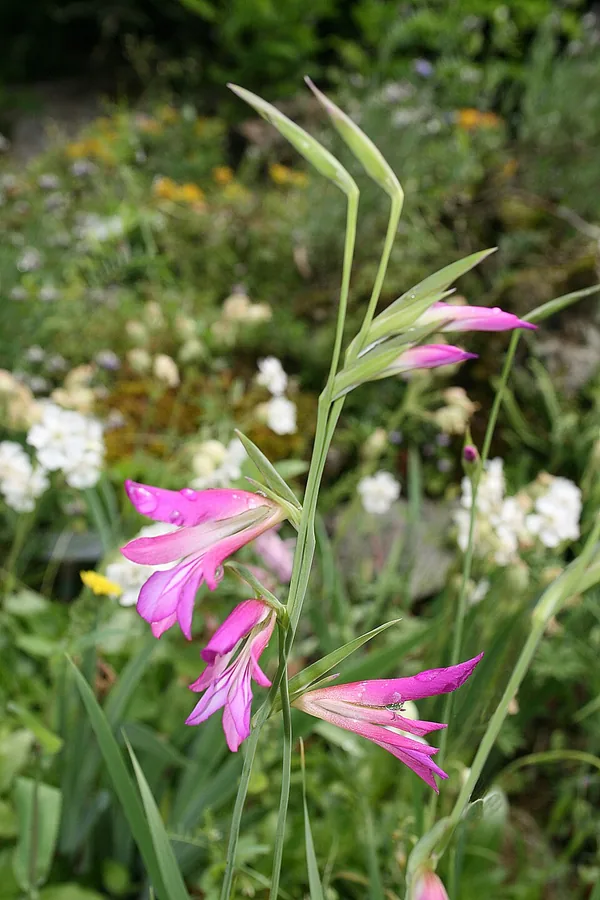
This tough Byzantine heirloom throws magenta flowers and keeps coming back on its own, right down to about USDA zone 6.
How to propagate
The nice thing about glads is they pretty much multiply themselves underground, so lifting the corms each fall just hands you free plants for next year.
Bulbs & cormsEasy
Spring at planting; lift and separate in fall · One growing season
Here's the fun part: glads basically make more of themselves. Dig the corms in fall, replant them next spring, and you'll find each parent has grown a new corm on top plus a little cluster of cormels around the base. The big ones bloom again in just one growing season.
DivisionEasy
Fall when lifting corms · One growing season
When you lift the corms, just twist the tiny cormels off the base of the parent to start new plants. The full-size corms flower next season, though the smallest cormels want a year or two of growing first before they're big enough to bloom.
SeedModerate
Spring · Two to three years
Going from seed is slow, and honestly it's mostly for breeders after new colors. Sow in spring, then settle in for two to three years while each seedling builds a corm big enough to flower.
Myths
Gladiolus flowers and leaves are safe for pets to nibble.
Easy to think so, but it's not the case. Every part of the plant carries an irritant, and the ASPCA lists it as toxic to cats, dogs, and horses. A nibble means drooling, vomiting, and a tired, off-color animal, and that buried corm is the most dangerous bit of all. Keep pets away from the foliage, and really away from the corms.