Houseplant · Euphorbiaceae
Crown of Thorns
Euphorbia milii
Hand it sun, dry roots, and a cautious touch, and crown of thorns keeps blooming nearly all year.
Full sun
Every 7–14 days
50–86°F · 10–30°C
USDA 9–11
Overview
This one lives up to its name on two counts: woody stems bristling with sharp spines and small flowers showing up almost nonstop above them. It's part of the spurge family and behaves like a succulent, tucking water away in those fat stems so it laughs off the kind of dry stretch that would do in something more tender. Most folks grow it as a houseplant on a sunny sill, where it can keep flowering off and on right through the year.
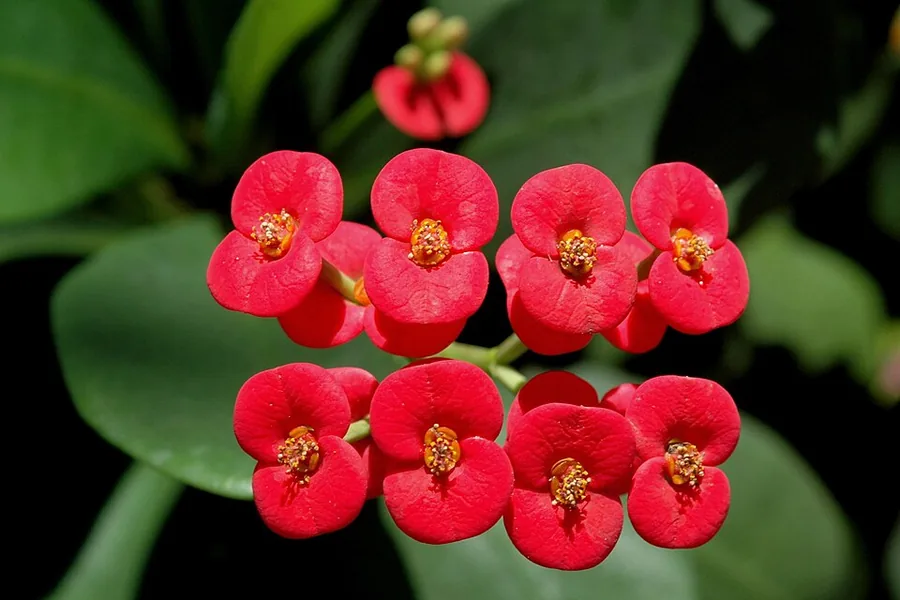
That part everyone takes for the flower? It's actually a pair of colored bracts, modified leaves in shades of red, pink, or yellow that wrap around the tiny real blooms in the middle. Kept indoors it stays a sensible size and barely asks for anything: plenty of light, a pot that drains in a flash, and a good dry gap between drinks. Because it grows slow and steady, it hardly ever crowds out the spot you put it in.
The one thing worth being careful with is the milky latex running through every stem. It stings skin and eyes and upsets the mouth and gut if anyone chews it, and then there are the spines on top. Handle it with gloves, keep it where pets and kids can't get at it, and you've got a hardy, long-lived plant that pays you back far more than it costs you.
Care
The short version: the most light you can offer, direct sun for preference, a gritty mix that drains almost instantly, and water only after the soil has gone completely dry. Give it a light feed in the warm months, and keep gloves on when you handle it.
Light
Park it in the sunniest spot you can find, ideally somewhere it catches a few hours of direct sun on a south-facing sill. It'll cope with bright indirect light, but blooming tails off quickly once the light dims, and a plant left in shade gets leggy and bare.
Water
Wait until the mix has dried right out, then give it a good soak and let it drain through. That tends to land around every 7 to 14 days, and a lot less often come winter. Wet, soggy soil is the quickest way to lose it, so always pour off whatever collects in the saucer.
Soil
Pot it in a gritty, fast-draining mix meant for cacti and succulents, the sort water pours straight through. It's perfectly content anywhere from a pH of 6.0 to 7.5, which tells you the drainage counts for a lot more than nailing the exact figure.
Temperature
Regular room warmth does the trick, somewhere between 50°F to 86°F (10°C to 30°C). Keep it above 50°F and clear of cold drafts, because cold paired with damp soil is exactly what kicks off rot.
Humidity
This is a low-humidity plant that wants no part of misting or a steamy corner. Plain dry indoor air is just what it's after, and decent airflow helps fend off rot too.
Feeding
Feed it monthly through spring and summer while it's putting on growth, with a balanced or low-nitrogen liquid feed at half strength. Skip feeding over winter, and keep a light hand year-round, since too much nitrogen drives leaves instead of flowers.
Pruning
Prune in spring to shape it and keep its size in check, and think of this as the chore that calls for the most caution. Wear gloves and eye protection, because the cut stems ooze caustic latex and carry sharp spines. Make clean cuts, keep that sap off your skin, and wash your tools and hands once you're done.
Repotting
Bump it up a pot size every 2 to 3 years, or sooner if roots are circling the bottom and water shoots straight through. Do it in spring with fresh gritty mix and gloves on, and resist jumping it into a pot way bigger than it needs.
Size & spacing
Indoors it climbs to roughly 2 to 6 feet (60 to 180 cm) tall over many years, fanning out 1 to 2 feet (30 to 60 cm) across. Thanks to that slow pace it stays neat, so a single plant is happy on a sill without elbowing anything.
Troubleshooting
Nearly every crown of thorns headache comes down to water or light. A soft, mushy stem means it got too much of one; sparse flowers usually mean it isn't getting enough of the other. Find what matches your plant below and tweak things early, before a little issue turns into rot.
Yellow leaves dropping while the base goes soft
When the lower stems turn dark and squishy, you're looking at stem and root rot, and the cause is nearly always water sitting in a mix that won't let go of it. Hold off on watering completely and let everything dry hard, then trim out the mushy parts with a clean, sterile blade. Has the rot crept up the plant? Move it into fresh gritty mix and wait until the soil feels totally dry before you water again.
Fix:
- Stop watering and let the soil dry out completely
- Remove rotted tissue with sterilized tools
- Repot into fresh gritty, fast-draining mix if rot is advanced
Lots of leafy growth, hardly any flowers
Here's the thing: this plant flowers in response to light, so one tucked away from a sunny window just isn't going to bloom much. Feeding it too much nitrogen makes things worse, since all that energy goes into foliage instead of bracts. Shift it to the sunniest place you've got, full sun if you can manage it, and swap over to a low-nitrogen feed mixed to half strength.
Fix:
- Move to the brightest spot available, ideally full sun
- Switch to a low-nitrogen fertilizer at half strength
Leaves letting go in late autumn and winter
Dropping a few leaves as daylight fades is really just natural dormancy doing its thing, nothing to panic about, provided the stems still feel firm to the touch. Cut back on water through this quiet stretch, then return to your usual routine once the brighter spring light comes back around. Keeping it warm and well lit will hold the leaf loss down.
Fix:
- Reduce watering during the rest period
- Resume normal care as light increases in spring
Toxicity
This plant deserves a careful approach. Every stem leaks a caustic milky latex that burns skin and eyes and inflames the mouth and gut if chewed, and those sharp spines pile a physical risk on top of that. Keep it nowhere near pets and children, and put on gloves and eye protection any time you prune it or shift it around.
Toxic to
Cats · Dogs · Horses · Rabbits · Livestock · Birds · People
Cats Toxic
Bite into a stem and a cat ends up with a mouthful of stinging latex, which means drooling, pawing at the face, and quite often throwing up. Sap that lands on the fur or in the eyes leaves raw, weepy irritation, and one poke from those spines can hurt a nosy nose.
Dogs Toxic
A dog that chews on it burns its mouth and gut, so you'll likely see plenty of drool, a tender mouth, vomiting, and a pet that turns its nose up at dinner. The latex stings any skin or eye it touches, and the spines bring a genuine chance of cuts on top.
Horses Toxic
That same harsh sap raises blisters on the lips and mouth and stirs up the gut. A horse that nibbles it can start drooling, walk away from feed, and show signs of colic, while the spines snag the soft tissue around the muzzle.
Rabbits Toxic
This is one to park well beyond reach. The irritating latex inflames a rabbit's mouth and its sensitive gut, and such a small animal really can't afford the kind of digestive upset it sets off.
Livestock Toxic
Cattle, goats, and sheep that take a bite of the stems get burning in the mouth and gut from the diterpene-ester sap, which shows up as drooling, going off feed, and general digestive distress. Most won't touch the spiny stems anyway unless grazing gets thin.
Birds Toxic
The harsh latex is just as risky for birds, irritating the beak, mouth, and crop whenever one pecks or gnaws at the stems. Put it somewhere a pet bird simply can't get to it.
People Caution
None of this plant is food, and that milky sap is where the real trouble lies. It brings on burning, blistering dermatitis on bare skin and can mean serious pain or harm if it gets in the eyes, plus the spines hand out sharp jabs, so glove up, protect your eyes, and keep it clear of little ones.
Wear gloves AND eye protection when pruning or handling; the stems also bear sharp spines that puncture skin. If latex contacts skin, wash it off promptly with soap and water; if it reaches the eyes, flush with water immediately. Keep cuttings and sap off bare skin.
Helpline numbers

United States
ASPCA Animal Poison Control: (888) 426-4435 (fee applies)
Poison Control: (800) 222-1222



Canada
Poison Centres: 1-844-764-7669
Varieties
There's a small lineup of named forms out there, from tidy dwarfs to Thai hybrids loaded with oversized bracts. Here are the ones you'll probably run across.
Euphorbia milii var. splendens
A strong grower that puts up bigger, flashier red bracts on chunky, heavily spined stems.
'Short and Sweet'
A compact dwarf that stays petite enough for a windowsill pot and settles into indoor life nicely.
Giant crown of thorns (Thai hybrids)
These ones throw out extra-large bracts in red, pink, yellow, and two-tone blends.
How to propagate
Making more crown of thorns is easy from cuttings, just so long as you deal with that caustic sap carefully first.
Stem cuttingsEasy
Spring or early summer during active growth · 4 to 8 weeks to root
Want more of these? Stem cuttings are the simple route, snipped in spring or early summer while growth is active. Pull on gloves and eye protection, rinse or dab the caustic latex off the cut end, and let the cutting callus for a few days before potting it into a gritty, barely damp mix. Keep it warm and well lit and it'll root in 4 to 8 weeks.
Myths
Those bright red parts are the actual flowers.
Nope, those vivid red, pink, or yellow paddles are bracts, basically leaves dressed up to look like petals. The true flowers are the little clusters tucked in the middle, so tiny they're easy to overlook next to all that color.
It's basically a type of cactus.
Sure, the spines make it look like one, but it sits in the spurge family Euphorbiaceae and is a succulent rather than a cactus. The dead giveaway is the milky latex that oozes out when you cut it, which cacti never do, and that sap happens to be caustic.