Houseplant · Bromeliaceae
Air Plant
Tillandsia
No pot, no soil, no stress. Hand an air plant bright light and a weekly soak and it'll take it from there.
Bright indirect
Every 7–14 days
50–86°F · 10–30°C
USDA 9–11
Overview
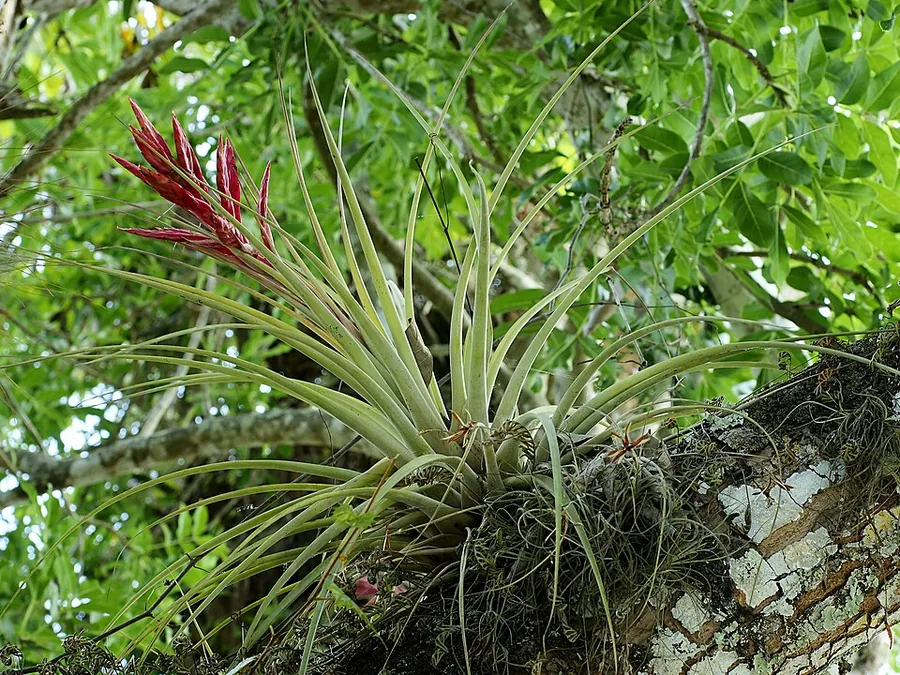
So, air plants are the Tillandsias, and they're a big bunch of bromeliads that grow without a speck of soil. Out in nature they sit on tree branches and bare rock, holding on with their roots while they sip up water and nutrients through their leaves instead. That soilless, epiphytic habit is exactly why they're such laid-back houseplants, because you can stick one on driftwood, pop it in a glass bowl, or just leave it sitting on a shelf.
Here's the neat part: the leaves handle the job that roots usually do. They're dotted with tiny silver scales called trichomes that grab moisture and pass it along, so a quick soak matters way more than any fussy potting routine. They come in all sizes, from little clumps a couple inches wide up to the broad, curling rosettes of the bigger types, and since they grow slowly, one plant stays a tidy size for years.
And every air plant gets one big moment. Once it's mature, it sends up a colorful flower spike, blooms a single time, and then slowly winds down, leaving a little ring of offsets behind to keep things going. Get the light and water right and that whole cycle can keep repeating for ages, with each new pup growing up and flowering when its turn comes.
Care
The short version: bright, indirect light plus a weekly soak in room-temperature water, and then a good full dry-out in moving air so water never gets stuck in the leaf base.
Light
Air plants love bright, indirect light, so a spot a few feet back from a sunny window is perfect. They'll put up with a bit of direct sun or medium indirect light, but deep shade just leaves them weak and sluggish. And too much harsh midday sun? That'll scorch the leaves, so steer clear of it.
Water
Honestly, watering is what makes or breaks the whole thing. Pop the plant into room-temperature water and leave it there for 20 to 30 minutes about once a week, or if misting suits you better, mist it well several times a week. What you do next is the real key, though: tip off the extra and let it dry right through within about 4 hours somewhere with decent airflow, because anything left pooling at the leaf base will start rotting it.
Soil
Forget about soil completely, there isn't any. These grow as epiphytes, so you fix them to wood or bark or just set them out bare, and they should never end up planted in a pot of mix. The moment something damp presses against the base, you're inviting rot, so just let them sit out in open air.
Temperature
They're easygoing about temperature, happy across roughly 50°F to 86°F (10°C to 30°C), which covers most homes all year. Just keep them above freezing, because they can't handle frost at all.
Humidity
Normal household humidity around 40% to 60% is plenty for them. When the air's hot and dry they'll dry out faster and want watering more often, and when the room's cool and humid you can ease right off.
Feeding
Go easy on the food, and only bother during spring through summer when they're putting on growth. Stir a weak bromeliad or low-nitrogen feed at quarter strength into whatever you soak or mist with, maybe once a month, and then quit feeding entirely once things cool off.
Pruning
There's hardly any work to this part. Grab clean scissors and tidy up whatever tips have dried or browned, and gently take off the dead outer leaves down near the bottom. Then, after a plant has flowered and is on its way out, you can clip away the spent flower stalk and just let its pups carry on.
Repotting
Not applicable - not potted; remount or rehome only if a display becomes crowded or a mount degrades
Size & spacing
Most air plants stay pretty small, somewhere around 2 to 12 inches (5 to 30 cm) tall with a spread of 2 to 10 inches (5 to 25 cm). Since you're displaying them rather than planting them, all you've got to do is give each one enough open space for air to move freely around the leaves.
Troubleshooting
Pretty much every air plant problem comes down to water, either not enough of it or too much sitting somewhere it shouldn't. The two signs below cover most of what you'll run into, so just match what you're seeing and step in before it reaches the core.
Center's gone dark and soggy, and leaves keep dropping off at the base
When the heart of the plant goes black and soft and the central leaves come away in your fingers with zero resistance, you're looking at crown rot, which creeps in after a watering leaves moisture trapped down in the leaf base. A core that's gone that soft is a goner, so just bin it and don't beat yourself up. If you happen to catch it right at the start you can occasionally dry things out and save it, but really, the fix that works is plenty of air moving around the plant so it never gets that wet to begin with.
Fix:
- Discard plants that have rotted through the center, as they cannot be saved
- If caught very early, dry the plant completely and improve airflow
Leaf tips going brown and curly on a shriveled-looking plant
Leaves that have turned dry and papery and rolled in on themselves? That's usually underwatering or air that's gotten too dry, though tough direct sun can crisp them up the same way. Give the plant a 20 to 30 minute soak and it'll often plump right back up by the next day. Just water a bit more regularly, keep it away from blazing midday sun, and snip the crunchy tips so it looks neat again.
Fix:
- Soak the plant in room-temperature water for 20-30 minutes, then dry fully
- Increase watering frequency and move out of harsh direct sun
- Trim off crispy tips for appearance
Toxicity
Worried about the pets? You can relax, because air plants carry no known toxin and don't show up anywhere on the poison lists for cats, dogs, or other animals. Sure, the firm leaves aren't a snack, but a quick taste isn't going to poison anyone. Set them out in whatever room you like and don't give it a second thought.
Safe for
People · Cats · Dogs · Horses · Rabbits · Livestock · Birds
Cats Safe
Good news if you've got a curious cat: the ASPCA doesn't list air plants as toxic to cats, so a nibble won't poison one. The leaves are stiff and definitely not meant for eating, though, so a cat that swallows a piece might cough or gag a little.
Dogs Safe
Dogs are fine here too, since there's nothing poisonous in the plant for them. A big fibrous mouthful could still bother a sensitive tummy, so it's smart to keep displays where a determined chewer can't get at them.
Horses Safe
Horses don't have anything to worry about, because this group has no reported toxin and won't poison them.
Rabbits Safe
Rabbits can hang out near air plants without any trouble. The leaves are tough and fibrous, though, so they're not really rabbit food, and the plant shouldn't count as part of the diet.
Livestock Safe
Cattle, goats, and sheep won't get poisoned by air plants either, since there's no known toxin in them.
Birds Safe
Pet birds are safe around air plants, with nothing toxic to fret about if one goes poking at the leaves.
People Safe
People are fine with air plants too, and you can handle them and keep them in whatever room you like. They're grown for how they look, not for the dinner table, so there's really no reason to eat them.
Safe to keep around pets; the thin stiff leaves are not a poisoning hazard, though they are not intended for eating.
Varieties
There are hundreds of Tillandsia species out there, but only a handful keep popping up on shelves and in shops. These are the ones worth getting to know by name.
Tillandsia ionantha
A little clumping kind whose green leaves blush red, with a center that turns violet right as it's about to flower.
Tillandsia xerographica
The big, slow-growing star of the bunch, with wide silvery-gray leaves that curl back to make a rosette that looks almost sculpted.
Tillandsia usneoides (Spanish moss)
A rootless oddball that hangs in long chains of thread-thin gray foliage, draping off branches instead of forming a rosette.
How to propagate
You don't really buy more air plants, you kind of wait for them. A happy plant makes its own copies after it flowers, and growing those pups on is the easiest way to end up with a whole collection.
Offsets & pupsEasy
After the mother plant flowers, when pups reach about one-third to one-half the parent's size · Several weeks to a few months once separated, as growth is slow
Want more of them? Mostly you just sit back and let them arrive. A grown plant blooms a single time, and as that flower fades it throws out little offsets, called pups, down around its base. You can wait for a pup to reach roughly one-third to one-half the parent's size and then twist it loose to live on its own, or you can leave the family together and watch it fill out into a clump. Either way it's slow going, so a pup you've pulled off needs several weeks to a few months before it's truly established.
Myths
Air plants just feed off the air, so watering isn't ever needed.
Don't let the name fool you. These guys take in water and nutrients through tiny leaf scales called trichomes, not out of thin air. Skip the regular soaking or misting and they'll dry out and die, so they really do need you to water them.
Air plants don't sit in soil, so they don't really need light either.
No roots in soil? That tells you nothing about how much light they want. They photosynthesize just like any other plant and need bright, indirect light to do well. Tuck one into a dark corner and it'll slowly get weaker and fade.