Houseplant · Bromeliaceae
Urn Plant
Aechmea fasciata
Keep that cup topped up and the light nice and bright, and you will get months of color out of this bromeliad.
Bright indirect
Every 7–14 days
59–86°F · 15–30°C
USDA 10–11
Overview
The name comes straight from the watertight pool at the plant's heart, a little vase that the tightly stacked leaves form between them. Where it grows wild, this silver-banded rosette hooks onto tree limbs and gathers rainwater right there in the cup, sipping from it rather than reaching into soil. Indoors it wants you to copy that habit, and that quirk is exactly what makes it both odd and easy as soon as you have the routine down.
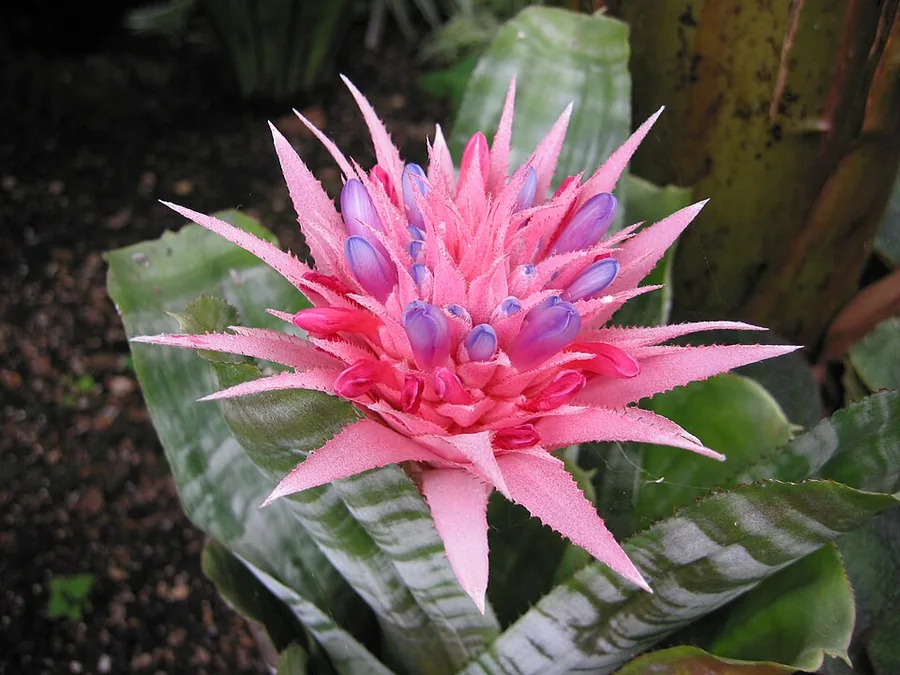
Then there is the bloom, which is the whole event. Give a rosette time to mature and it sends up a long-lasting pink bract dotted with violet flowers that ripen toward red, and that display can hang on for several months. Think of the bract as the payoff for waiting, because a rosette only ever flowers one time before it quietly bows out.
What seems like the end is really a passing of the baton. While the parent winds down, it puts out offsets called pups all around its base, and every one of them turns into a fresh plant. Keep the light bright and filtered and the cup full, and a single urn plant will keep that cycle rolling for years to come.
Care
The short version: bright but indirect light, with the central cup kept full of fresh water while the mix is left to dry out in between. Park it somewhere warm and a bit humid, feed at half strength over the growing months, and give those spiny edges some breathing room from neighbors.
Light
For the richest color and your best chance at a flower, set the urn plant where it gets bright, indirect light. It can scrape by in partial shade or medium indirect light, but skimping on light is the number-one reason a perfectly healthy rosette never blooms.
Water
Here is the trick that makes bromeliads different: keep that central cup topped up with fresh water all the time, while letting the mix dry out between drinks. Pour it out and refill it every so often so the water never turns stale or stacks up mineral salts. Got hard tap water? Switch to rain or distilled, and figure on watering the mix roughly every 7 to 14 days.
Soil
Pot it up in a loose, fast-draining bromeliad mix, basically the acidic, bark-heavy stuff sold for orchids. Its roots are there to hold on more than to feed, so they really dislike sitting soggy, and an airy mix lets water drain straight through.
Temperature
Regular indoor warmth is all it asks for, somewhere in the 59°F to 86°F (15°C to 30°C) band. Keep it above 59°F (15°C) and clear of cold drafts, since a chilly, wet plant is exactly what lets rot creep into the center.
Humidity
It is happiest when the air carries a little moisture, in the neighborhood of 50% to 70% humidity. If your room runs dry, give the leaves a mist or stand the pot on a pebble tray to bump up the moisture nearby.
Feeding
Give it a feed once a month during spring and summer using a balanced liquid fertilizer thinned to half strength or weaker. You can pour it into the soil or mist it over the leaves, but keep things light, because this bromeliad gets by on far less food than your average houseplant.
Pruning
When the flower stalk and pink bract have browned over, snip them off, and tidy up any dead or beat-up outer leaves. The mother rosette slowly fades once it has flowered, so take it out after the pups are well settled. Slip on gloves first, since those leaf edges carry small spines.
Repotting
You only need to repot every so often, about every 2 to 3 years, usually when you are sizing up or splitting off pups. Keep an eye out for roots poking through the drainage holes, a plant gone top-heavy, or pups packing the container, and when you see that, move it into fresh bromeliad mix.
Size & spacing
Grown inside, the urn plant gets to around 12 to 35 inches (30 to 90 cm) tall and fans out 12 to 24 inches (30 to 60 cm) wide. Since it grows slowly, whatever size you bring home is pretty much the size you will live with for a good stretch.
Troubleshooting
Almost every urn plant hiccup begins at the cup or down in the roots, and you will spot it first in the leaves or the center. Once you can read those early hints, you can jump in before a minor wobble turns into real trouble. Find what matches your plant below, then act while there is still time to help.
A mushy, darkened middle that comes apart
What you are looking at is crown rot, which shows up when old water lingers in the cup or the plant sits cold and damp for too long. Empty and rinse the urn, shift it to a warmer and brighter spot, and if the parent is already going, save the healthy pups while you can.
Fix:
- Drain and flush the cup, move to a warmer, brighter spot
- Reduce moisture and improve air circulation
- If the mother is collapsing, salvage healthy pups and discard the rotted rosette
Droopy plant sitting on dark, soft roots
Here the problem is root rot in waterlogged mix, and it happens when the medium stays damp or simply will not drain fast enough. Move it into fresh, open bromeliad mix, snip off whatever roots have gone soft, and from then on pour into the cup instead of drenching the soil.
Fix:
- Repot into fresh, fast-draining bromeliad mix
- Let the mix dry between waterings
- Trim away rotted roots
Tacky leaves dotted with fuzz or little crusty bumps
All of that adds up to scale insects or mealybugs settling in where the leaves meet and on the undersides. Dab them away with a cotton swab soaked in watered-down alcohol, follow that with insecticidal soap, and keep the plant on its own until you stop spotting them.
Fix:
- Wipe pests off with a cloth or cotton swab dipped in diluted alcohol
- Treat with insecticidal soap or horticultural oil
- Isolate the plant until clear
A fine-looking rosette that simply refuses to bloom
Usually it comes down to not enough light, or a rosette that just is not grown up yet. Slide it over to a brighter window with filtered sun, and if the plant is still young, be patient, because each rosette flowers a single time and only once it has fully matured.
Fix:
- Move to a brighter spot with filtered light
- Allow the rosette to reach full size before expecting bloom
Edges turning crispy and brown at the tips
Nine times out of ten, this means the mix baked dry while nobody topped off the cup, and dry air or hard water from the tap just makes it worse. Top up the urn, give the soil a drink, and swap over to rain or distilled water so salts stop piling up.
Fix:
- Refill the central urn and water the mix
- Raise humidity by misting or using a pebble tray
- Flush the cup and mix with rain or distilled water
Toxicity
Here is the part pet owners will like: the urn plant is safe. The ASPCA lists it as non-toxic to both cats and dogs, and there is no chemical poison on record for this bromeliad. The one thing worth minding is the leaf edges, which wear little spines that can scratch, so put the plant somewhere pets and small kids will not graze against it.
Safe for
People · Cats · Dogs · Horses · Rabbits · Livestock · Birds
Cats Safe
Per the ASPCA, this bromeliad counts as non-toxic to cats, so if yours sneaks a bite there is no poisoning to worry about.
Dogs Safe
A dog can live right alongside this plant just fine, and even a stray mouthful of leaf will not harm one.
Horses Safe
For horses, there is nothing poisonous about the urn plant at all.
Rabbits Safe
A rabbit has nothing to fear from it, though greens like this should only make up a little of what it eats.
Livestock Safe
Goats, sheep, and cattle can hang around it without any risk of being poisoned.
Birds Safe
Whether it is a pet bird or some backyard poultry, they are perfectly fine near this one.
People Safe
There are no toxins here, so it sits happily in a home with kids and grabby toddlers around.
Leaf margins bear small spines/teeth that can scratch or prick skin, so handle the plant with care (gloves help). Any mild irritation from chewing would be physical/mechanical, not from toxins.
Varieties
There are a few named versions of Aechmea fasciata floating around, each tweaking the leaf color or the flower a touch. These are the ones you will most likely run across.
Aechmea fasciata var. purpurea
Look for a reddish-purple blush across the foliage that comes through most on the leaf backs.
'Primera'
A vigorous grower sold widely, known for boldly silver-striped foliage topped by a big pink flower head.
'Morgana'
On the smaller side, this one is loved for the rich rose-pink color of its bracts.
How to propagate
Best of all, the urn plant makes more of itself at no cost through the pups it produces after it blooms. No seeds to sprout and no rooting hormone to mess with, just a little timing and a little patience.
Offsets & pupsEasy
After the mother rosette flowers and begins to decline, once pups reach about one-third to one-half the parent's size (roughly 6 in / 15 cm tall) · Several weeks to a few months to root and establish
Once the parent has bloomed and starts winding down, it throws up little offsets, the pups, around its base, and that is how the plant keeps itself going. Hold off until a pup is somewhere between a third and half the size of the parent, around 6 inches (15 cm) tall, then twist or slice it away with a couple of roots still on it. Settle it into fresh bromeliad mix, park it somewhere warm and bright with the cup topped up, and let it spend several weeks to a few months rooting in.
Myths
Cats and dogs can be poisoned by the urn plant.
According to the ASPCA, Aechmea fasciata is non-toxic to dogs and cats alike. What can actually hurt is a scratch from those prickly leaf edges, and that has nothing to do with the plant being poisonous. No part of this bromeliad will poison your pet.
Pour water on the soil only and leave the central cup dry.
Out in nature this plant drinks straight from its cup, so it likes that vase kept full. Top up the urn with fresh water and let the mix dry out in between. Full cup, dry soil, that is the rhythm.
Once it flowers the entire plant dies, so you may as well toss it.
Only the rosette that did the blooming fades, and even that happens slowly. On its way out it pushes up little offsets, known as pups, around the base, and those turn into brand-new plants. Every flower comes with a free batch of replacements.