Houseplant · Bromeliaceae
Guzmania (Scarlet Star)
Guzmania lingulata
Keep that central cup topped up and the light nice and bright but soft, and this bromeliad will hang onto its scarlet star for months.
Bright indirect
Every 5–10 days
55–81°F · 13–27°C
USDA 10–12
Overview
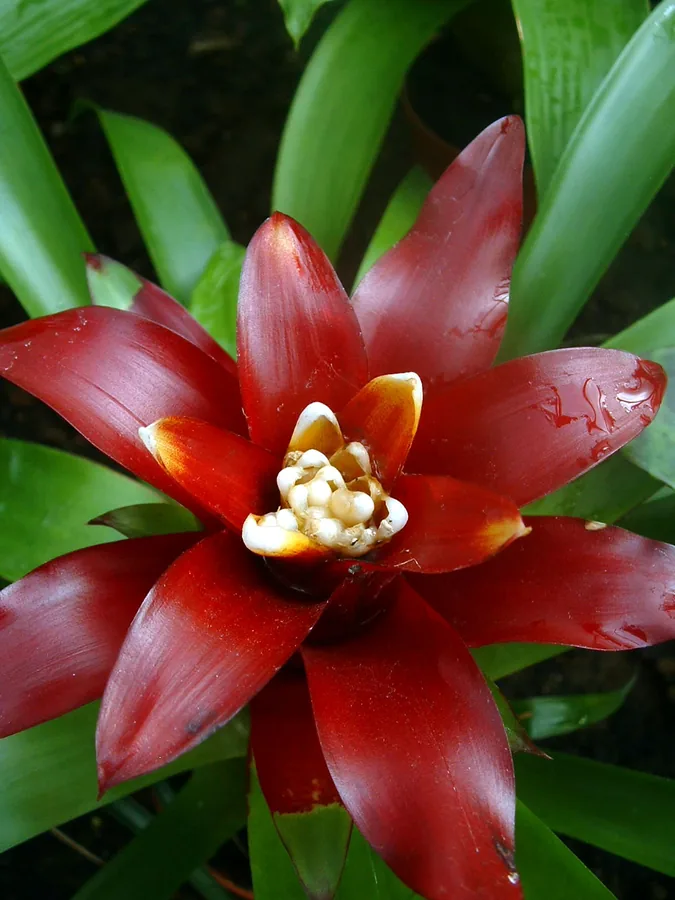
The guzmania, or scarlet star, is a bromeliad from the rainforests of Central and South America, and instead of rooting in the ground it perches right up on tree branches. Bring it indoors and it forms a tidy rosette of glossy strap-shaped leaves that funnel water down into a cup at its center. The real star, though, is that bright bract spike, often a deep red, that shoots up from the middle and stays colorful for months.
Here's a fun twist: what looks like a big flower is actually a bunch of colorful bracts, and the true flowers are tiny and quick to fade down inside them. Since it's an epiphyte, its roots are mostly there to hang on rather than to feed, so the plant does its drinking and breathing through that leafy tank. Get the watering sorted and everything else is honestly a breeze.
There's one quirk that's good to know upfront so it doesn't throw you. Each rosette blooms just once, then slowly fades while sending up pups at its base to keep things going. The mother isn't sick when this happens, she's just passing things along, and those pups turn into your next round of plants.
Care
The short version: bright indirect light, a central cup kept topped up with rainwater or distilled water, a loose fast-draining mix you let dry on top, and warm, humid air, and you're set.
Light
Give the guzmania bright indirect light, the sort you get near a window that never catches the harsh midday sun. It'll cope with medium light and a bit of shade, but skimp on light and the bract color dulls and growth slows. Direct sun's the real problem, though, since it'll scorch the leaves.
Water
It all comes down to that central cup. Keep it topped up with about 2 to 3 cm of water all the time, use rainwater or distilled water so minerals don't spot the leaves, and flush it out every 1 to 2 weeks so it doesn't go stale. Let the top few cm of the mix dry between waterings, because those roots rot fast if they stay wet.
Soil
Plant it in a loose, fast-draining epiphytic mix of bark, perlite, and sphagnum, basically the stuff sold for orchids. Regular potting soil? It just holds way too much water for an epiphyte. A slightly acidic pH of 5.0 to 6.0 keeps it happy.
Temperature
Regular room warmth is all it's after, somewhere from 55°F to 81°F (13°C to 27°C). Keep it clear of cold drafts and chilly windowsills in winter, and whatever you do, don't leave cold water sitting in the cup.
Humidity
Being a rainforest plant, the guzmania likes the air on the damp side, around 50% to 70%. Dry indoor air browns the leaf tips, so group it with other plants, sit it over a pebble tray, or run a humidifier nearby.
Feeding
Feed it lightly through spring and summer with a balanced liquid fertilizer knocked down to quarter strength, given to the soil and just a splash to the cup. It's a light feeder, so piling on more actually does more harm than good.
Pruning
There's barely anything to do. Snip off browned leaf tips or tired outer leaves with clean scissors, and once the bract spike fades and the mother rosette starts to go, cut her away so her energy heads to the pups.
Repotting
Guzmania hardly ever needs repotting, and it's not a fan of being messed with. Only move it to pot up rooted pups or freshen the mix every 2 to 3 years, and switch pots when it wobbles, the mix has broken down, or pups are crowding things.
Size & spacing
A grown one stays nice and compact, only reaching about 12 to 18 inches (30 to 45 cm) tall and roughly the same across. That little footprint means it slots easily onto a shelf, a desk, or a windowsill.
Troubleshooting
Nearly every guzmania headache comes back to water, whether too much is pooling where it shouldn't or the wrong kind is sitting in the cup. The clues turn up at the center, the leaf tips, or the bracts. Find what matches below and jump on it before rot gets going.
Squishy, off-smelling middle right at the crown
So the middle's gone soft and a bit smelly? That's crown rot, and it shows up when water sits too long in the cup or the mix stays cold and wet. You'll know it because the center leaves pull loose easily and the base turns brown and sour. Tip out the cup, quit watering the mix, and move the plant somewhere warmer, brighter, and breezier. And if the mother's already winding down after her bloom, don't fight it, just pot up her healthy pups instead.
Fix:
- Empty the cup and stop watering the mix
- Move to a warmer, brighter spot with airflow
- If the mother is already declining post-bloom, separate and pot up any healthy pups instead of trying to save the rosette
Dull bracts and a plant that's slowly checking out
Nine times out of ten this isn't trouble at all, it's just the plant's monocarpic life cycle doing its thing. Every rosette blooms once, then slowly bows out while pushing pups from its base. So let the mother pour herself into those pups, snip her off once she's done, and raise the little ones in bright indirect light. And if a plant hasn't bloomed yet but the bracts look dull? It's just after a bit more light.
Fix:
- Allow the mother to fuel the pups, then remove it once spent
- Grow on the pups and give bright indirect light to encourage future blooming
- If unbloomed and dull, move to brighter indirect light
Crispy brown leaf tips and edges
Crispy tips usually just mean the air's too dry, or that hard tap water has left a mineral and fluoride buildup in the leaves. Here's the tell: the browning keeps to the tips and edges while the cup and base stay firm and green. So bump up the humidity by huddling plants together, sitting the pot on a pebble tray, or running a humidifier, and swap over to rainwater or distilled water. Then just tidy the dead tips with clean scissors, following the shape of the leaf.
Fix:
- Raise humidity with grouping, a pebble tray or a humidifier
- Switch to rainwater or distilled water for the cup and mix
- Trim dead tips with clean scissors following the leaf's natural shape
Toxicity
Good news if you've got pets: the guzmania is totally safe. The ASPCA has the scarlet star down as non-toxic to cats and dogs, and there's nothing in it that hurts other animals or people either. Feel free to set it up high, but only to keep the plant safe, not the pet.
Safe for
People · Cats · Dogs · Horses · Rabbits · Livestock · Birds
Cats None
No need to shoo the cat away from this one. If it sneaks a nibble it won't get poisoned, and honestly those firm tips usually put it off pretty quick.
Dogs None
A chewed leaf? Nothing to worry about here, because there's nothing toxic in it. Worst case, you'll lose a bit of foliage and maybe the dog gets a mild tummy grumble from the fiber.
Horses Safe
There's nothing in it that would bother a horse. Then again, it lives indoors, so it's pretty unlikely a horse would ever run into one.
Rabbits Safe
A rabbit that has a chew is in no danger at all. That said, the tough, fibrous leaves aren't exactly a treat worth grazing on.
Livestock Safe
There's nothing here that would upset cattle, goats, or sheep. And being a tender houseplant, it stays well out of their way anyway.
Birds Safe
Pet birds can hop on and peck away with no harm done. Neither the leaves nor those colorful bracts have anything toxic in them.
People Safe
It's perfectly safe around kids and grown-ups too. Nothing on it is poisonous, though it's really meant for looking at, not eating.
No special handling required; stiff leaf tips can be mildly scratchy but pose no chemical hazard.
Varieties
Just about every guzmania sold as a houseplant is some form or hybrid of the scarlet star, and what sets them apart is mostly the color and shape of their bracts. These are the ones you're most likely to run into.
Guzmania lingulata var. minor
It's the smaller, compact one you'll usually spot at the store, and that bright red-orange star of bracts is exactly why.
Guzmania 'Rana'
This hybrid opens up broad, two-toned yellow-and-red bracts that flatten out into a whole rosette of color.
Guzmania 'Ostara'
It sends up a tall, skinny spike of bright red bracts that stands well above the green leaves.
How to propagate
Why buy more guzmanias when you can just grow them from the pups your plant hands you? It's really the go-to way to keep this bromeliad going, since each rosette only ever blooms once.
Offsets & pupsEasy
After the mother flowers and the pups reach about one-third to one-half the mother's size · Pups root in a few weeks but typically take 2-3 years to reach blooming size
Want more guzmanias? You don't buy them, you get them free from the pups the mother throws out after she blooms. Just wait until each pup is about a third or half the mother's size and has a few roots of its own, then cut or gently twist it away. Pop each one into fast-draining epiphytic mix, keep that central cup topped up, and give it warmth and bright indirect light. They root in a few weeks, but here's the catch: it usually takes 2 to 3 years before a pup's ready to bloom.
Myths
This bromeliad's just as risky for cats and dogs as any other tropical houseplant.
You can let this one go. The scarlet star is on the ASPCA's non-toxic list for cats and dogs, and there's nothing in it that hurts pets, so it's fine to keep in a room with your animals.
When the leaves go brown and floppy after the flower fades, the plant's caught something fatal.
Nothing's actually gone wrong. This is just the monocarpic cycle, where each rosette flowers once and then fades out while it raises the pups that take over from it.